20 Mullet Fade Haircuts That Look Sharp
Twenty mullet fade haircut men variations to bookmark — low, mid, high, burst, drop, and taper fades. Photos, face-shape notes, chair-ready phrasing.
In this article · 32
- What Is a Mullet Fade Haircut?
- How to Choose Your Mullet Fade
- The 20 Mullet Fade Variations
- 1. Low Fade Mullet
- 2. Mid Fade Mullet
- 3. High Fade Mullet
- 4. Skin Fade Mullet
- 5. Low Taper Fade Mullet
- 6. Mid Taper Fade Mullet
- 7. Burst Fade Mullet
- 8. Drop Fade Mullet
- 9. Blowout Taper Mullet
- 10. Undercut Fade Mullet
- 11. Temple Fade Mullet
- 12. Textured Mullet Fade
- 13. Curly Mullet Fade
- 14. Wavy Mullet Fade
- 15. Straight Mullet Fade
- 16. Fringe Mullet Fade
- 17. Curtain-Bangs Mullet Fade
- 18. Two-Block Mullet Fade
- 19. Spiky Mullet Fade
- 20. Long Mullet Fade
- How to Ask Your Barber for a Mullet Fade
- Styling and Maintenance
- FAQ
- What is a mullet fade haircut for men?
- Which fade goes best with a mullet?
- Does the mullet fade suit round faces?
- Can I get a mullet fade with curly hair?
- How do I ask my barber for a mullet fade?
- How often do I need to re-cut a mullet fade?
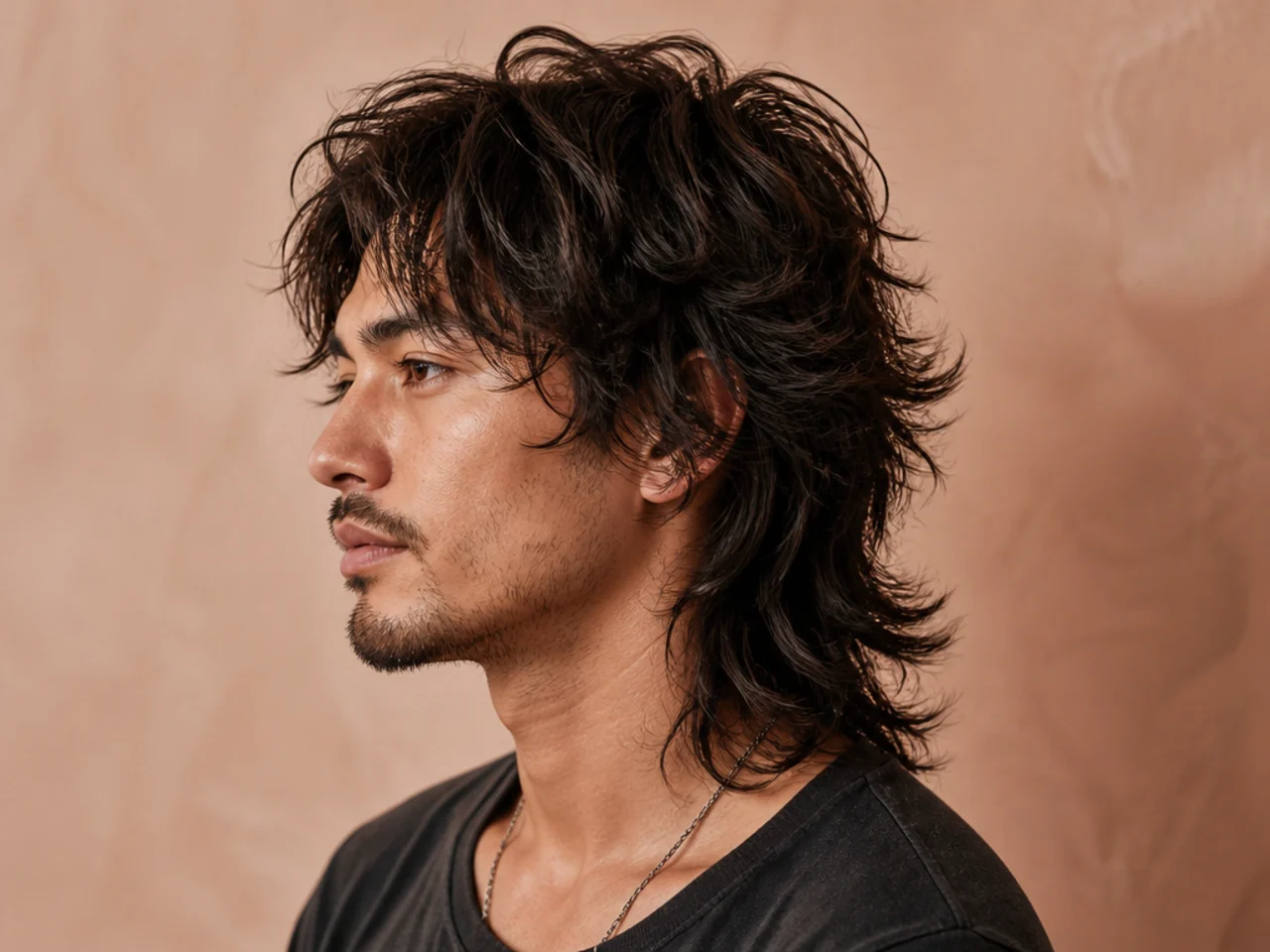
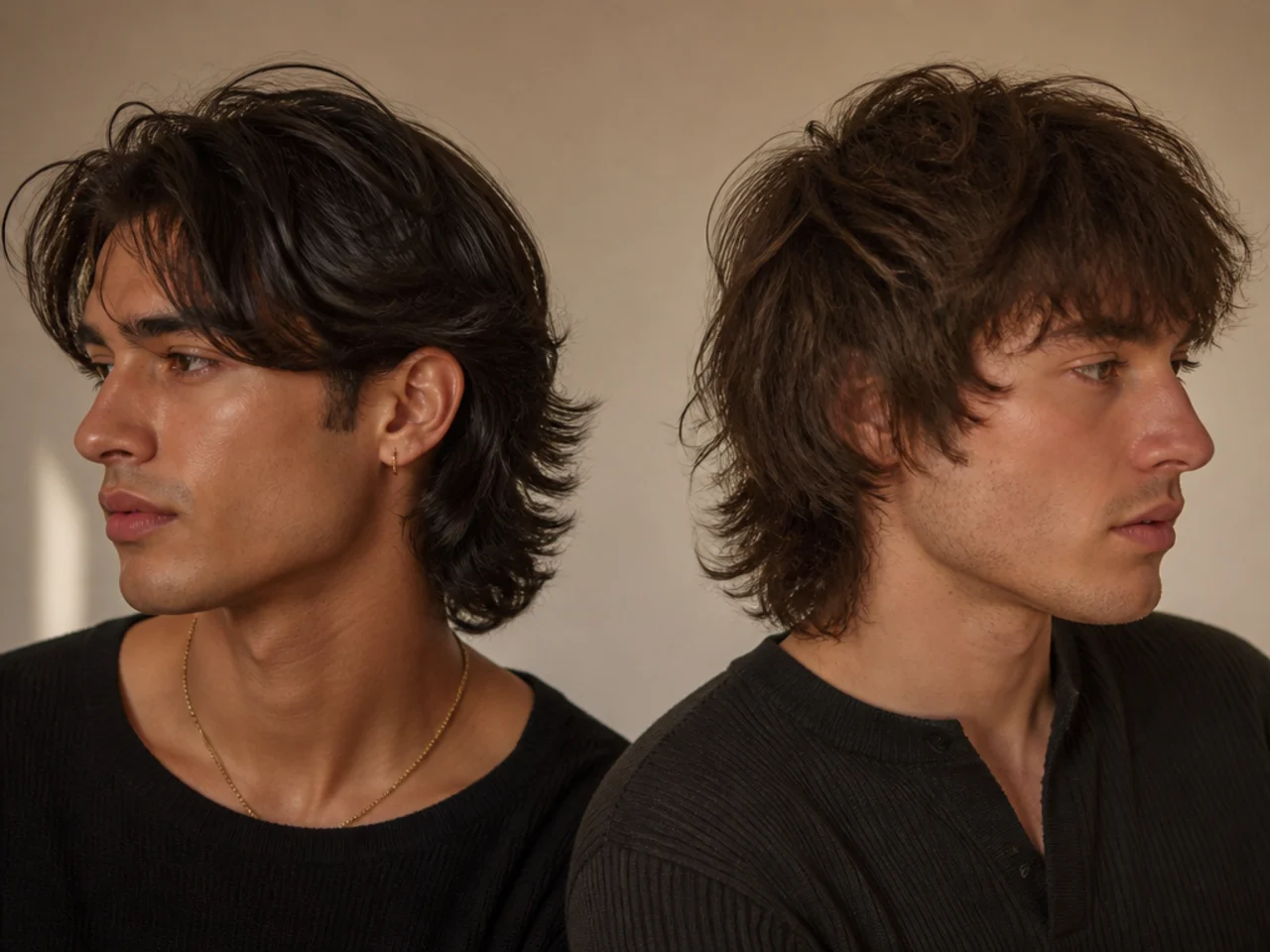
The mullet fade is where two eras meet on one head. Long, textured hair at the back gives you the mullet's swing; a low, mid, high, burst, taper, drop, or skin fade on the sides gives you a clean silhouette that reads intentional, not stuck in 1985. This guide covers 20 mullet fade haircut men variations, who each one flatters, and exactly how to ask for it in the chair.
What Is a Mullet Fade Haircut?
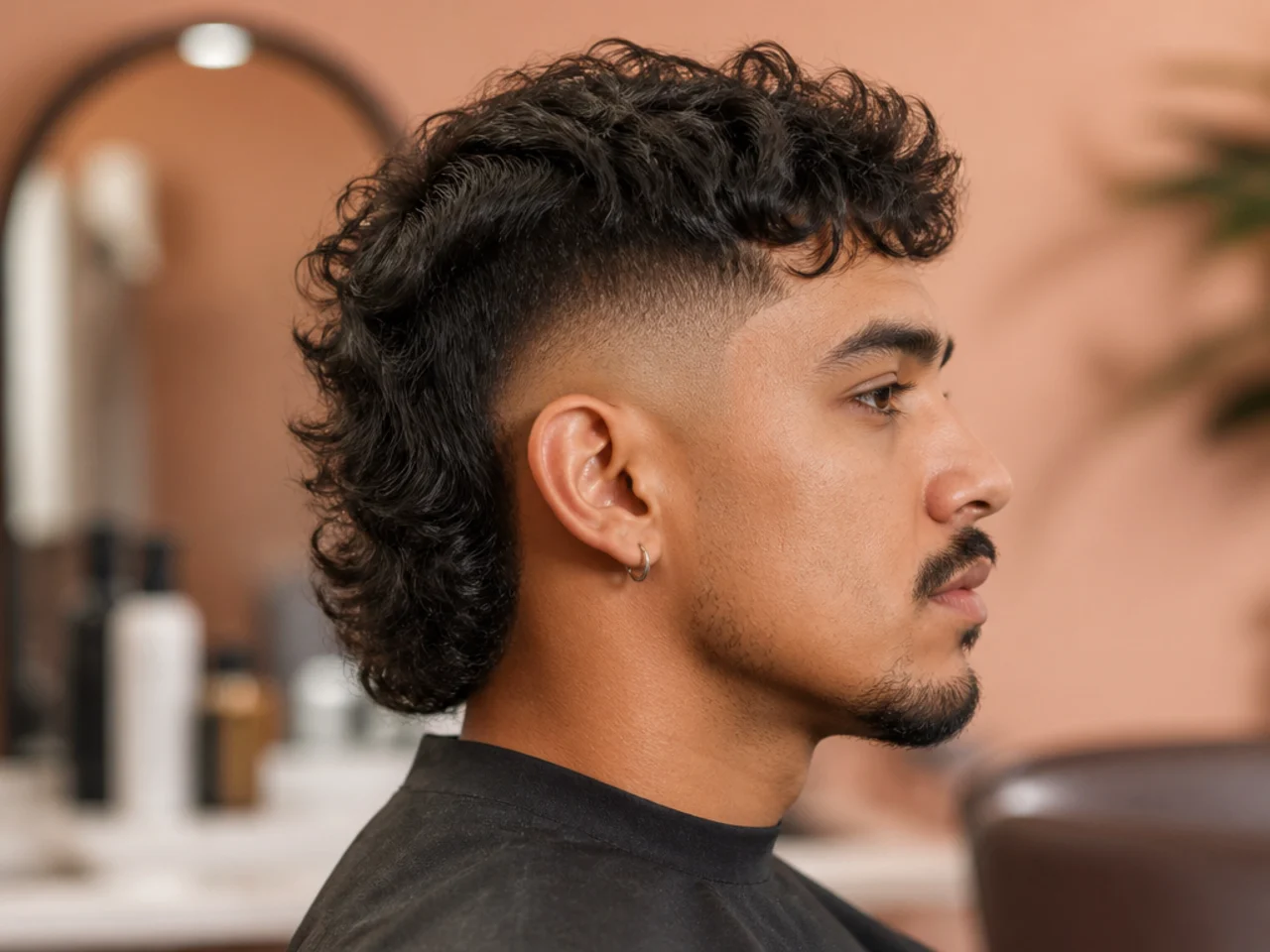
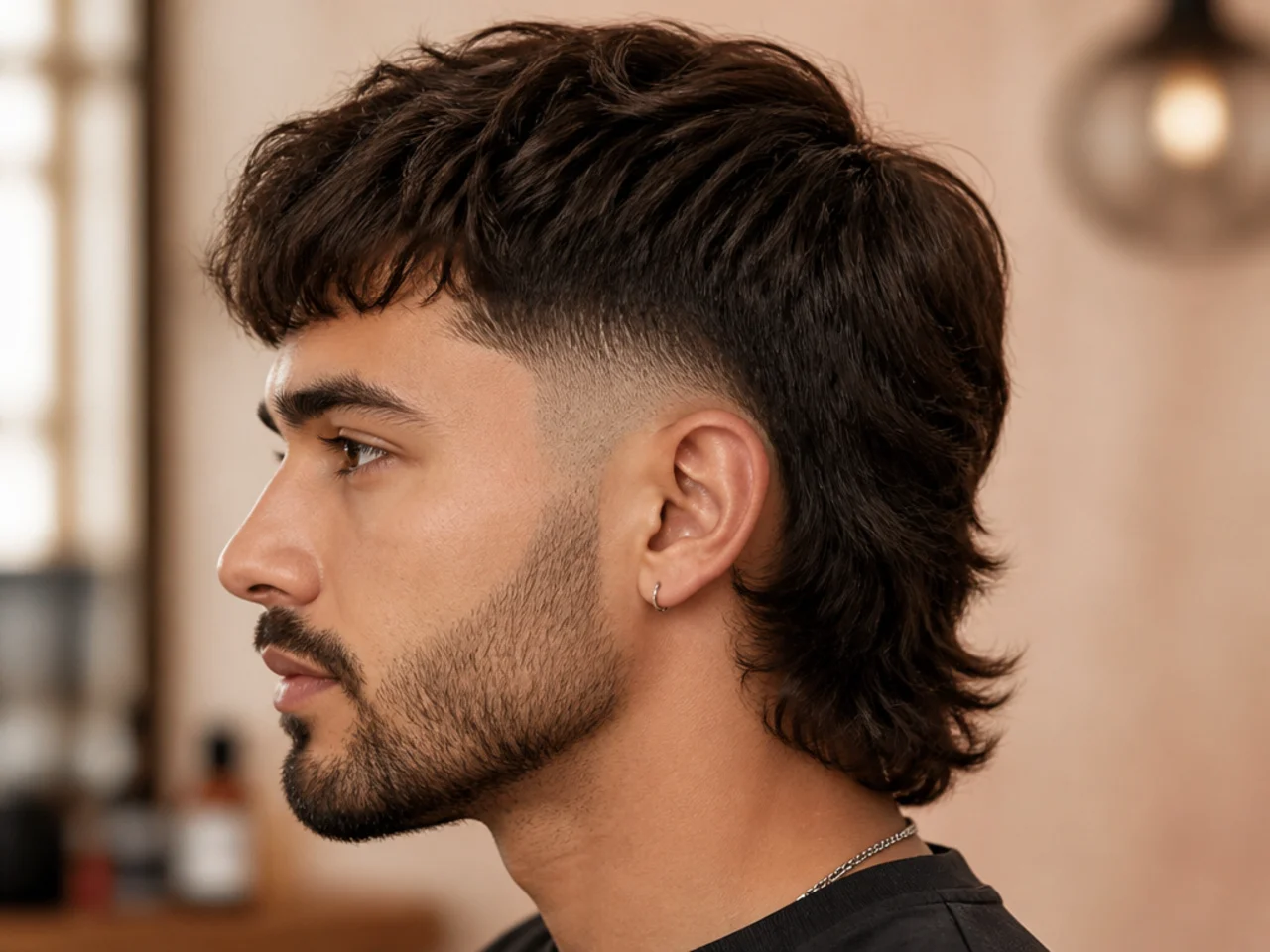
A mullet fade is a two-length men's cut that keeps the mullet's signature back-heavy silhouette and swaps the classic disconnected sides for a graduated fade. The back sits between two and four inches, layered enough to move. The sides drop from a short guard length at the top down to skin — or close to it — at the sideburn and around the ear.
That fade is the whole update. A classic modern mullet uses a scissor blend or a soft taper that leaves some length above the ear. A mullet fade shortens the whole side of the head, which pulls all the visual weight into the top and back and makes the shape read as a deliberate silhouette rather than a grown-out cut.
Where the fade starts on the head sets the personality. A low fade sits just above the ear and reads clean. A mid fade starts at the temple and reads modern. A high fade climbs toward the crown and reads bold. Burst, drop, and blowout variations trade the straight fade line for a curved one — a signature that shows up in every angle.
How to Choose Your Mullet Fade
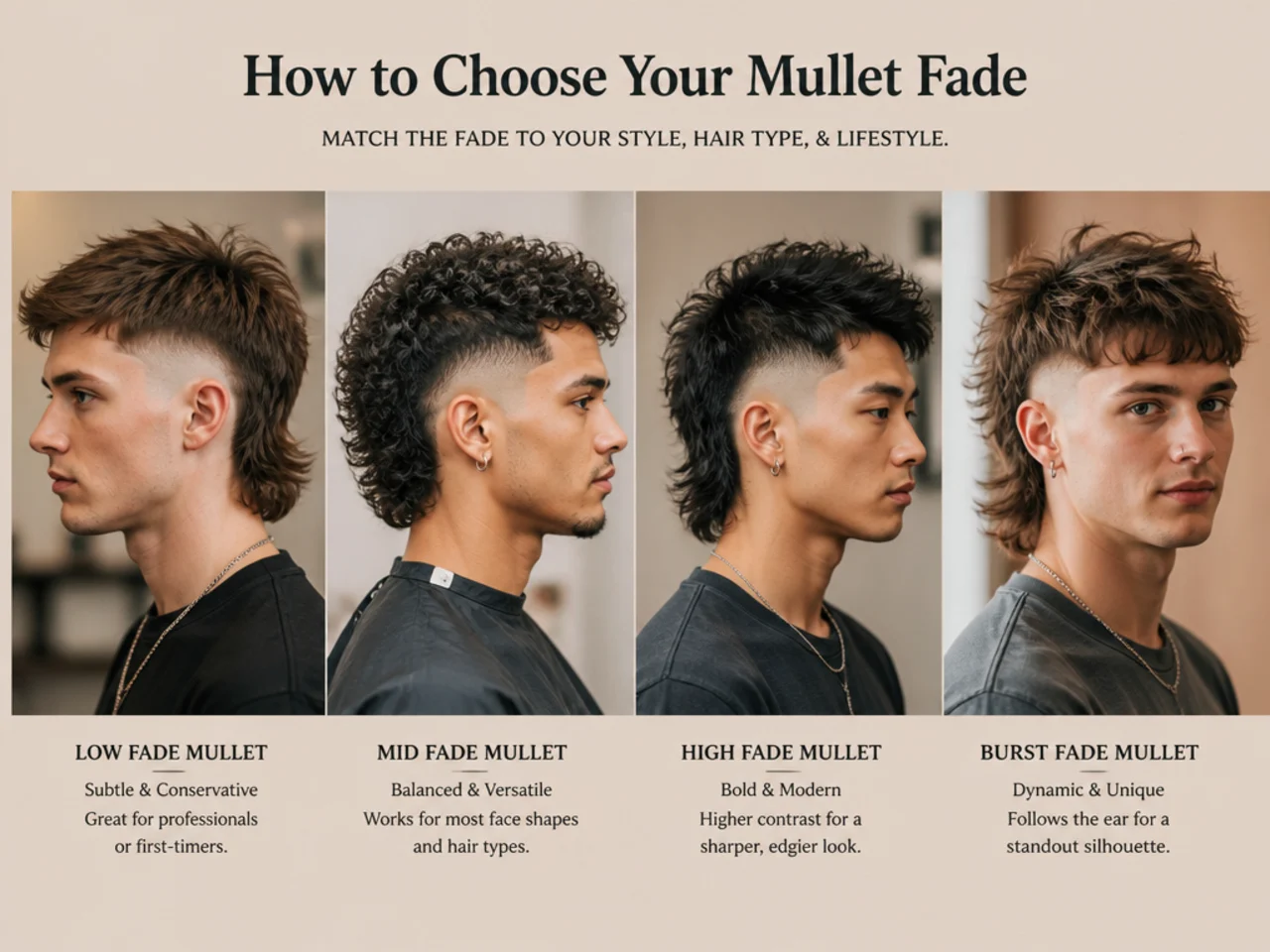
Face shape drives fade height. Round faces get the sharpest read from a mid or high fade with a lifted top — the vertical line narrows the profile. Square faces balance a strong jaw with a low or mid fade and soft top layers. Oval faces work with every fade height. Long faces need a lower fade and a fringe or side-swept top to shorten the vertical space. Heart faces flatter with a low fade and a fuller back that balances a wider forehead.
Hair type sets the top and back treatment. Straight hair reveals every layer line — ask for point-cut internal layers so the back has movement instead of a blunt curtain. Wavy hair reads best with soft internal layers cut in the direction of the wave. Curly and coily textures need dry-cutting so the pattern builds the shape naturally, plus internal layers to remove bulk without breaking the curl clumps.
Lifestyle sets the loudness. A low fade mullet passes at almost any workplace. A mid fade sits in the modern-neutral zone. High, skin, burst, drop, and undercut fades all read as statement cuts. Match the fade to how much attention you want the cut to pull. For neighboring silhouettes, browse the mullet and wolf cut hub or read our full modern mullet breakdown.
The 20 Mullet Fade Variations
Every version below tells you what makes it different, who it flatters, and the exact language for the chair. Bring a photo, then hand your barber the numbers.
1. Low Fade Mullet
The workplace-safe baseline. The fade starts just above the ear and drops to skin at the sideburn, leaving guard 2 length across most of the side. The back sits at two inches with soft internal layers. From the front the sides read clean; from behind, the mullet's shape stays intact.
Suits every face shape. Best on straight to wavy hair. See our full low fade haircut guide for the standard direction.
Ask for: "Low fade mullet, guard 2 across the sides dropping to skin at the sideburn and around the ear, two-inch back with textured internal layers, soft-blended into the top." Style with matte clay through damp hair, finger-comb back.
2. Mid Fade Mullet
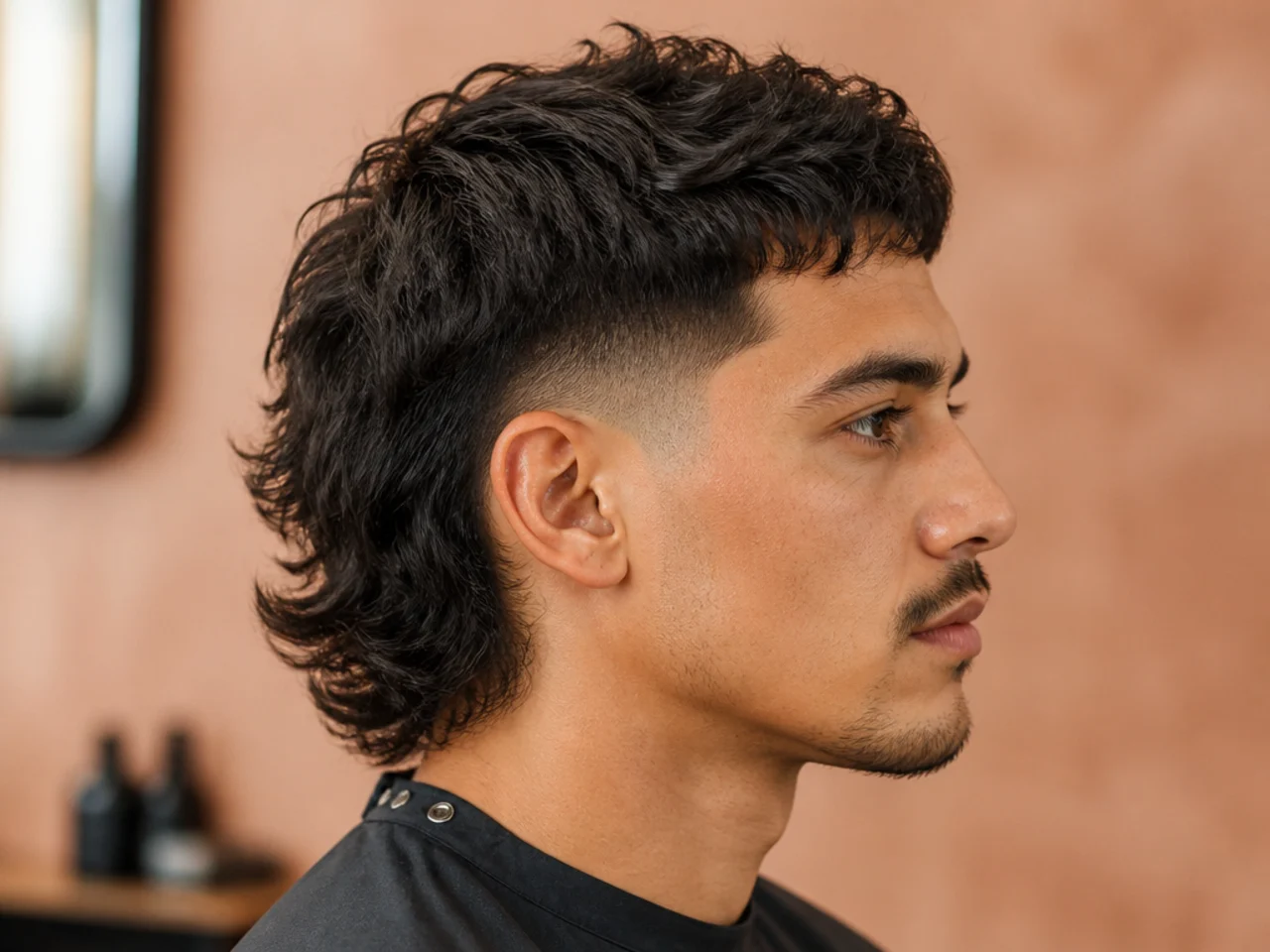
The barber's-default height. The fade starts at the temple, blending from guard 3 down to skin at the ear. The top and back keep two-and-a-half to three inches for a lifted read. This is the most-requested mullet fade at working shops.
Suits oval, round, square, and diamond faces. Best on straight to wavy medium-density hair.
Ask for: "Mid fade mullet, blend starts at the temple — guard 3 dropping to skin, three-inch top with textured layers, two-and-a-half-inch back point-cut for movement." Rough-dry with fingers to lift the roots, then matte paste through the top.
3. High Fade Mullet
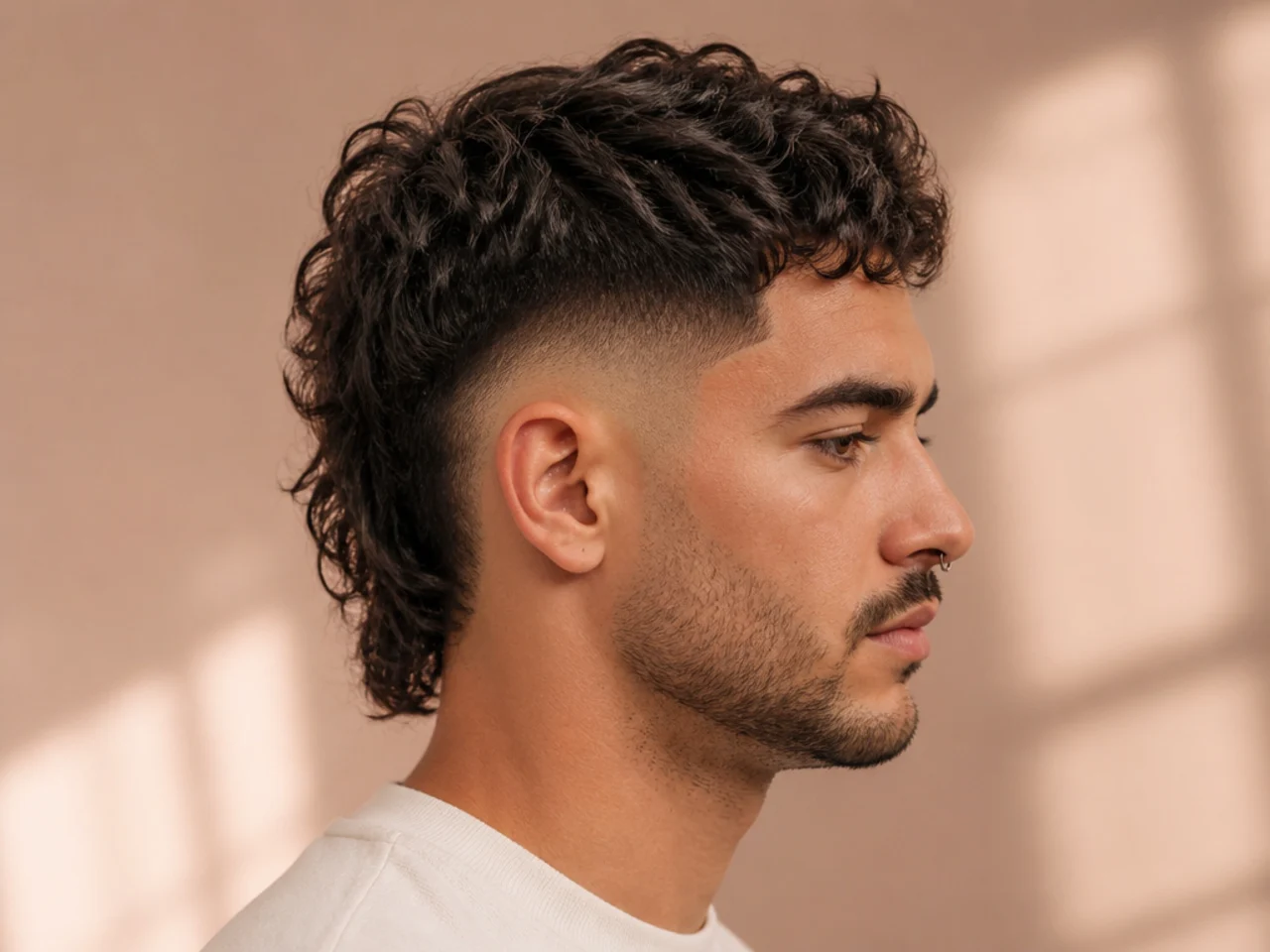
The statement contrast. The fade climbs from the temple toward the parietal ridge, leaving a narrow band of length across the top that drops into the mullet's back mass. The visual weight sits high, and the shape reads bold at any distance.
Suits round, square, and diamond faces where the vertical line flatters proportion. Best on medium-thick straight to slightly wavy hair.
Ask for: "High fade mullet, blend starts near the parietal ridge — guard 2 dropping to skin, three-inch top with lifted texture, two-and-a-half-inch back with soft internal layers." Book fade touch-ups every two weeks.
4. Skin Fade Mullet
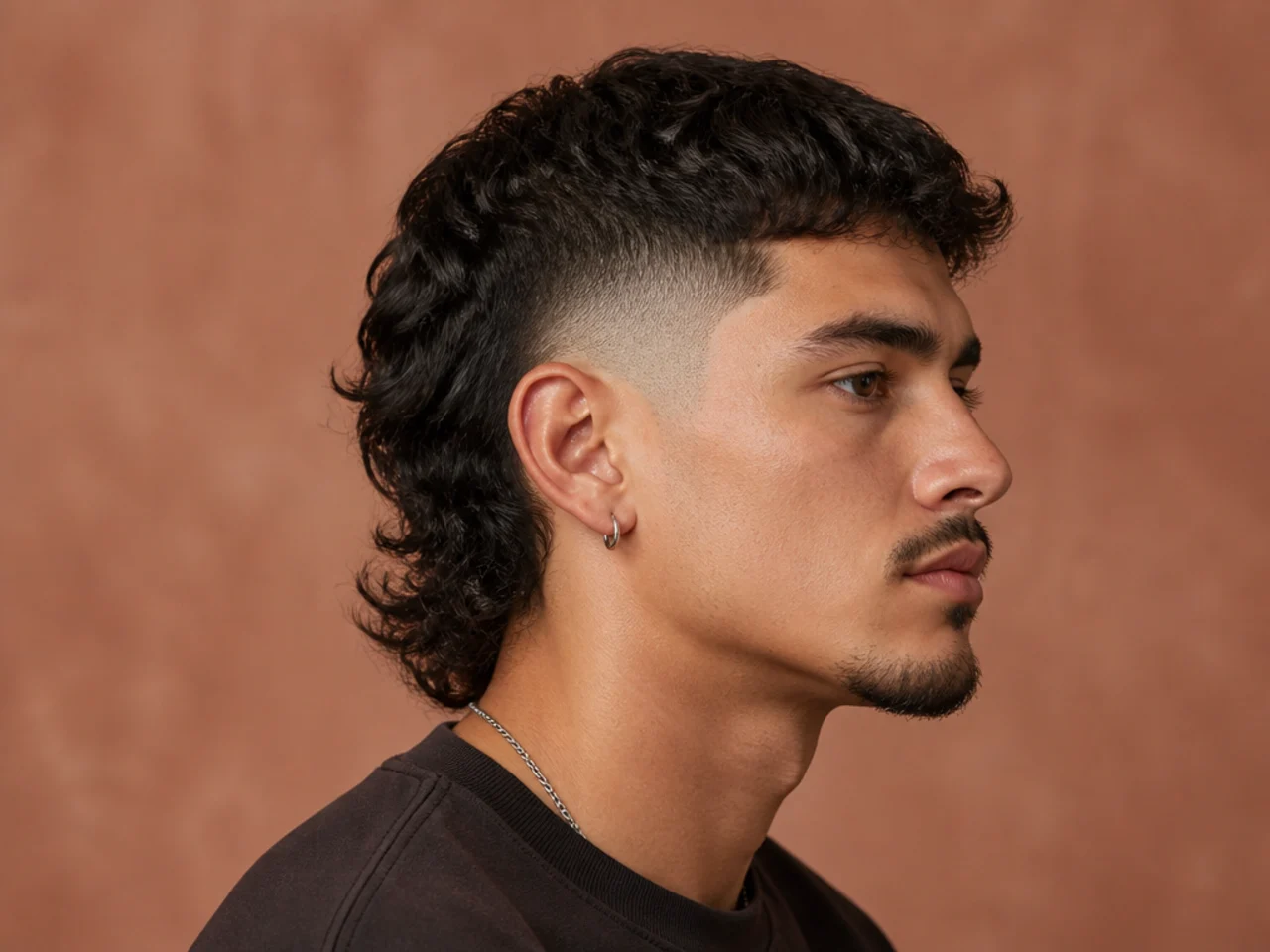
The cleanest version. The sides drop to bald skin from wherever the fade begins — low, mid, or high — with no visible guard length at any point. That maximum contrast pushes the mullet's shape forward hard. It reads sharp and slightly moody in every photo.
Suits oval, square, and diamond faces. Works with any hair type but needs medium-thick top density so the contrast reads balanced. See our skin fade haircut men guide for the fade details.
Ask for: "Skin fade mullet, mid start, bald skin at the sideburn and around the ear blended up to guard 2 at the top, three-inch back with textured layers." Wax or clay through the top only — the fade needs to show.
5. Low Taper Fade Mullet
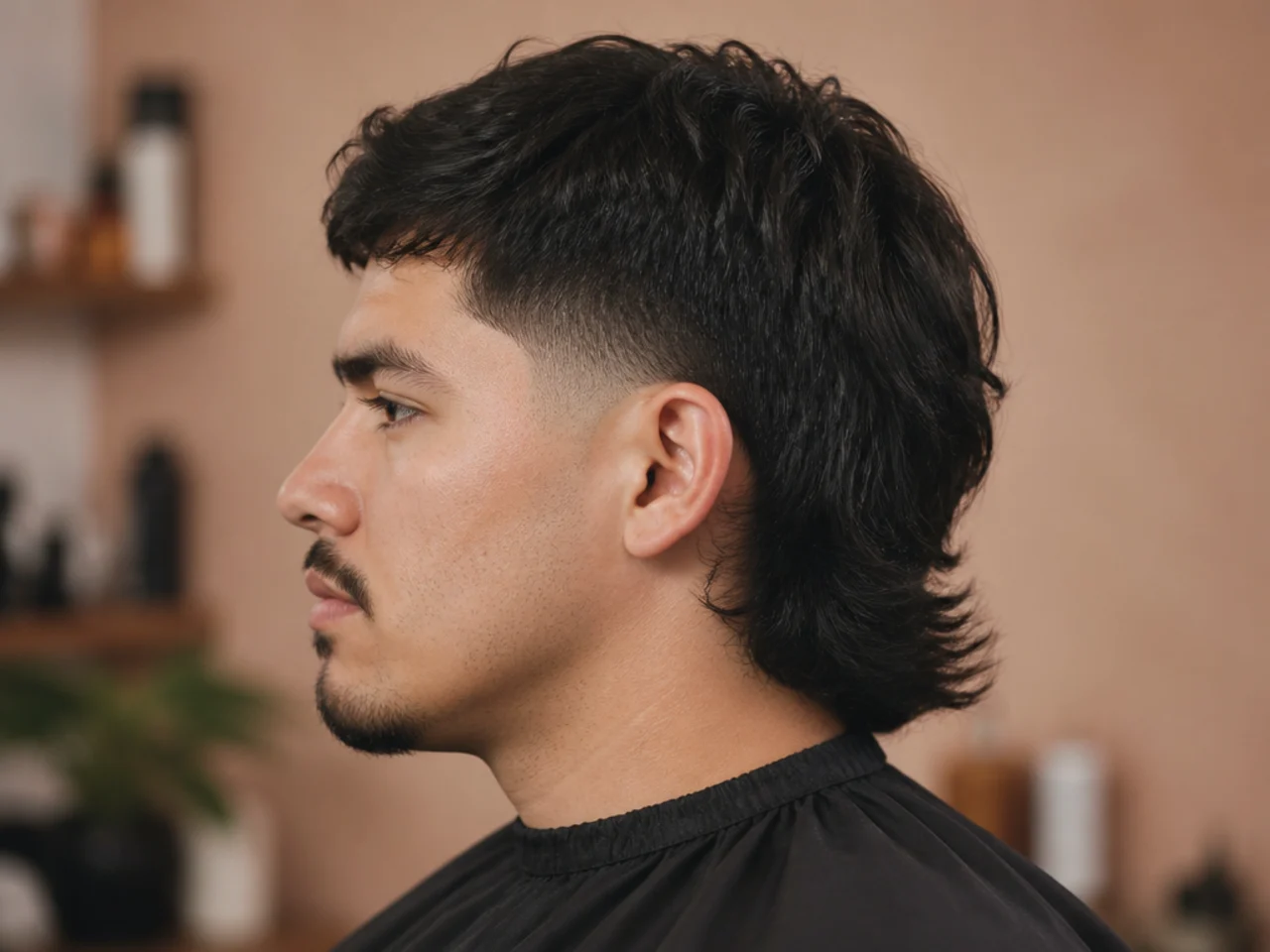
The softest option on the list. A low taper fade touches only the sideburn and neckline, leaving the bulk of the side length untouched. From the front you would barely register a fade at all — the mullet reads as the main event.
Suits every face shape. Best on hair that holds side length well — wavy, curly, or thick straight.
Ask for: "Low taper fade mullet, taper the sideburn and around the ear only — guard 1 dropping to skin — keep guard 3 across the rest of the side, three-inch back with soft internal layers." Air-dry or diffuse for texture, matte cream at the top for hold.
6. Mid Taper Fade Mullet
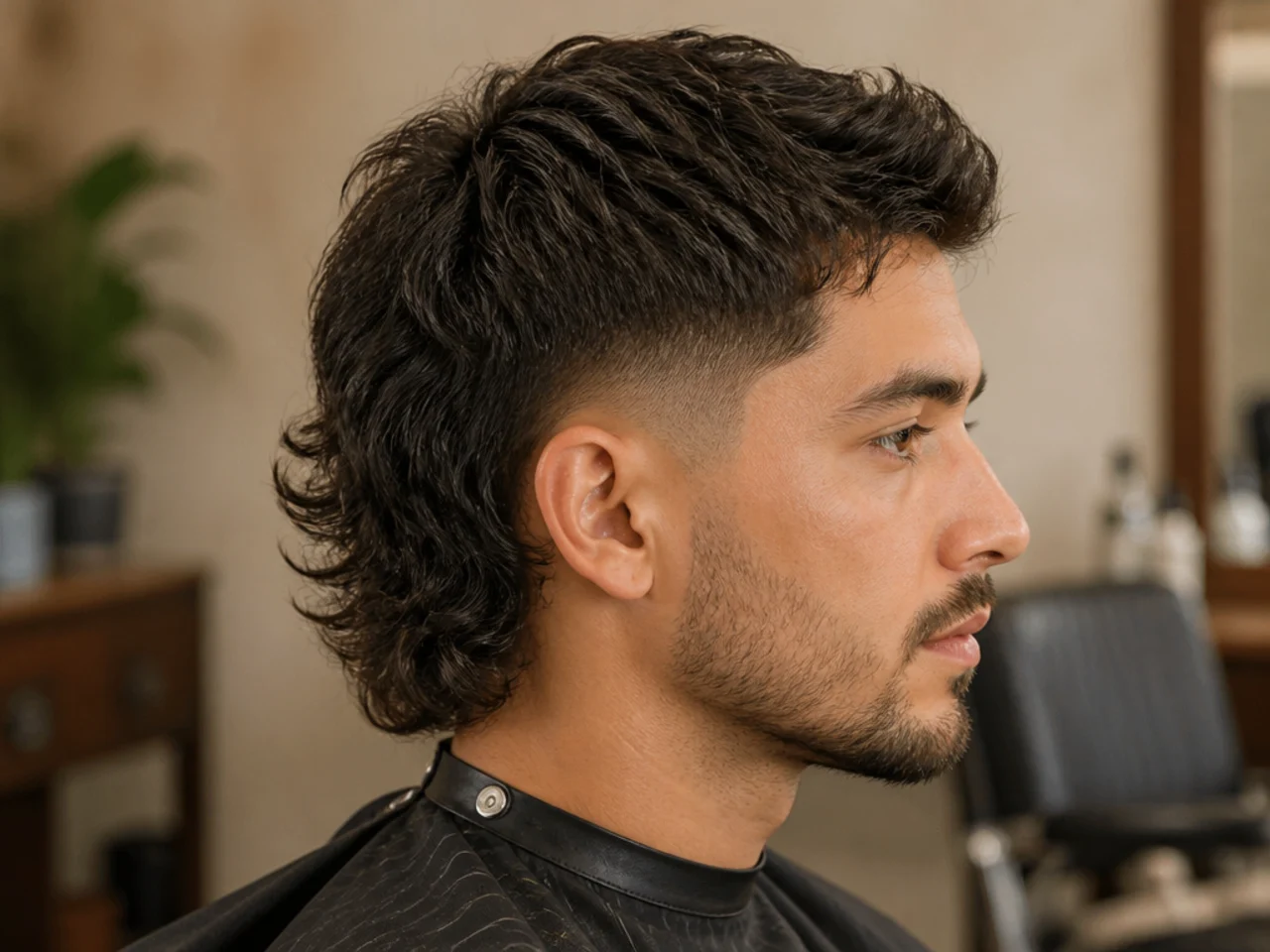
Between a low taper and a mid fade. The taper wraps around the temple as well as the sideburn, but the transition stays graduated rather than sharp. Reads clean without a hard line, and pairs well with textured tops that need a softer frame.
Suits round, square, and heart faces. Best on wavy or curly medium-density hair.
Ask for: "Mid taper fade mullet, taper from the temple down to skin at the sideburn — guard 2 across the top of the side — three-inch back with point-cut layers, blended into a textured top." Sea-salt spray through the back, matte cream through the top.
7. Burst Fade Mullet
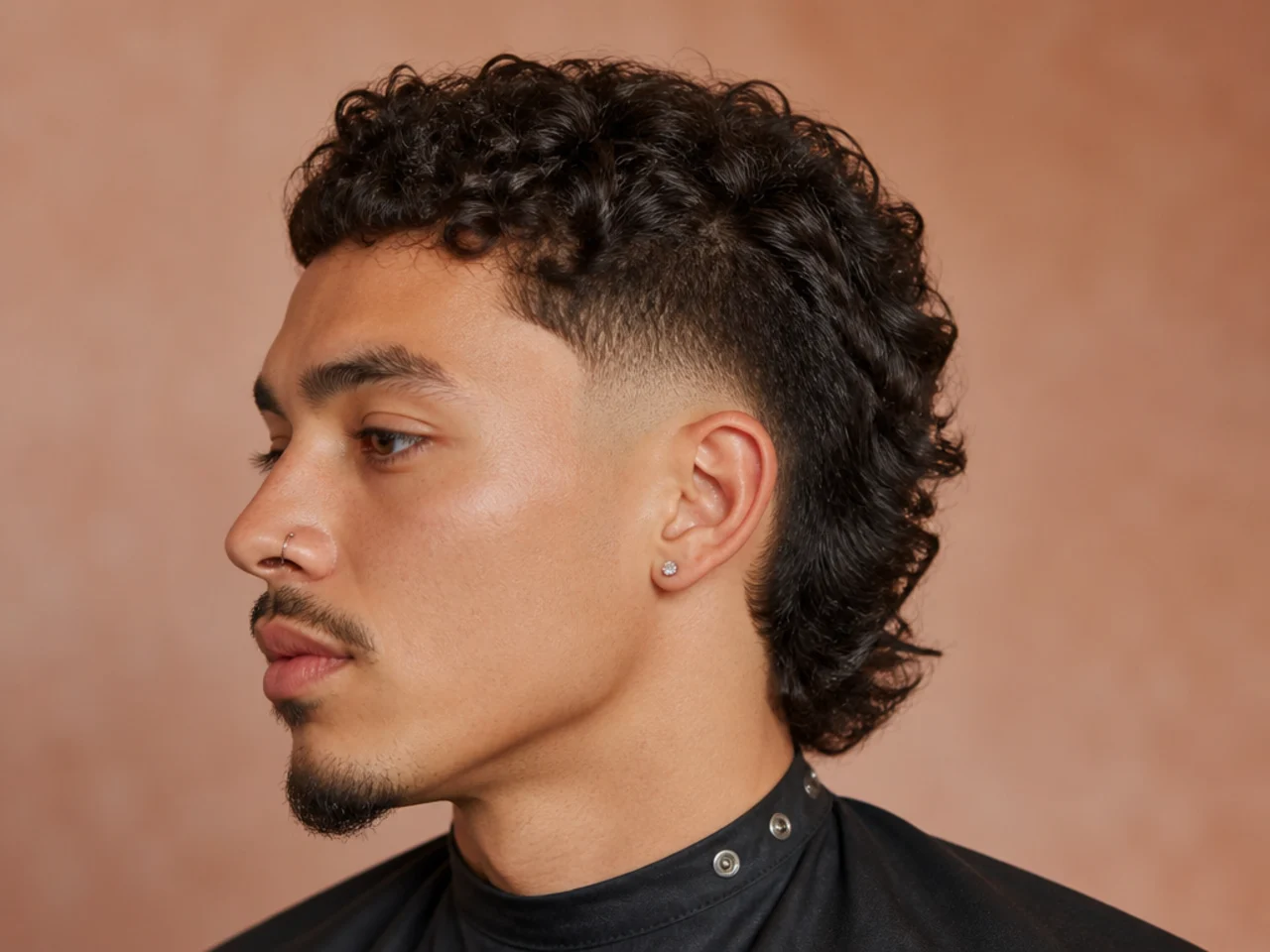
The burst fade curves around the ear in a semicircle rather than dropping straight down. That leaves length behind the ear untouched, which flows into the back mass for a signature you do not see on every corner. One of the most photogenic mullet fades in rotation.
Suits oval, square, and diamond faces. Works with any hair type but shines with a slight wave or curl. Compare with our burst fade mullet deep-dive.
Ask for: "Burst fade mullet, semicircle burst around each ear dropping to skin, keep length behind the ear intact, three-inch top and back with textured layers, no hard perimeter line." Cream through the top for hold; let the back move on its own.
8. Drop Fade Mullet
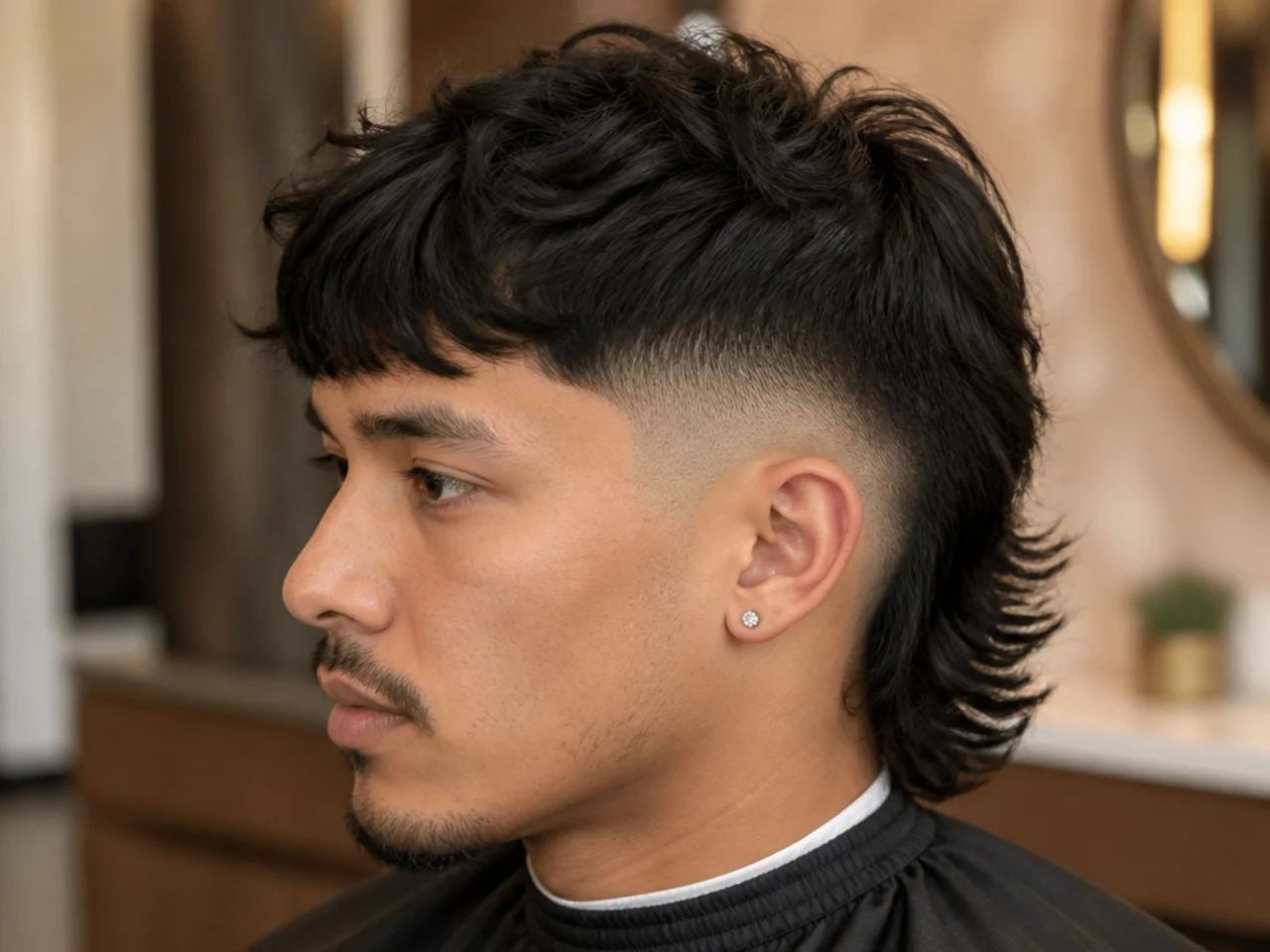
The fade line dips downward behind the ear, following the hairline in a curve instead of running level. That drop lengthens the visual sideburn area and frames the back mass from a low angle. Cleaner and less loud than a burst, sharper than a straight low fade.
Suits oval, long, and diamond faces. Best on straight to wavy hair.
Ask for: "Drop fade mullet, drop the fade line behind the ear following the hairline, mid start — guard 2 dropping to skin, three-inch back with layered texture, soft-blended into the top." Matte paste through the whole top, finger-styled backward.
9. Blowout Taper Mullet
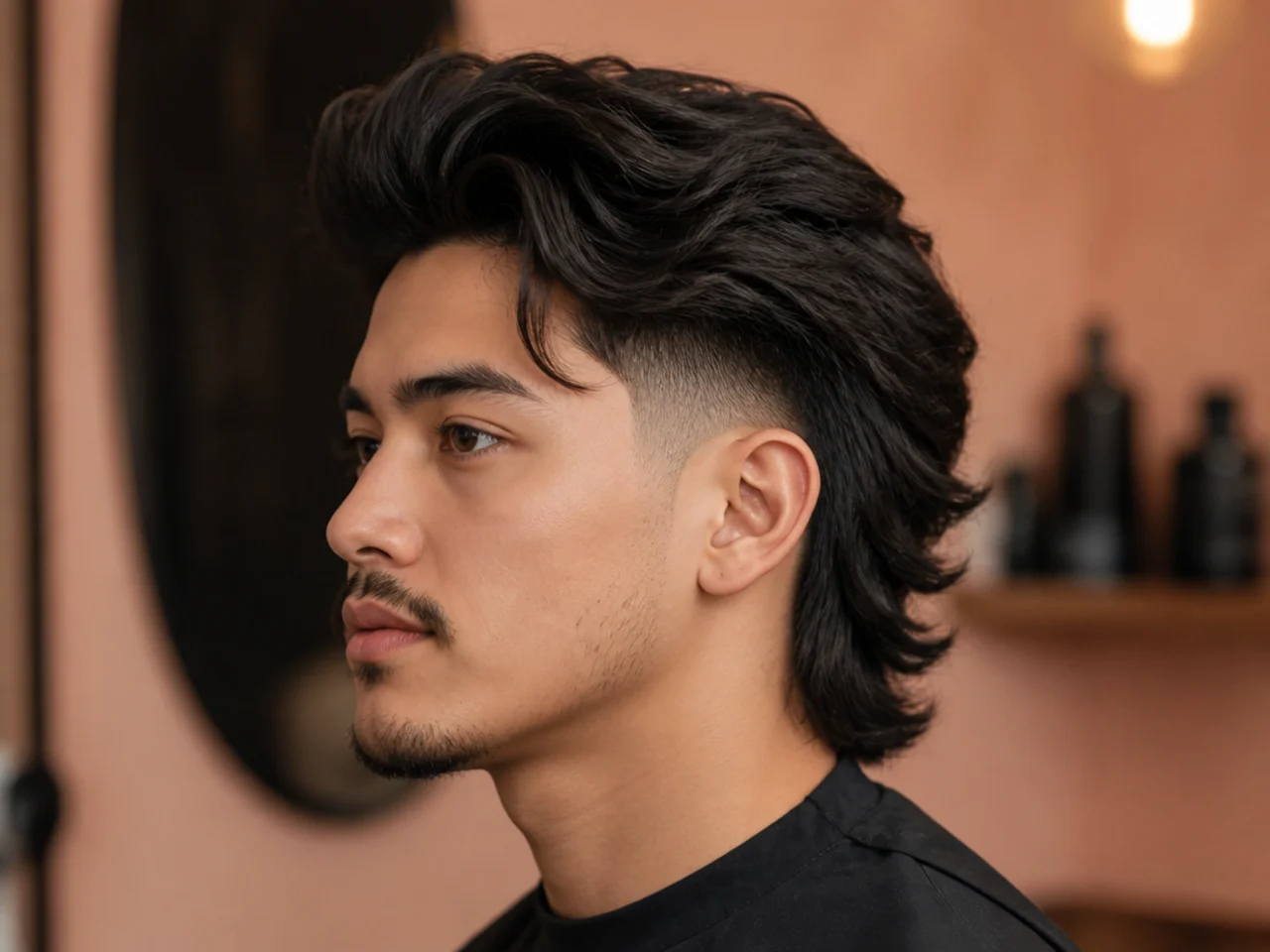
The blowout taper mullet puts all the volume in the top — big, fluffy, textured — with a low taper on the sides so nothing distracts from the height. The mullet back rides just below the top mass, layered for movement. Heavy Puerto-Rican and Latin-barber influence, popular with teens and twenty-somethings.
Suits oval, round, and heart faces where added height flatters. Best on curly, coily, or thick wavy hair.
Ask for: "Blowout taper mullet, low taper at the sideburn and around the ear — guard 1 dropping to skin — keep the top four inches with blown-out volume, two-and-a-half-inch back with textured layers." Blow-dry the top upward with a round brush and diffuse the back.
10. Undercut Fade Mullet
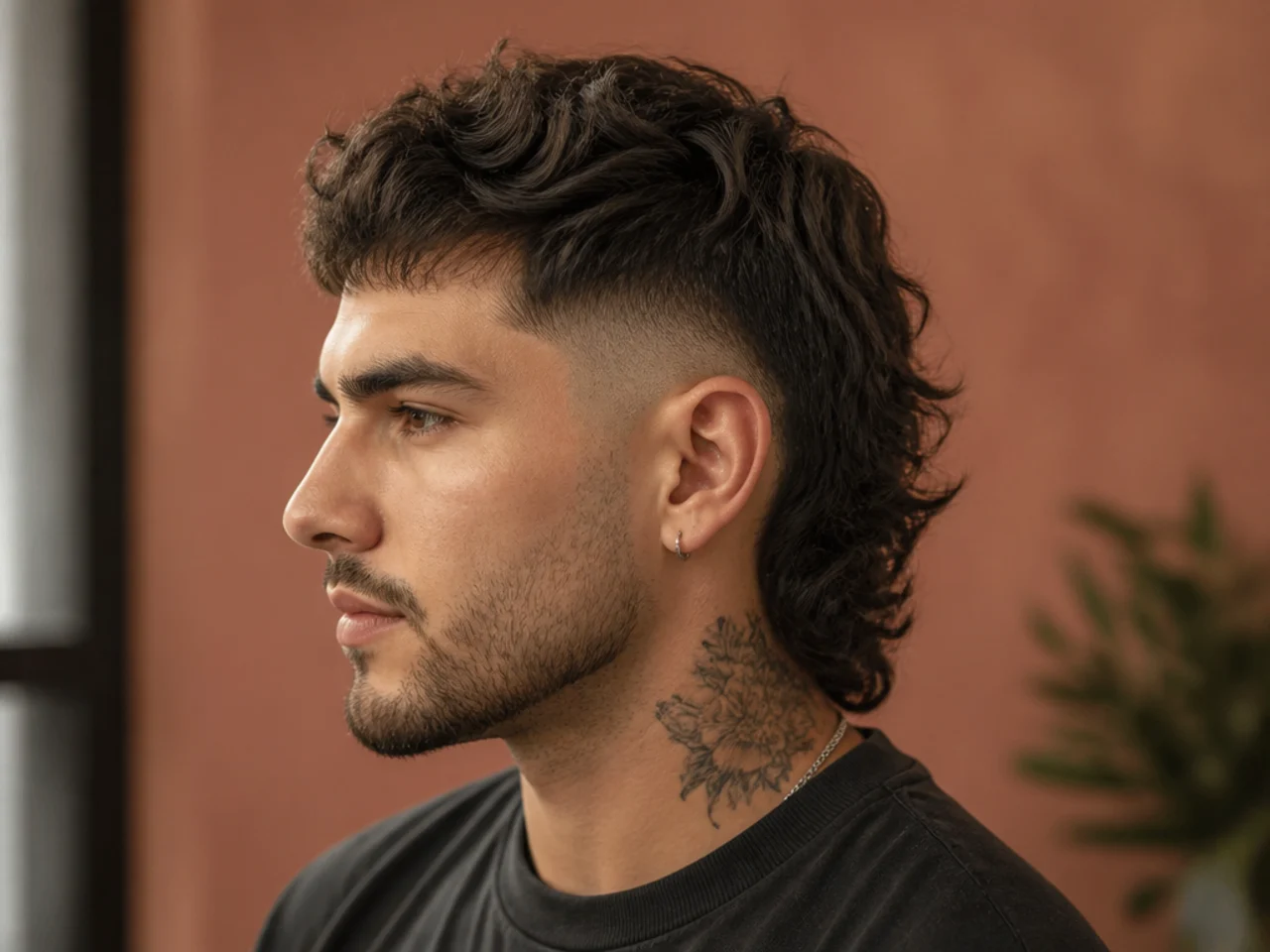
A hard disconnection line sits above a faded band on the sides. From the front, the top drops flat over the fade with no blend at all; from below the line, a mid or low fade takes the length down to skin. The most-committed silhouette on the list without going full mohawk.
Suits oval, long, and diamond faces. Best on straight to wavy hair that lies flat when styled forward.
Ask for: "Undercut fade mullet, hard disconnected line around the parietal ridge, mid fade underneath dropping to skin at the sideburn, three-inch top and back with textured layers." Matte paste over the top for a flat, disconnected read.
11. Temple Fade Mullet
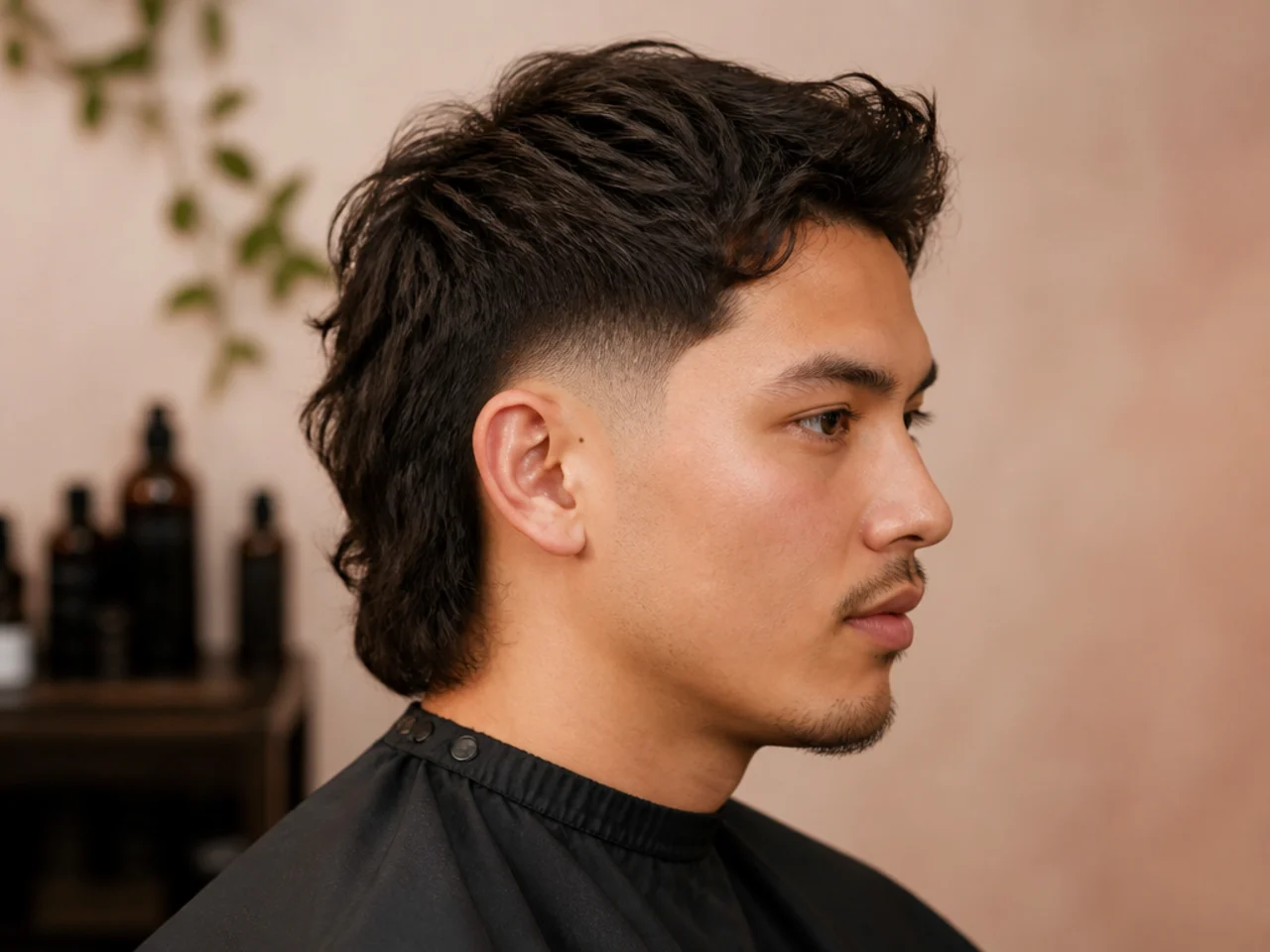
A sharp razor-cut arc frames the temple and runs into the fade. The line reads architectural — a defined edge that gives the whole cut a razor-clean finish — and pairs especially well with tightly coiled hair.
Suits round, square, and diamond faces. Best on coily, curly, and thick wavy hair.
Ask for: "Temple fade mullet, hard razor line from the front hairline arching across the temple, skin fade underneath dropping from guard 2, three-inch back with layered texture, blended into a defined top." Curl sponge or brush for coily hair, cream pomade for wavy.
12. Textured Mullet Fade
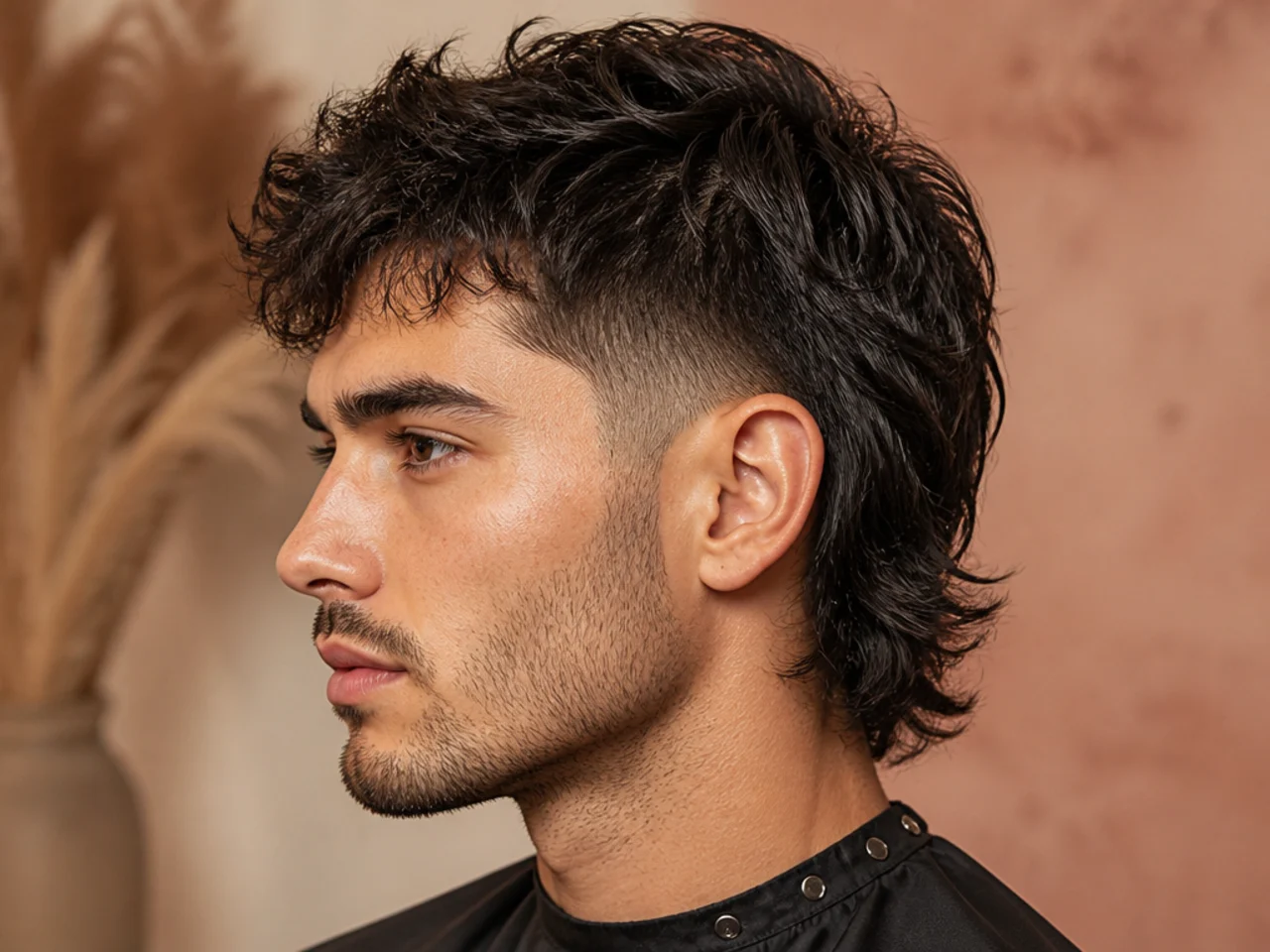
Aggressive point-cutting turns the top into visible pieces rather than a smooth mass. The back mirrors the top's finish — choppy, layered, moving in a dozen directions — and a mid fade keeps the sides sharp. Reads editorial and slightly undone.
Suits oval, heart, and diamond faces. Best on medium-thick straight or wavy hair.
Ask for: "Textured mullet fade, mid fade sides, three-inch top with heavy point-cutting for piecey pieces, three-inch choppy back with razor-feathered perimeter." Salt spray and matte paste through damp hair, twist random pieces for definition.
13. Curly Mullet Fade
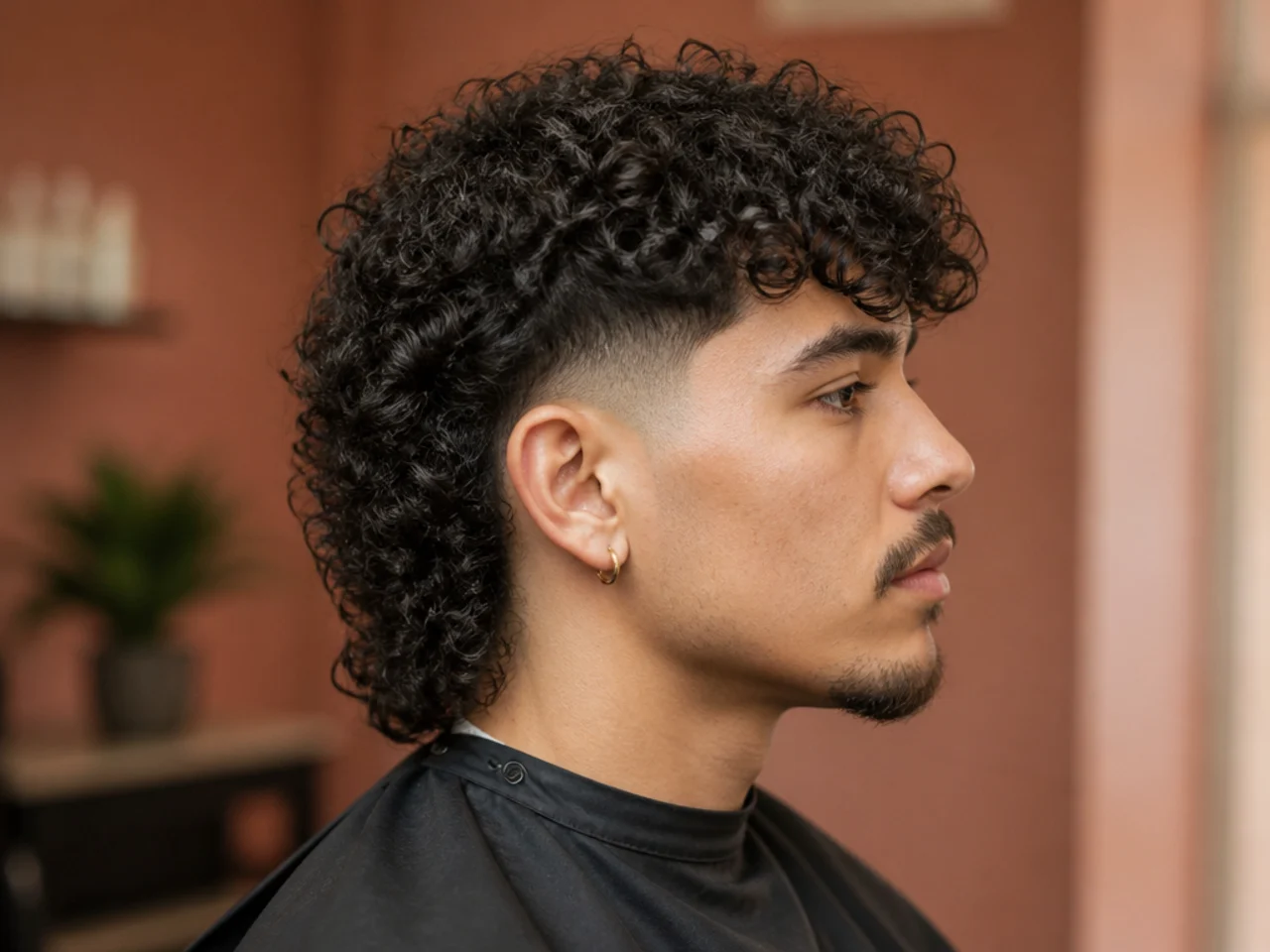
Type 3 to 4a curls do most of the work. The pattern builds the back weight on its own; the fade removes bulk from the sides so the curls up top read as a distinct mass. The layering job is just internal cleanup — no perimeter changes.
Suits oval, heart, and diamond faces. Best on type 3 to 4a curls. See our curly hair mullet guide for the styling details.
Ask for: "Curly mullet fade, dry-cut throughout, three-inch back with internal layers to remove bulk, low or mid fade on the sides dropping to skin, follow the curl pattern at the perimeter." Curl cream on soaking-wet hair, plop with a T-shirt, then diffuse on low heat.
14. Wavy Mullet Fade
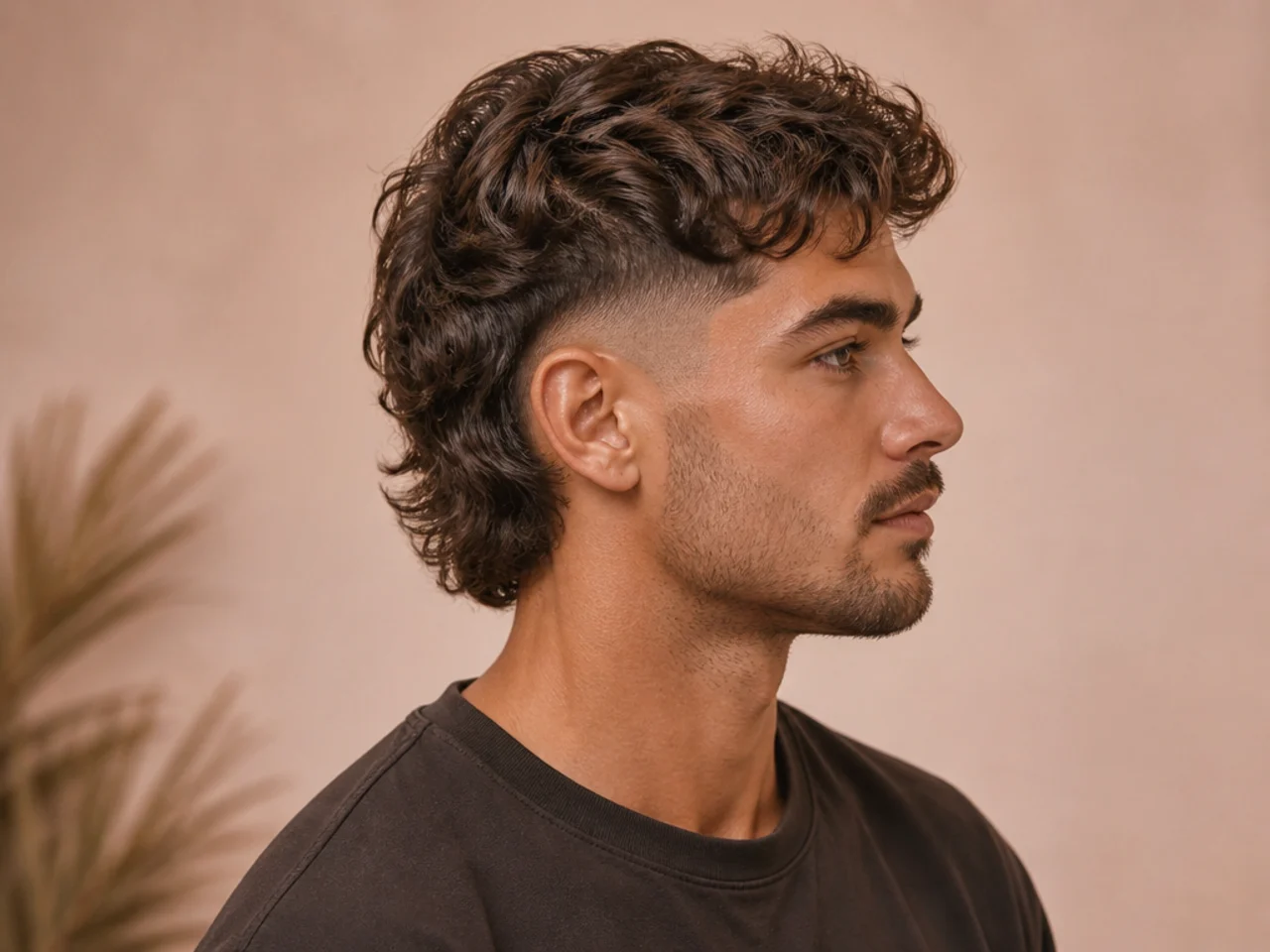
Soft internal layers cut in the direction of the wave let the back fall in natural bends. A mid fade keeps the sides from getting bulky and competing with the top texture. The lightest-effort variation on the list — the pattern does the shape.
Suits oval, heart, and diamond faces. Best on type 2 wavy hair.
Ask for: "Wavy mullet fade, mid fade sides, three-inch top and back with soft internal layers cut in the wave direction, keep the perimeter feathered, no blunt lines." Salt spray on damp hair, scrunch once, air-dry — never brush.
15. Straight Mullet Fade
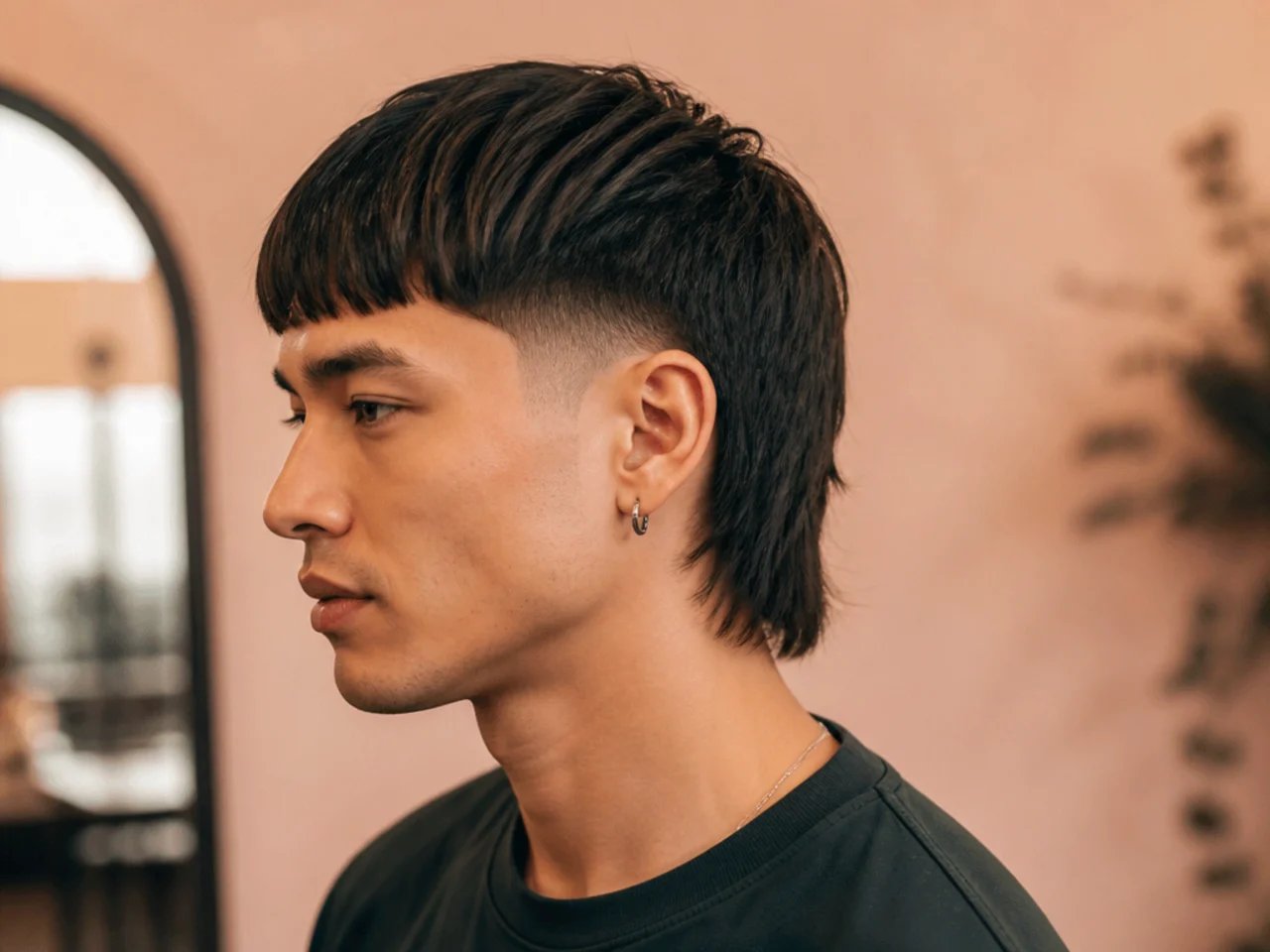
Straight hair reads every layer line, which turns the mullet fade into a precision cut. Every angle is intentional — the fade line, the internal layer stack, the perimeter shape. Reads sharp and slightly formal because the finish looks so clean.
Suits oval, square, and diamond faces. Best on straight, medium-density hair.
Ask for: "Straight mullet fade, mid fade sides dropping to skin at the sideburn, three-inch top with point-cut internal layers to build movement, three-inch back with a razor-feathered perimeter." Matte pomade with a wide-tooth comb pulled back.
16. Fringe Mullet Fade
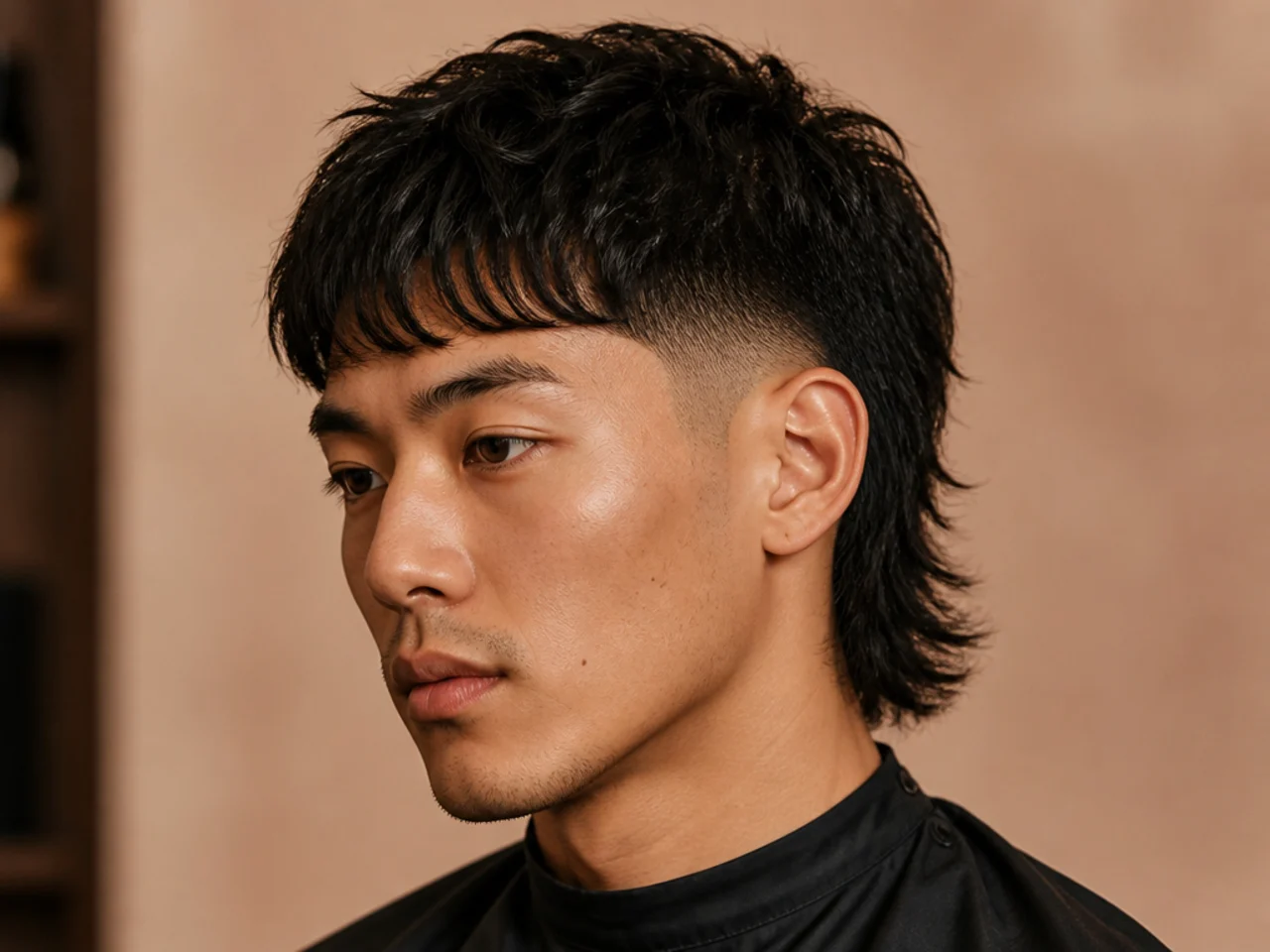
A long forward fringe drops over the brow and meets a low or mid fade at the temple. The fringe mullet reads editorial — the top mass owns the frame, and the back rides low behind. Popular with skaters and indie musicians.
Suits oval, square, and heart faces. Best on straight to slightly wavy fine-to-medium hair.
Ask for: "Fringe mullet fade, low or mid fade sides, four-inch top cut as a heavy forward fringe to just above the eyebrows, two-and-a-half-inch back with soft layers." Blow-dry the fringe forward and down with a round brush.
17. Curtain-Bangs Mullet Fade
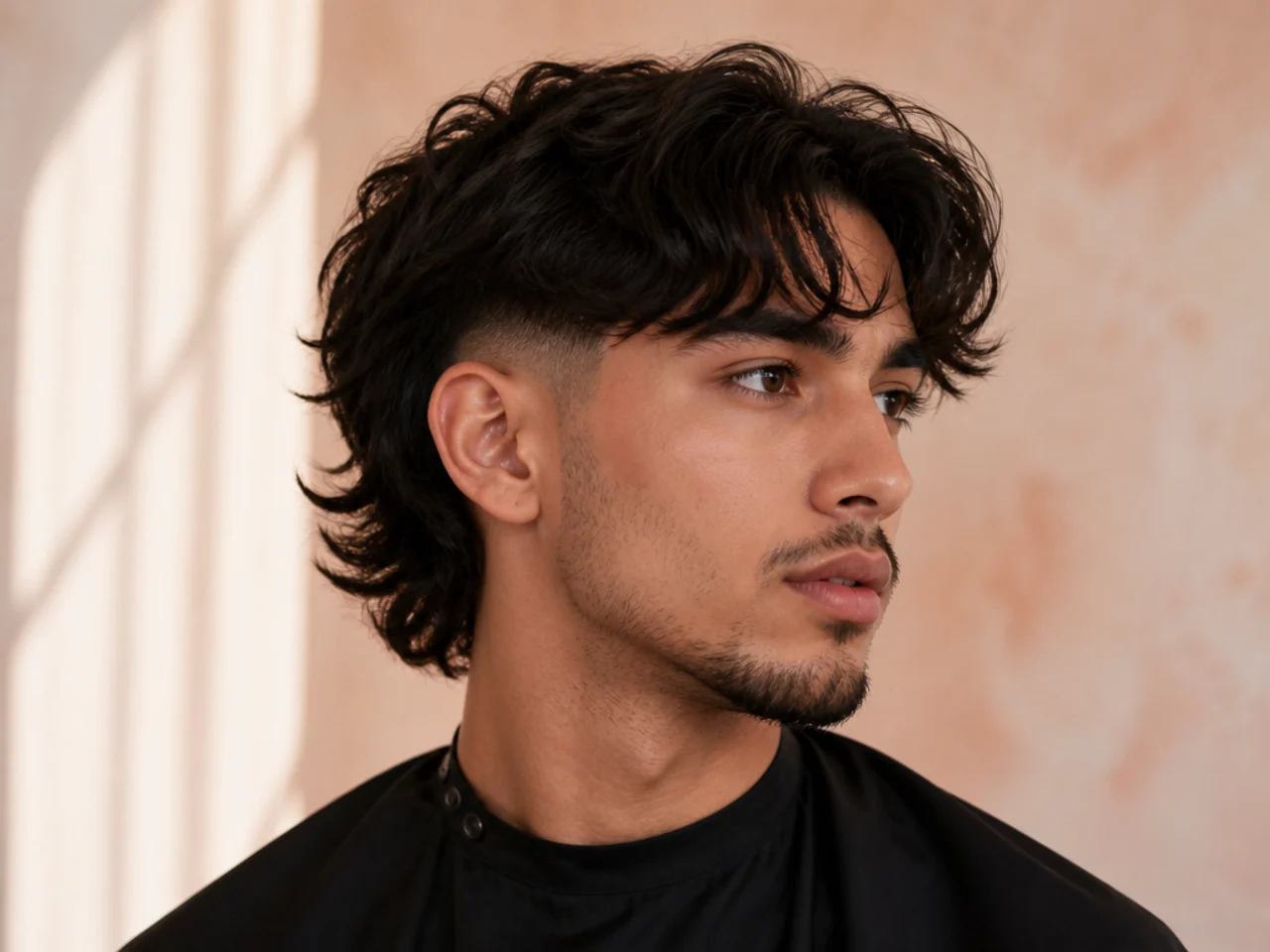
A center-parted curtain fringe splits and falls to either side of the forehead, while a mid fade wraps the sides and a two-inch layered back sits below. The most flattering variation for guys with a strong forehead — the curtain narrows the visual frame and softens the whole face.
Suits oval, heart, and diamond faces. Best on straight to wavy hair long enough to reach the cheekbones.
Ask for: "Curtain-bangs mullet fade, mid fade sides, four-inch center-parted fringe cut to fall to the cheekbones, two-and-a-half-inch back with textured layers." Blow-dry the fringe split from the center with a round brush.
18. Two-Block Mullet Fade
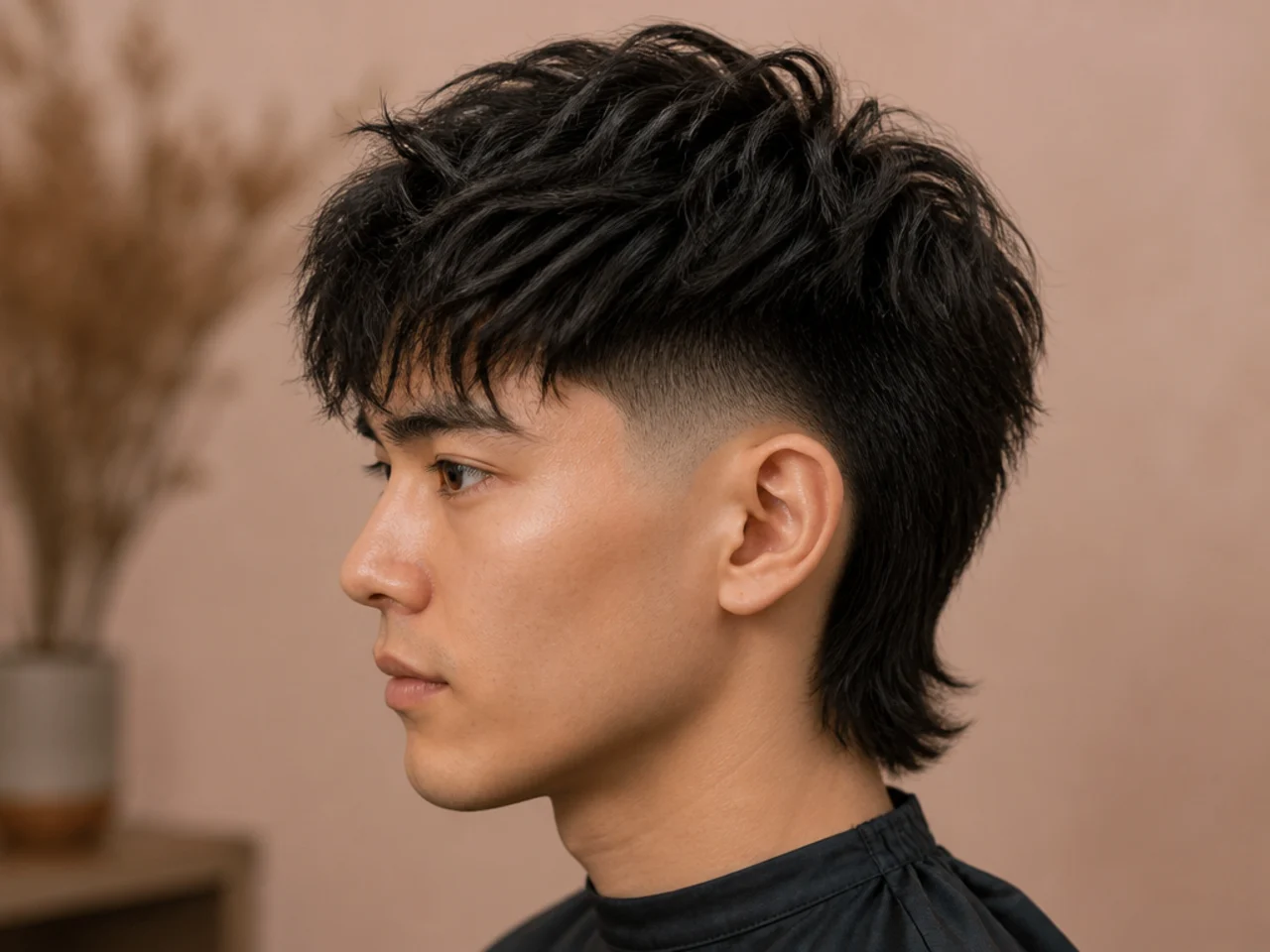
The two-block silhouette borrowed from K-pop and rebuilt around a mullet fade. A dense top mass sits above a hard-edged mid or high fade, and the mullet's back length flows out from the top rather than a separate section. Common on Korean and Asian barbershop feeds.
Suits oval and long faces. Best on dense straight to slightly wavy hair. Cross-reference our Korean haircuts for men guide.
Ask for: "Two-block mullet fade, hard-line mid fade dropping to skin, four-inch dense top with blunt internal layers, three-inch back with soft-blended layers flowing from the top." Blow-dry the top back with a paddle brush, then let the front fall naturally.
19. Spiky Mullet Fade
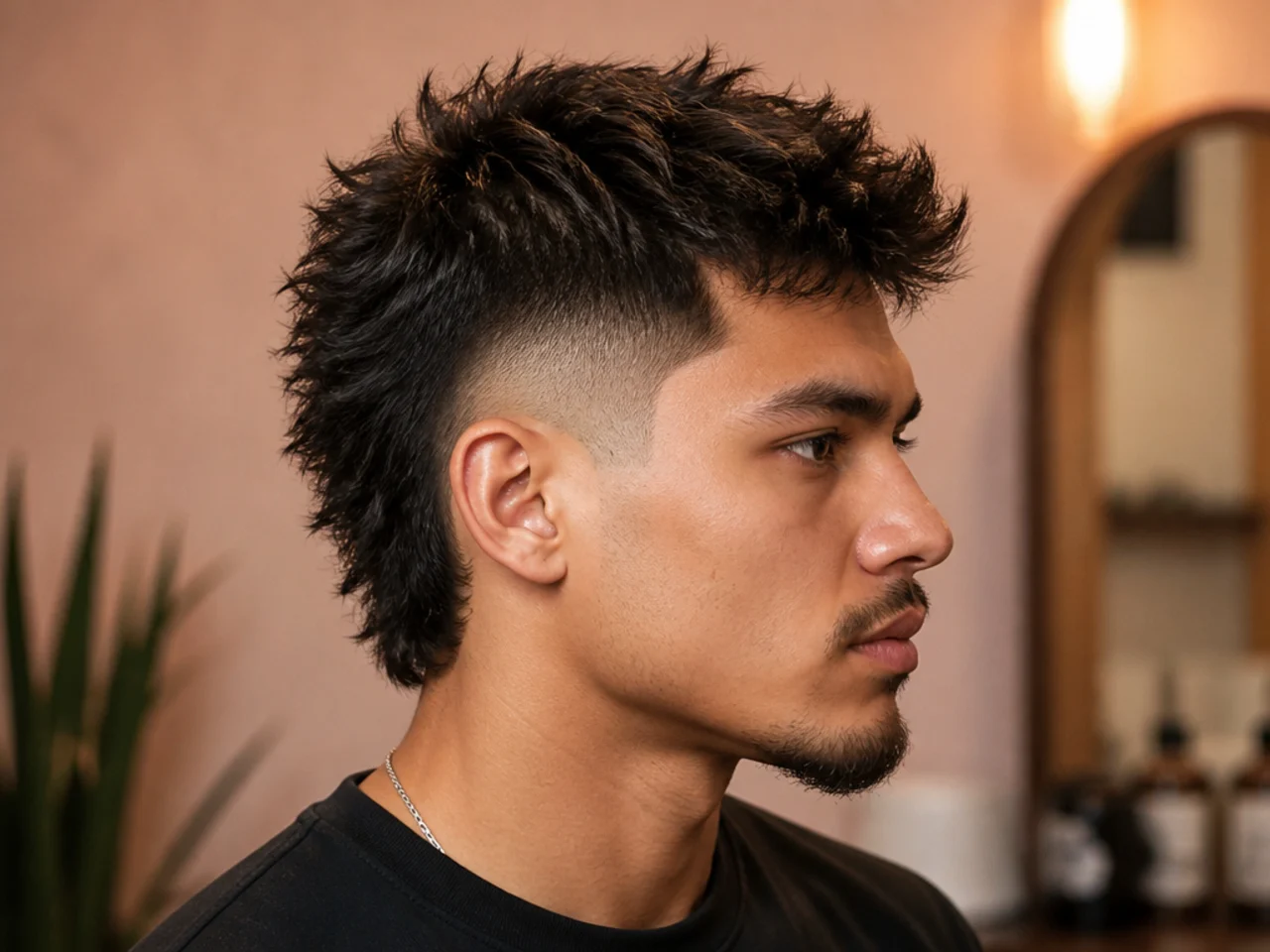
The top rides vertical — point-cut spikes lifted straight up — and the mullet extends that texture down the back. Short sides frame the spikes and stop the shape from spreading wide. Reads bold, modern, and slightly punk.
Suits square and diamond faces where vertical line elongates. Best on thick straight hair that holds a spike shape.
Ask for: "Spiky mullet fade, low or mid fade sides, three-inch top point-cut for spike definition, two-and-a-half-inch back with textured layers." Matte clay worked into damp roots, blow-dry upward, finger-spike, hairspray to hold.
20. Long Mullet Fade
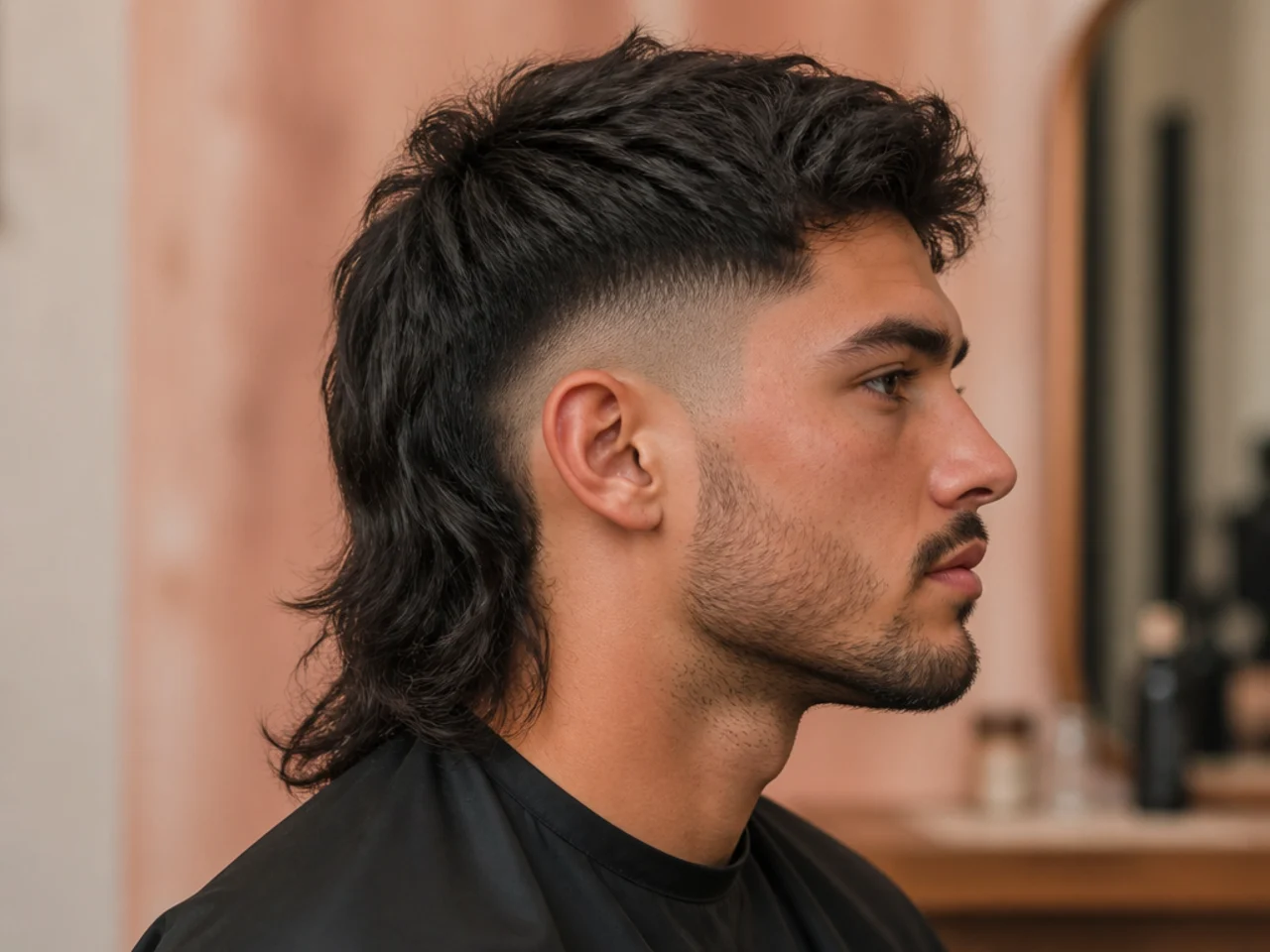
Length is the point. The back runs four to five inches, layered enough to swing rather than sit flat, while a low fade keeps the sides clean so the length reads as intentional. The most committed mullet fade — earns comparisons to a men's wolf cut hybrid.
Suits oval, long, and heart faces. Best on straight to wavy hair and patience for the grow-out.
Ask for: "Long mullet fade, low fade sides — guard 2 dropping to skin at the sideburn — four-inch back with choppy layers, three-inch top with textured internal layers, feather the perimeter." Salt spray in damp hair, scrunch the back, air-dry.
How to Ask Your Barber for a Mullet Fade
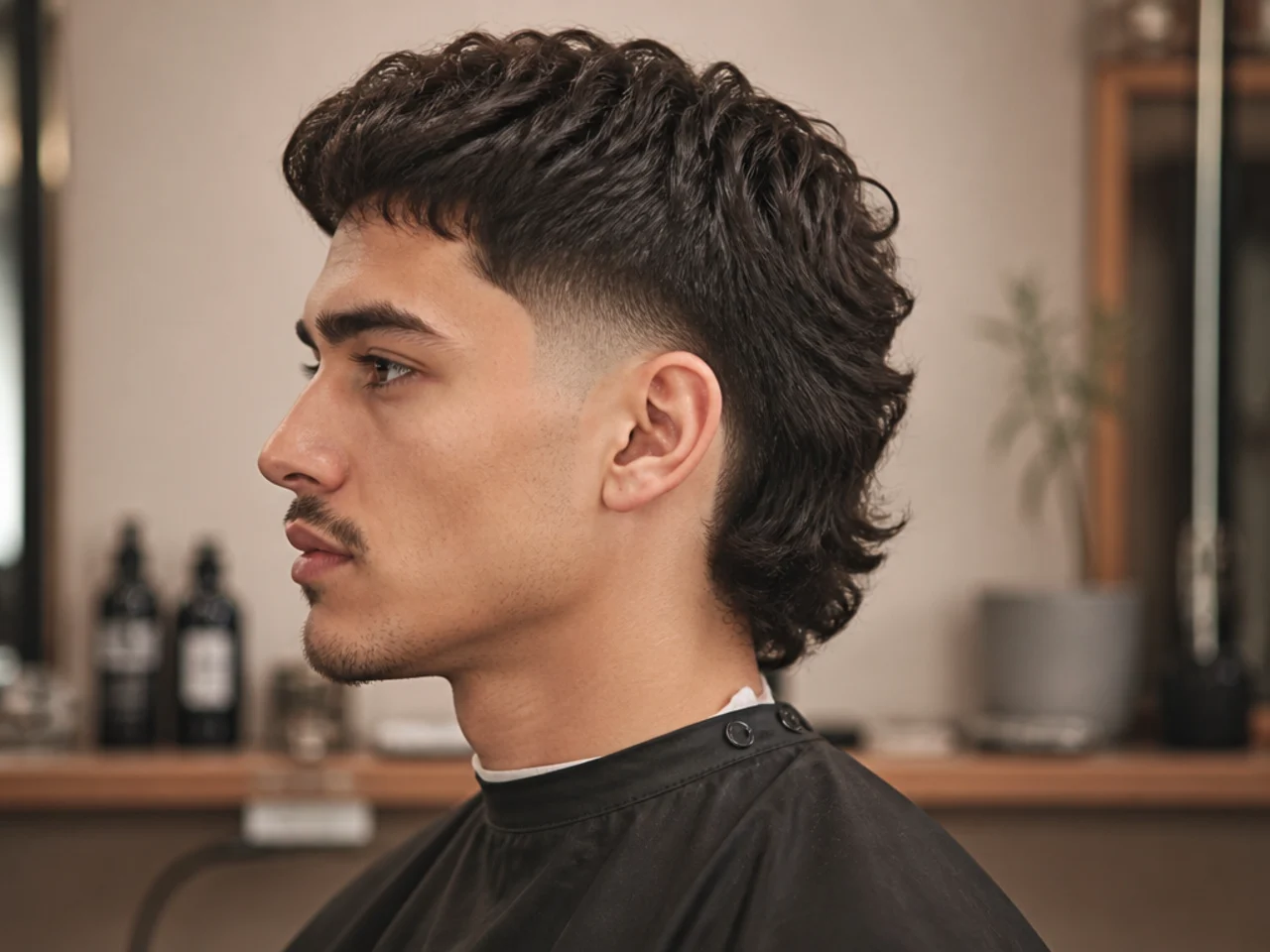
Bring a photo. That is rule one for any layered cut, and doubly true here because "mullet fade" covers 20 different silhouettes. Once you sit down, walk through this checklist.
- Say "mullet fade" — not just "mullet" or "fade with a mullet at the back." The two words together tell your barber to treat the back and sides as one deliberate silhouette rather than a mullet with grown-out sides.
- Set the fade type. Low, mid, high, skin, low taper, mid taper, burst, drop, blowout taper, undercut, or temple. That single word decides where the transition sits on the head and how loud the finished cut reads.
- Set the fade's shortest point. Skin (bald), guard 0.5, or guard 1. Skin reads sharpest and needs re-cutting every two weeks. Guard 0.5 lets you stretch to three weeks. Guard 1 forgives longer between visits.
- Set the fade's longest point. Guard 2 for a clean workplace look, guard 3 for a soft blend, guard 4 for a heavy textured top that sits close to the fade. This is where the fade meets the top.
- Set the back length in inches. Two inches for the shortest, cleanest versions. Two-and-a-half to three for standard. Three-and-a-half to four for length-focused variations. Four-plus for the long mullet fade.
- Set the top length and texture. Two to three inches for spiked, textured, or classic tops. Three-and-a-half to four for fringes, curtains, quiffs, and two-blocks. Ask for point-cut internal layers so the top has movement, not weight.
- Confirm the transition. Soft-blended for classic, taper, and workplace versions. Hard-lined for undercut, two-block, and temple-fade versions. Do not leave the transition style to your barber's default.
Show the photo again to confirm the shape before scissors touch hair. If you are weighing this against neighbors, our short mullet haircut men guide covers the shortest end of the family and our modern mullet breakdown covers the standard length without a fade.
Styling and Maintenance
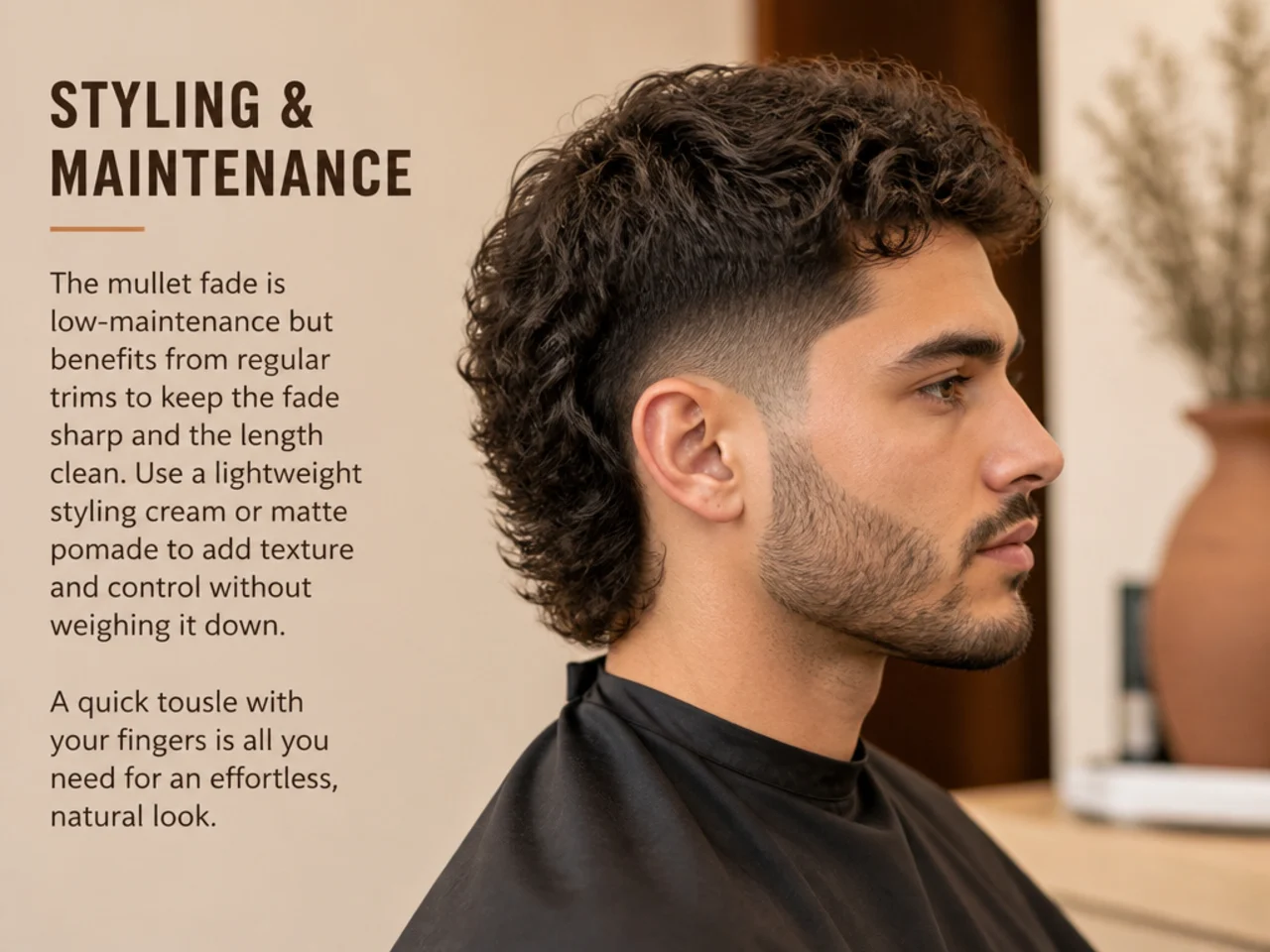
Wash and towel-dry so hair is damp, not wet. Damp hair absorbs product; wet hair drips it. Rough-dry with fingers to lift the roots at the crown and back — that lift builds the volume everything else sits on. Straight and wavy hair benefit from a two-pump sea-salt spray at this stage; curly and coily hair should start with a leave-in conditioner instead.
Product goes on second. Matte clay for textured tops. Cream pomade for slick-back and Korean variations. Fiber pomade for spikes and quiffs. Curl cream for type 3 to 4c textures. A pea-sized amount is enough for the top; another pea-sized amount rubbed through the back mass keeps the layers defined without weight.
Scrunch the back after applying product. Grab the back length and push it upward toward the scalp, which encourages the layers to fall in defined pieces instead of one flat curtain. Air-dry from here if your hair has movement; diffuse on low if you have any wave or curl. A finishing mist of light hairspray locks the fringe and crown without stiffness.
Re-cut the fade every two to three weeks — every two weeks if you have a skin fade or a hard-lined variation. Re-cut the length every five to eight weeks. Book both together if your barber allows split appointments. For full cadence guidance, see our how often to get a haircut guide. Between fade visits, run a beard trimmer over the neckline yourself to buy an extra week of clean edges.
Wash the top three to four times a week and condition every wash — layered length shows damaged ends faster than blunt cuts. Sleep on a silk or satin pillowcase to preserve texture and stop the back from creasing overnight. If you want to compare related shapes, browse our burst fade mullet or low fade mullet guides for angle-specific reference.
FAQ
What is a mullet fade haircut for men?
A mullet fade pairs the mullet's back-heavy length with a faded side treatment. The back keeps two to four inches of layered length; the sides taper or fade from short to skin, blended into the top so nothing looks disconnected. The fade is what makes the modern version read sharp instead of shaggy — and it is why the mullet fade haircut men are asking for right now looks nothing like the 80s original. See our full modern mullet breakdown for the standard non-fade direction.
Which fade goes best with a mullet?
A low or mid fade is the safest first pick — it sharpens the mullet's shape without overwhelming the back length. High fades and skin fades read louder and lean statement. Burst and drop fades add a signature curve around the ear that most workplaces still accept, and blowout tapers stack volume on top for a Latin-barber-shop look. Match the fade to how much attention you want the cut to pull.
Does the mullet fade suit round faces?
Yes — a mullet fade actually flatters round faces because a taller top and short faded sides add vertical line and narrow the profile. Ask for a mid or high fade with two to three inches of textured height on top, not a low fade with a flat top. Skip disconnected undercut versions if you want the read to stay soft rather than architectural.
Can I get a mullet fade with curly hair?
Curly hair is one of the best textures for a mullet fade. The pattern builds the back weight on its own, and the fade keeps the sides from spreading wide. Ask your barber to dry-cut the length so the pattern is visible, and request internal layers rather than stacked layers so the crown does not stack into a triangle on 3a-3c curls or a helmet on 4a-4c coils. Our curly hair mullet guide walks through the pattern-specific styling.
How do I ask my barber for a mullet fade?
Say five things — the fade type (low, mid, high, skin, taper, burst, drop, blowout, undercut, temple), the fade's shortest point (guard 1, half a guard, or skin), the back length in inches (two to four), the top length and texture (two to four inches, point-cut or blunt), and whether the transition into the top is soft-blended or hard-lined. Bring a photo of the exact silhouette you want. The seven-step checklist above covers the rest before scissors touch hair.
How often do I need to re-cut a mullet fade?
Every two to three weeks for the fade line — sooner if you have a skin fade or a hard-lined undercut version — and every five to eight weeks for the length. Faded sides grow out fastest and blur the whole shape first, so book the fade touch-ups separately if your barber allows quick appointments. Between visits, run a beard trimmer over the neckline yourself to keep the edges clean.