5 Reasons a Mullet Works for Curly Hair
Five reasons the mullet curly hair works pairing is a match — softer transition, defined back drop, easy volume balance, 3A–4C range, and stealth grow-out.
In this article · 18
- The One-Line Answer
- What Makes This a Mullet and Not a Wolf Cut
- Reason 1: Your Curl Pattern Fixes the Eighties Transition Line
- Reason 2: The Back Reads Defined Instead of Flat
- Reason 3: Short Sides and Top Solve Curly Hair's Volume Problem
- Reason 4: Every Curl Type From 3A to 4C Can Wear It
- Reason 5: Grow-Out Is Stealth Mode
- Mullet on Curly Hair: Side by Side Across Curl Types
- Which Version of the Curly Mullet Should You Ask For?
- How to Ask Your Stylist for a Curly Mullet
- Styling and Maintenance
- FAQ
- Does a mullet actually work on curly hair?
- Which curl type suits a mullet best?
- How is a curly mullet different from a curly wolf cut?
- Should curly hair be cut wet or dry for a mullet?
- How often do I need to trim a curly mullet?
- Is a curly mullet workplace-appropriate?
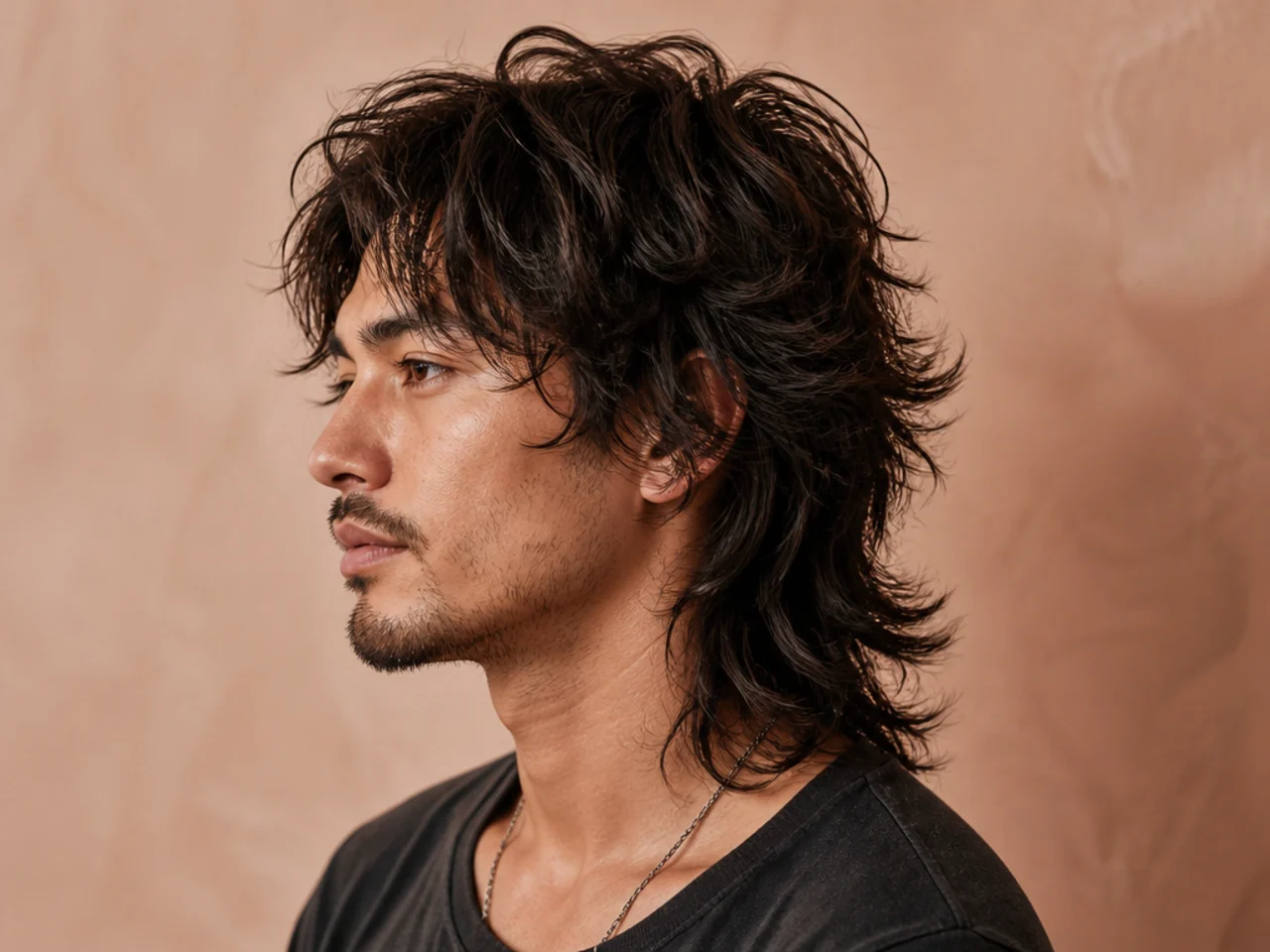
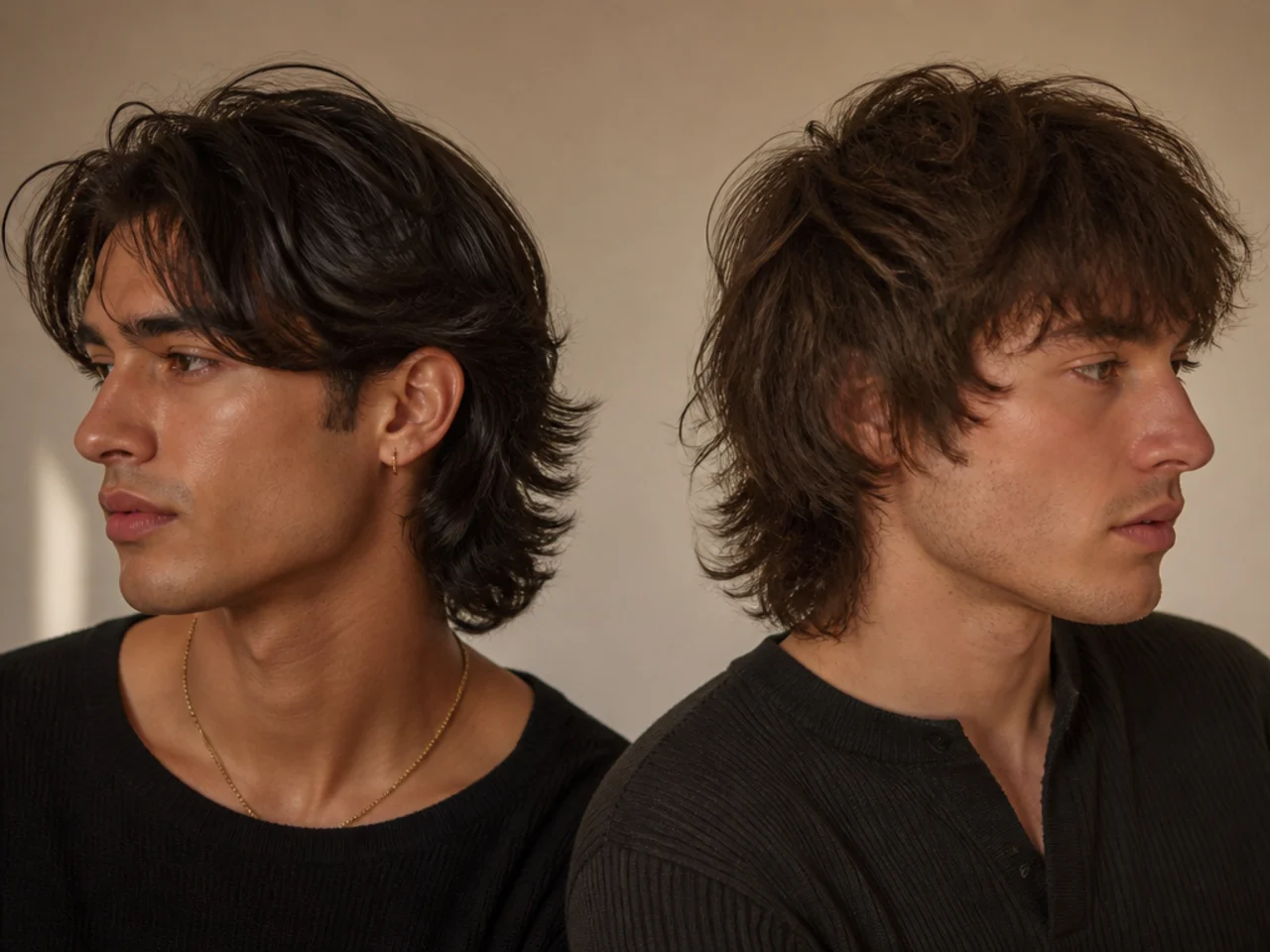
The mullet spent thirty years as the punchline haircut, and curls are the reason it stopped being one. The pattern breaks the hard visual line between short top and long back that made the eighties version read costume, and the drop hangs in defined coils instead of one flat curtain. Here are five reasons stylists keep steering curly clients toward the mullet, plus the exact chair language for every curl type from 3A to 4C.
The One-Line Answer
The mullet curly hair works pairing lands because the curl pattern fixes every visual problem the classic mullet ever had. The harsh eighties transition line disappears under the natural break of a corkscrew or coil. The back stops reading as a flat sheet of length and starts reading as defined pieces the eye can follow. The short top and sides sit exactly where curls want to live — lifted, not weighed down — and the longer back sits exactly where gravity flatters the pattern. Every type from loose 3A waves to tight 4C coils wears the shape through a different execution of the same silhouette. The mullet did not come back on straight heads. It came back on curly ones, and then straight guys copied it.
What Makes This a Mullet and Not a Wolf Cut
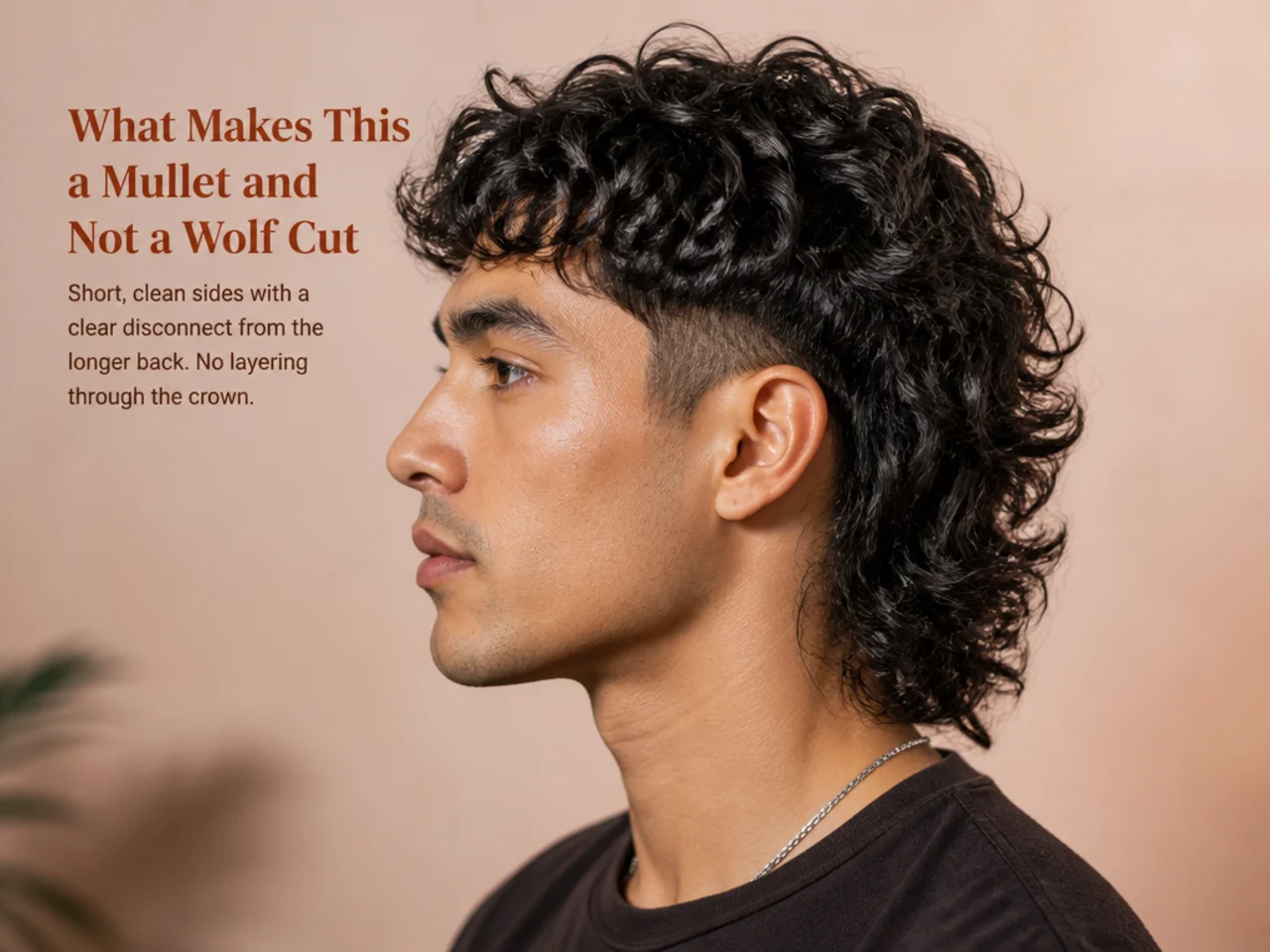
The mullet concentrates length at the back — short top, short sides, and a defined drop past the collar. Layers stay minimal through the crown so the top-to-back differential reads clean. The modern mullet haircut men pillar covers the anatomy in full, but the short version is: it is a length choice with attitude at the nape.
The wolf cut spreads that length across the whole crown. Internal layers stack shorter through the top, face-framing pieces spring at the cheekbone, and the feathered perimeter runs continuous rather than dropping in one direction. Our 5 reasons the wolf cut works for curly hair breakdown covers the sister silhouette. On curls, the mullet reads bolder from the profile and cleaner from the front; the wolf reads softer overall and busier through the crown.
Pick the mullet if you want a defined back drop and a shorter crown that stays out of the way. Pick the wolf if you want layered movement everywhere. Both are covered in the parent mullet haircut for men survey if you want to see the whole family side by side.
Reason 1: Your Curl Pattern Fixes the Eighties Transition Line
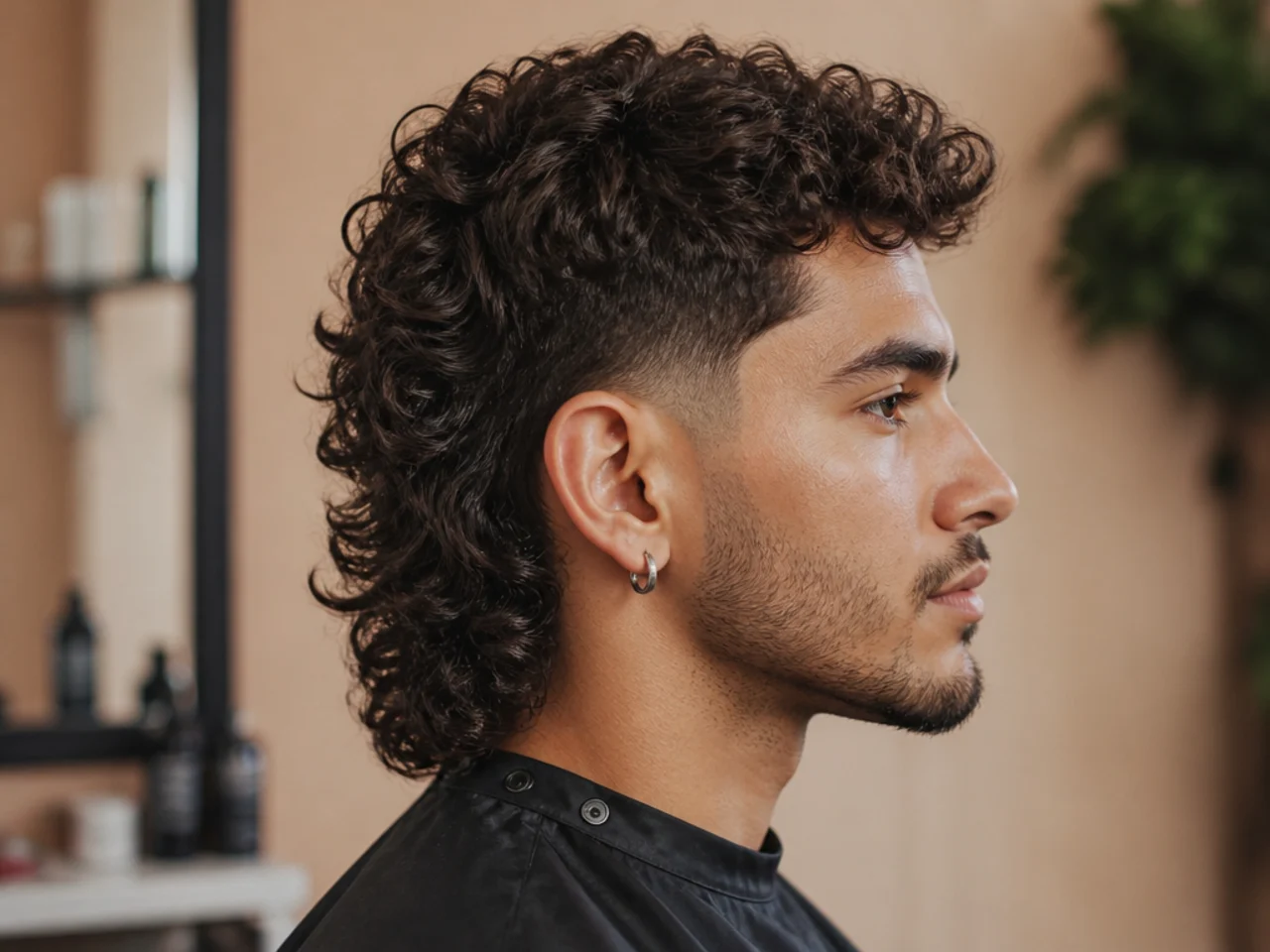
The single thing that made the eighties mullet look dated was the hard visual line between the short top and the long back. On straight hair, the transition sits as one clean geometry — top ends here, back begins here. The eye reads the seam and the whole cut turns into a period costume.
Curls erase that seam. A 3B corkscrew or a 4A coil breaks the horizontal line naturally, so where a straight-hair mullet has a knife edge, a curly mullet has a soft blend the pattern produces on its own. The barber can cut the same aggressive length differential the eighties used — one and a half inches on top, four sprung inches at the back — and the finished shape reads current instead of throwback. The math has not changed; the texture has.
This is why every curly guy in a modern reference photo can wear a proportion that would look dated on his straight-haired friend. The pattern is doing the softening work that a straight-hair mullet has to fake with heavy point-cutting through the transition zone.
What this means at the chair: the stylist should cut the top and back as two distinct sections with a soft blended handoff — not one long gradient the way a wolf cut is built. Say: "Two distinct sections, softly blended at the crown, not a full-length gradient." That one line separates a curly mullet from a curly shag every single time.
Reason 2: The Back Reads Defined Instead of Flat
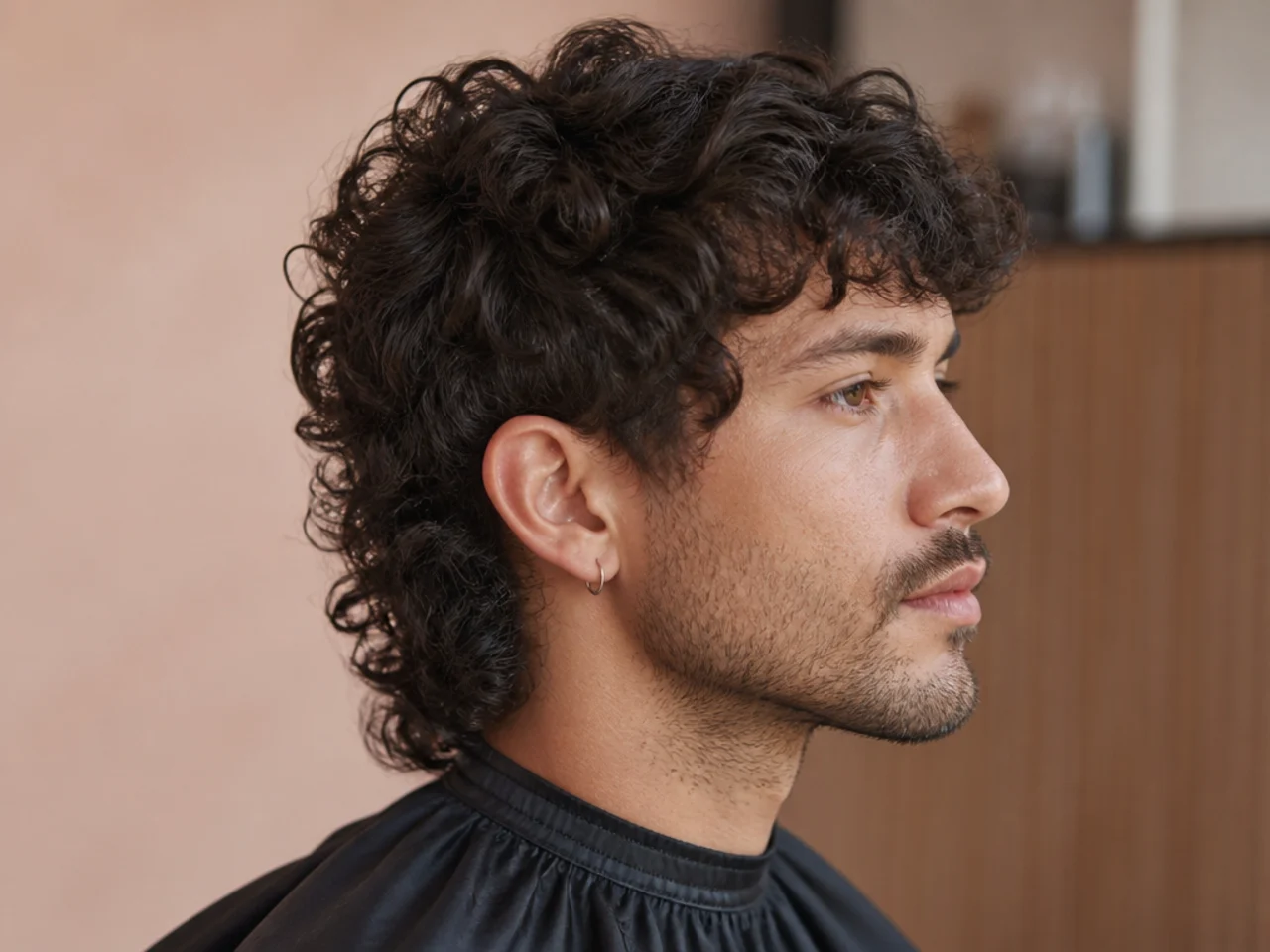
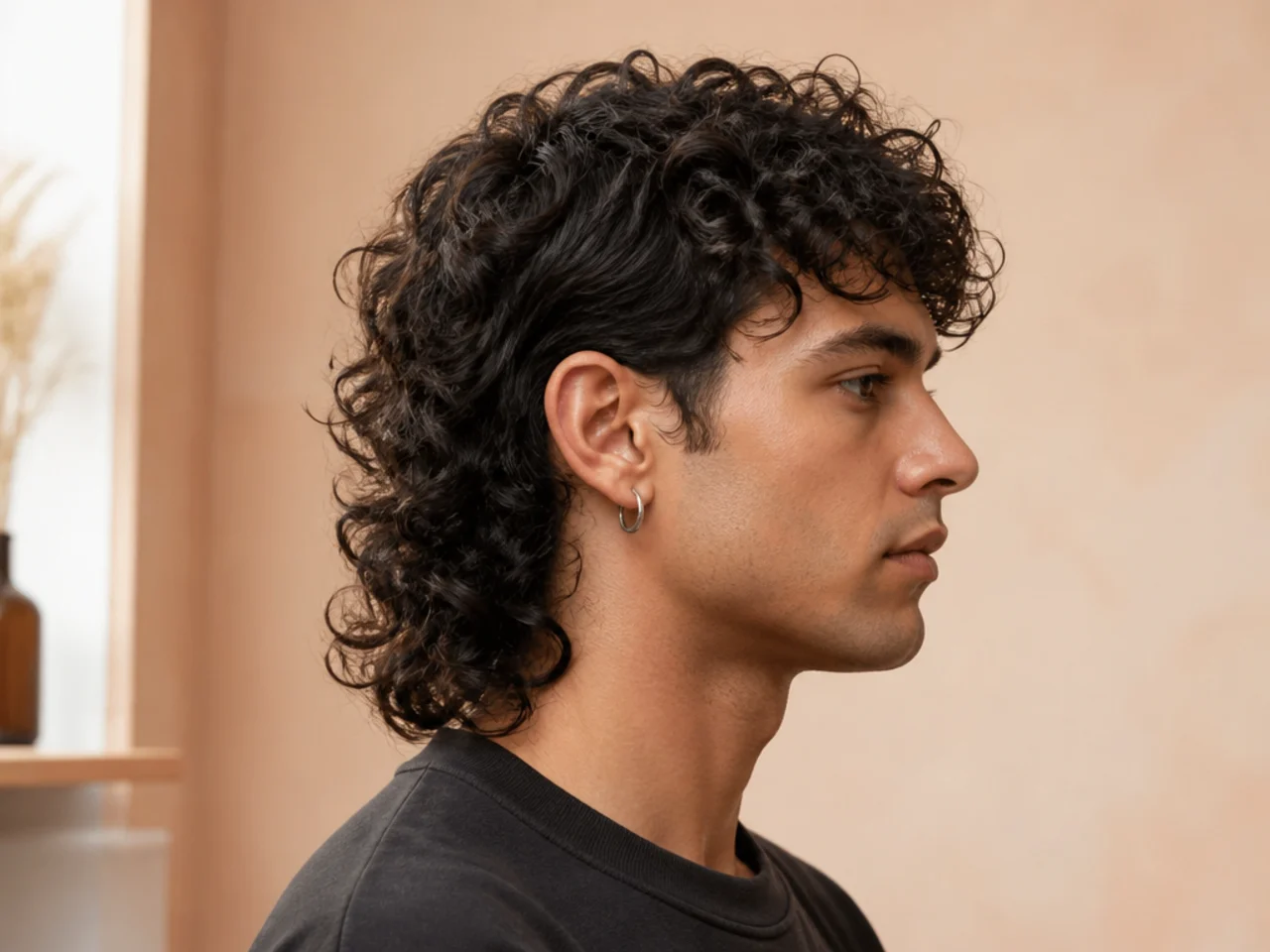
The nape of a straight-hair mullet is a solid sheet of hair. Even with layers, it hangs as one shape, and the length is the whole visual — nothing else on the back is doing any work. On curly hair, the same length hangs as separated coils. The pattern turns the mullet drop from a single object into a collection of defined pieces.
This is the reason curly mullets photograph so cleanly from behind. A 3B corkscrew back looks like sculpted rows of spirals. A 3C spiral back reads as denser coil separation. A 4A S-loop back reads as sculpted architectural volume. In every case, the length is not the point — the pattern within the length is. The mullet just gives the pattern a stage.
Length-wise, two to three sprung inches past the crown is usually the sweet spot for pattern definition. Any shorter and the back does not hang far enough for gravity to reveal the coil rhythm; any longer and the pattern starts fighting its own weight and compressing at the tips. The 20 curly hair mullet haircuts for men breakdown covers the exact sprung-length target for every variation.
Ask for it this way: "Cut the back to sprung length, not stretched length, with visible coil separation preserved through the drop." Sprung means the length once the curl contracts. A back that measures three inches sprung is often five or six inches stretched — cut to the wrong number and the finished shape is halfway to nothing.
Reason 3: Short Sides and Top Solve Curly Hair's Volume Problem
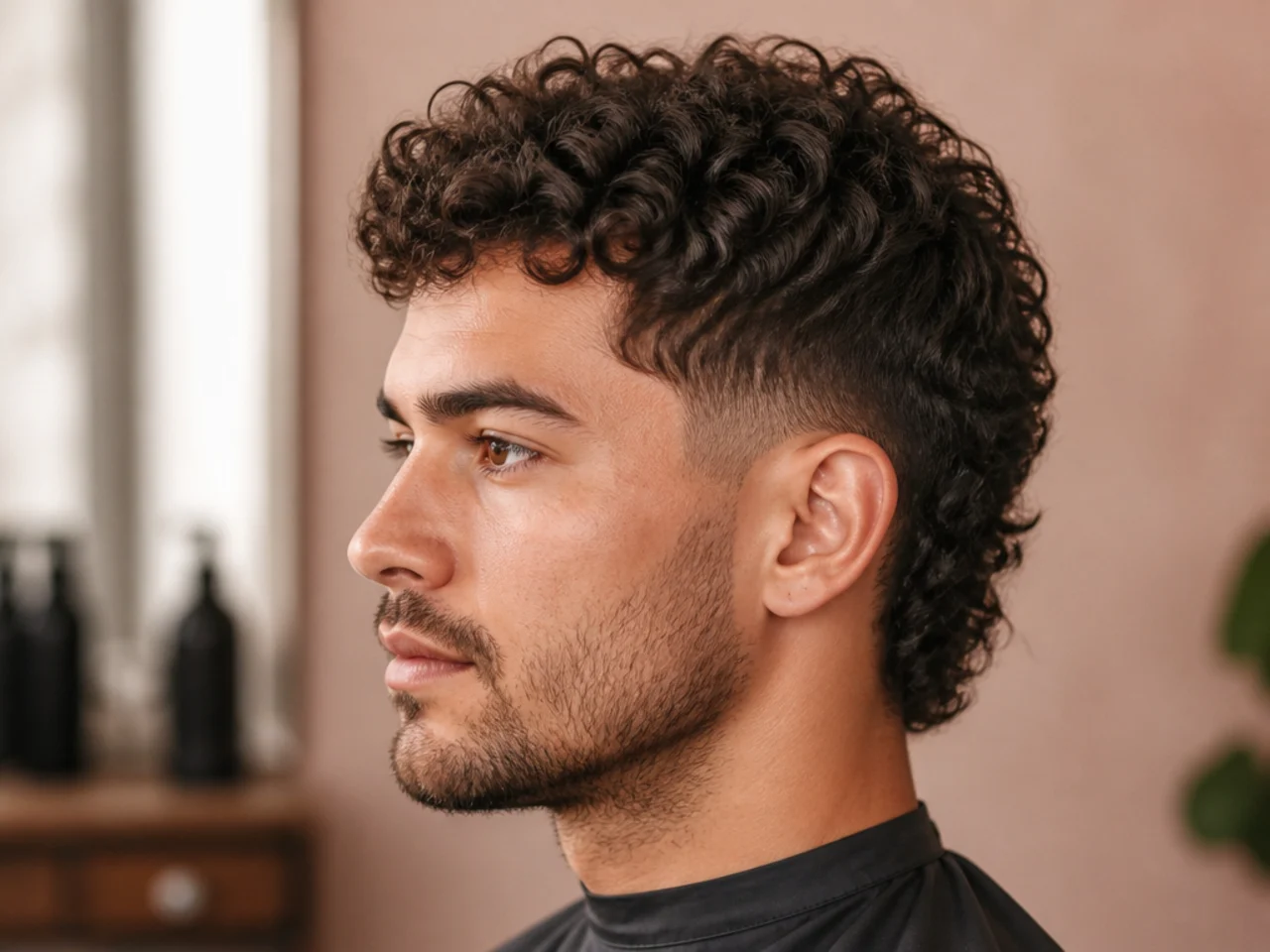
Curly hair on the top and sides builds volume you do not need. Bulk stacks at the temples. The crown puffs sideways instead of up. The whole head silhouette turns wide before it turns tall. Product controls some of it. Cut controls all of it.
The mullet solves the volume problem structurally. Short sides — whether scissor-blended, tapered, or faded — remove the temple bulk that pushes a curly silhouette wide. A shorter top keeps the crown from mushrooming. And the length that would have gone sideways gets redirected to the one place gravity actually flatters it: the back, where it hangs down instead of out.
Every curly guy who has ever tried to grow the top out and given up at week five knows why this matters. The volume that reads great at three inches turns into a triangle at six. The mullet lets you keep the length appetite satisfied without paying the volume tax up top. The short mullet haircut men breakdown zooms in on the tightest end of this range — one inch on top, two sprung inches at the back, sides at a guard 2 — which is the version that erases the volume problem completely.
What to keep in mind about the sides: a low taper or blend keeps the whole thing office-friendly. A low taper fade mullet sharpens the perimeter without pulling focus from the drop. A burst fade curves around the ear and leaves the coil back completely untouched — one of the strongest side treatments for this cut because the fade never crosses the length line.
Reason 4: Every Curl Type From 3A to 4C Can Wear It
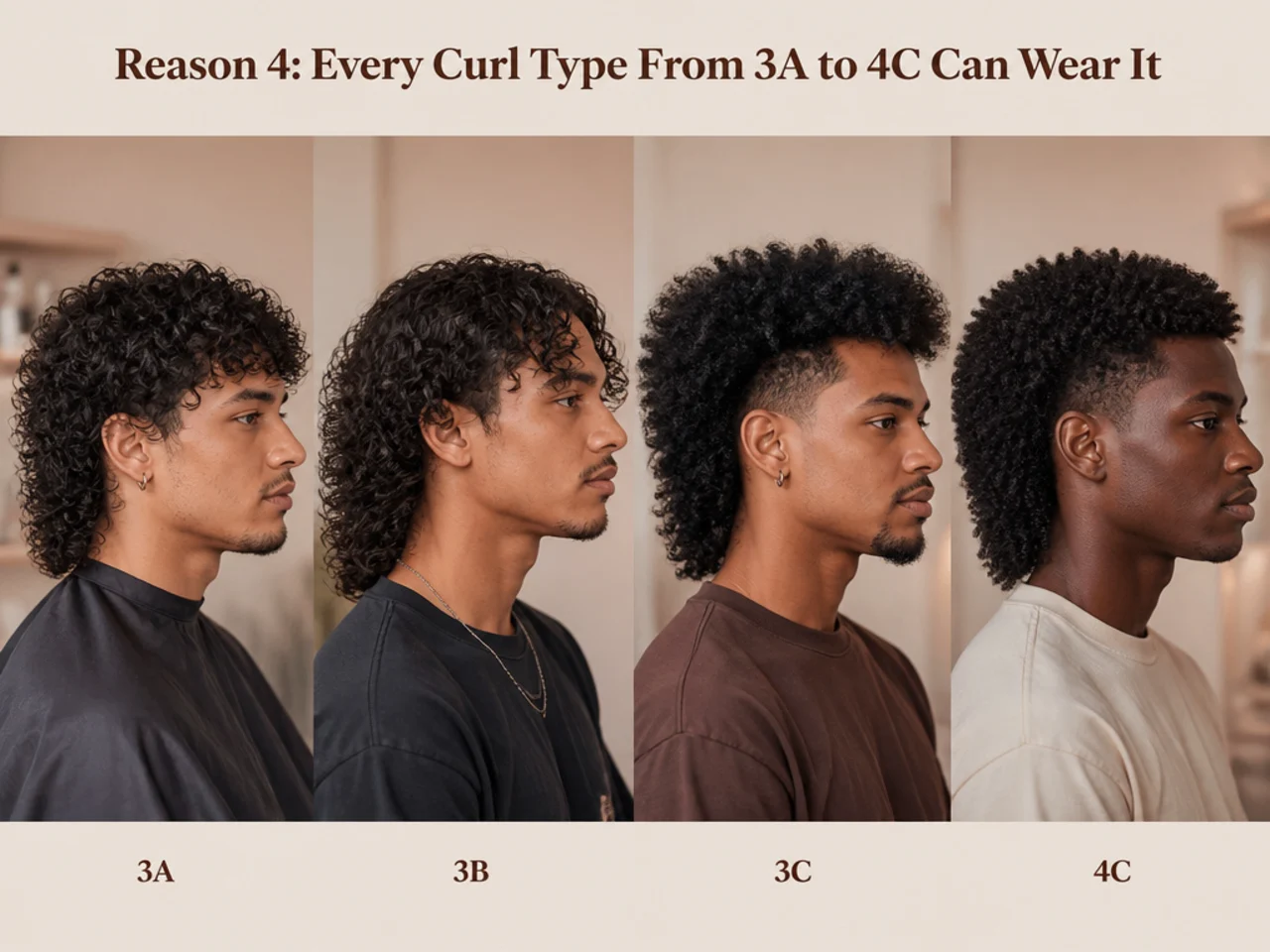
The mullet is one of the few silhouettes that translates cleanly across the whole type-3 and type-4 spectrum. The proportion stays constant — short top and sides, longer back that hangs past the collar. What changes is the execution.
Loose 3A waves need the longest back of any pattern. The S-shape needs three or four sprung inches past the collar so gravity carries the wave visibly instead of collapsing it into straightness. Top length can push to three inches without triggering the volume problem — the wave is looser than the coil, so it packs less mass.
Springy 3B corkscrews are the reference-photo pattern. Every pinterest photo you have saved is probably 3B. Two dry inches through the top, three sprung inches of coil-defined back, soft blending at the crown. The pattern carries the mullet drop without adjustment.
Tight 3C spirals stack denser. Aggressive internal thinning becomes non-negotiable through both top and back, or the shape reads as a fluffy block. Same top length as 3B, but interior weight removal is heavy.
Coily 4A through 4C patterns all wear the mullet, but the technique changes. Dry-cut with coils fully sprung and fully hydrated. Length gets specified in sprung inches — the coil pattern shrinks up to 75% at 4C, so a back that reads three inches sprung might be nine inches stretched. Layer for shrinkage, not for cutting motion. See the curl types guide if you do not know your number, and the curly hair haircuts hub for full pattern-first vocabulary.
Reason 5: Grow-Out Is Stealth Mode
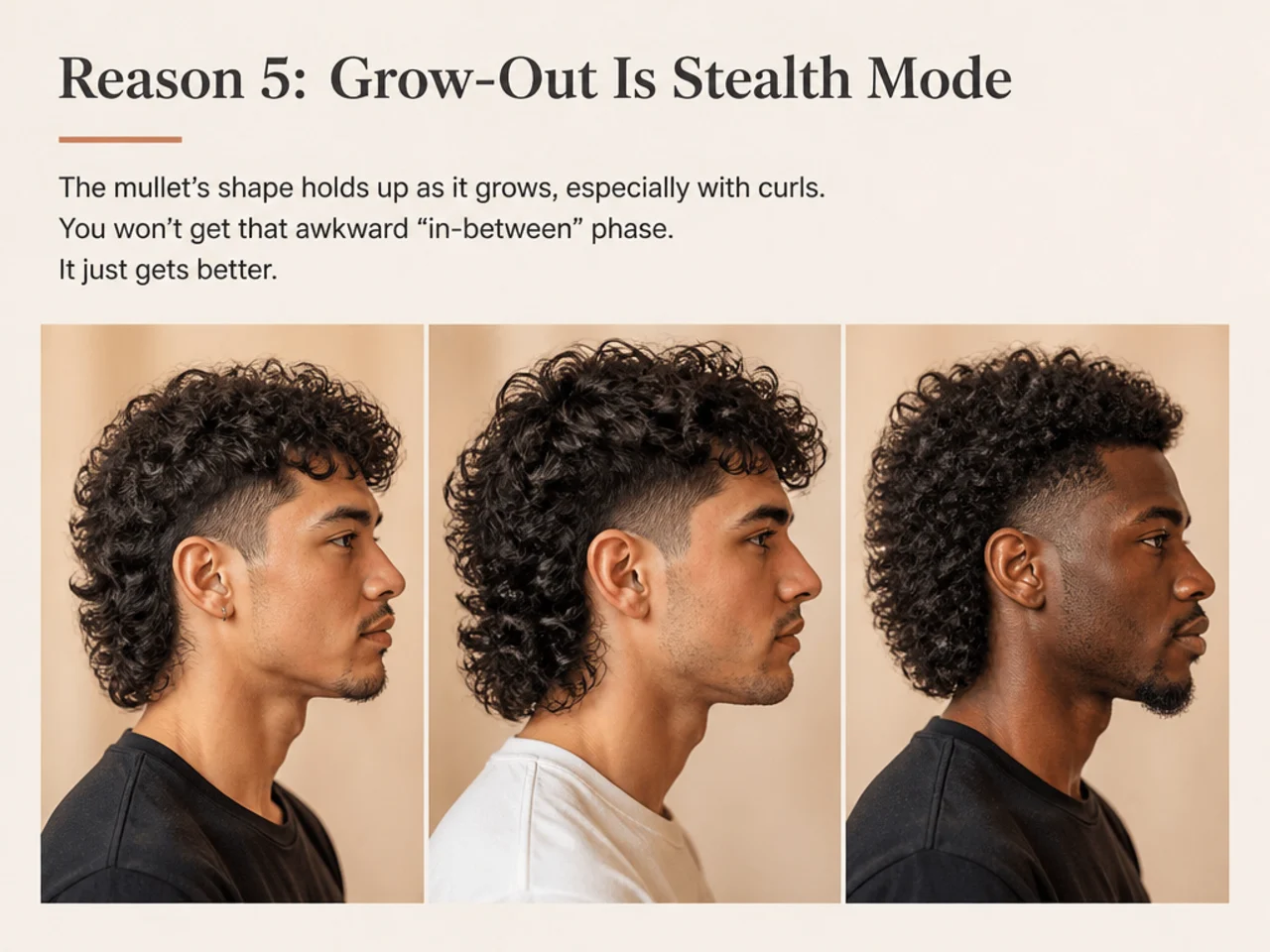
Grow-out is where the mullet earns its money on curly hair. Every other haircut has a collapse window — straight-hair mullets look sharp for two weeks, blurry by four, shaggy by six. Fade and taper sides on any hair type need a re-cut every three weeks or the transition line dissolves.
Curls break the whole math. The pattern hides an extra inch of growth completely — the coil rolls the new length into the existing shape, so grow-out reads as more definition rather than as more hair. The top and back grow at the same rate, so the top-to-back differential holds. And because the mullet is not a fade-dependent silhouette, the crown and back can stretch to eight, ten, sometimes twelve weeks between full re-cuts.
Fade or taper sides do still need a refresh every three to four weeks — that part is unavoidable. But the sides are a five-minute walk-in, and the top and back keep looking intentional between full appointments. On a monthly cost basis, a curly mullet runs about half what a straight-hair equivalent costs, because you are only touching the top and back every second or third visit.
The one caveat is split ends. Split curls unravel a pattern faster than a lost inch of length ever would. Ask your stylist to dust wispy tips at every appointment — even the fade-only visits. Five minutes of dusting preserves the whole pattern for another cycle. For a length-cadence breakdown across the mullet family, our parent mullet haircut for men survey covers grow-out strategy by variation.
Mullet on Curly Hair: Side by Side Across Curl Types
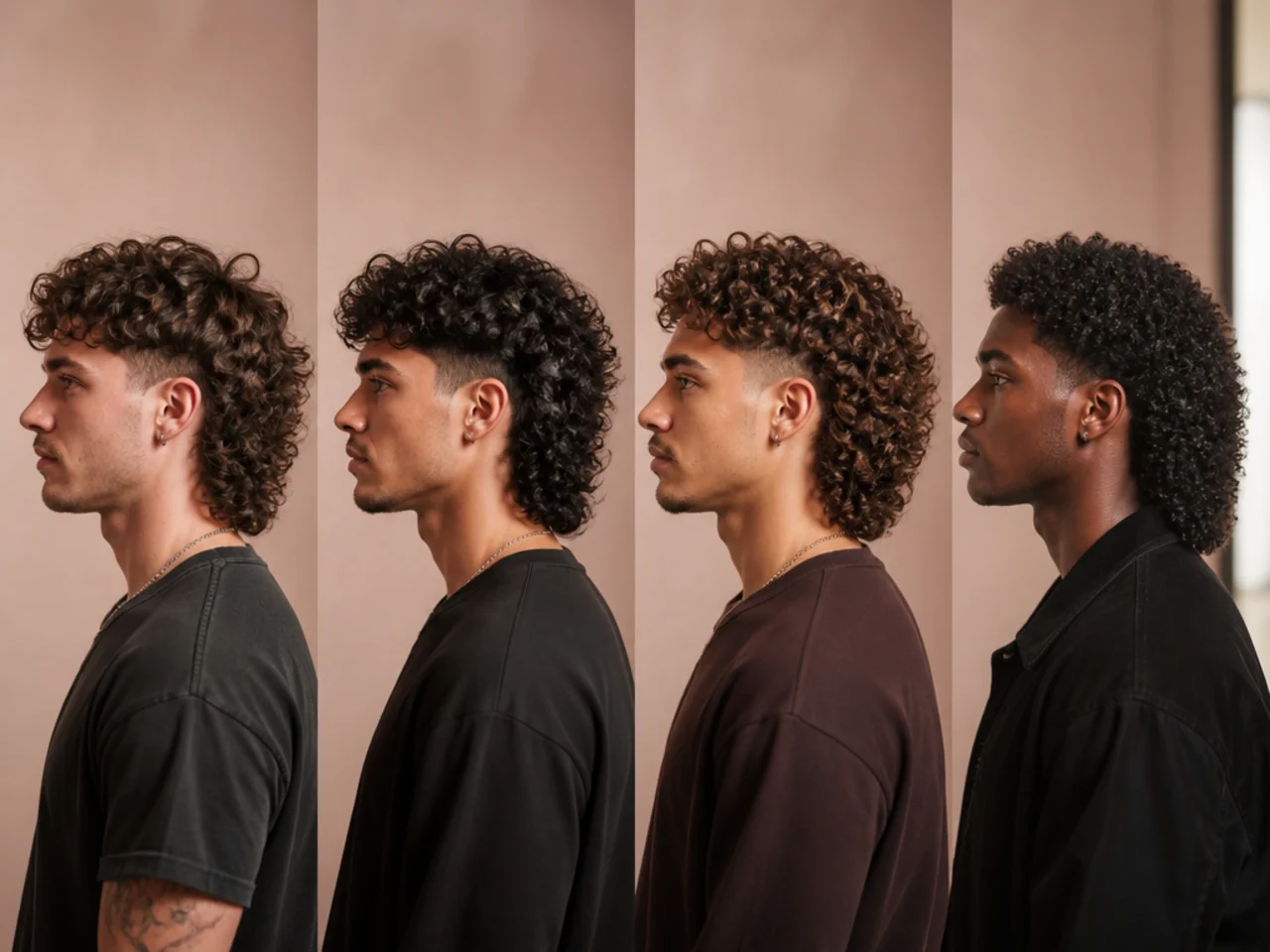
Same cut, different execution. Here is what actually changes between one curl pattern and the next, laid out in a single view.
Two things worth pulling out of the table. First, the re-cut cadence gets longer as the curl gets tighter — 4C coils hide grow-out for longer than any other pattern on the head. Second, the styling time stays under five minutes across the whole spectrum. Neither number is true for the same silhouette on straight hair, where the cadence is fixed at four weeks and the styling routine runs eight to twelve minutes daily just to fake volume.
Which Version of the Curly Mullet Should You Ask For?
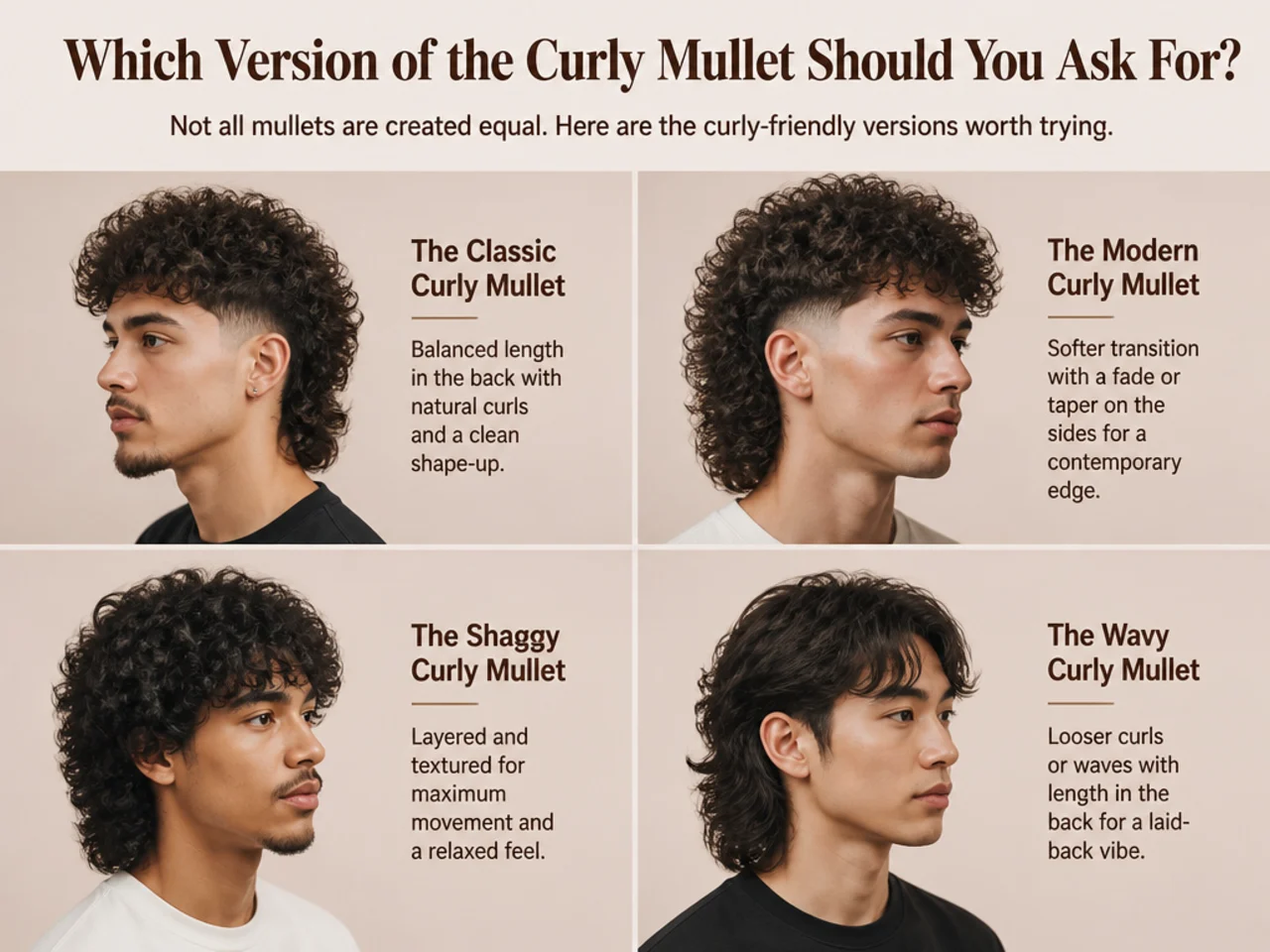
Pick your version by matching three variables: curl type, workplace, and length appetite. The chart above sets the technical baseline; the questions below narrow the visual.
Ask for the classic curly mullet if you want the baseline — two dry inches through the top with soft internal layers, blended sides, back hanging three sprung inches past the crown to brush the collar. Reads modern in every setting. Best on 3B and 3C.
Ask for the short curly mullet if you want the office-safe version. One inch on top, two sprung inches at the back grazing the collar, guard-2 blended sides. The mullet identity stays present but subtle. The short mullet haircut men breakdown covers the tightest length range.
Ask for the curly mullet with low taper fade if you want cleanness without losing the drop. The low taper fade mullet starts above the ear and dies into the sideburn — reads clean in any office and keeps the coil back completely intact.
Ask for the curly mullet with burst fade if you want editorial energy. The arc curves around each ear and leaves the nape untouched, so the coil drop flows out of the fade rather than getting clipped. Best on 3C through 4B where the crown builds height and the back builds mass.
Ask for the long curly mullet if you want a statement. Three inches on top with soft internal layers, five to six sprung inches at the back reaching mid-back, blended sides with no fade. Best on 3A, 3B, or 3C with moderate density; too much density plus this length equals volume overload.
Ask for the curly mullet with two-block or disconnected undercut only for creative-industry environments. Both read loud — dramatic, statement, and unmistakably not corporate. If you want back concentration plus layered crown movement, the wolf-cut-hybrid version pairs the two silhouettes into one cut.
How to Ask Your Stylist for a Curly Mullet
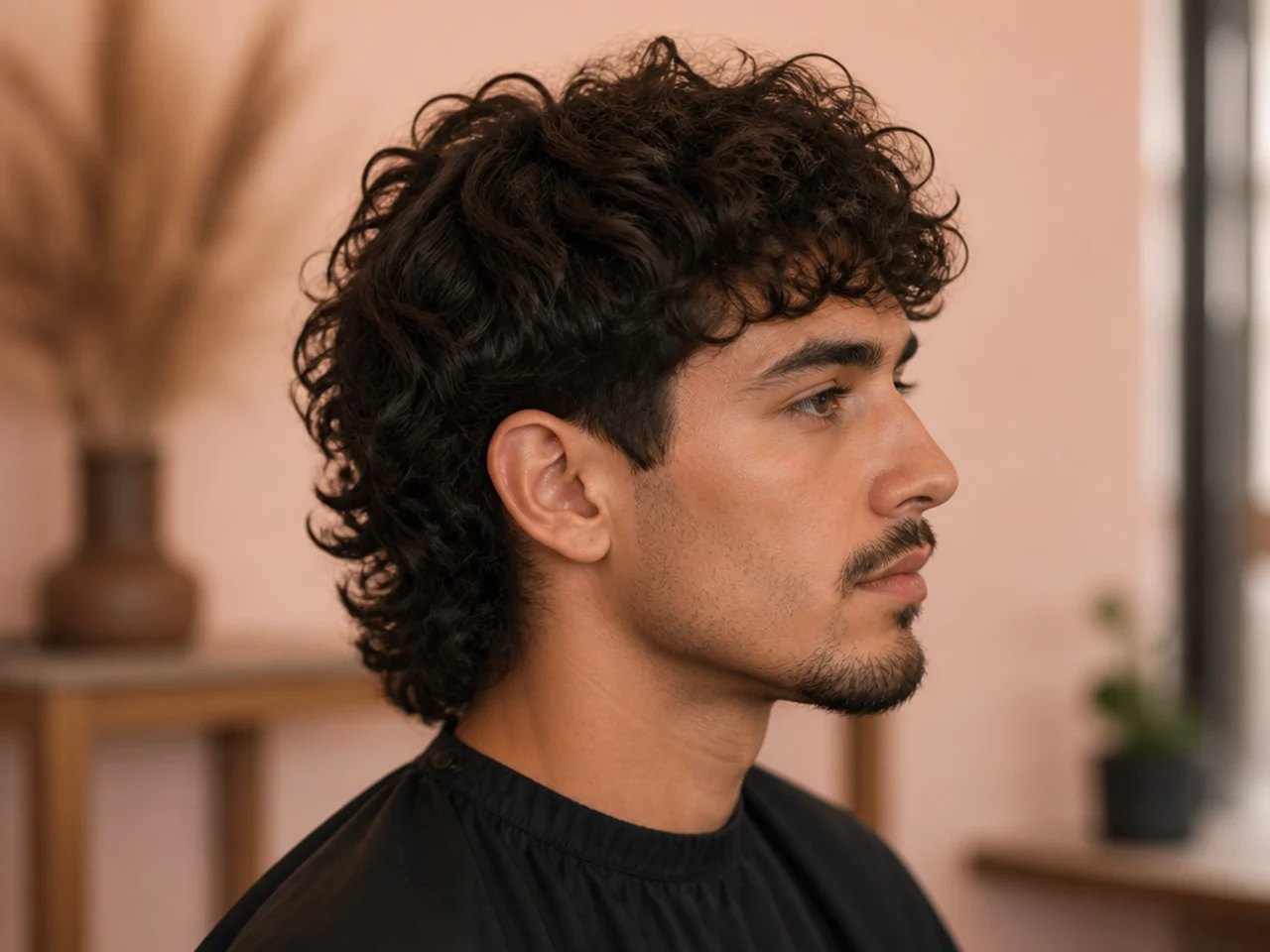
The chair conversation matters more with curls than with any other hair type. A straight-hair mullet can be lengthened or shortened after the fact — a curl cut cuts what you keep. Bring a photo of your hair worn loose and fully hydrated so your true pattern is visible before scissors touch anything.
- Say "curly mullet" and specify your curl type by number. 3A, 3B, 3C, 4A, 4B, or 4C. If you do not know, ask your stylist to look and tell you first. The technique changes at every step.
- Request a dry cut. Wet-cutting stretches curls, so the finished back length snaps back one to three inches shorter than the reference photo the second the hair dries. Dry-cutting shows the true finished shape.
- Set the top length in dry or sprung inches. One inch for a short compressed mullet, two inches for baseline, three inches for a modern soft version.
- Set the back length in sprung inches. Sprung means the length once the curl contracts — not stretched. Two inches for a subtle drop, three to four for a defined mullet, five or more for a long or dramatic version.
- Set the transition. Blended (soft handoff between top and back), hard (disconnected undercut), or hidden (two-block). The transition is what makes the mullet read as a defined shape rather than a length choice.
- Set the side treatment. Scissor-blended, low taper, mid taper, burst fade, mid fade, skin fade, disconnected undercut, or two-block. Match the loudness to how much attention you want the whole cut pulling.
- Ask for internal layers cut for weight removal, not surface layers for texture. Curls already have texture. What they need is weight removed from the interior so the top lifts and the back hangs as defined pieces rather than a fluffy block. This one line separates a good curly mullet from a puffy back-heavy disaster.
Once those seven answers are in the chair, your stylist can start cutting without a single guess. Show the photo one more time and confirm the sprung back length before the first scissor pass.
Styling and Maintenance
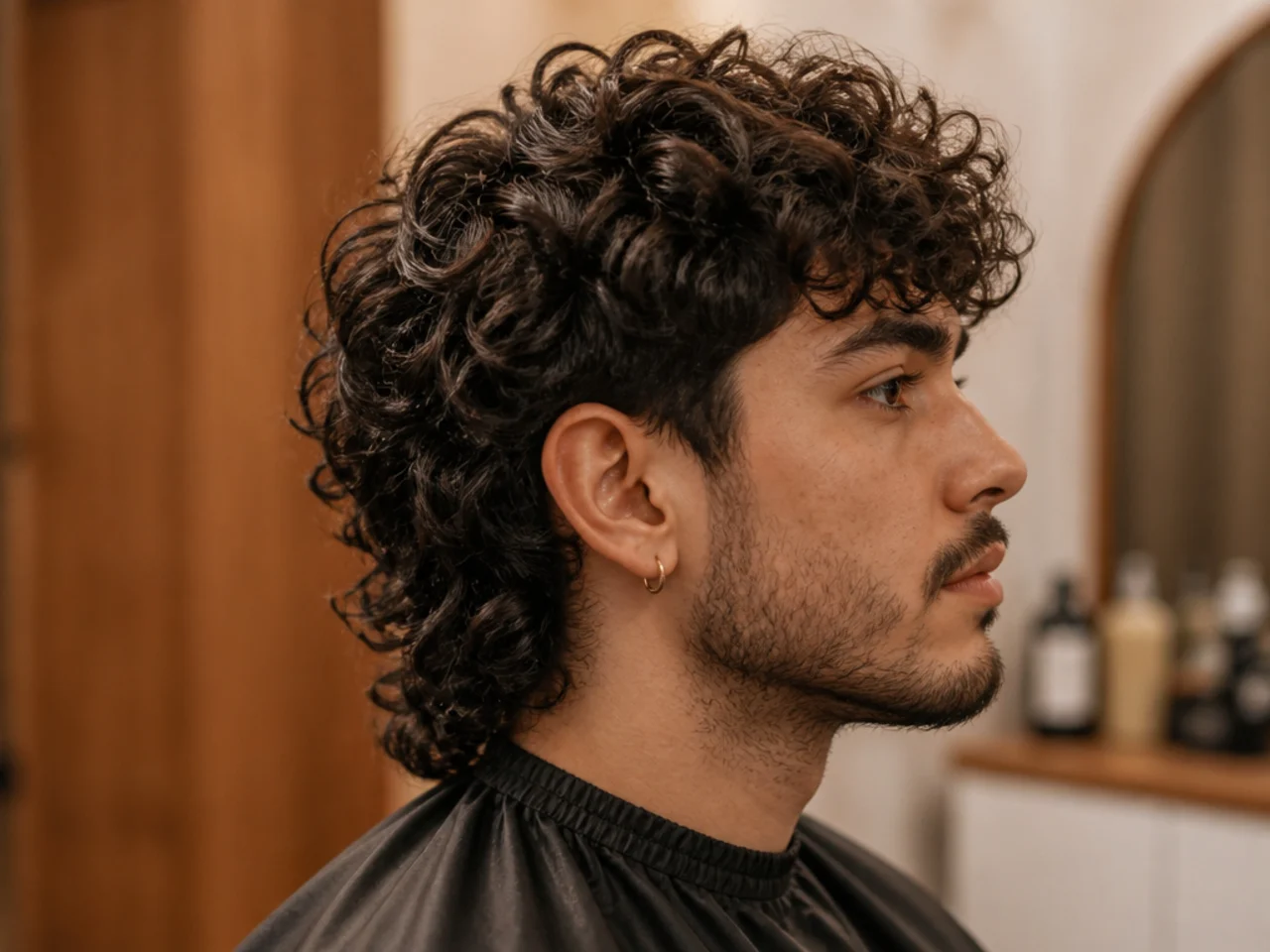
Curls need moisture more than any other hair type. Get the routine right and the mullet silhouette holds for days between wash cycles. Skip the essentials and the pattern flattens by lunch on day one.
Wash with a sulfate-free shampoo two to three times a week — sulfates strip the natural oils curls rely on for pattern hold. Follow with a rich conditioner every wash, and once a week swap in a deep conditioner or a hair mask to keep the back length hydrated. The nape is the oldest hair on the head and dries out first, so the back mass needs more moisture attention than the top.
Apply product to soaking-wet hair, not damp. Start with a leave-in conditioner, then a curl cream for definition, then a curl gel for hold when you want it. Scrunch each product upward toward the scalp on the top and downward through the back — never comb through, because combing snaps the pattern. For 4A through 4C coils, use the shingling method — smoothing product through section by section — instead of scrunching.
Diffuse or air-dry. A diffuser on low heat and low speed for 60 to 90 seconds sets the crown and shortens drying time. Air-drying takes 30 to 60 minutes but preserves the truest pattern. Whichever you pick, do not touch the hair while it dries — every touch breaks a curl and creates frizz, especially in the back where the length is most vulnerable.
Sleep on a satin or silk pillowcase, or wrap the hair in a satin bonnet. Cotton absorbs moisture and creates friction, which flattens the pattern by morning. Pineapple the longer back — a loose high ponytail at the crown — so the back coils do not crush against the pillow overnight.
Re-cut the top and back every six to ten weeks. Fade or taper sides need a refresh every three to four weeks; between visits, ask your stylist to dust wispy split ends at every appointment. The curly hair men haircut guide surveys the full length-and-cut range if you want to see the mullet next to its cousins across the curly-men spectrum.
FAQ
Does a mullet actually work on curly hair?
Yes — curls are the reason the modern mullet stopped looking dated. The pattern softens the hard top-to-back transition of the eighties original, so the length differential reads intentional rather than throwback. Every pattern from 3A waves to 4C coils wears the shape through a different execution of the same silhouette.
Which curl type suits a mullet best?
3B and 3C carry the mullet drop cleanest because the corkscrew pattern holds back length without collapsing into one flat curtain. 3A needs slightly longer back so the S-wave still reads by the collar. 4A, 4B, and 4C need aggressive internal thinning so the back reads defined rather than as a fluffy block. See the curl types guide if you need help placing your pattern.
How is a curly mullet different from a curly wolf cut?
The mullet concentrates length at the back — short top, longer nape. The wolf cut spreads layered length across the whole crown with face-framing pieces at the cheekbone and a feathered perimeter. On curls, the mullet reads bolder from the profile; the wolf reads softer from the front. Our 5 reasons the wolf cut works for curly hair breakdown covers the sister silhouette in the same depth.
Should curly hair be cut wet or dry for a mullet?
Dry — always. Wet-cutting stretches curls, so the finished back length shrinks one to three inches shorter than the reference photo the second the hair dries. Dry-cutting shows the true sprung length at every step and preserves the top-to-back differential the mullet lives on. If your stylist insists on wet-cutting curls, find one who specializes in curl work.
How often do I need to trim a curly mullet?
Every six to ten weeks for the layered top and back — curls hide grow-out longer than any other hair type. Fade or taper sides need a refresh every three to four weeks. Ask your stylist to dust wispy split ends at every visit, even the fade-only appointments; split curls unravel the pattern faster than a lost inch of length.
Is a curly mullet workplace-appropriate?
The short, blended, and low-taper versions read clean in most offices. A short curly mullet with the back just brushing the collar is the safest workplace choice. Skip the disconnected undercut, skin fade, rat tail, and any back length past the shoulder blade in traditional corporate settings. Creative offices can wear any variation on the list, and the parent 20 curly hair mullet haircuts for men breakdown covers workplace-tier notes for each one.