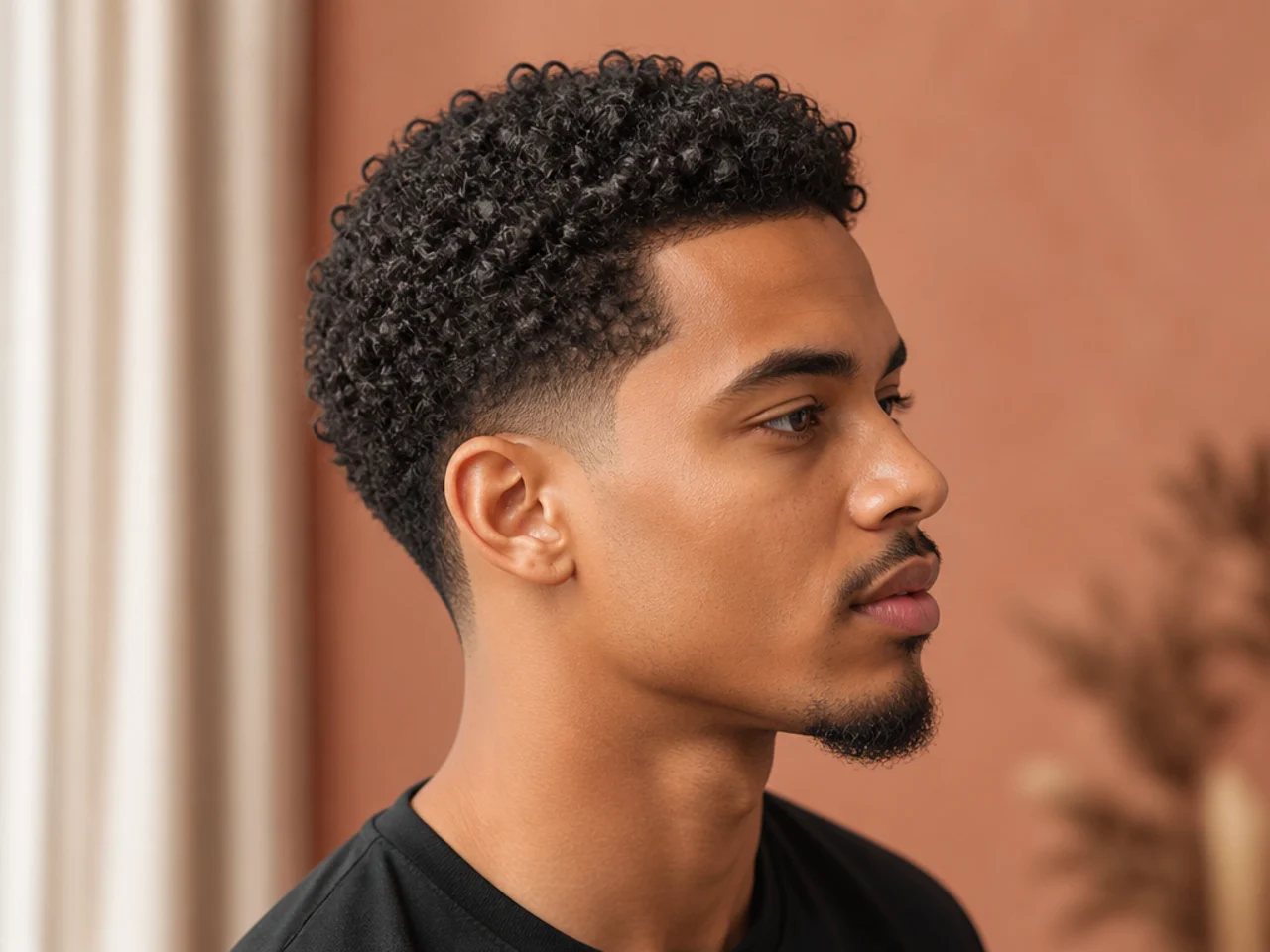
20 Curly Haircuts for Black Men
Twenty curly haircuts Black men are asking for in 2026 — twist-outs, sponge coils, frohawks, and curly mullets across 3B through 4C patterns, with guard numbers and the exact ask for your barber.
In this article · 26
- What Counts as a Curly Haircut for Black Men?
- How to Choose Your Curly Cut
- The 20 Curly Variations
- 1. Short 3C Wash-and-Go with Low Taper
- 2. Classic High Top with Straight Sides
- 3. Mini Afro with High Skin Fade
- 4. Frohawk with Burst Fade
- 5. Curly Twist-Out with Mid Skin Fade
- 6. 4B Sponge Coils with Low Skin Fade
- 7. Two-Strand Twists Worn In with Drop Fade
- 8. Big Curly Blowout with Mid Skin Fade
- 9. Cornrows Front with Curly Back and High Fade
- 10. Wet-Look Curl Definition with Low Skin Fade
- 11. Curly Fringe over Drop Fade
- 12. Loose 3B Ringlets with Low Skin Fade
- 13. Coily Caesar with Mid Fade
- 14. Razor-Design Curly Top with Skin Fade
- 15. Curly Mullet with Low Fade
- 16. Sponge Coil Mohawk with Burst Fade
- 17. Mid-Length Curls with Undercut
- 18. Curly Comma Fringe with Drop Fade
- 19. Bantu Knots on Curly Top with Skin Fade
- 20. Bleached Tips Curls with High Fade
- How to Ask Your Barber for a Curly Cut
- Styling and Maintenance for Curly Black Hair
- FAQ
Curly Black hair rewards a barber who respects the pattern. Scissor work on top, no thinning shears, no razor through the curl. The right fade, taper, or clean edge on the sides frames whatever your natural texture is doing. Below are twenty curly haircuts for Black men worth asking for in 2026 — 3B ringlets through 4C coils, short defined tops through full frohawks — with guard numbers, face-shape notes, and the exact wording to hand your barber.
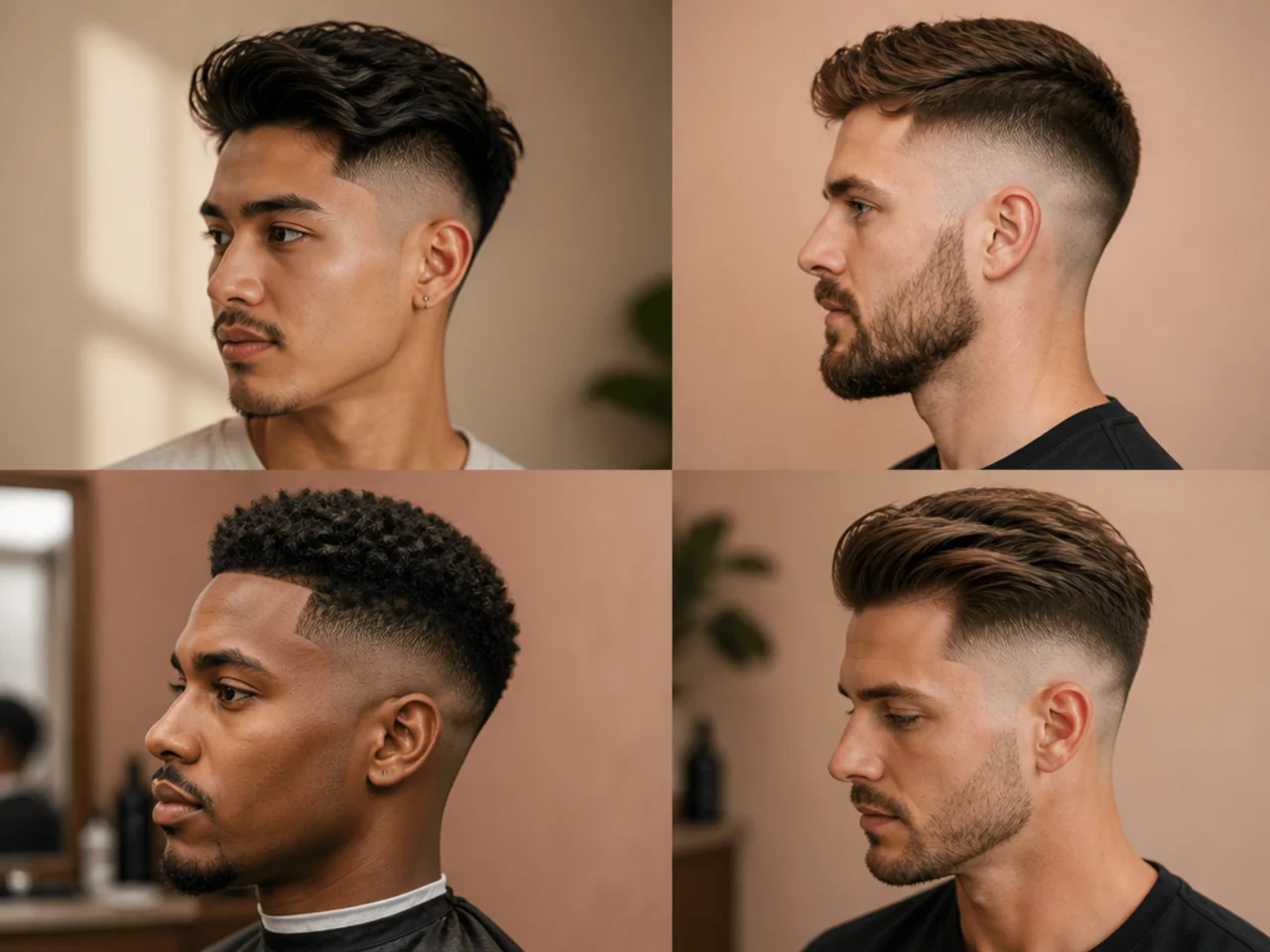
New to the family? The wider fade haircuts for Black men roundup covers every fade height, and the curl types breakdown helps you pin down where your texture actually sits.
What Counts as a Curly Haircut for Black Men?
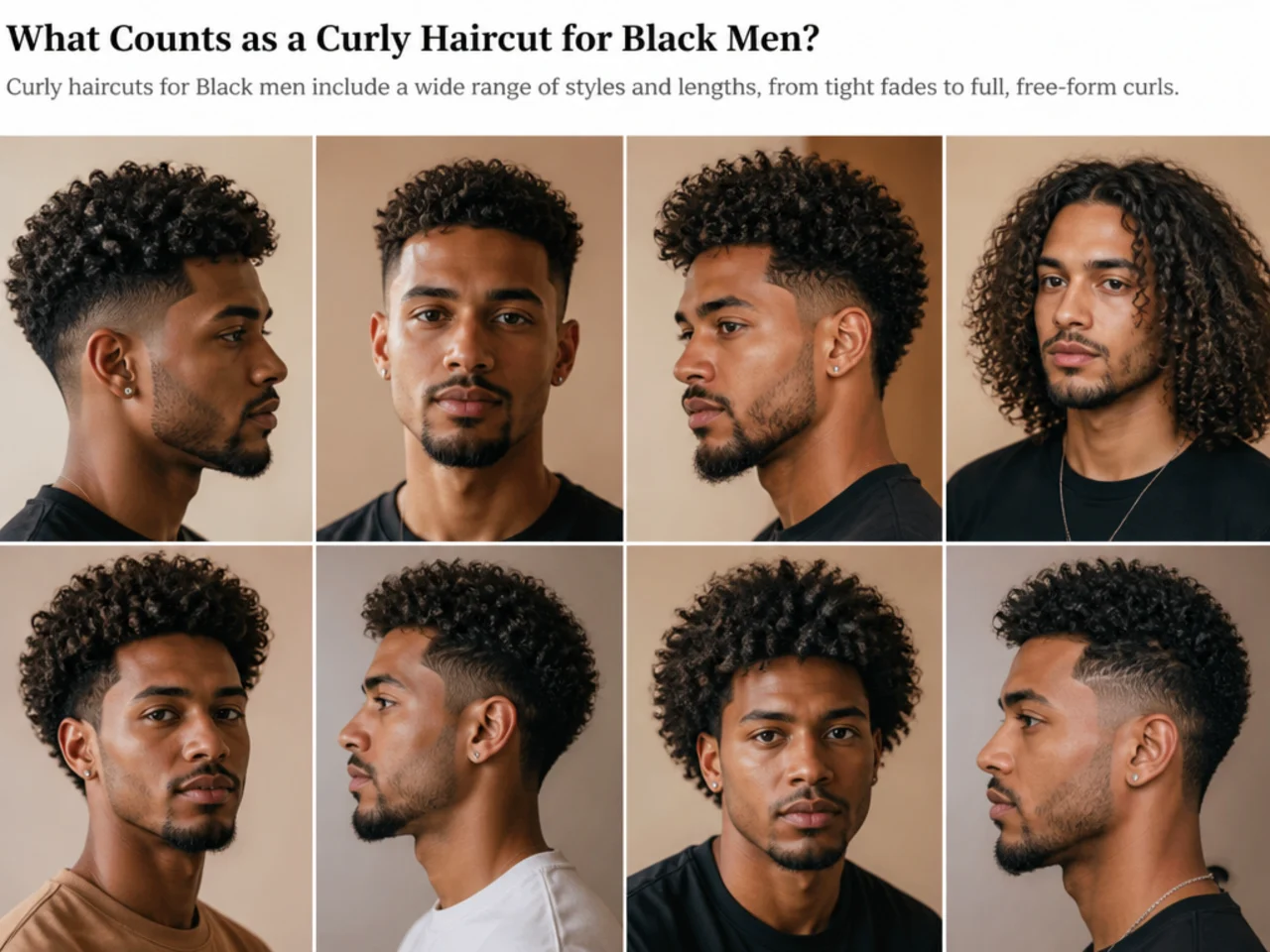
Any cut that keeps your natural curl pattern intact on top, without straightening, thinning, or razor-chopping through the coil. On Black hair that spans a wide range — loose 3B ringlets, defined 3C spirals, tight 4A S-coils, dense 4B zigzags, and compact 4C coils that shrink to half their stretched length. Each pattern behaves differently in the chair, and the right cut is the one that reads clean when your hair is dry and defined, not stretched out with a comb.
The perimeter is where most of the styling decision lives. A fade runs the sides to bare skin at the shortest point. A taper stops at a #0.5 or #1 for a softer edge. A boxy classic finish like the high top skips the fade entirely and keeps the sides at a fixed length. All three work with curly Black hair — the choice is about how much contrast you want between the top texture and the sides.
Every cut below preserves the natural pattern. Length varies from a half-inch coily caesar up to five inches of curly frohawk, and the sides span low tapers, mid skin fades, high fades, burst fades, drop fades, and classic no-fade edges. Pick the one that fits your curl type, your face shape, and how often you'll actually make it to the chair.
How to Choose Your Curly Cut
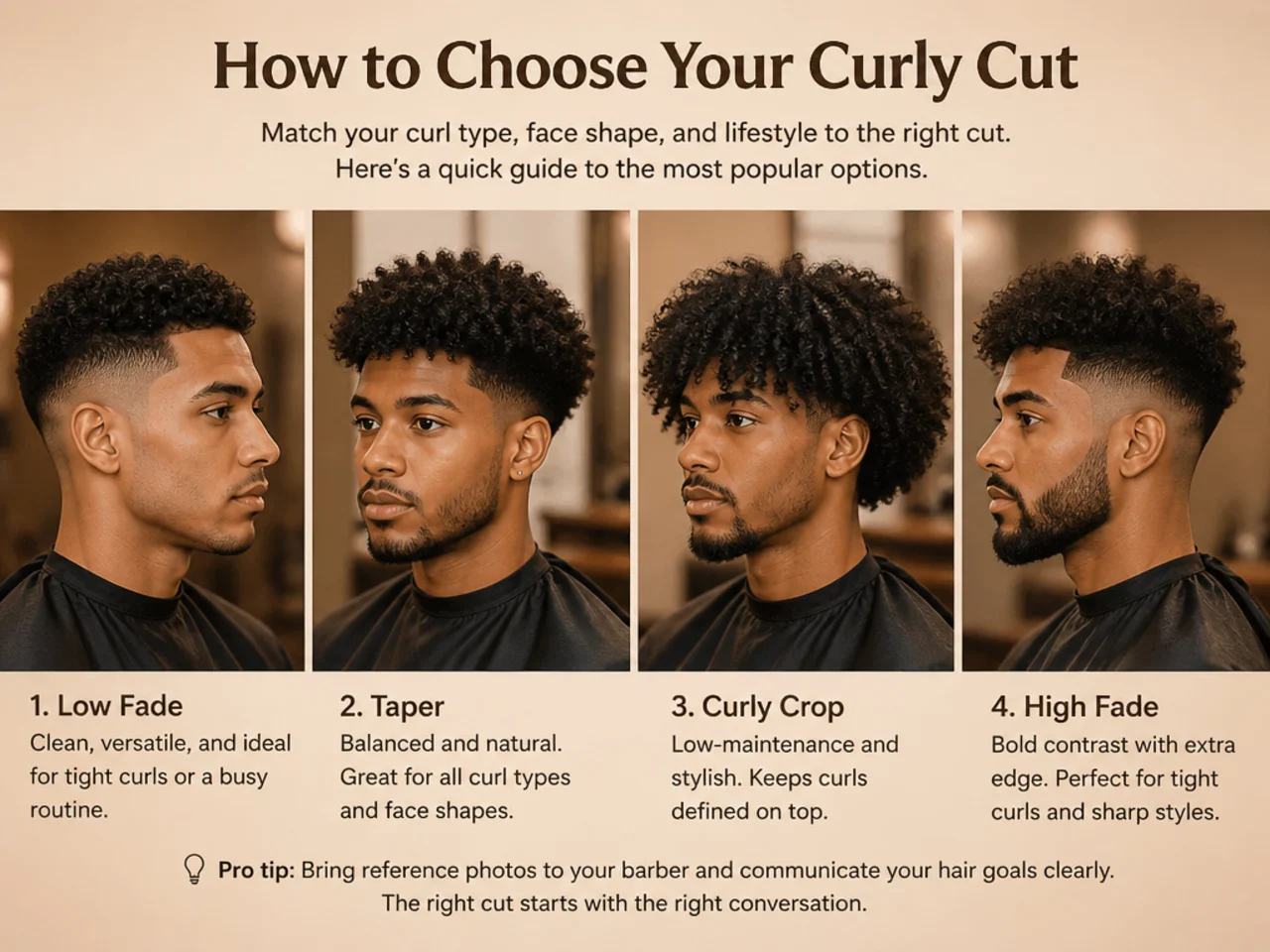
Four variables narrow the field: curl pattern, face shape, top length, and how much daily maintenance you'll actually do.
Curl pattern. 3B carries loose corkscrew ringlets that hold air-dry definition with a light cream. 3C holds tighter springy curls that photograph beautifully at two inches. 4A has a defined S-coil pattern that reads full at two to three inches. 4B carries tight zigzag coils that hold shape even at short lengths. 4C is the densest — compact coils with heavy shrinkage that suit sculpted shapes like sponge coils, mini afros, and high tops.
Face shape. Oval takes almost every combination. Round wants vertical volume on top with a low or mid perimeter to elongate the face. Long wants the opposite — keep the top shorter, go mid or high on the sides. Square jaws pair well with softer rounded curl shapes on top. Heart-shaped faces suit forward-styled fringes and mid-tapered sides. Diamond faces read balanced under mid to high fades with medium top length.
Top length. Half an inch to an inch reads as a coily buzz or caesar. One to two inches sits as a defined curly cap — the everyday starting point for most Black men. Two to three inches is the sweet spot for twist-outs, wash-and-gos, and defined coils. Three to five inches moves you into mini-afro, frohawk, or full curly-top territory. Beyond five and you're in afro taper fade or high-top range.
Maintenance appetite. Wash-and-gos with a curl cream are the low-effort route. Twist-outs, sponge coils, and blowouts need a nightly ritual, a satin bonnet, and a refresh in the morning. Braided fronts with loose curly backs buy you two weeks between refreshes but need a stylist to install. Pick the version you'll actually keep up.
The 20 Curly Variations
Twenty curly Black men cuts, sorted from cleanest starter to boldest statement. Each block covers the curl type it flatters, the perimeter to match, the ask for your barber, and one styling move worth stealing.
1. Short 3C Wash-and-Go with Low Taper
The everyday starter — one and a half inches of 3C curl on top, defined with nothing more than a curl cream and left to air-dry, low taper fade at the sides dropping softly to a #1 above the ear. Reads clean at any workplace and takes ninety seconds to style. Best on oval, square, and heart faces, and on any guy new to defined curly cuts.
Ask for: "low taper fade, #1 at the shortest, one and a half inches of curls on top scissor-cut, no thinning shears, soft blend at the transition."
Styling: curl cream on soaking-wet hair, scrunch upward with your palm, air-dry hands-off. A satin bonnet at night keeps the pattern from flattening on the pillow.
2. Classic High Top with Straight Sides
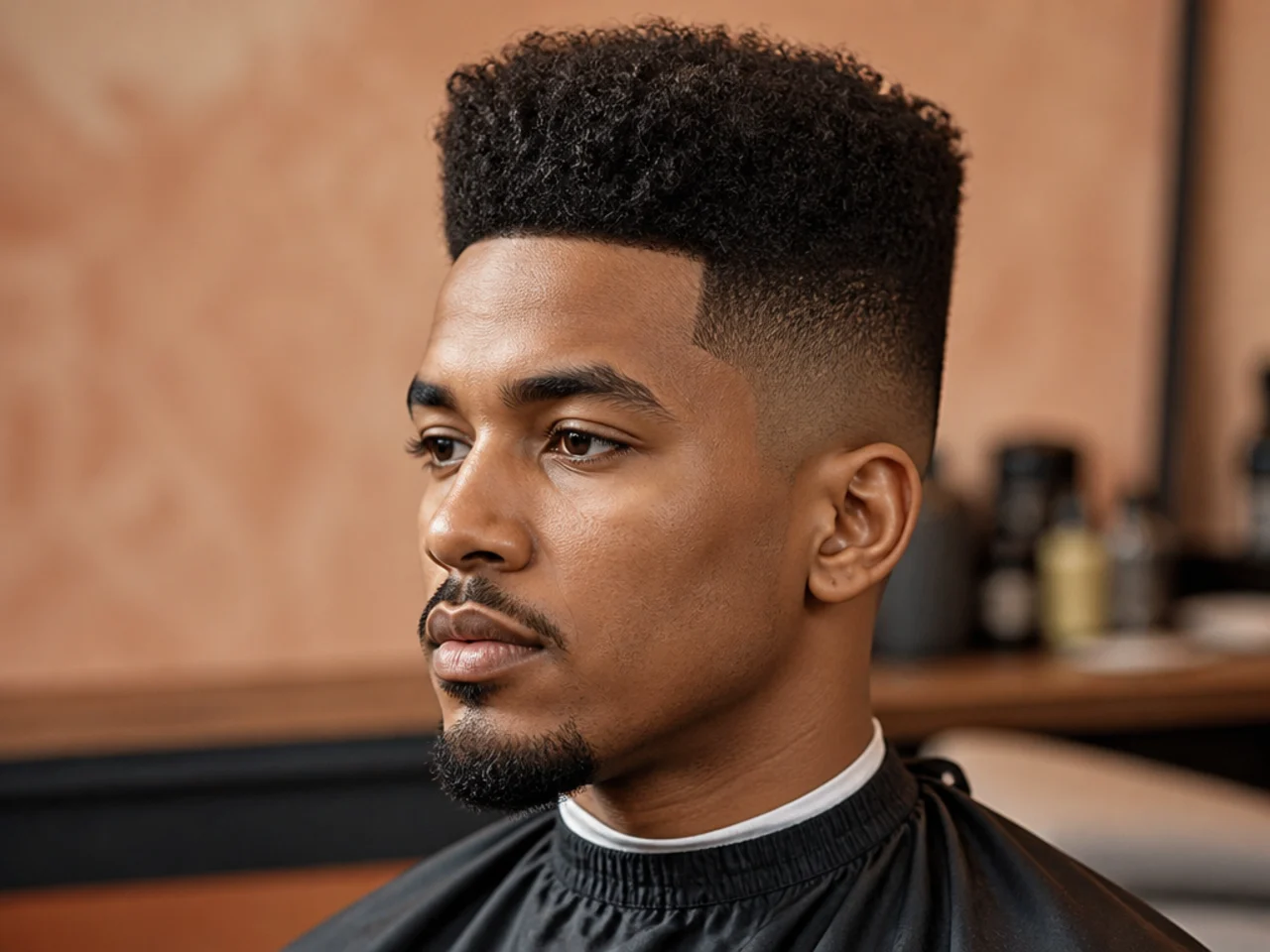
Heritage cut — three inches of 4A coil on top shaped flat across the crown, sides taken to a #1 or #2 straight all the way around with no fade. Kid 'n Play, the Fab 5, Fresh Prince. Reads modern again in 2026 because the shape is deliberate and the perimeter is fixed. Best on oval and long faces where the crown height sits balanced, and on 4A or 4B density that holds the flat shape.
Ask for: "high top, three inches on top cut flat across the crown with clippers, #1 or #2 straight around the sides — no fade, no taper."
Styling: pat the crown into shape with a boar-bristle brush and a leave-in every night. Sleep in a du-rag or satin bonnet so the flat shape doesn't lean by morning.
3. Mini Afro with High Skin Fade
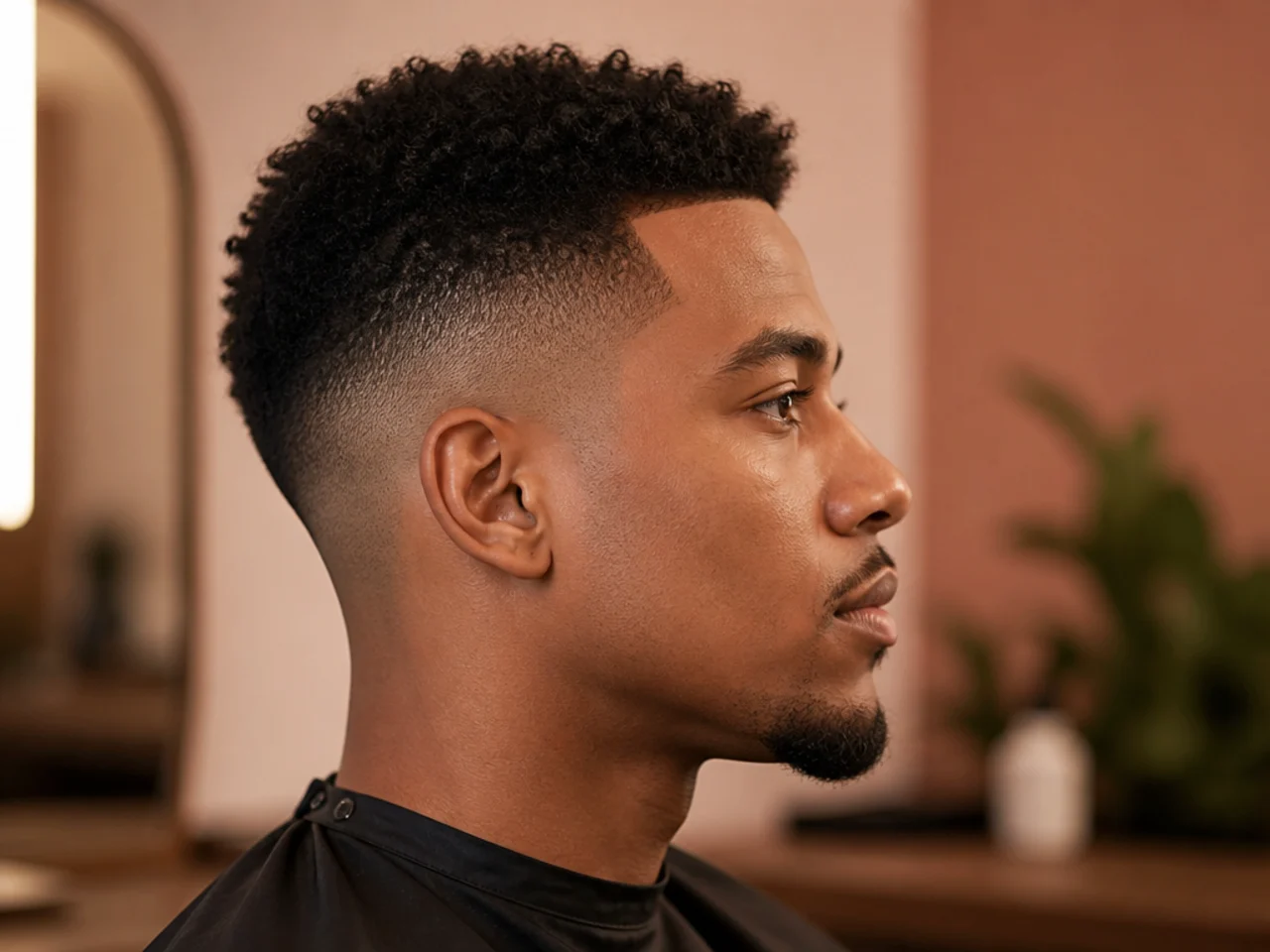
Two inches of picked-out 4B or 4C coil on top in a rounded mini-afro shape, high skin fade starting above the parietal and dropping to a bald #0 at the bottom. The high fade throws every bit of visual weight upward, so the compact afro reads as the whole silhouette. Best on oval and long faces, and on 4B and 4C density that holds the round shape.
Ask for: "high skin fade, bald at the bottom, two inches of natural texture on top scissor-cut into a rounded afro, sharp line-up at the forehead."
Styling: leave-in on damp hair, pick out with a wide-tooth pick to lift and round the shape, moisturize daily with a light oil. Satin bonnet overnight so the round shape holds.
4. Frohawk with Burst Fade
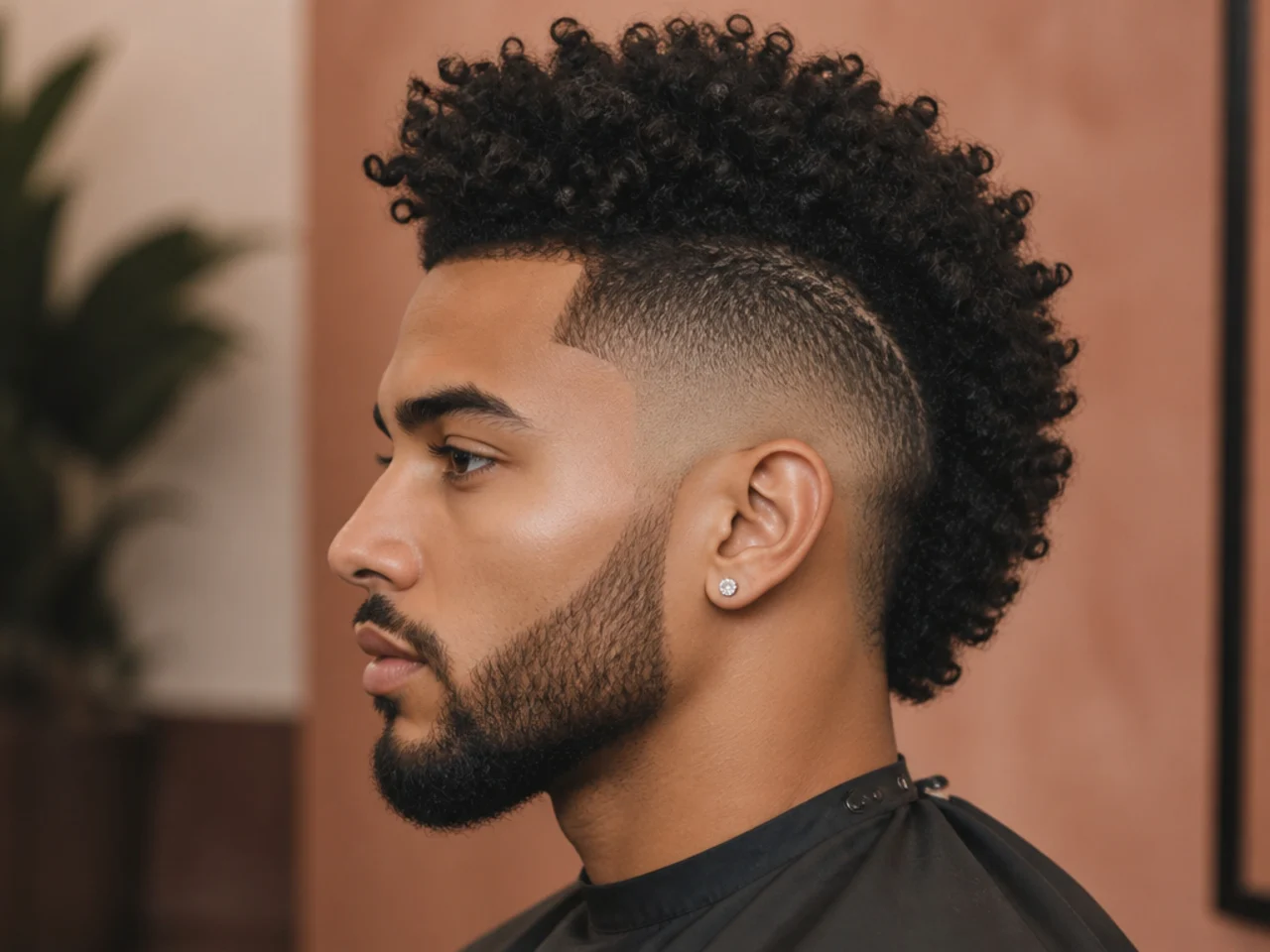
The bold one — four inches of 4A or 4B curl on top narrowed from full at the crown down to shorter at the temples for a mohawk silhouette, burst fade curving in a semicircle around each ear so the back of the neck stays longer. Reads statement without shaving the sides. Best on oval and long faces where the height sits balanced.
Ask for: "burst fade to skin around each ear, #0 at the shortest, four inches of curls on top narrowed at the temples for a frohawk shape, natural finish."
Styling: curl cream on damp hair, pick the center upward, keep the temple curls flat with your palm. A light hold spray anchors the frohawk shape all day.
5. Curly Twist-Out with Mid Skin Fade
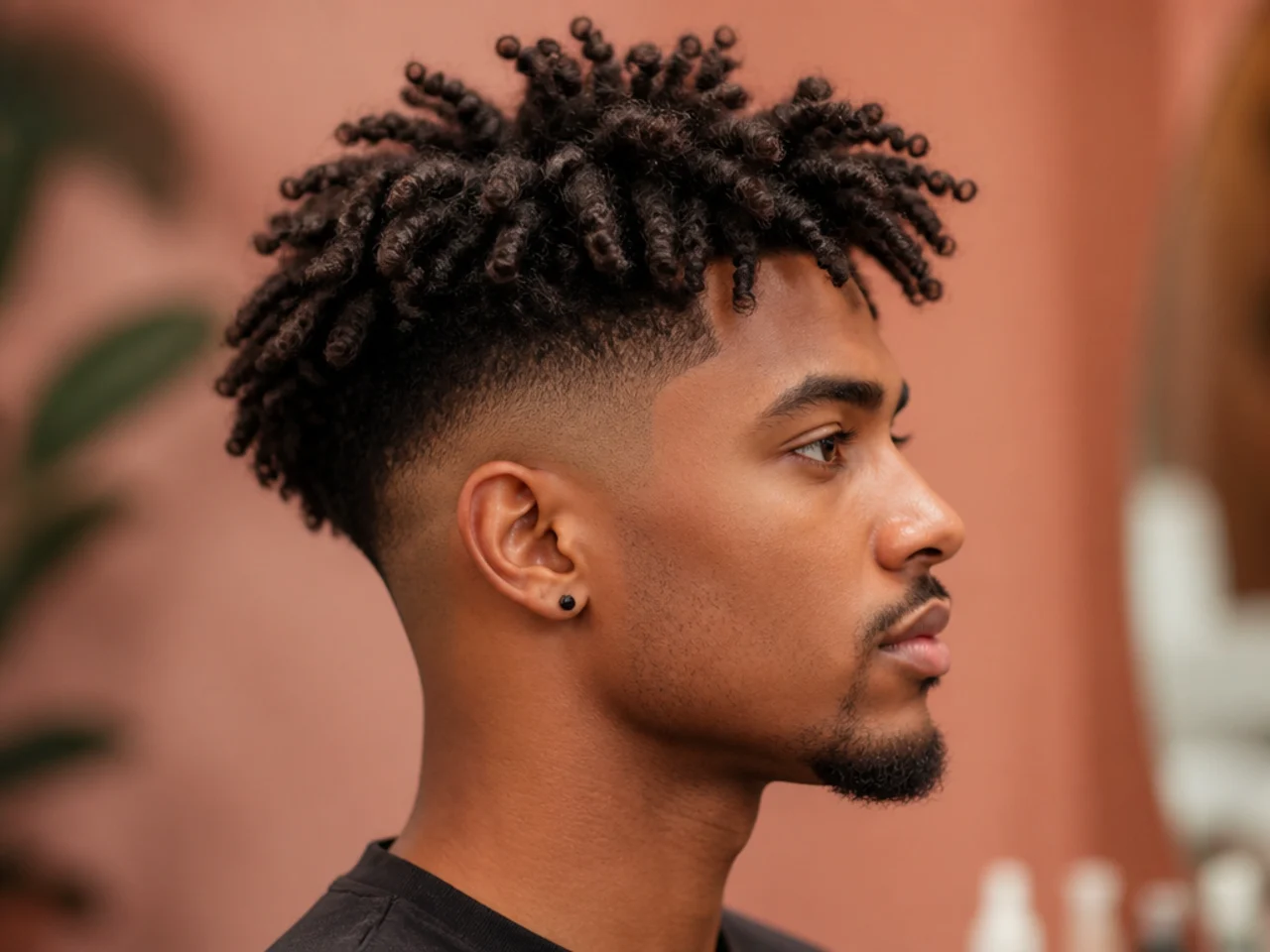
Twist-outs give you elongated S-shaped coils instead of undirected curl texture — you twist small sections at bedtime and unravel in the morning for defined pattern that reads springy and framed. Mid skin fade at the sides drops to a bald #0 at the temple for maximum contrast against the twist-out crown. Best on 4A and 4B curl types with enough density to hold the twist, and on oval, square, and diamond faces.
Ask for: "mid skin fade, bald at the bottom, two and a half inches of curls on top scissor-cut dry, cut the shape before I twist so the outline is set."
Styling: twist the top in small sections with curl cream on soaking-wet hair at bedtime, sleep in a satin bonnet, unravel gently in the morning with oiled fingers.
6. 4B Sponge Coils with Low Skin Fade
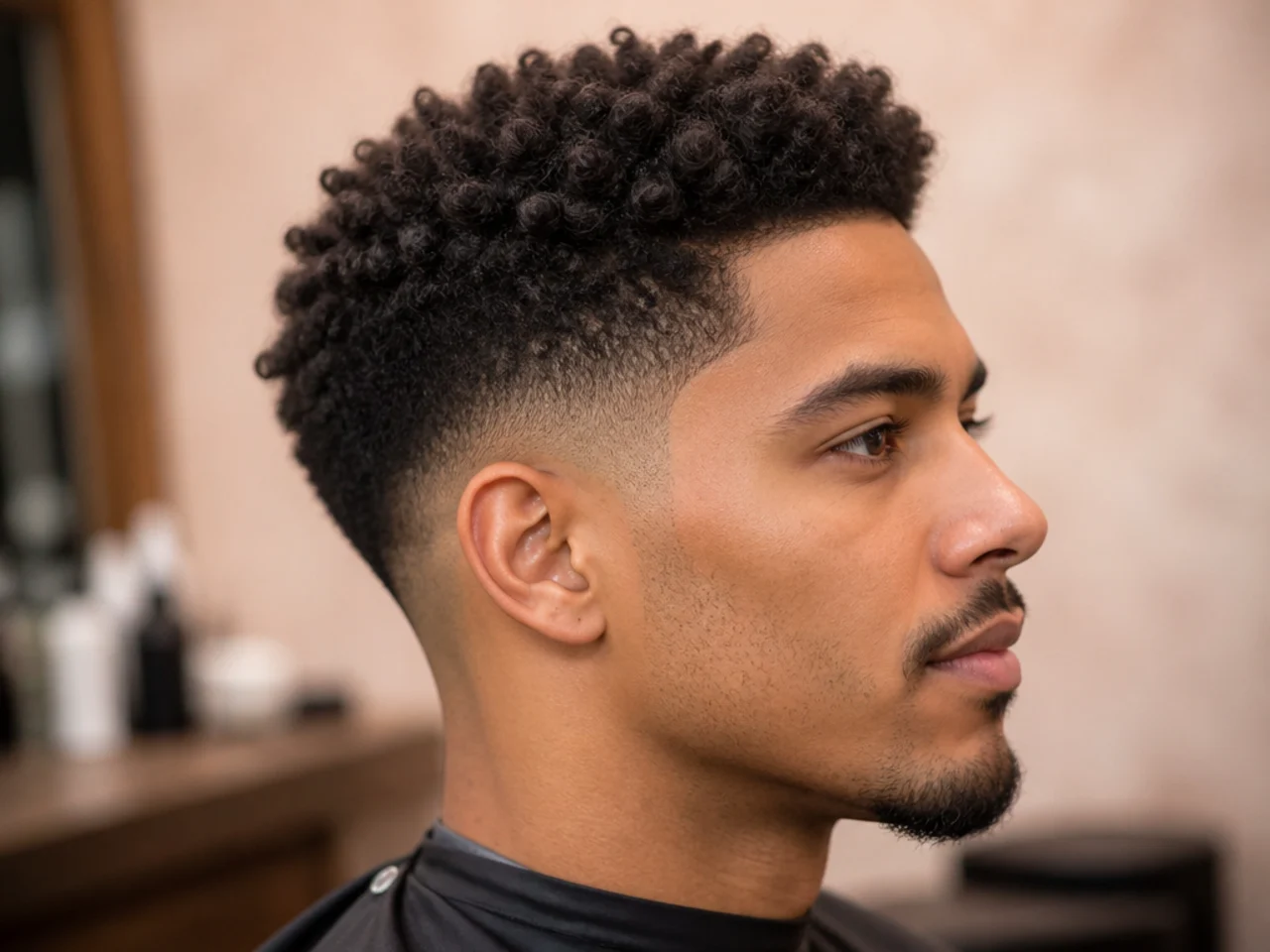
Two inches of 4B coil rolled with a hair sponge into tight uniform curls, low skin fade running from a bald #0 at the bottom up to natural length above the parietal. The low fade preserves the most curl volume around the head while the sponge coils on top read as a sculpted texture. Best on 4B and 4C density where the sponge really grips the coil, and on every face shape.
Ask for: "low skin fade, bald at the bottom, two inches of natural texture on top, sponge finish at the chair, sharp line-up at the forehead and nape."
Styling: moisturize with a leave-in, work a light curl cream through damp hair, rotate the curl sponge in tight circles across the top. Refresh with a water spritz and re-sponge every two to three days.
7. Two-Strand Twists Worn In with Drop Fade
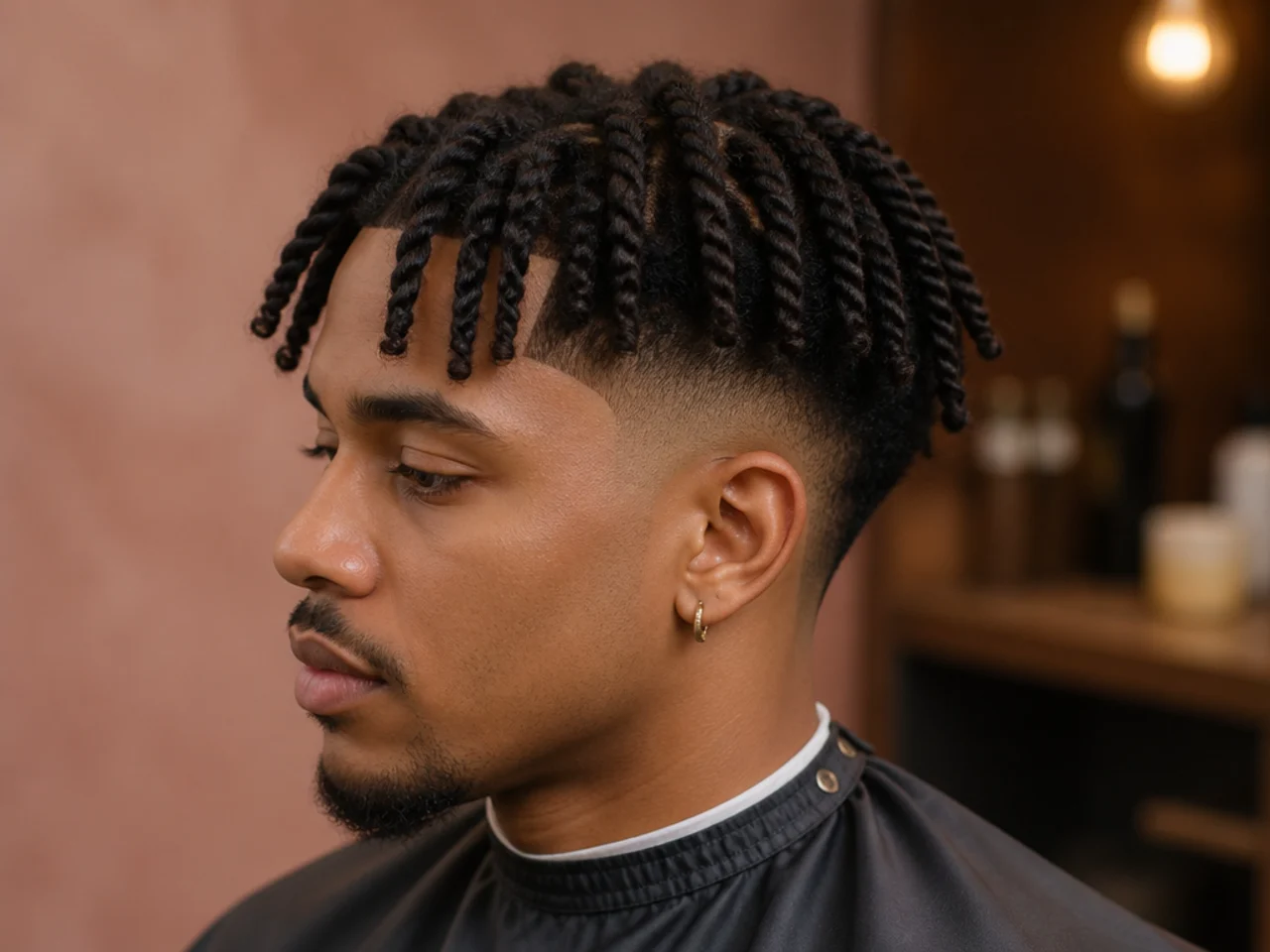
Two-strand twists rope small sections of the top into defined vertical twists you can wear for a full week or two between refreshes, drop fade at the sides with the transition arcing lower behind the ear than at the temple. Different from a twist-out — the twists stay in rather than unraveling. Best on 4A, 4B, and 4C curl types with enough length to twist (two to three inches minimum), and on oval, square, and diamond faces.
Ask for: "low drop fade, #0.5 at the shortest, cut the perimeter first, then twist the top into small two-strand twists — leave them in, don't unravel."
Styling: oil the scalp along the twist partings twice a week, re-twist the roots every two weeks. Sleep in a satin bonnet to keep the twist tension. Wash carefully so the twists don't unravel.
8. Big Curly Blowout with Mid Skin Fade
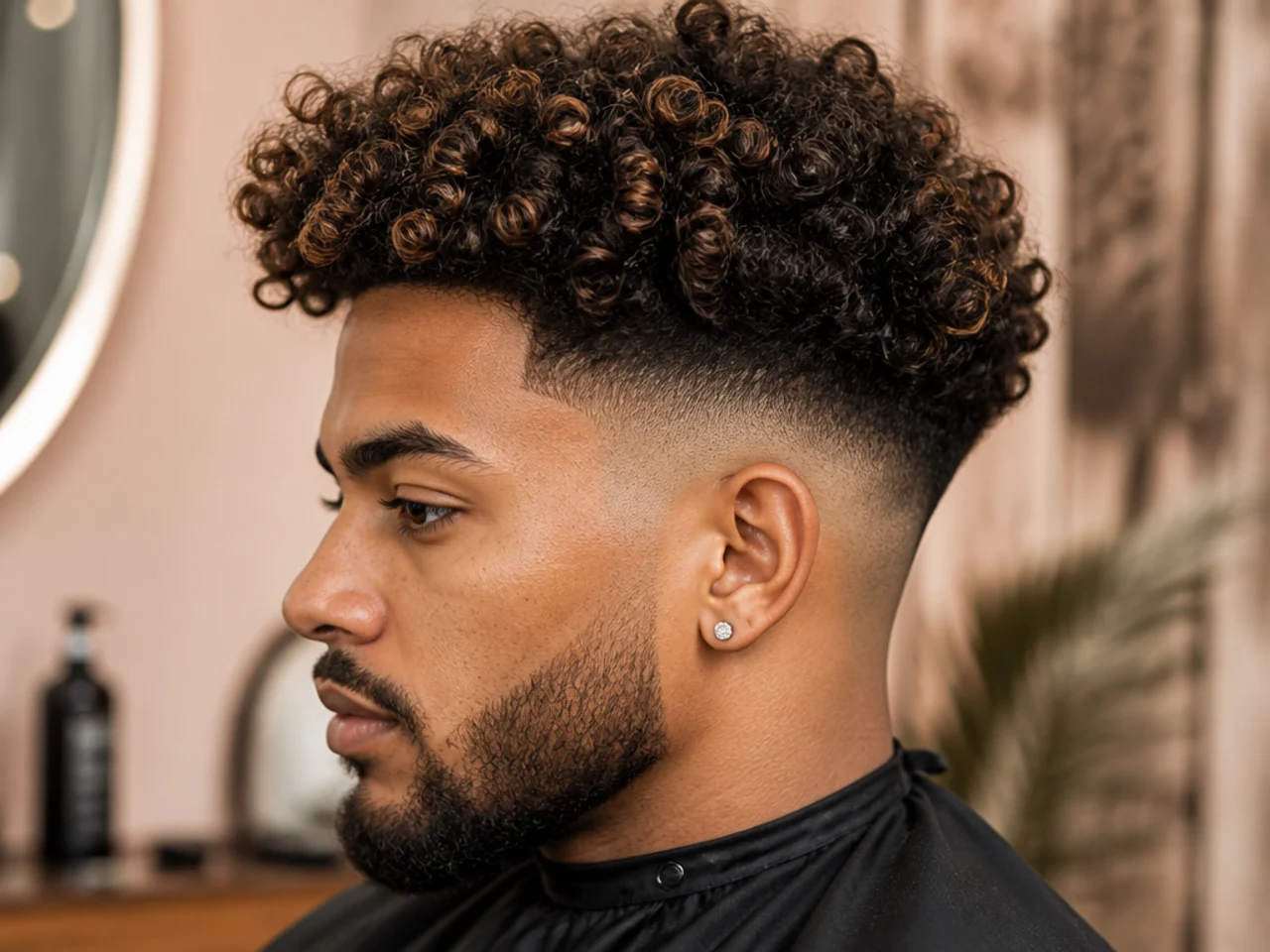
The blowout expands the curl pattern so three inches of 3C or 4A reads bigger and softer than a wash-and-go. Mid skin fade at the sides frames the volume with maximum contrast. This is the cut most guys want for a night out, a wedding, or a big photo. Best on medium-density hair that holds a blowout for a full day, and on oval, square, and heart faces.
Ask for: "mid skin fade, bald at the bottom, three inches of curls on top styled as a blowout with a diffuser, natural round shape on top, no comb-through."
Styling: blow-dry on cool with a diffuser cup pointed at the roots, then pick out gently with your fingers or a wide-tooth pick. A light hold spray locks the volume without crunch. Related family: the curly blowout taper family covers the exact styling in more depth.
9. Cornrows Front with Curly Back and High Fade
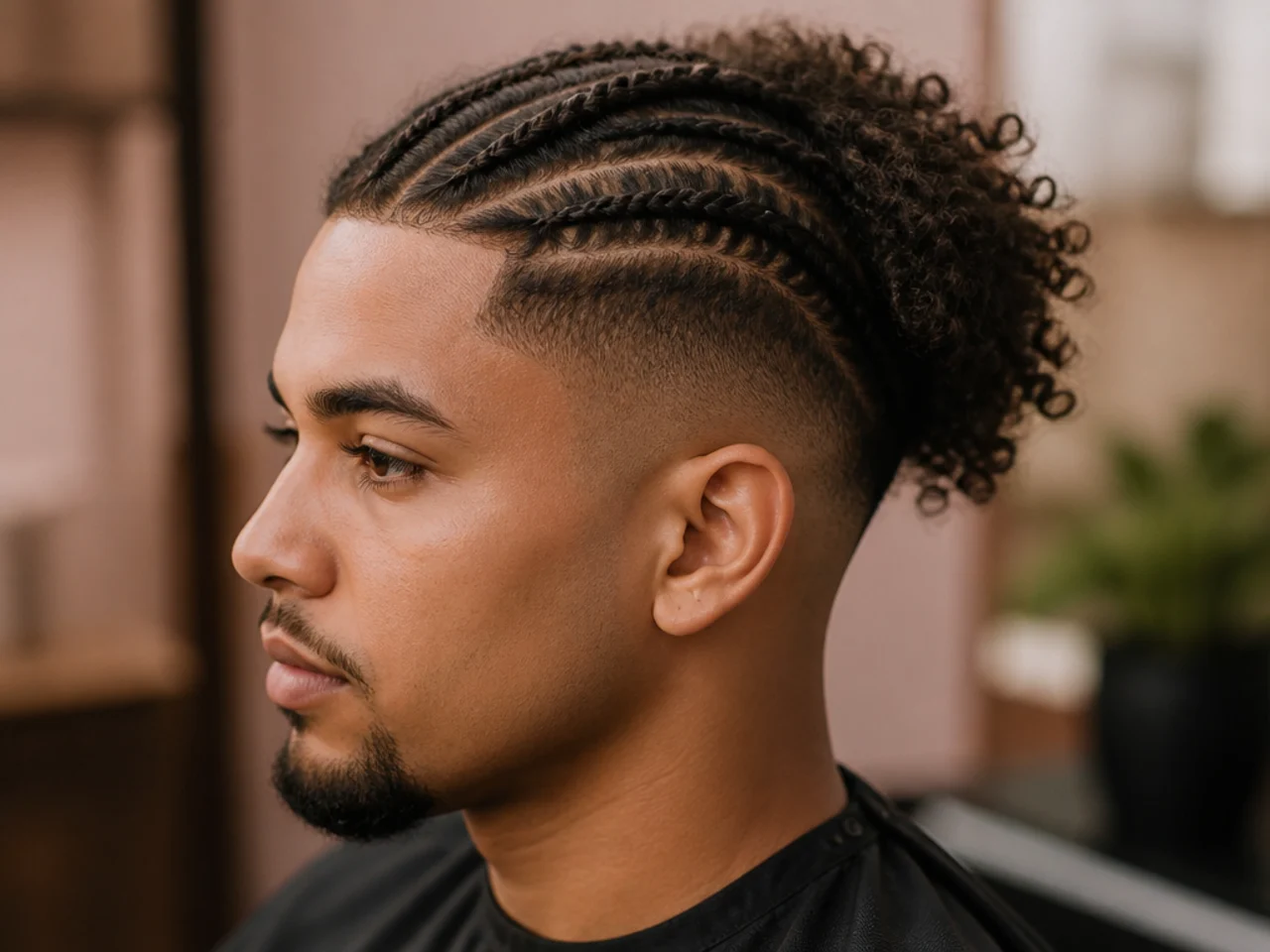
The two-texture combo — the front third of the crown braided into three or four cornrows running from the forehead back to the middle of the head, the back two thirds left as two inches of loose 4A curl, high fade at the sides to a #0.5. Reads modern and buys you two weeks between salon visits. Best on 4A, 4B, and 4C curl types with enough length to braid, and on oval and long faces.
Ask for: "high fade, #0.5 at the shortest, three cornrows braided across the front third of the crown, leave the back crown as two inches of loose curl."
Styling: oil the scalp along the braid partings twice a week, re-braid the front every two weeks. Moisturize the loose back curls daily with a leave-in and light cream.
10. Wet-Look Curl Definition with Low Skin Fade
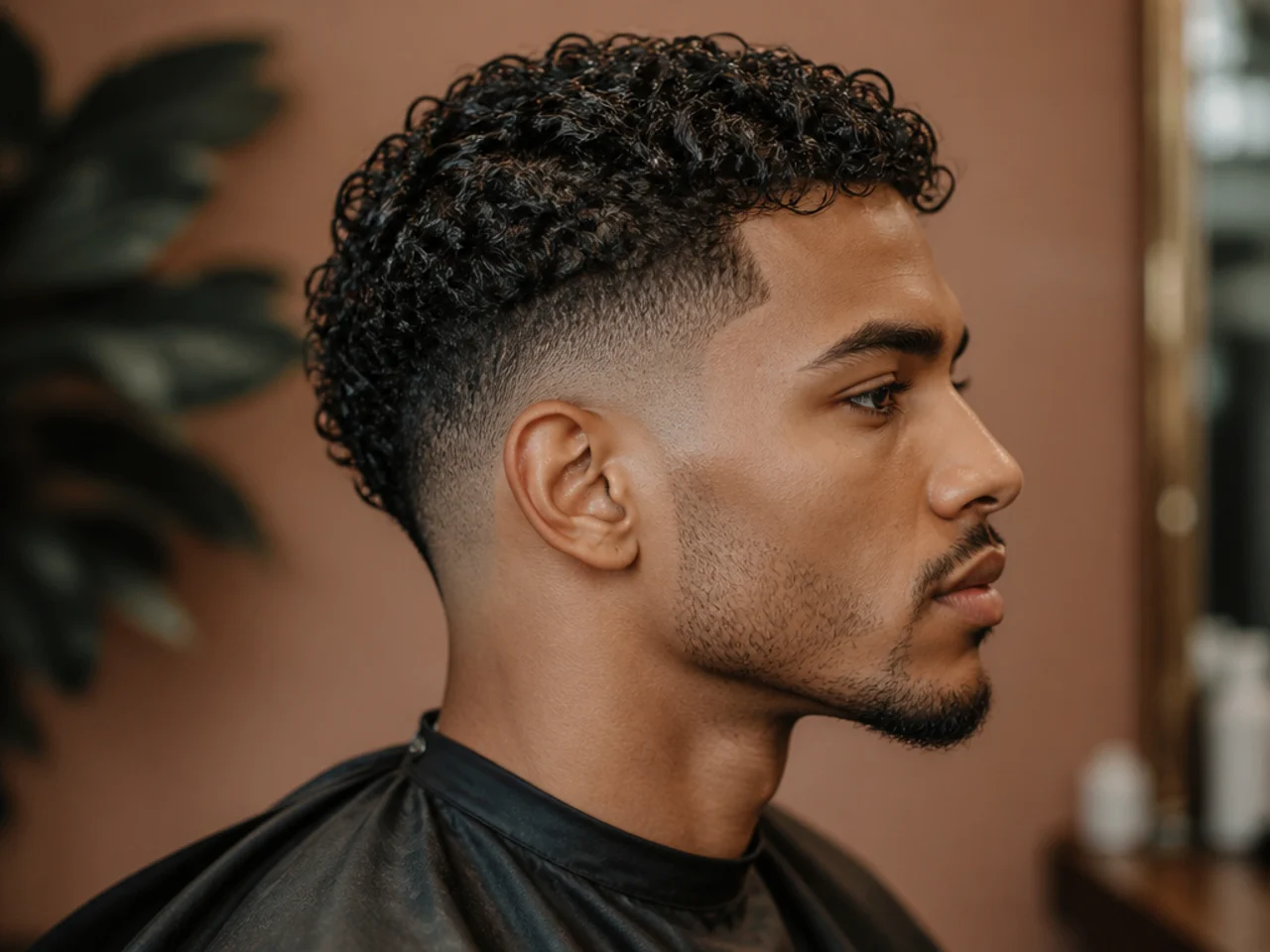
The evening version — two inches of 3B, 3C, or 4A curl on top styled with a strong hold curl gel so the pattern reads glossy and hyper-defined, low skin fade at the sides finishing at a #0 for the sharpest contrast. Photographs beautifully in low light. Best on 3B, 3C, and 4A patterns where individual curl definition is visible, and on every face shape.
Ask for: "low skin fade, bald at the bottom, two inches of curls on top scissor-cut for a defined curl pattern, no thinning."
Styling: curl-defining gel or strong curl cream on soaking-wet hair, rake through with fingers to distribute, scrunch upward and let air-dry. Scrunch out the cast (the gel crunch) with a drop of oil once fully dry.
11. Curly Fringe over Drop Fade
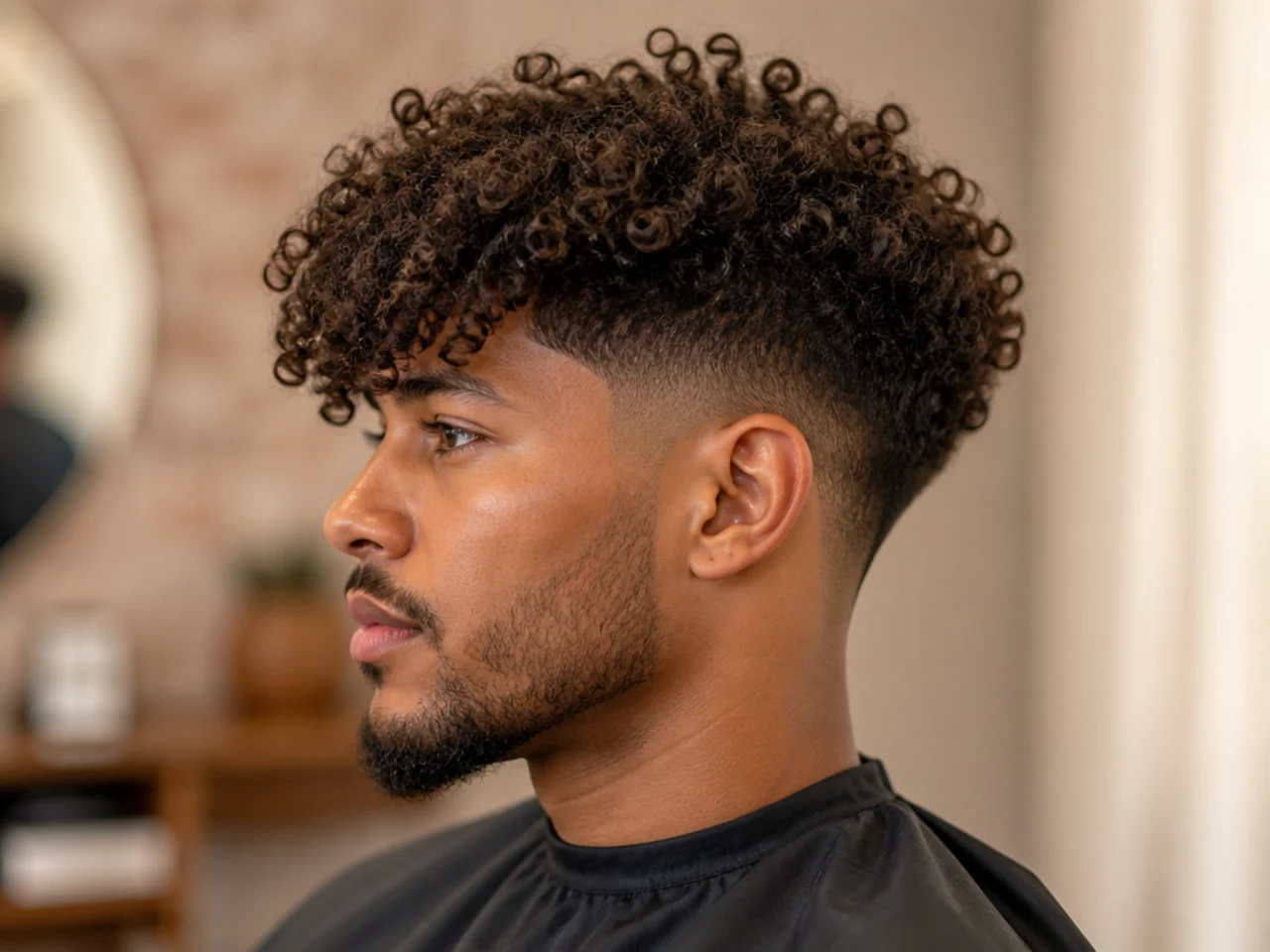
The fringe version — three inches of 3C or 4A curl on top with the front pieces left long enough to fall past the brows as a soft curly fringe, drop fade at the sides so the transition arcs lower behind the ear than at the temple. The fringe softens angular jaws and hides tall foreheads. Best on square, heart, and oblong faces, and on 3B or 3C patterns loose enough to actually fall rather than spring up.
Ask for: "low drop fade, #0.5 at the shortest, three inches on top with the front pieces left long enough to fall to the brow, natural curly fringe shape."
Styling: curl cream through the fringe on damp hair, twirl the front pieces around a finger to set the direction, air-dry. Refresh with water and cream between washes.
12. Loose 3B Ringlets with Low Skin Fade
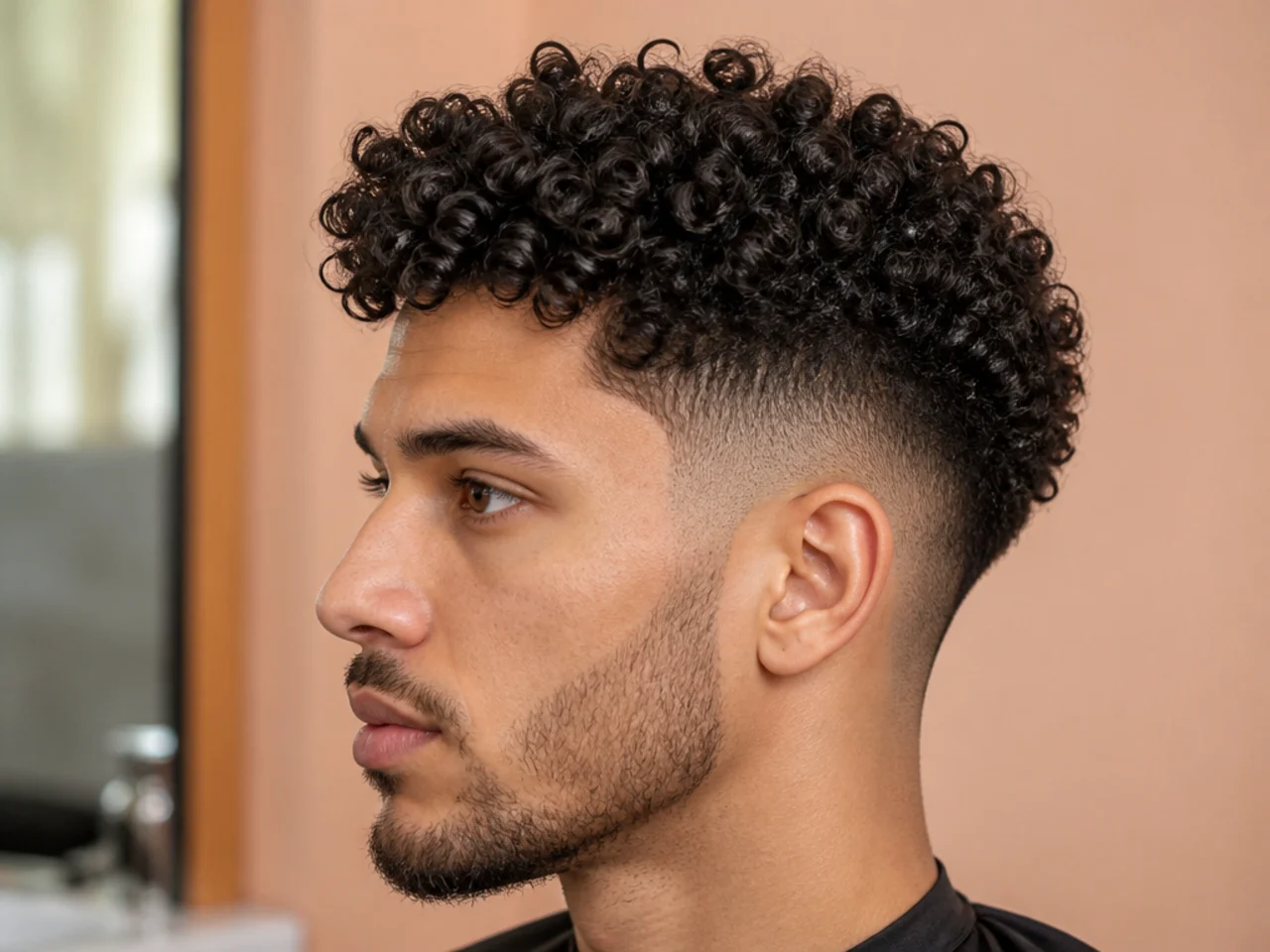
The looser texture play — three inches of 3B corkscrew ringlets left to bounce and separate naturally, low skin fade at the sides finishing at a bald #0. This is the cut for guys with looser texture who don't want their curls flattened into a defined pattern — the ringlets stay springy and individual. Best on 3A and 3B curl patterns, and on oval, heart, and diamond faces.
Ask for: "low skin fade, bald at the bottom, three inches of loose ringlets on top scissor-cut, no thinning, keep the individual curl separation."
Styling: light curl cream and a drop of leave-in on damp hair, rake with fingers to distribute, do not scrunch — scrunching tightens looser 3B curls too much. Air-dry hands-off.
13. Coily Caesar with Mid Fade
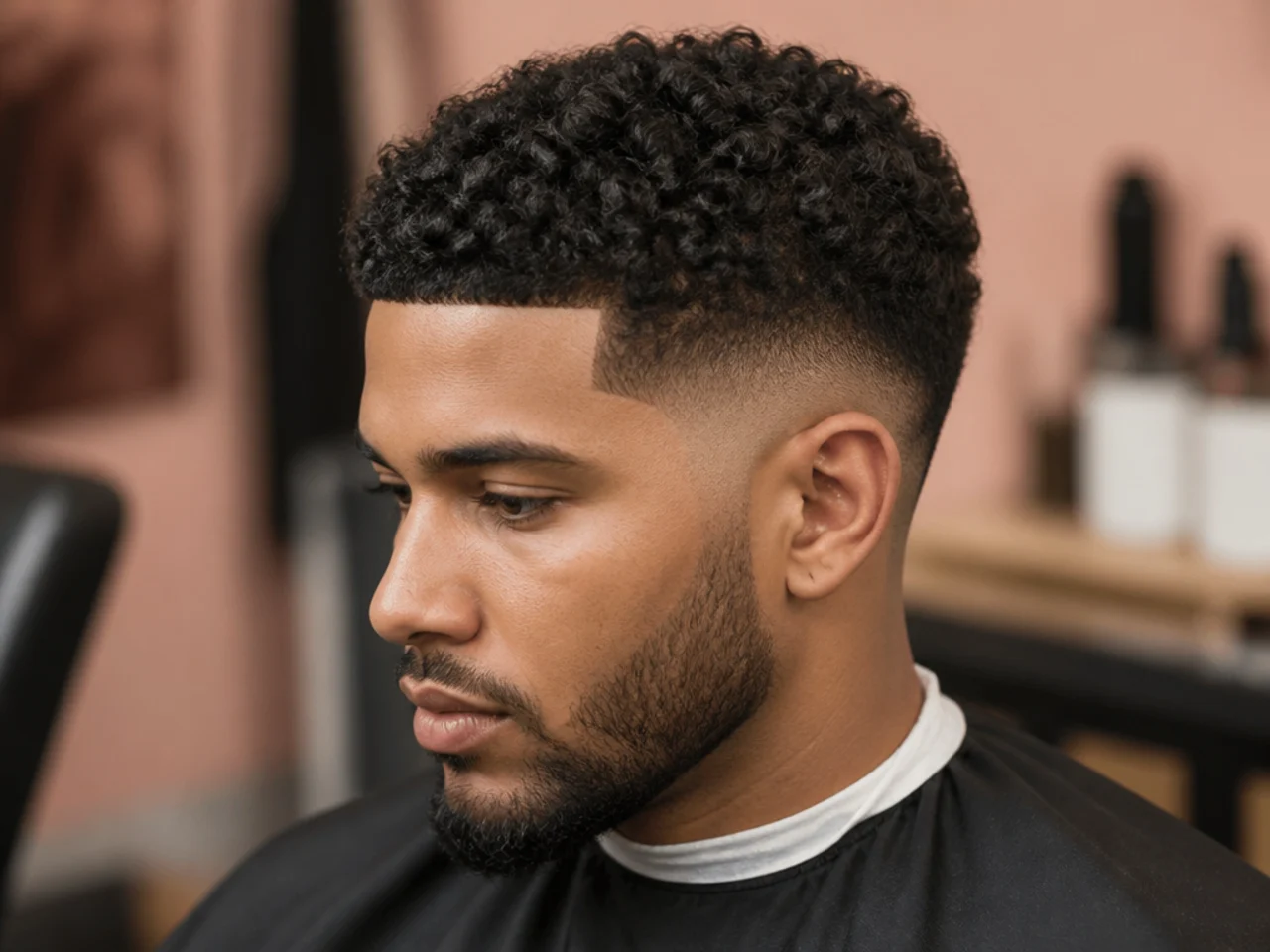
The shortest curly cut in the guide — half an inch to three quarters of an inch of 4B or 4C coil across the top, cut in a straight line across the forehead in a caesar shape, mid fade at the sides finishing at a #0.5 or #1. Ultra low maintenance. The tight coil pattern reads defined even at that length because 4B and 4C hair packs visual weight into short lengths. Best on oval, square, heart, and round faces.
Ask for: "mid fade, #0.5 at the shortest, half an inch of natural texture across the top with a straight caesar line across the forehead."
Styling: rub a pea of curl cream or a light oil across the top after every wash to keep the scalp from looking dry. That is the entire routine.
14. Razor-Design Curly Top with Skin Fade
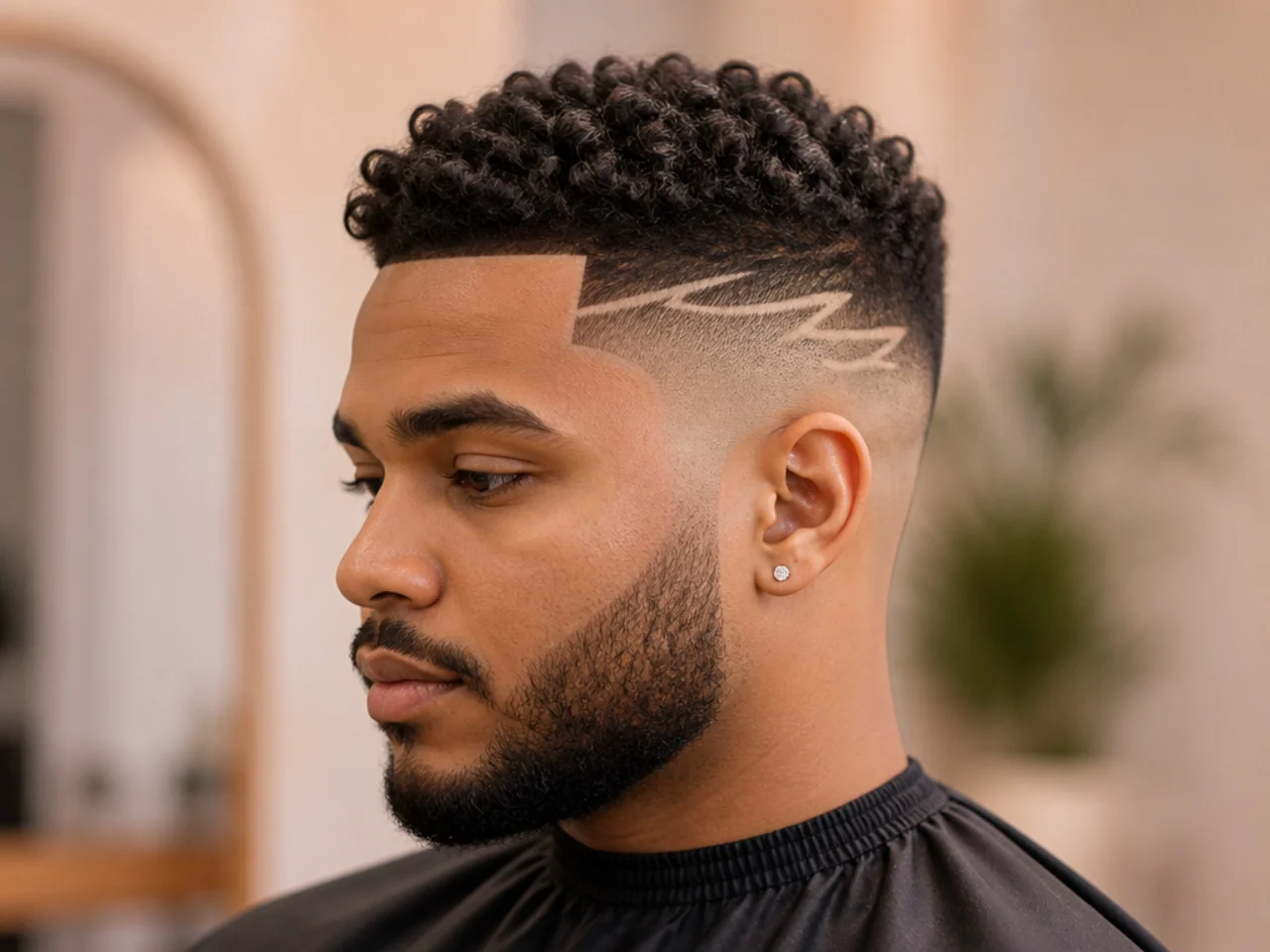
The design version — two and a half inches of 4A or 4B curl on top, mid skin fade at the sides, and a razor-etched design along one temple or the fade line. Could be a single hard line, a chevron, a signature initial, or a repeating geometric pattern. The design is what pulls the eye and separates the cut from every other curly-top-with-fade. Best on 4A, 4B, and 4C density where the coil bulk balances the sharpness of the razor work.
Ask for: "mid skin fade, bald at the bottom, two and a half inches of natural texture on top, razor design along the left temple — bring a reference for the design."
Styling: normal curl routine (leave-in plus cream). The razor design blurs faster than the fade — book a shape-up every ten to fourteen days to keep the etched lines crisp.
15. Curly Mullet with Low Fade
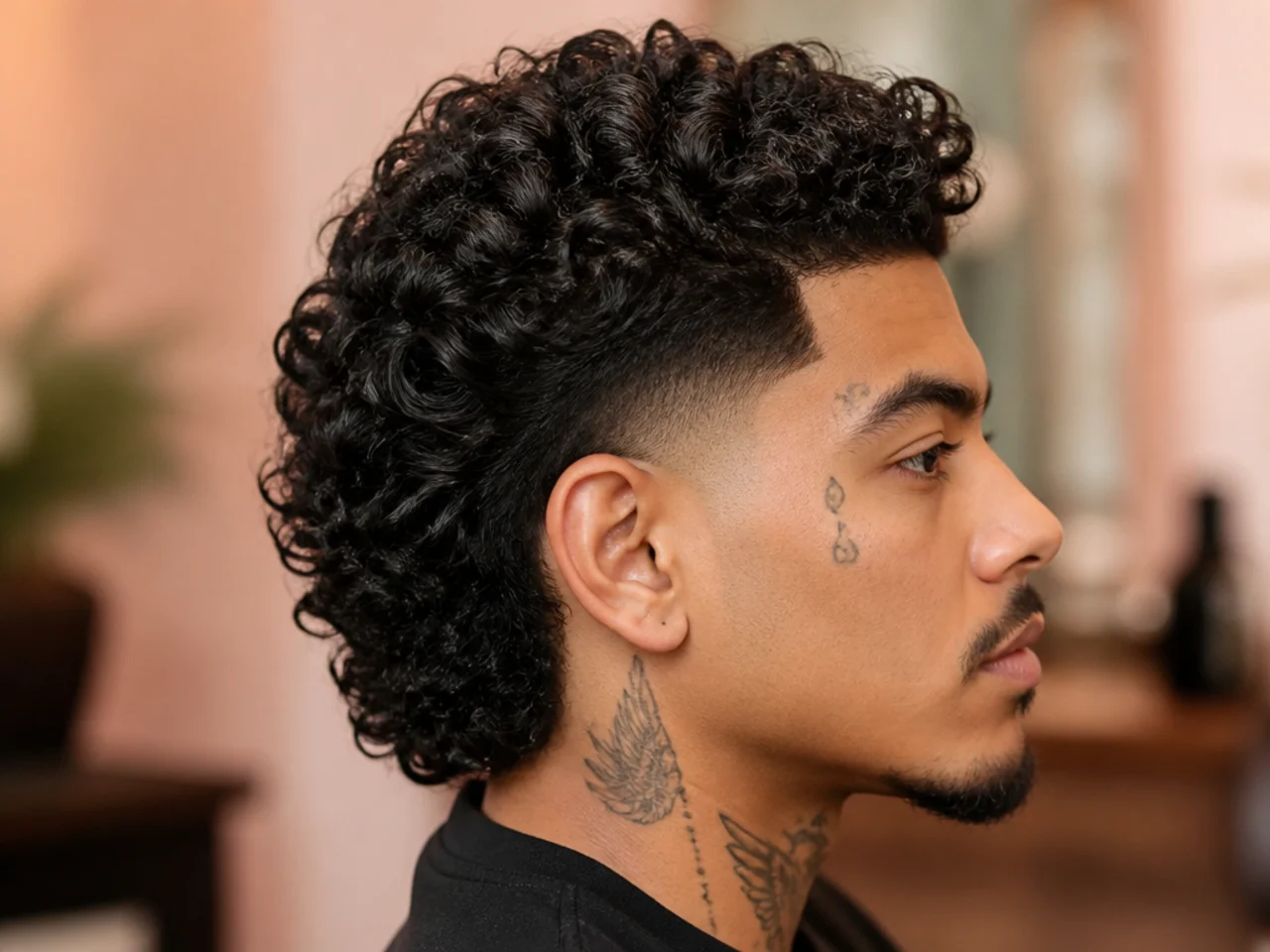
The 2026 trend — three inches of 3C or 4A curl on top with a two-to-three-inch curly section left long at the nape, low fade around the sides to a #0.5. The nape section reads as a soft curly mullet, not a business-in-front party-in-back caricature. Best on 3B, 3C, and 4A patterns where the nape section will hang in curls rather than fluff into an afro, and on oval and square faces.
Ask for: "low fade, #0.5 at the shortest, three inches of curls on top, leave two to three inches of curl at the nape as a mullet section, scissor-cut throughout."
Styling: curl cream on damp hair, scrunch the top and nape section separately, air-dry. The nape section reads best when it holds defined curl rather than fluffing.
16. Sponge Coil Mohawk with Burst Fade
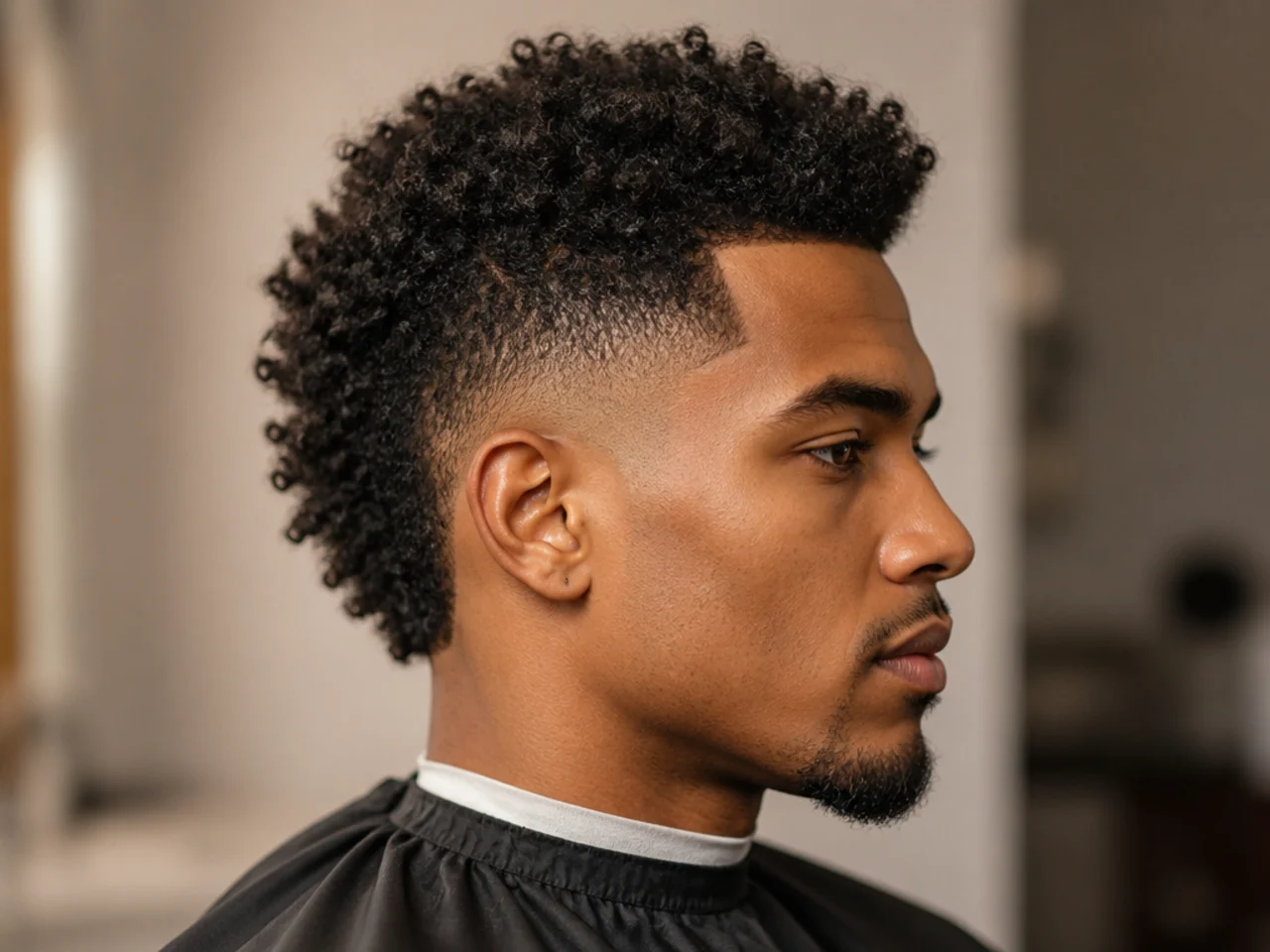
The sculpted statement — two and a half inches of 4B or 4C coil down the center of the crown, rolled with a hair sponge into tight uniform coils, burst fade curving around each ear so the shape reads full at the crown and clean at the sides. Best on 4B and 4C density where the sponge grips the coil, and on oval and long faces.
Ask for: "burst fade to skin around each ear, #0 at the shortest, two and a half inches of natural texture on top narrowed to a mohawk strip down the center, sponge finish at the chair."
Styling: moisturize, rotate the sponge in tight circles across the crown, pick the mohawk strip upward slightly to add height. Refresh every two to three days.
17. Mid-Length Curls with Undercut
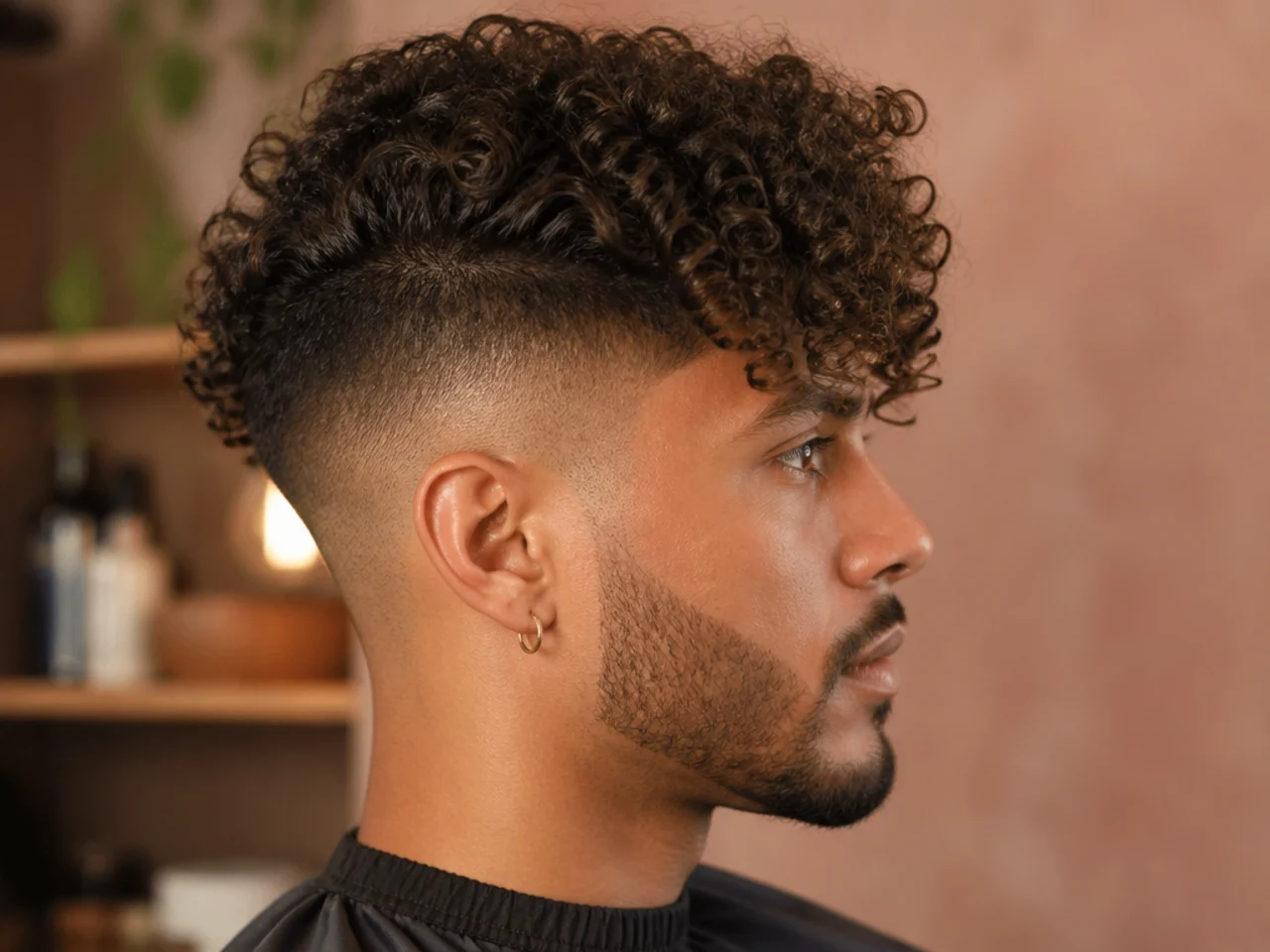
The flowing longer look — four inches of loose 3B or 3C curl on top left to fall naturally around the crown, hard undercut fade at the sides with a fixed #1 guard length and a clean disconnect between top and sides (no gradient). The extreme contrast pulls all attention upward and reads editorial. Best on oval and diamond faces, and on 3B and 3C patterns loose enough to actually flow.
Ask for: "hard undercut, #1 all the way around the sides, no fade or taper, four inches of loose curls on top scissor-cut, disconnected top-to-side."
Styling: curl cream and a light hold gel on damp hair, scrunch upward, air-dry. Deep-condition weekly to keep four inches of curl moisturized without weighing down.
18. Curly Comma Fringe with Drop Fade
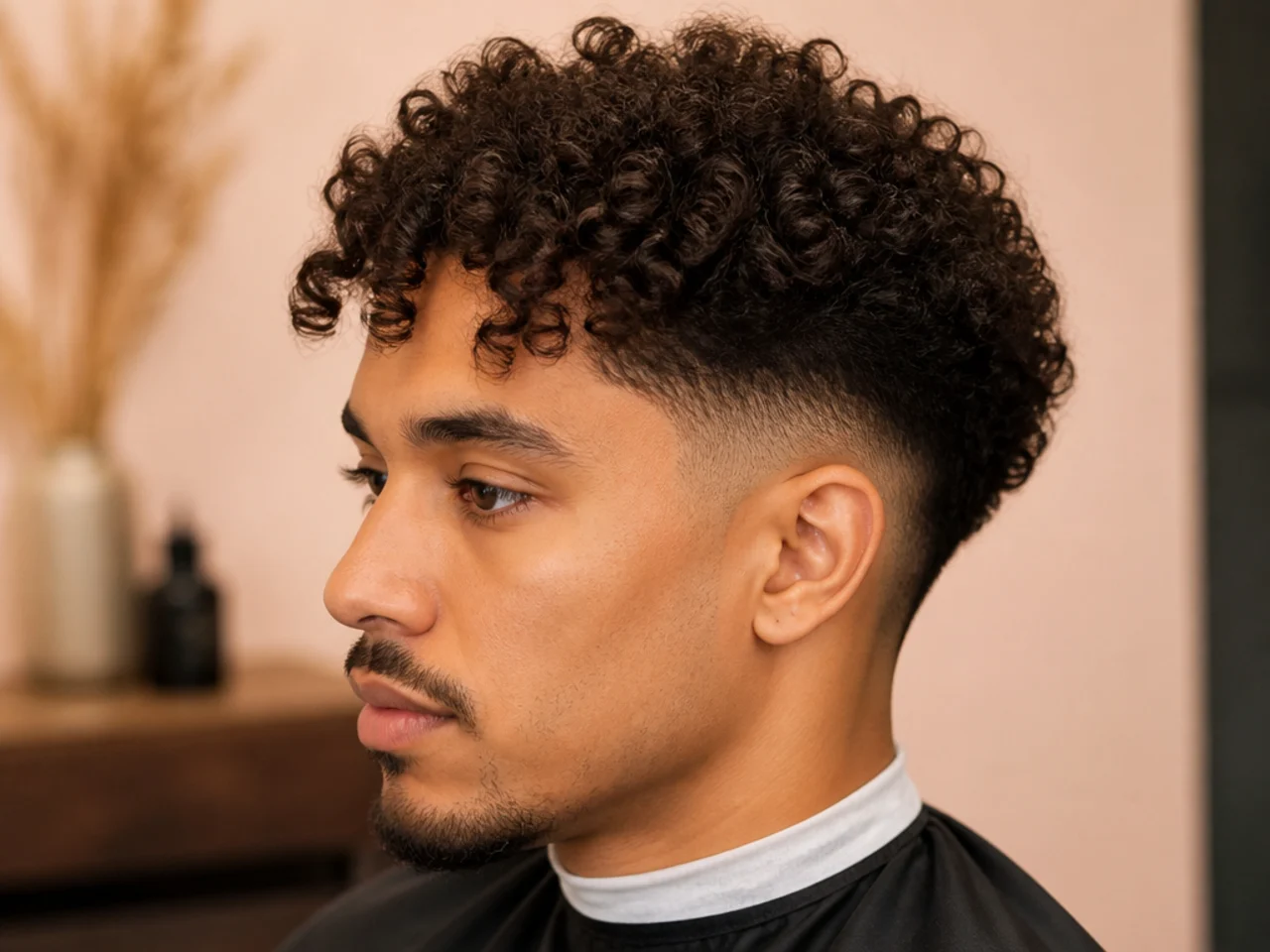
Korean-inspired shape adapted for Black hair — two and a half inches of 3C or 4A curl on top with the front piece styled forward and curled into a soft comma over the forehead, drop fade at the sides. Reads current and softens tall foreheads. Best on 3B and 3C looser patterns where the comma will hold shape, and on oval, square, and long faces.
Ask for: "low drop fade, #0.5 at the shortest, two and a half inches of curls on top with the front piece left long enough to curl forward into a comma shape."
Styling: curl cream on damp hair, wrap the front piece around a finger to form the comma curl, air-dry. A dot of light-hold pomade at the fringe locks the curl.
19. Bantu Knots on Curly Top with Skin Fade
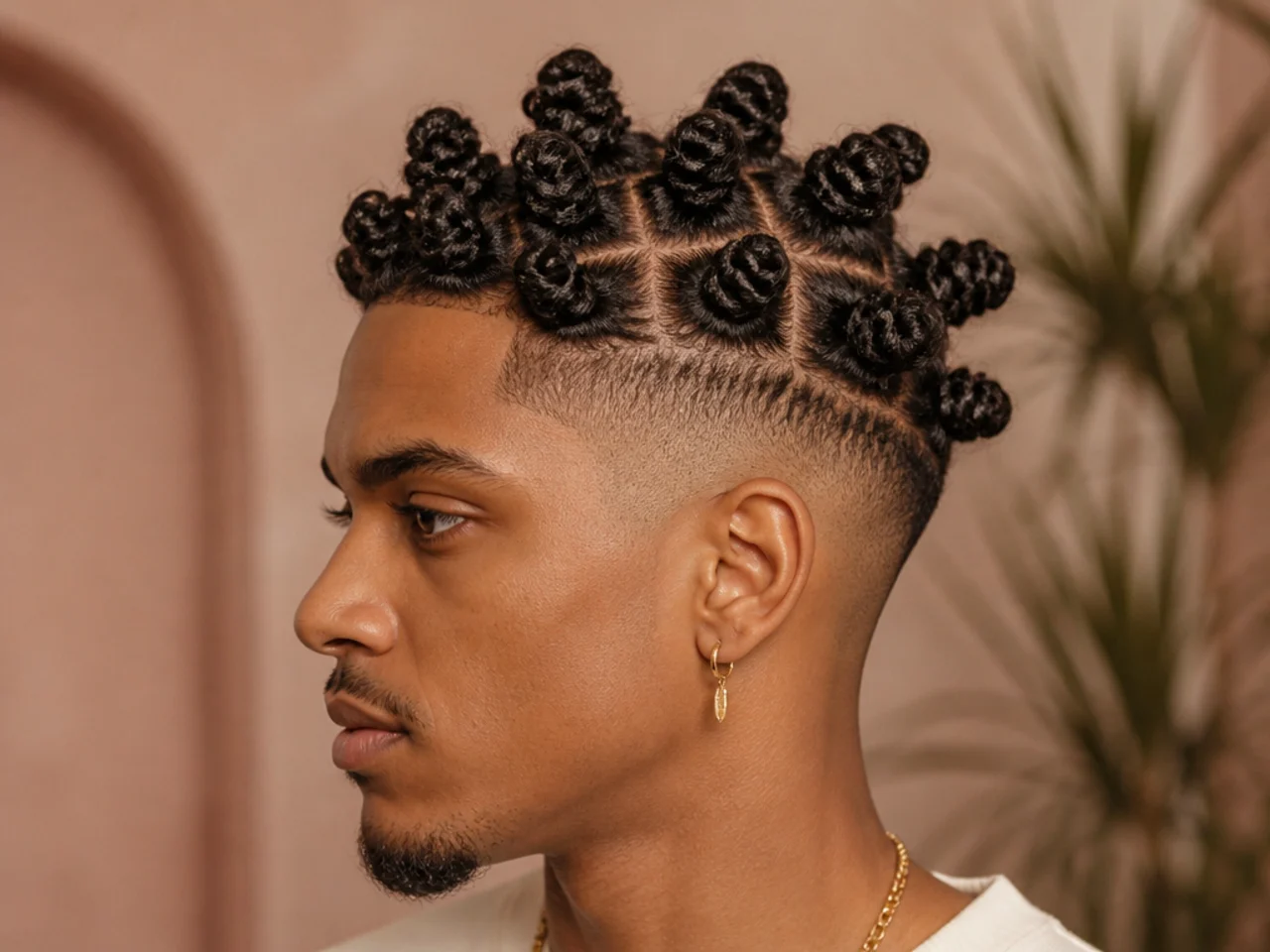
The heritage statement — three inches of 4A or 4B curl on top rolled into a row of small bantu knots along the crown, low skin fade at the sides finishing at a bald #0. Wear the knots for two to four days as their own shape, or unravel them for a defined curl-out. Best on 4A, 4B, and 4C curl types with enough length and density to hold the knots, and on oval, square, and diamond faces.
Ask for: "low skin fade, bald at the bottom, three inches of natural texture on top, cut the perimeter first — I'll roll bantu knots after."
Styling: curl cream on damp hair, section the top into small squares, twist each section from base to tip and coil into a knot. Sleep in a satin bonnet. Unravel gently with oiled fingers for a knot-out.
20. Bleached Tips Curls with High Fade
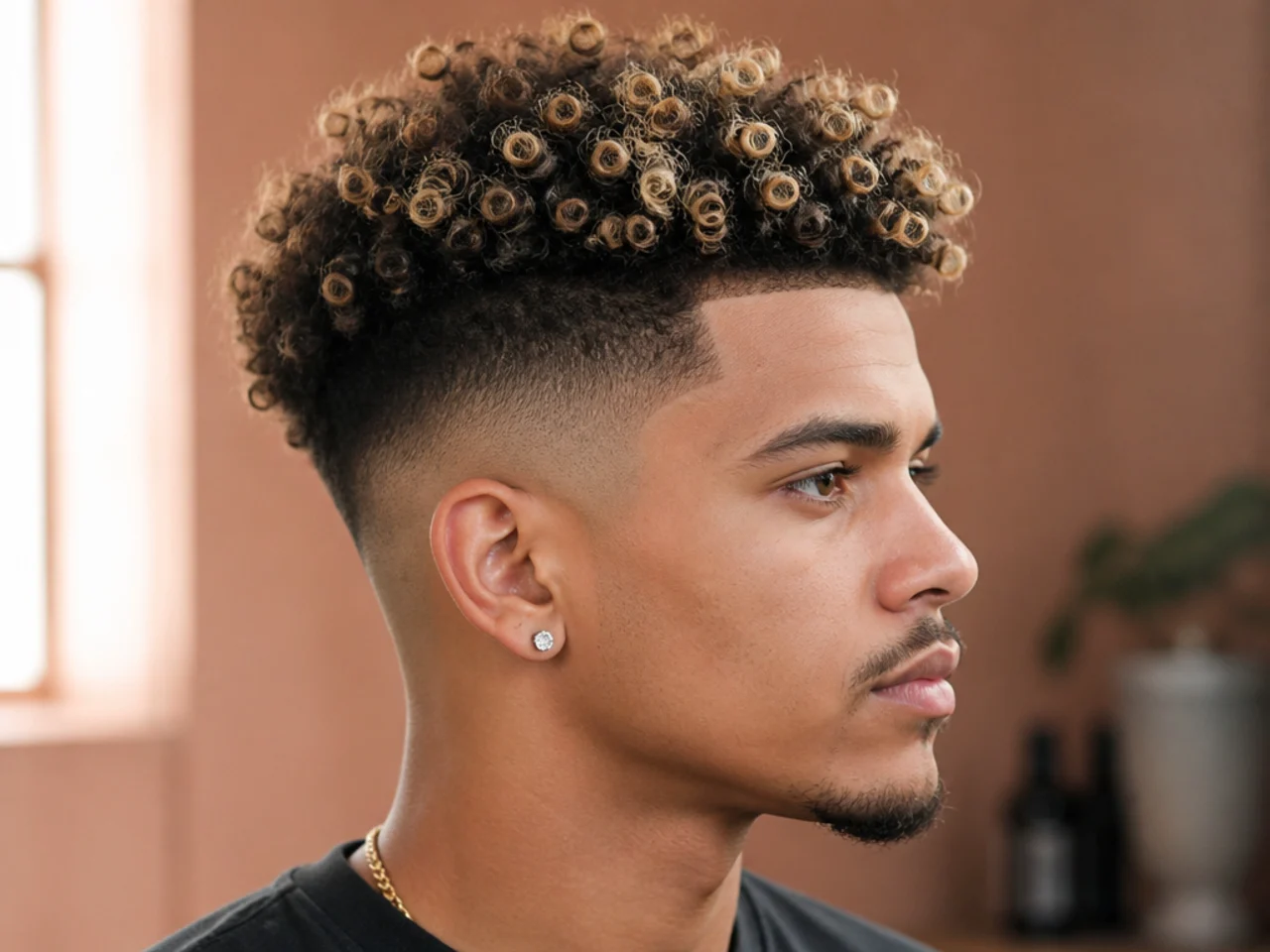
The color statement — two and a half to three inches of 3C or 4A curl with the tips lightened one to three shades or fully bleached blonde, high fade at the sides finishing at a #0.5. Bold, not for every workplace, but photographs like a magazine editorial. Best on medium-density curls that can survive the lift, and on oval, square, and heart faces. Book the color separately with a colorist experienced with textured hair.
Ask for: haircut first — "high fade, #0.5 at the shortest, two and a half to three inches of curls on top." Book the color with a textured-hair specialist after.
Styling: deep-condition every wash to counter bleach dryness, purple shampoo weekly if you went fully blonde, leave-in daily to keep the tips soft. Skip heat styling for the first two weeks after bleach.
How to Ask Your Barber for a Curly Cut
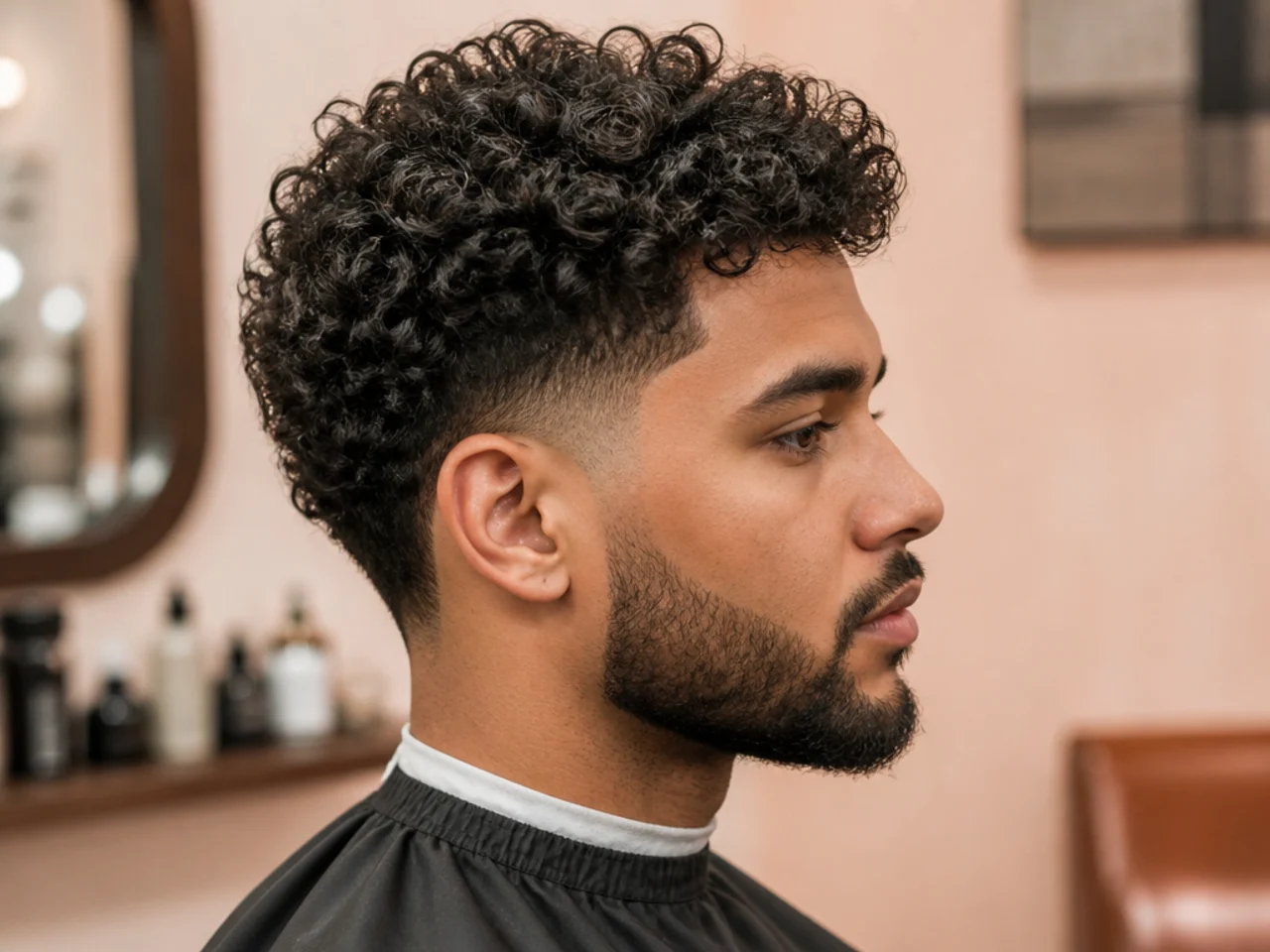
Seven lines cover the whole conversation. Hit these and you'll walk out with the version you had in mind.
- Show a photo — one with your curl pattern. A cut on 3B ringlets reads completely different from the same shape on 4C coils. Screenshot a reference where the model's texture matches yours as closely as possible.
- Say what perimeter you want by name. Fade (runs to skin), taper (stops at a guard), or classic (fixed length, no blend). Barbers use the words precisely — you should too.
- Confirm the height. Low sits above the ear. Mid drops from the temple. High starts above the parietal ridge. Point to where you want the transition to sit on your own head.
- Confirm the guard at the shortest point. #0 (bald), #0.5, #1, or #2. This one number decides most of the look — get it wrong and the whole cut reads different.
- Ask for the top to be cut dry with the curls defined. Cutting curly hair wet stretches the pattern and hides the finished shape. A dry cut on defined curls lets the barber see what they're actually shaping.
- Specify the top length in inches when the curls are defined. "Two and a half inches of curl once it's dry." Give the number, not "medium curls." Barbers work off inches, not vibes.
- Book your next appointment before you leave. Every two to three weeks for the perimeter and line-up, every five to seven weeks for a full top reshape.
Styling and Maintenance for Curly Black Hair
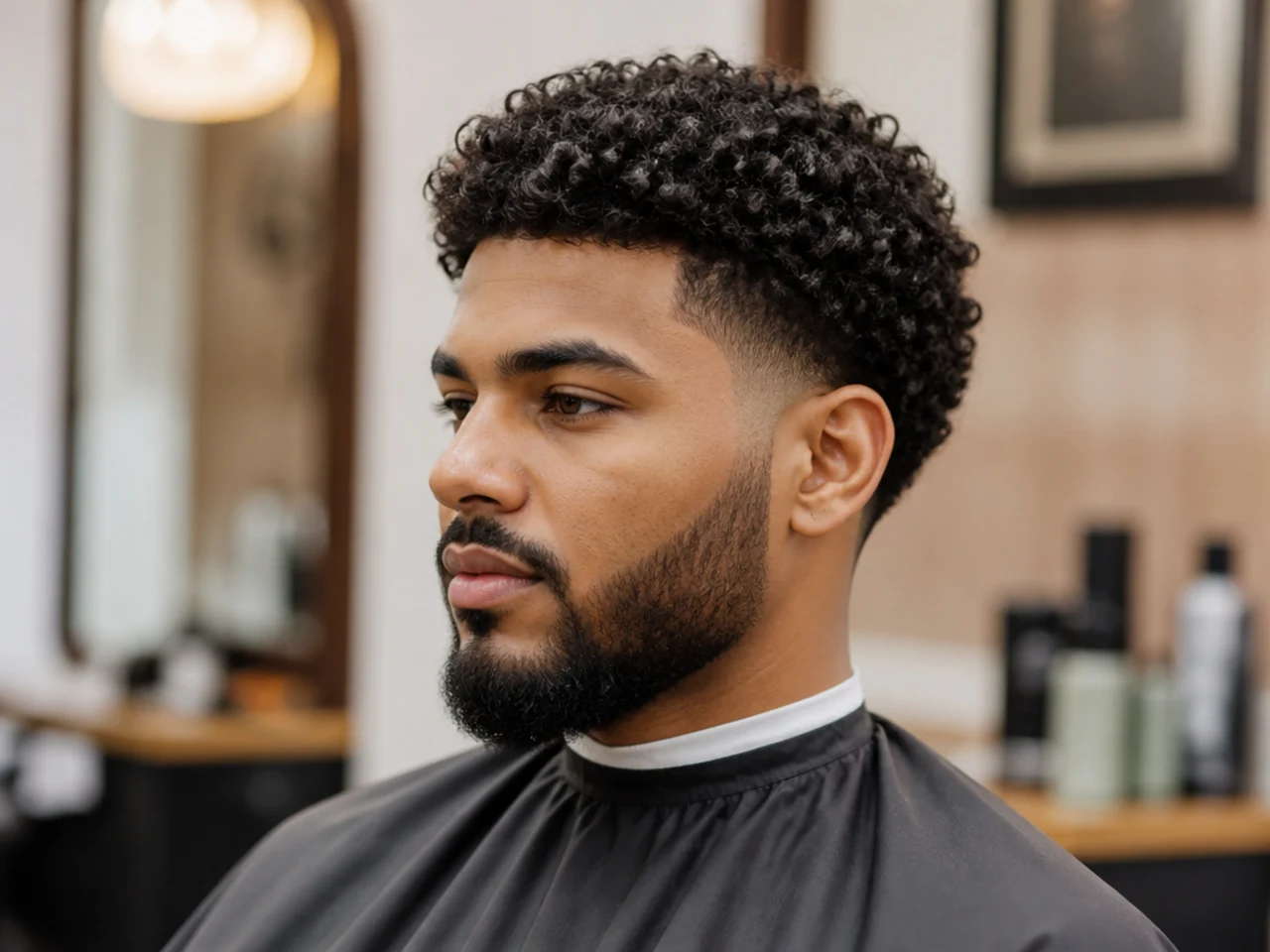
Curly Black hair needs moisture more than it needs product. Water first, leave-in second, cream over that, hands off after.
Wash rhythm. Once or twice a week with a sulfate-free shampoo. Rinse and condition between washes with a co-wash or lightweight conditioner. Daily shampoo strips the oils your curls need to hold their pattern.
Product order. Water-based leave-in on soaking-wet hair, then a rich curl cream, then a light oil to seal. Leave-in is the carrier, cream is the definer, oil is the anchor. Reverse it and the cream dries in patches.
Defining the curls. Rake product through with your fingers, then scrunch upward toward the scalp with your palm to encourage the curl to spring. Air-dry undisturbed for the cleanest pattern, or diffuse on cool if you're short on time. Do not touch the hair while it dries — every disturbance flattens the pattern.
Twist-outs and sponge finishes. Twist small sections at bedtime with curl cream for a next-day twist-out. Roll a curl sponge in tight circles on damp hair to form uniform sponge coils. Both lock in when the hair air-dries undisturbed overnight in a satin bonnet.
Overnight care. Satin bonnet, du-rag, or satin pillowcase, every single night. Cotton wicks moisture and flattens the pattern within hours. In the morning, spritz water and a pea of leave-in, then scrunch back into shape. The whole refresh takes ninety seconds.
Maintenance cadence. Perimeter and line-up every two to three weeks (or every ten to fourteen days for a full skin fade). Full top reshape every five to seven weeks. Deep-condition weekly. Trim the ends every eight to ten weeks even if you're growing out — split ends drag the pattern down and prevent length retention.
Between-visit cleanup. Keep the neckline and sideburns sharp with a good edger — the best hair clippers for men guide covers what to look for. If you own decent clippers, you can re-blend the taper edge yourself at week three, but leave the actual fade line for the barber.
For more curl-focused ideas, the curly hairstyles for men roundup covers looser textures across all ethnicities, and the curly hair haircuts hub walks through the curl-first framework in more depth.
FAQ
What's the difference between a curly cut and a wave cut on Black hair? A curly cut preserves the natural coil or curl pattern up top — scissor work only, no brushing, no wolfing. A wave cut brushes the top hair with the grain into concentric 360-wave patterns and requires a shorter length (usually a #1.5 or #2) plus a nightly du-rag ritual. The two are almost mutually exclusive — waves only form when the coil is trained flat against the scalp; curls only read when the coil is free to spring up.
Do I need to relax or straighten my hair for any of these cuts? No. Every cut in this guide works with your natural pattern. Relaxers change the internal chemistry of the hair and often cause breakage on 4A through 4C textures. Every look here — from the shortest coily caesar to the biggest curly blowout — is achievable on natural hair with the right products and technique.
Which curly cut is the lowest maintenance for Black men? The coily caesar with a mid fade (variation 13). Half an inch of coil on top, wash-and-air-dry with a light oil, mid fade every two weeks. Total daily time investment: less than a minute. Also strong for low maintenance — the short wash-and-go with low taper (variation 1) if you want defined curls without a bigger shape commitment.
Can I get any of these cuts if my hair is transitioning from relaxed to natural? Yes, and the short cuts (variations 1, 6, 12, 13) are ideal because they let you cut off the relaxed ends without a big-chop moment. Ask your barber to only cut the ends where the texture changes — you'll expose the natural pattern and grow the transition line out gradually.
How much should I expect to pay? A standard curly cut with a fade and line-up at a Black barbershop runs $35 to $65. Add a twist-out set, sponge finish, or beard blend: $65 to $100. Bantu knots, cornrow install, or razor-design work at a specialist shop: $80 to $150. Add a tip. A shape-up-only touch-up between full cuts is $15 to $25 at most Black-owned shops.
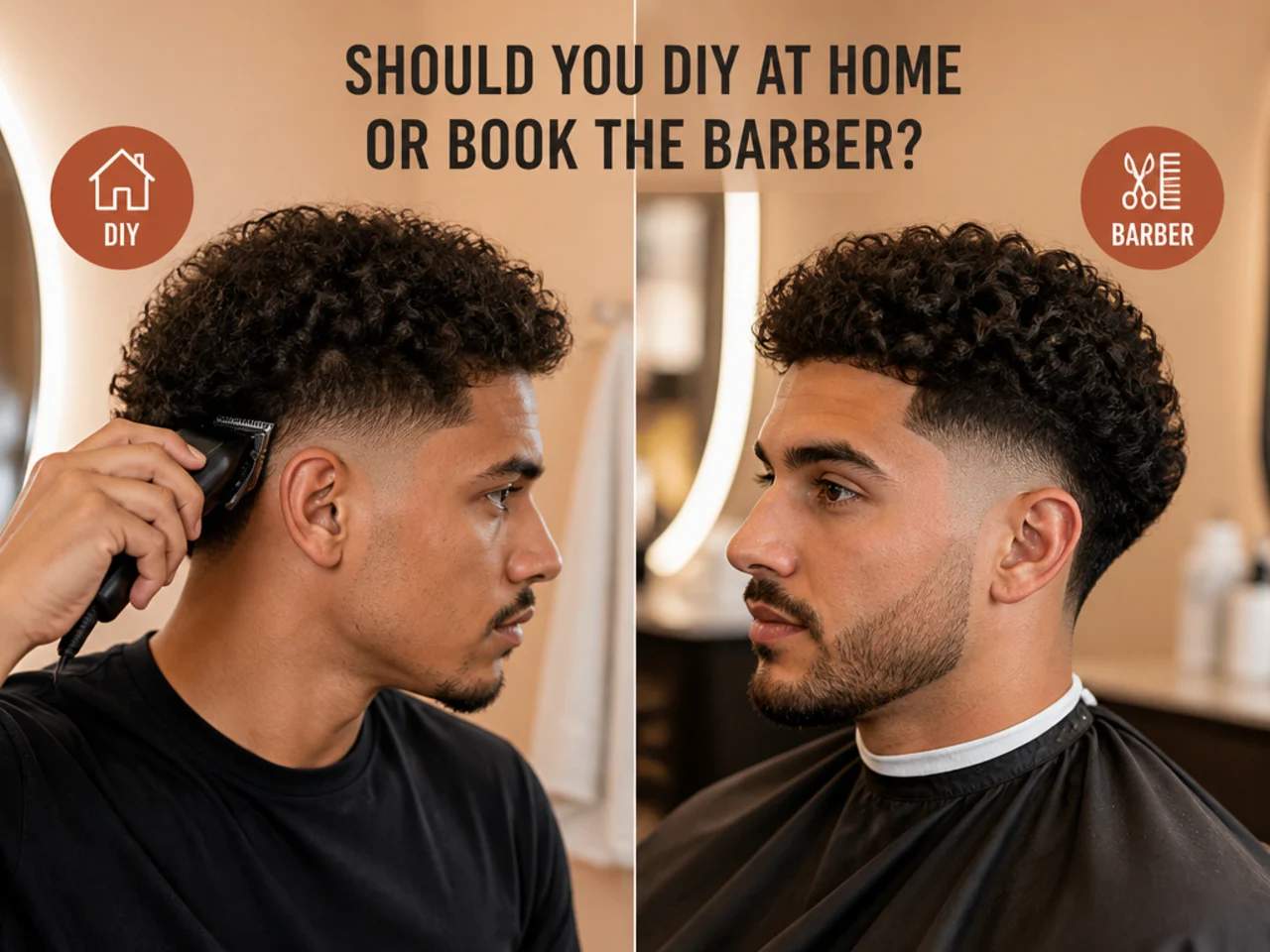
Can I do any of these cuts at home? The line-up cleanup and the perimeter trim, sometimes. The top shape and the fade or taper blend, almost never — scissor-cutting curly hair to a defined shape is a technique that takes years to develop. Between cuts, use clippers at a single guard length to clean up the neckline and sideburns, roll your own sponge coils or twist-out, but leave the actual shape work for your next barber visit.