Medium Length Haircuts for Men — 5 Reasons It Wins Every Time
Medium length haircuts for men — five reasons the four-to-six-inch length outperforms short and long. Face-shape fit, grow-out, workplace, styling.
In this article · 14
- The One-Line Answer
- Why Medium Length Wins
- 1. It suits more face shapes
- 2. It grows out gracefully
- 3. It works with more textures
- 4. It reads modern without effort
- 5. It fits more workplaces
- Short vs Medium vs Long — Quick Comparison
- Which Length Should You Pick?
- FAQ
- Is medium length harder than short for beginners?
- How do I know if medium length will work with my hair?
- Does medium length cost more per year than short?
- Can I switch from short to medium without a bad grow-out phase?
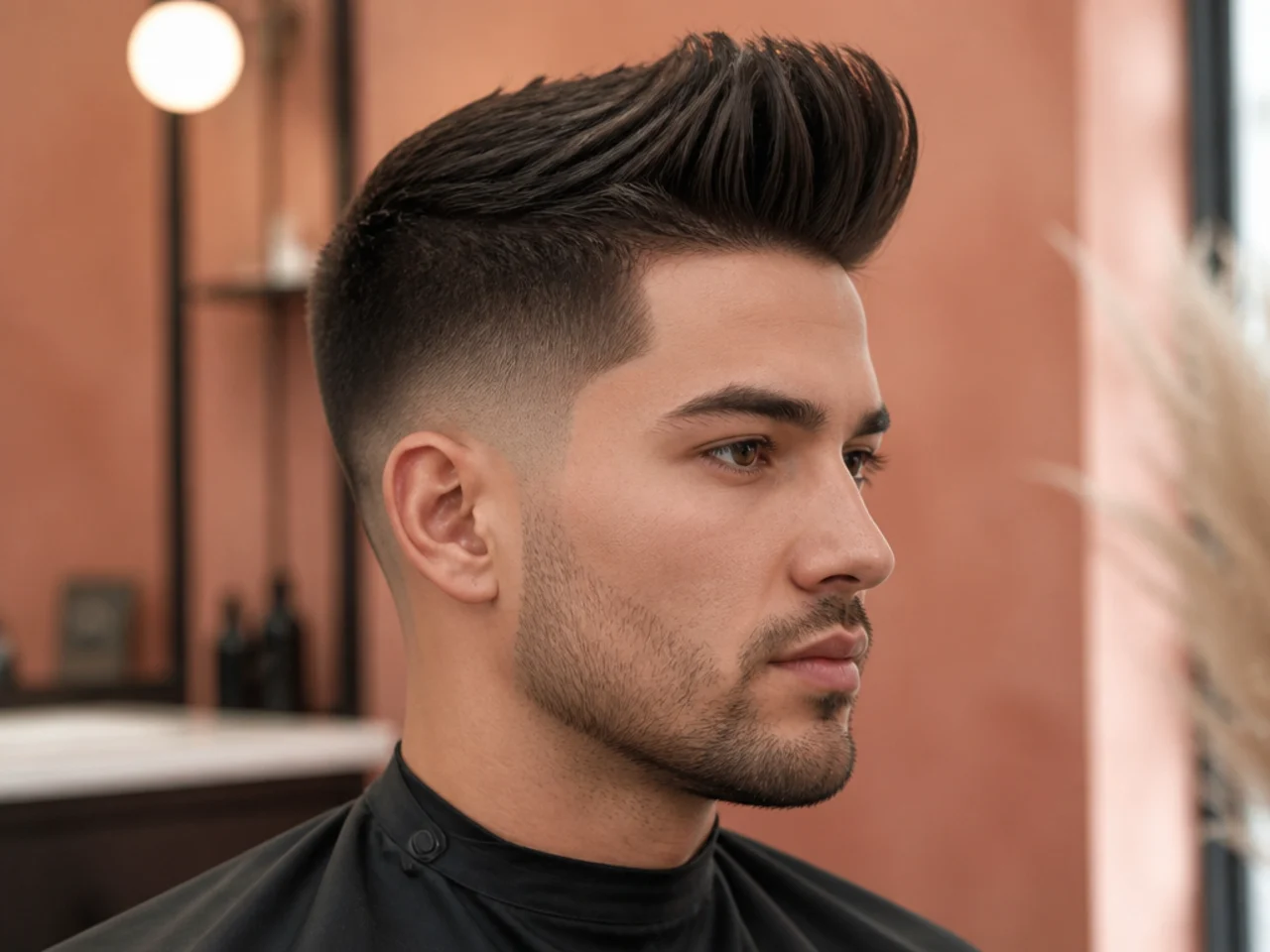
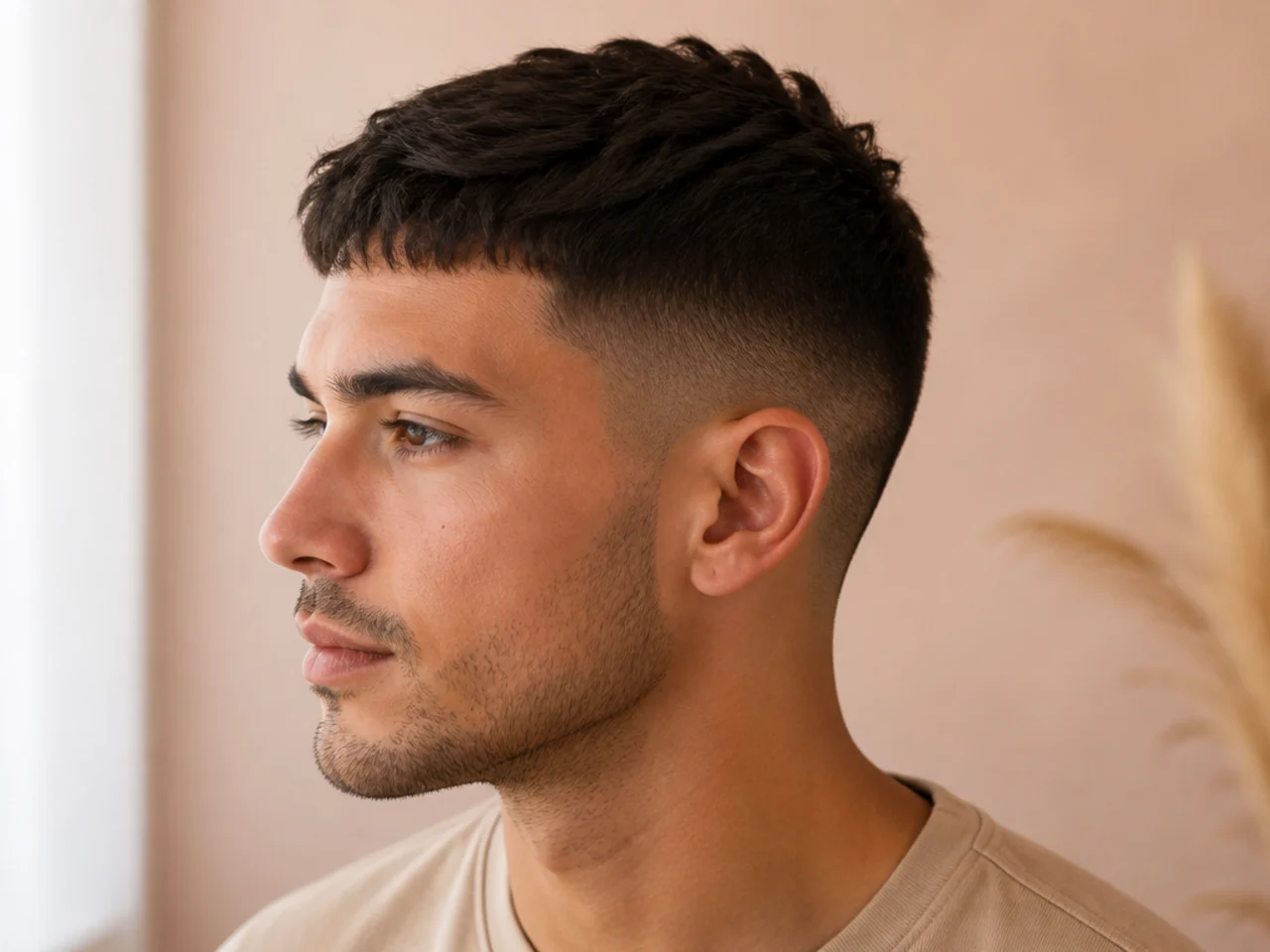
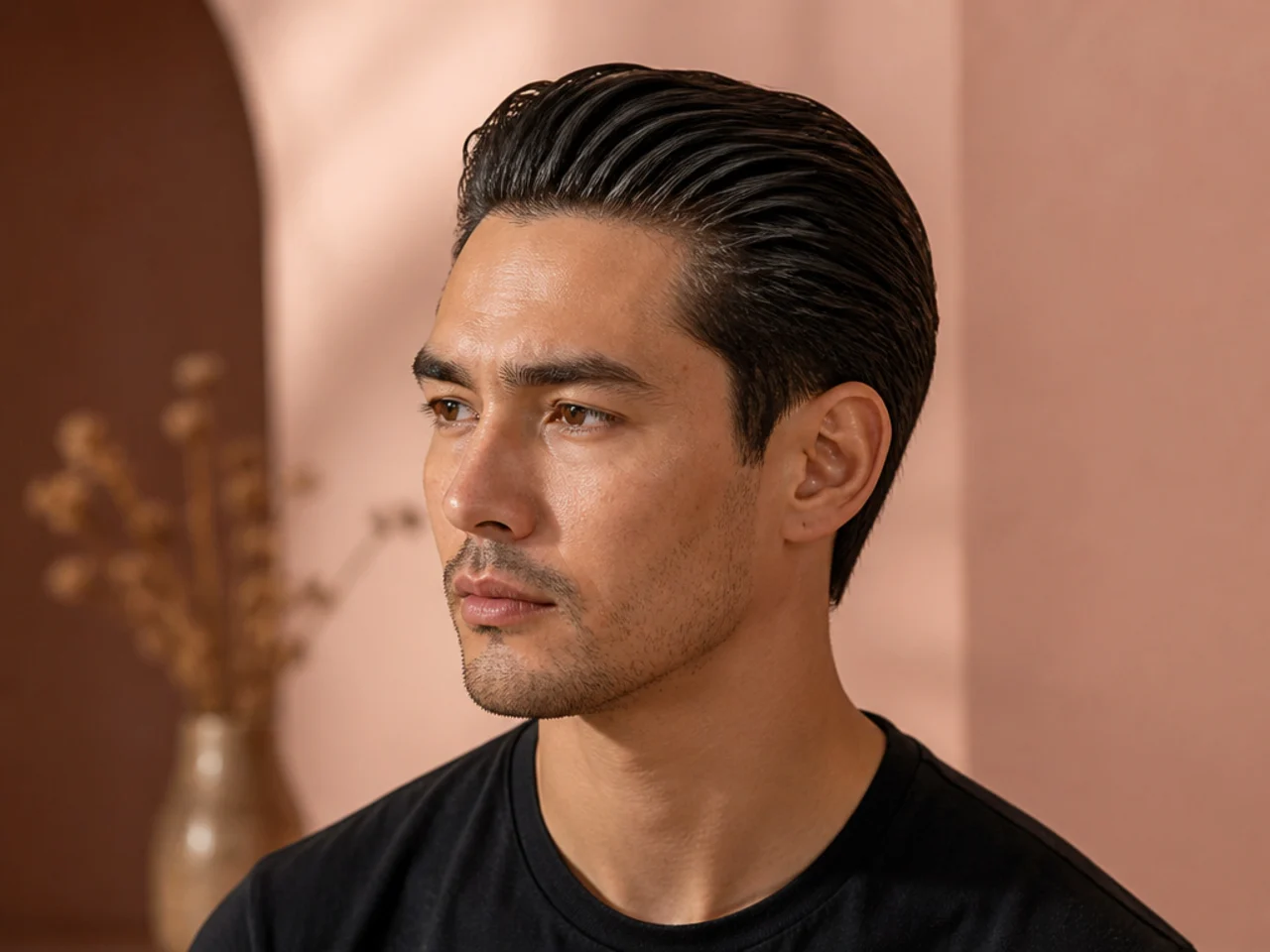
Short reads sporty. Long reads statement. Medium reads like a man who thought about it once, picked what worked, and stopped thinking about it. The four-to-six-inch length flatters more face shapes, holds more styles, and passes more dress codes than either neighbor — and it grows out without ever looking messy. Here are the five reasons medium length wins every time.
The One-Line Answer
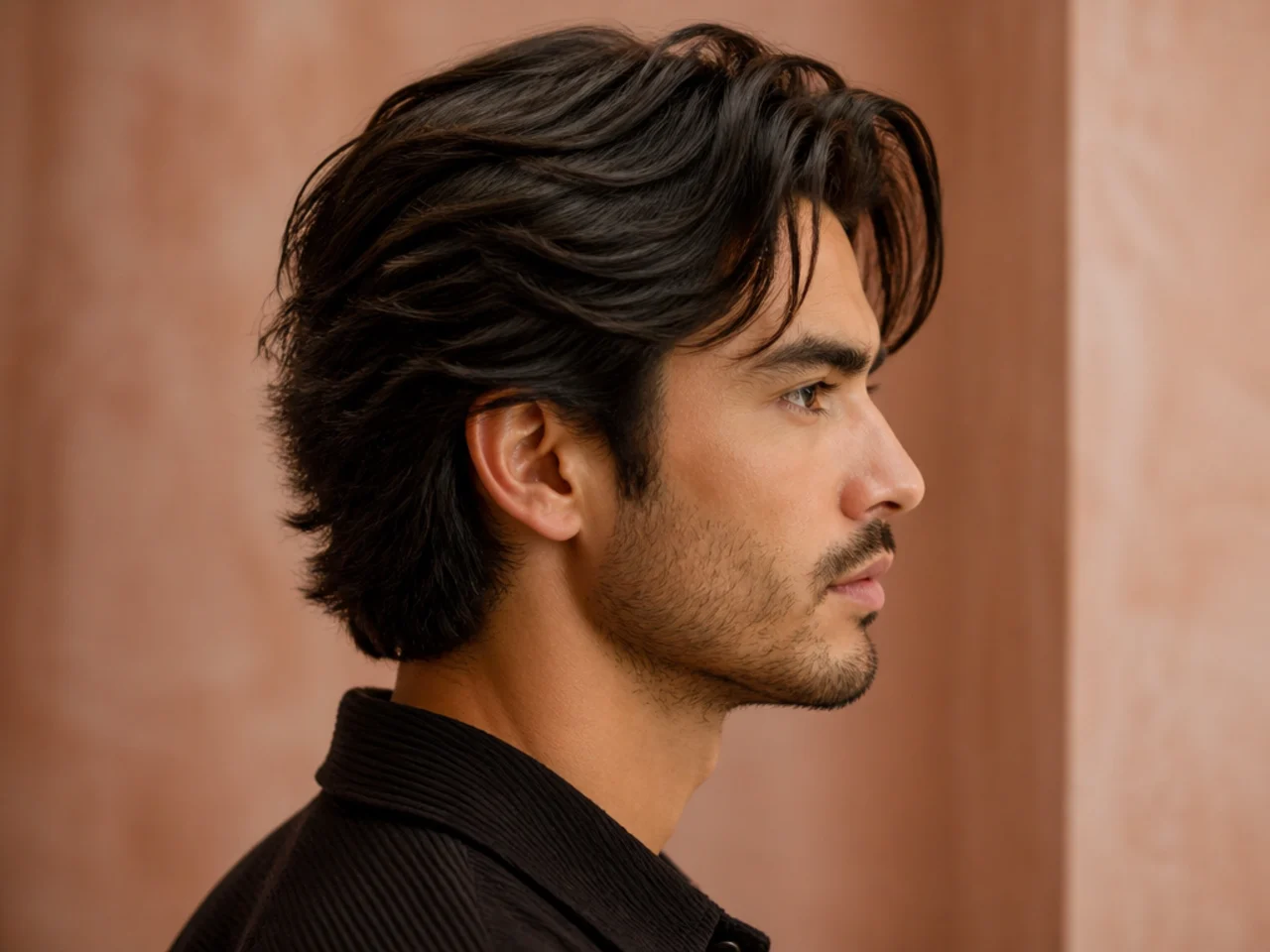
Medium length wins because it suits more face shapes, grows out gracefully, works with more hair textures, reads modern without effort, and fits more workplaces than short or long. Each of those five wins compounds — a cut that suits your face, tolerates a missed appointment, works with your natural texture, doesn't need daily blow-drying, and passes at both the office and the wedding is a cut you keep for years.
Why Medium Length Wins
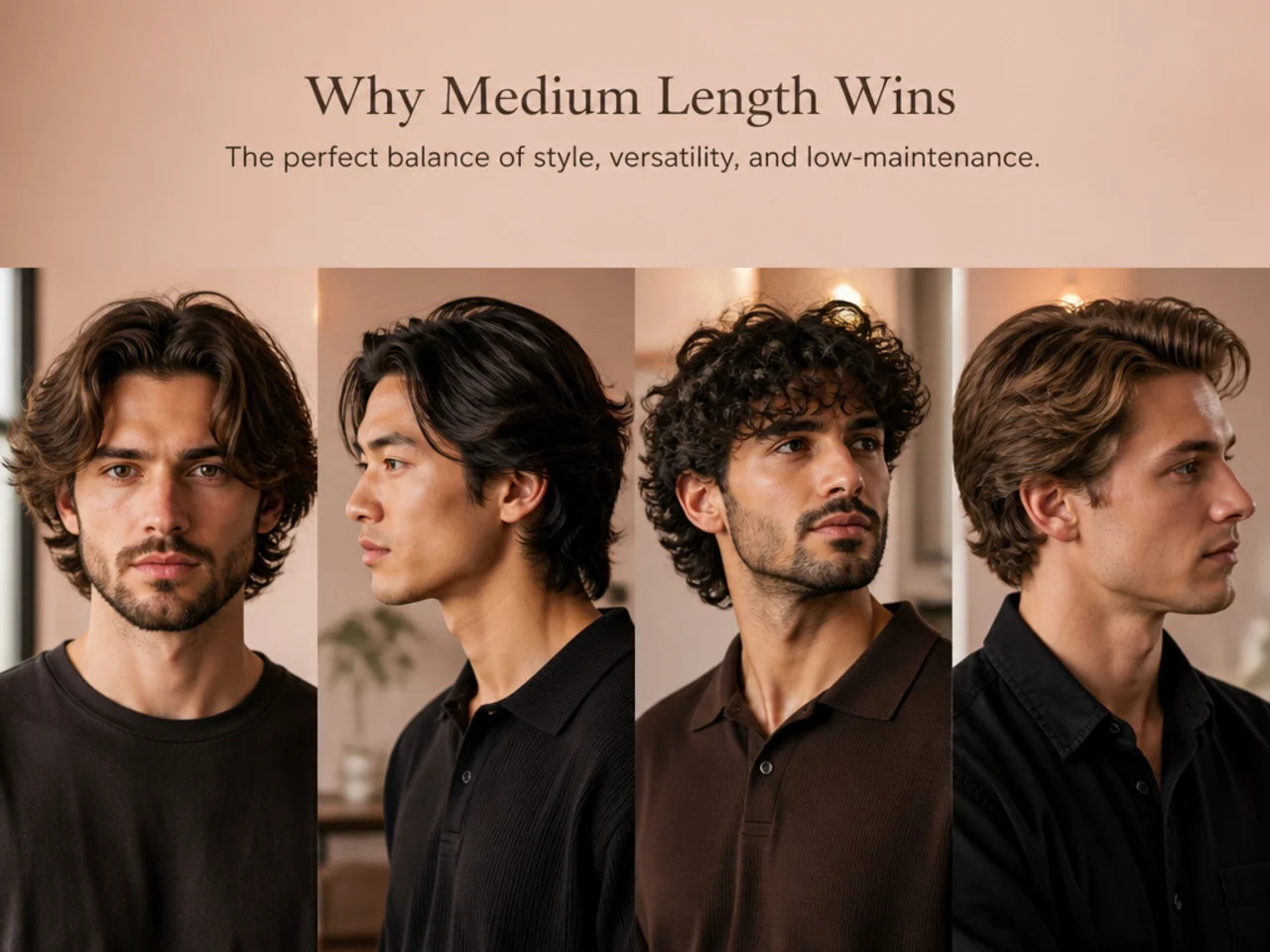
The men's haircut market is dominated by two poles. The short end — buzz, crew, French crop, taper fade — trades presence for zero maintenance. The long end — flow, mullet, man bun — trades workplace flexibility for statement. Medium length is the middle way, and it beats both ends on almost every axis that matters day to day. See the shorter neighbors in our short simple mens haircuts guide and the longer neighbors in the flow haircut men breakdown.
1. It suits more face shapes
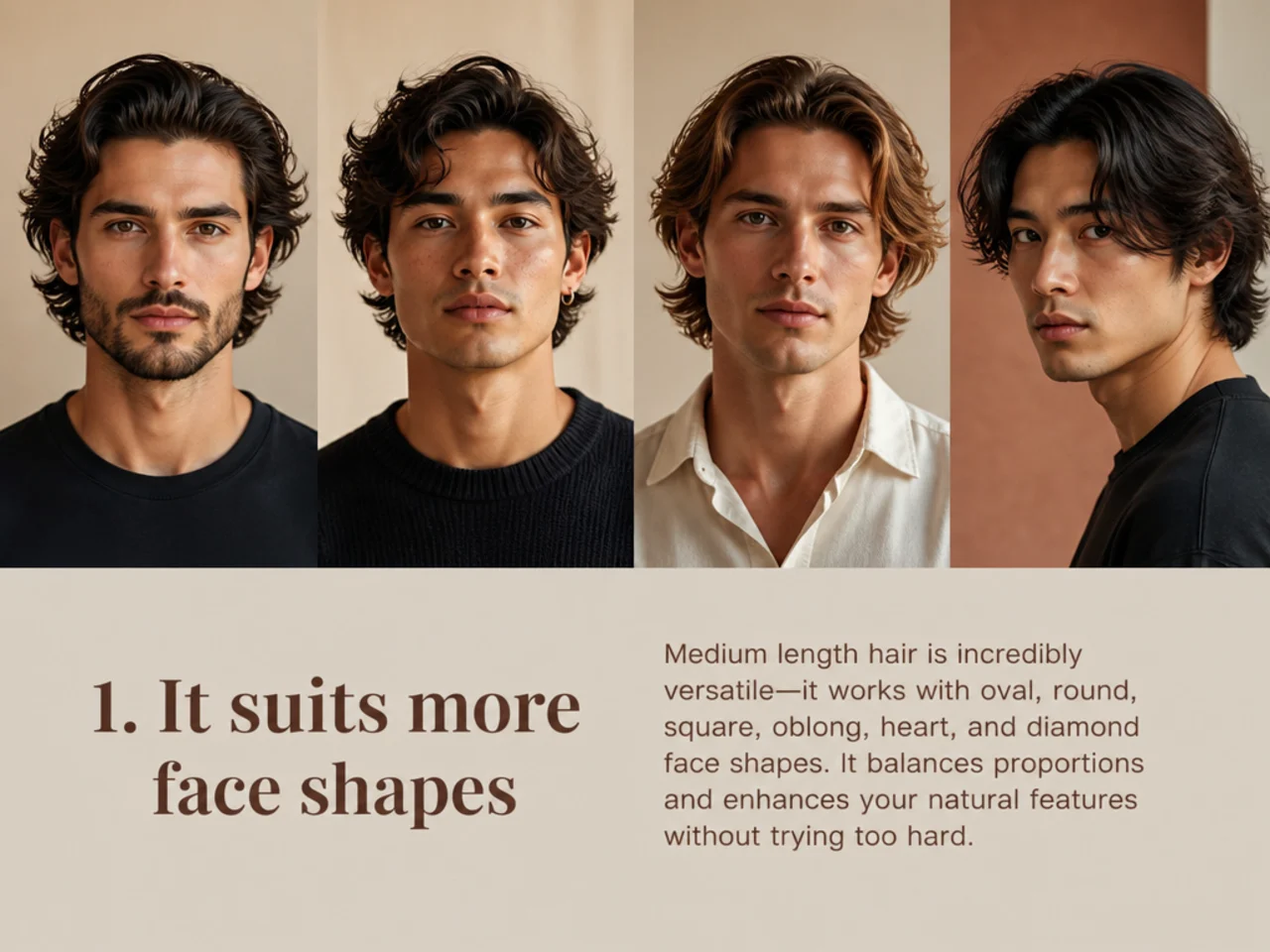
A buzz suits guys with strong, symmetrical bone structure and a well-shaped skull. A long flow suits guys with narrow oval faces and enough natural wave to keep the length from stringing out. In between, medium length adapts to almost every face shape — because the length is the styling variable, not the constraint.
Oval faces suit any medium variation from four to six inches. Square faces balance with soft internal layers and a scissor-blended side. Round faces get vertical lift from a quiff or textured crop. Long or oblong faces balance with a forward fringe or curtain part that adds horizontal weight. Heart faces suit a soft fringe that covers the temples. Diamond faces work with almost anything because the cheekbones lead.
Compare that to short cuts, which mostly favor oval and square faces, and to long cuts, which mostly favor oval faces with natural wave. Medium is the length with the widest face-shape fit — which is why barbers default to some version of it when a client says "just make it look good." For a deeper breakdown of face-shape variation, see the medium length haircuts targeted at every face shape guide or the haircuts for square faces primer.
2. It grows out gracefully
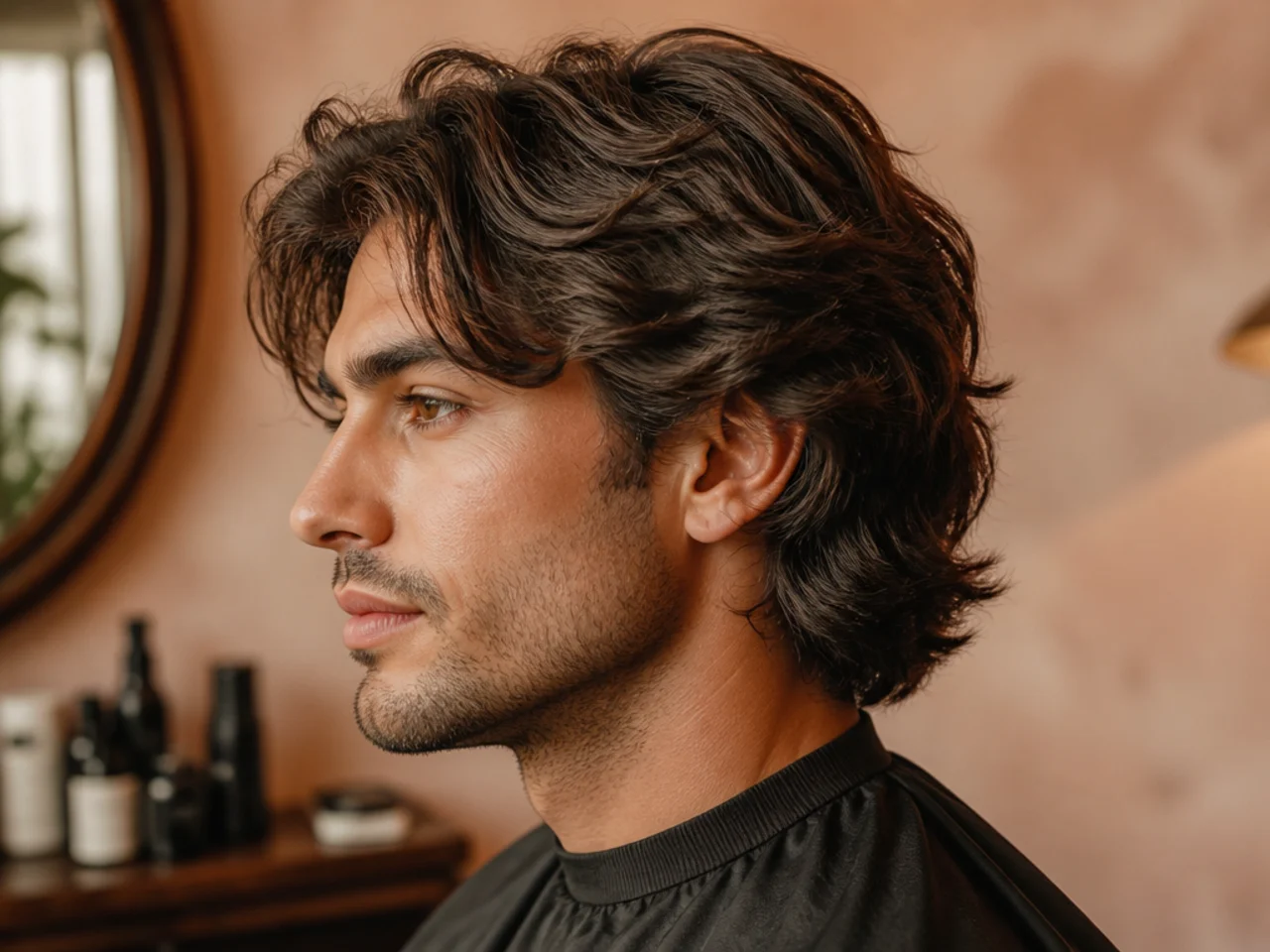
A fresh buzz reads sharp for two weeks and shaggy by four. A fresh flow reads clean for a month and starts looking overdue by month three. Medium length lives in the middle — a cut done at five inches on top and blended at the sides reads intentional at week one, still crisp at week three, and only starts asking for a trim at week five or six.
The math is simple. Hair grows about half an inch a month. On a short cut, that half inch is 50 percent of the length — the change is dramatic. On a medium cut, half an inch is 10 percent of the length — you can barely see the difference. On a long cut, half an inch is 5 percent — but the split ends and single-length weight start reading tired instead of grown.
Medium length is the only length where the natural grow-out reads as intentional variation instead of neglect. A five-inch top at week one becomes a five-and-a-half-inch top at week five — still in the classic medium zone, still shaped. That's why the medium haircut visit typically costs less per month than either short or long: fewer visits, same clean read. See the full cadence in our how often should men get a haircut guide.
3. It works with more textures
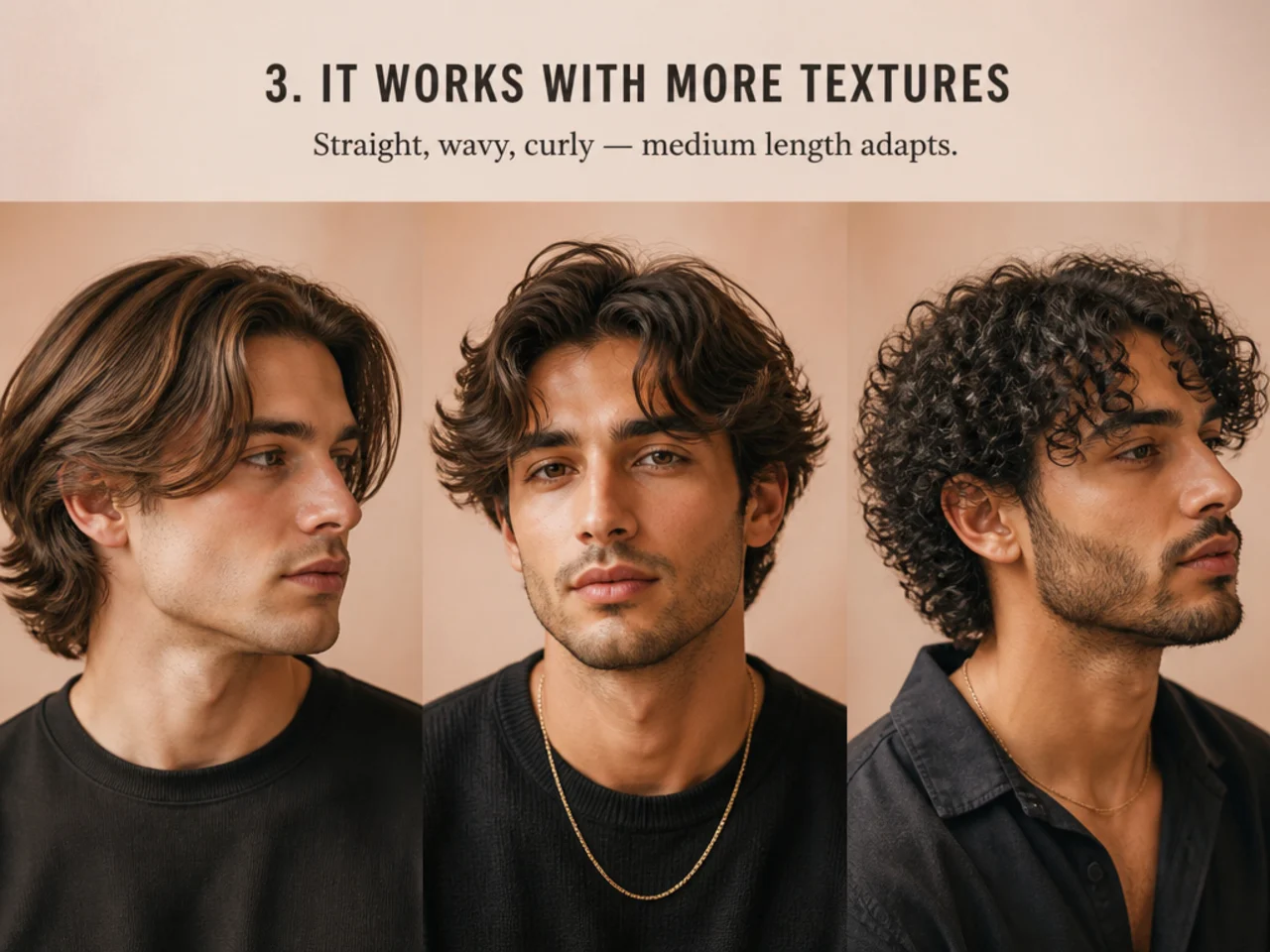
Straight hair sits clean at medium length in almost any variation — slick back, side part, middle part, textured crop, quiff, comb over. Wavy hair sits beautifully at medium length with soft internal layers cut in the direction of the wave — the length gives the pattern room to move without weighing the shape down. Curly hair reveals its full pattern at medium length — dry-cut layering builds the shape the pattern needs.
Coily hair sits especially well at medium length with a defined perimeter and a leave-in cream to hold the pattern. The medium range is long enough to let the coil bounce, short enough to define. Short cuts flatten coils under clipper work. Long cuts stack coils into a triangle that fights the head shape. Medium sits in the sweet spot.
Compare texture range across lengths. Short cuts work best on straight to slightly wavy — the shorter the cut, the more it demands consistent, dense hair. Long cuts work best on straight or wavy — very curly or coily hair at long length needs weekly styling to hold pattern definition. Medium length flatters every texture across the full 1A-to-4C range. For a full texture breakdown, browse our curly hair haircuts primer or the thick wavy hair haircuts guide.
4. It reads modern without effort

Look at any current reference — actors, athletes, indie musicians, off-duty athletes — and the dominant men's haircut length across every industry is medium. It reads current in a way that short and long do not. A buzz reads timeless but neutral. A long flow reads statement or subculture. Medium reads "this year" without dating itself to a specific trend.
The reason is that medium length holds the modern default styling — matte finish, soft texture, no aggressive product, no obvious effort. That look is impossible on a short cut (nothing to texture) or a long cut (needs blow-drying and product to hold shape). At medium length the modern default is what happens when you leave hair alone after a good cut — which is why the cut carries the modern read without needing daily styling to sustain it.
The current references — modern mullet, medium middle part, textured crop with soft fringe, Korean-inspired soft layers, medium bro flow — all sit at medium length. That's not a coincidence. Every men's haircut trend that has held for more than a year in the last decade has sat somewhere in the four-to-six-inch zone.
5. It fits more workplaces

A buzz fits any workplace including uniformed roles. A long flow fits creative and casual workplaces but reads out of place in traditional corporate, finance, law, or client-facing sales. Medium length fits everywhere except uniformed roles — the widest workplace range of any length.
At the conservative end, a medium side part, medium comb over, or medium Ivy League passes at any corporate office, courtroom, or client meeting. In the middle, a medium textured crop, medium middle part, or medium quiff reads clean in tech, consulting, and hospitality. At the creative end, a medium flow, medium shag, or medium mullet reads intentional in agencies, studios, and startups.
The workplace flexibility means one cut usually covers the entire spectrum. A four-and-a-half-inch top with scissor-blended sides can be styled with pomade for a client meeting on Monday, textured with paste for the office Wednesday, and worn tousled at a friend's wedding Saturday. Short cuts and long cuts both demand more consistency across settings — medium lets one cut serve every context in your calendar. For the workplace-ready set, browse our business hairstyles for men and professional hairstyles for men references.
Short vs Medium vs Long — Quick Comparison
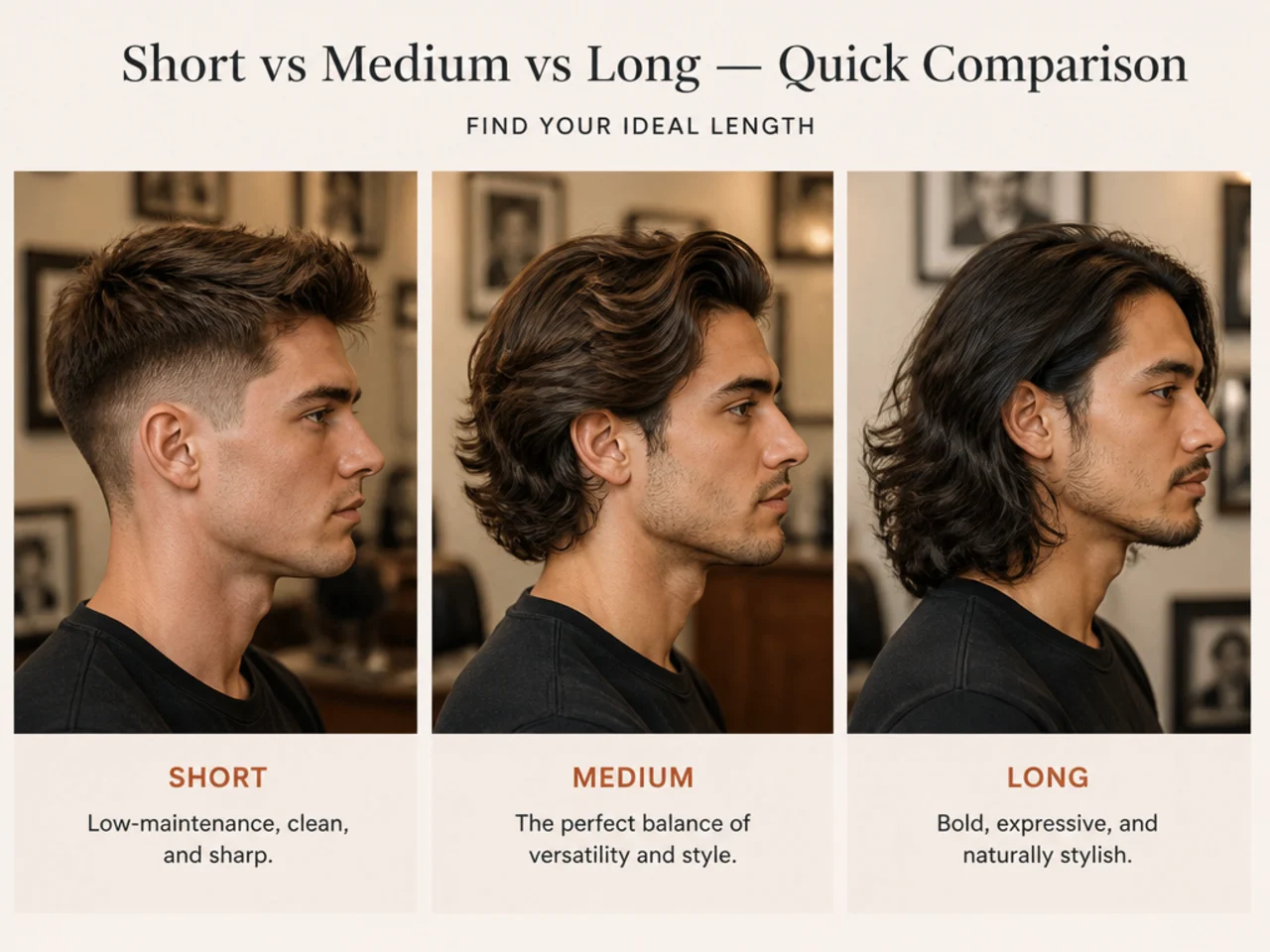
Here's the seven-axis comparison. Match your priorities to the column that wins on the axes you care most about.
- Face-shape fit: Short favors oval and square. Medium fits every face shape. Long favors oval only. Medium wins.
- Workplace range: Short fits every workplace including uniformed. Medium fits every non-uniformed workplace. Long fits creative and casual only. Short and Medium tie for range, Medium wins for non-uniformed.
- Maintenance cadence: Short needs a re-cut every three weeks. Medium every four to six. Long every eight-plus. Long wins on frequency, but Medium wins on total cost per year because the visits are simpler.
- Hair-type range: Short favors dense straight to wavy. Medium fits every texture 1A-4C. Long favors straight and wavy with density. Medium wins.
- Styling time: Short is zero to 30 seconds. Medium is one to three minutes. Long is three to seven minutes with a blow-dryer. Short wins.
- Grow-out grace: Short reads shaggy by week four. Medium reads intentional through week six. Long reads tired by month three. Medium wins.
- Cost per year: Short totals more visits at lower price. Long totals fewer visits at higher price. Medium is usually the cheapest per year — five-week average cadence at a mid-tier cut cost.
Medium length wins six of the seven axes outright, ties on the seventh, and only loses on pure styling time — where the difference is one to two minutes a day. If the extra 60 seconds doesn't decide the choice for you, medium is the length to pick.
Which Length Should You Pick?
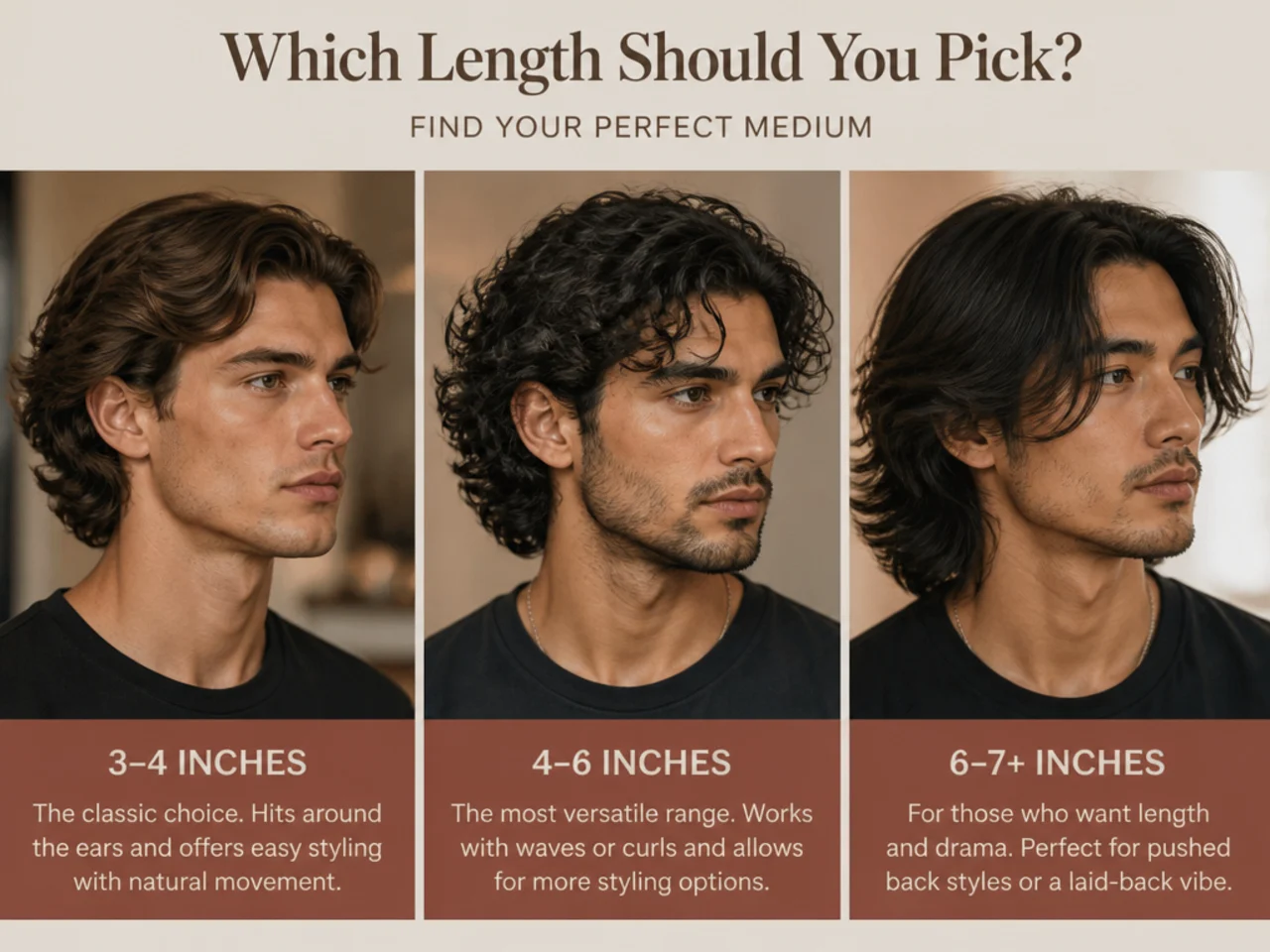
Pick short if your job requires a uniform or heavy safety gear, you play a contact sport that involves helmets, you struggle to make time for morning styling, or you have a strong scalp shape and symmetrical hairline that you want to show off. Short cuts — buzz, crew, French crop, Ivy League — win on pure styling simplicity and lowest-effort mornings. See our short simple mens haircuts guide for the family.
Pick medium if you want a cut that suits your face shape, passes at work, grows out gracefully, and works with whatever natural texture you have. Medium length is the safe answer to almost every situation — the length barbers default to when clients say "just make it look good." Start with a five-inch classic layered cut, a medium side part, or a medium middle part depending on your face shape. See the full medium length hairstyles for men breakdown for reference variations.
Pick long if your workplace welcomes a statement look, you have straight or wavy hair with enough density to hang cleanly, and you don't mind the every-morning styling investment. Long cuts — full flow, modern mullet, man bun, wolf cut — win on personal expression and identity signaling. Budget for weekly deep-conditioning and monthly trims to keep the length reading clean instead of tired.
FAQ
Is medium length harder than short for beginners?
Slightly, but not by much. The first few weeks are the same — a good cut styles itself. The learning curve is small: which product for your finish (matte, glossy, or wavy), and how to blow-dry the direction of the fall. Both are one-lesson skills.
How do I know if medium length will work with my hair?
If your hair holds a soft brush stroke on damp hair without falling flat, medium length will work. If your hair collapses under any weight — very fine straight hair — ask for a shorter medium at four inches with heavy internal layers instead of the six-inch flow zone.
Does medium length cost more per year than short?
Usually less. A medium cut runs $40 to $65 every five to six weeks — about nine visits per year. A short cut runs $30 to $50 every three weeks — about 17 visits per year. Even at a higher per-cut price, medium wins the annual math because you sit in the chair almost half as often.
Can I switch from short to medium without a bad grow-out phase?
Yes, with the right structure. Ask your barber to shape the sides and neckline into a clean taper each visit while the top grows. That keeps the shape intentional throughout the grow-out. The uncomfortable phase is usually four to eight weeks, and the intentional-taper approach cuts that in half.