
15 Things I Learned Growing Out Curtain Bangs
Growing out curtain bangs is a six month job with one bad stretch in the middle, and the bad stretch is a length rather than a phase. Here is what goes wrong at each stage and what to do instead of cutting them back in.
In this article · 22
- What Growing Out Curtain Bangs Actually Means
- How to Choose Your Grow Out Route
- The 15 Things I Learned
- 1. The Awkward Length Is the Cheekbone
- 2. Half an Inch a Month Is the Entire Timeline
- 3. Trimming the Front Restarts the Clock
- 4. Blending Trims Cut the Hair Below the Bang
- 5. Dry Cutting Is the Only Way to See the Fall
- 6. The Middle Part Stops Working Around Month Three
- 7. A Deep Side Part Buys Two Months
- 8. The Round Brush Does More Than Any Product
- 9. Texture Decides How Long It Feels
- 10. The Ends Get Thin Before They Get Long
- 11. Clips Are a Six Week Fix Not a Six Month Plan
- 12. People Confuse This With a French Bang
- 13. Volume Moves Down the Head as It Grows
- 14. On Short Hair the Bang Has Nowhere to Go
- 15. You Will Know It Is Done at the Jaw
- Styling and Upkeep
- Mistakes to Avoid
- FAQ
- Final Thoughts
Nobody warns you that the awkward stage of growing out curtain bangs is not a phase you wait through, it is a specific length that lasts about six weeks.
Curtain bangs become face framing layers whether or not you help them. The only question is how obvious the step between the fringe and the lengths looks while they get there.
The one thing that resets the whole project is trimming the front. Every time the shortest piece gets shortened, the six month clock starts again from that length.
What Growing Out Curtain Bangs Actually Means
You are not waiting for the bang to vanish. You are waiting for it to reach a length where it reads as the shortest layer rather than as a fringe.
Hair grows about half an inch a month. A bang cut at the cheekbone is roughly three inches from the jaw, which is six months, not the eight weeks most people budget for.
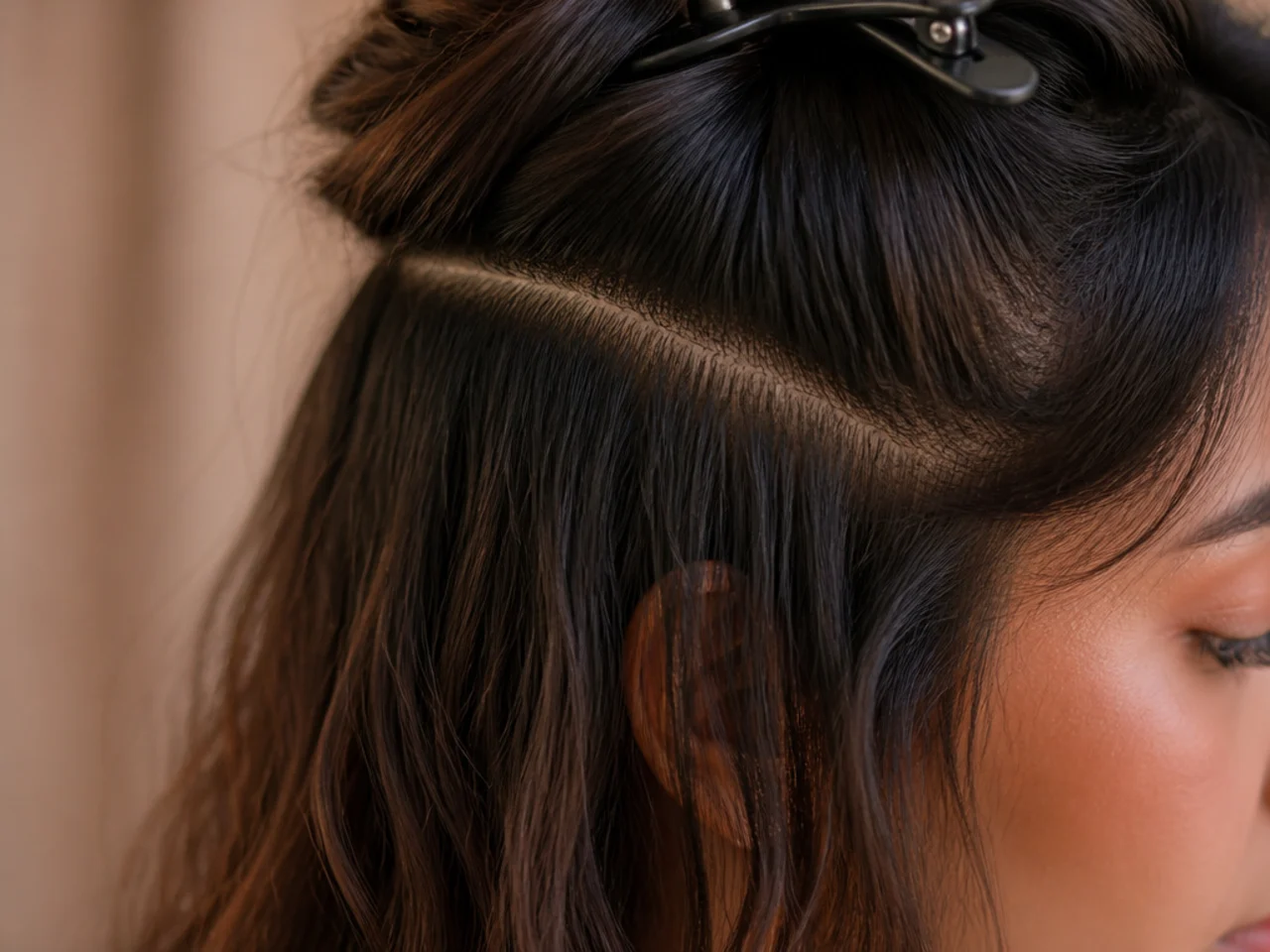
The step is the problem, not the length. A visible jump between the fringe and the hair underneath is what makes grown out bangs look untidy, and that jump can be removed by cutting the lengths rather than the fringe.
Curtain bangs already lean this way. They are cut longer at the outer edges specifically so they can blend into the sides, which is why they grow out more gracefully than a blunt fringe ever does.
How to Choose Your Grow Out Route
Blend it down if you want it invisible. Shortening the surrounding lengths to meet the bang removes the step in one appointment, at the cost of overall length.
Wait it out if length matters more. Nothing gets cut, the step stays visible for two to three months, and you finish with more hair than you started with.
Change the parting if you only need to survive six weeks. Moving the part sideways drops the shortest pieces out of the centre of the face and into the side sweep.
Pin it back only as a stopgap. Clips work for the worst month and then start looking like a permanent solution to a problem you have stopped fixing.

The 15 Things I Learned
1. The Awkward Length Is the Cheekbone
The shortest piece sits exactly where the face is widest, so it has nowhere to fall. It is too long to hold a curtain shape and too short to tuck behind an ear, and it pushes outward against the cheek instead of hanging down. This is a length, not a phase, and it passes in about six weeks.
2. Half an Inch a Month Is the Entire Timeline
Everything else follows from that number. Cheekbone to jaw is roughly two months, jaw to collarbone another four. Knowing the arithmetic stops the mid point panic, because the stage that feels endless is measurably a matter of weeks.

3. Trimming the Front Restarts the Clock
Any trim to the shortest piece puts you back where you were two months earlier, and the trim always feels justified at the time because that piece is the one annoying you. If a hairdresser reaches for the front section, say the fringe is being grown and only the lengths are being touched.

4. Blending Trims Cut the Hair Below the Bang
The step disappears when the layer underneath is shortened up to meet the fringe, not when the fringe is shortened down to meet it. This costs you an inch of overall length and removes the problem in a single appointment, which is a fair trade if the step is what is bothering you.
5. Dry Cutting Is the Only Way to See the Fall
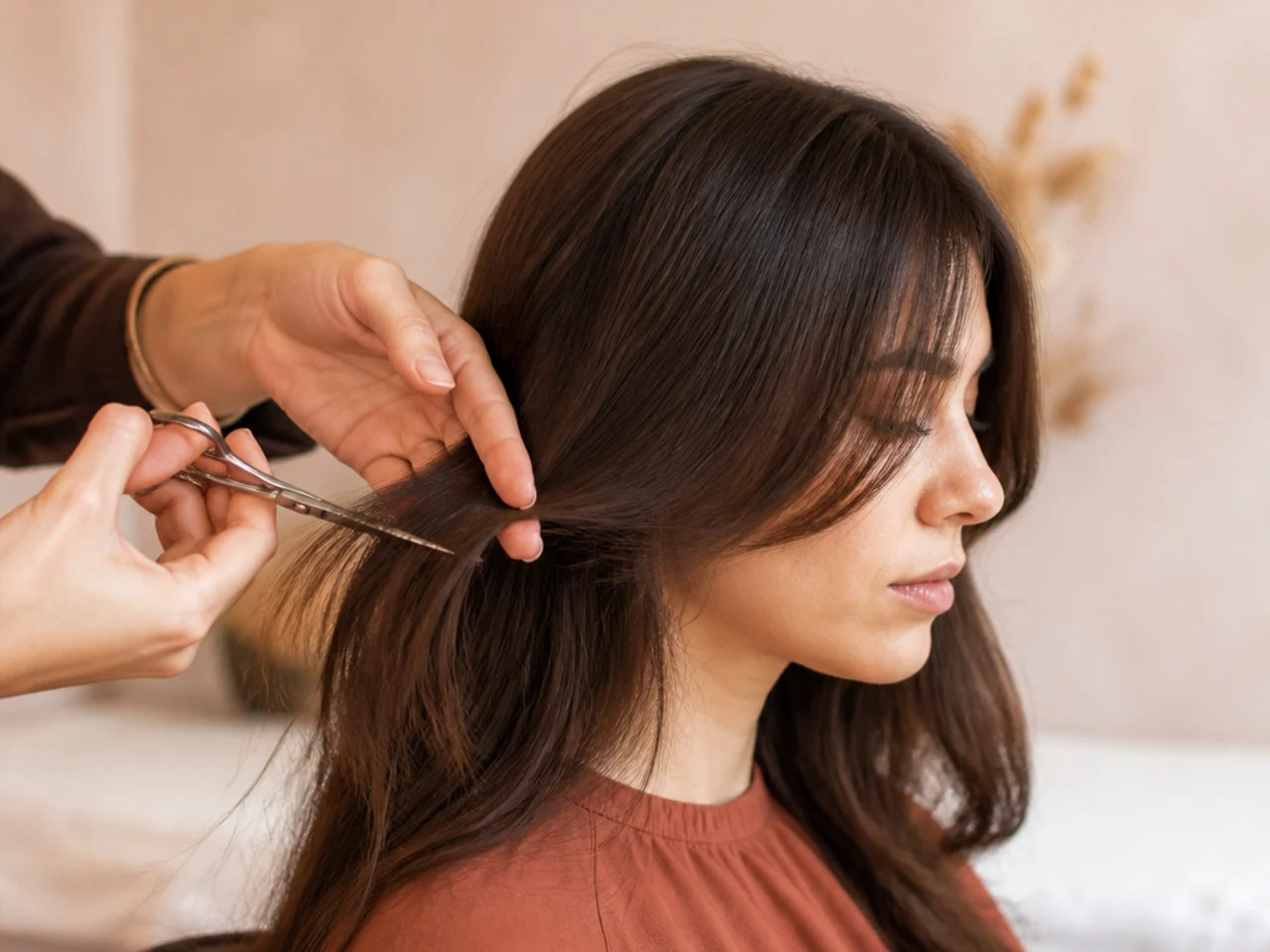
Wet hair hangs lower than dry hair, by roughly a centimetre on straight hair and by as much as a third of its length on curls. A blending trim measured wet lands short once it dries and springs up, which turns a subtle blend into a new fringe.

6. The Middle Part Stops Working Around Month Three
At that length the two halves are heavy enough to fall straight down rather than sweeping outward, so the curtain shape collapses into two flat panels either side of the nose. Either commit to a side part for a while or start blow drying the front back rather than down.

7. A Deep Side Part Buys Two Months
Moving the parting well off centre pushes the shortest pieces sideways into the bulk of the hair, where they disappear into the sweep. It works because the awkward length only looks awkward when it hangs vertically, and more on which part suits which face is in side swept bangs by face shape.

8. The Round Brush Does More Than Any Product
Drying the front section back over a round brush sets a bend at the root, and that bend is the entire curtain effect. Product cannot create it, because the direction hair takes is fixed while it dries and product only holds whatever position the drying chose.

9. Texture Decides How Long It Feels
Curly hair spends less time in the awkward stage because the curl lifts the shortest piece off the face instead of letting it hang across the cheek. Straight hair spends the longest, since every millimetre of the grow out is visible in a single vertical line.

10. The Ends Get Thin Before They Get Long
Curtain bangs are point cut so the ends taper, and a tapered end thins further as it grows and catches on things. By month four the front sections look wispy compared to the rest, which reads as damage but is actually the original cut still showing.

11. Clips Are a Six Week Fix Not a Six Month Plan
Pinning the front back is genuinely the right answer during the worst stretch, but a clip worn every day for months pulls the same pieces in the same direction and trains them to sit that way. Alternate which side you pin and give the front a few days loose each week.

12. People Confuse This With a French Bang
A french bang is cut shorter and rounder across the middle, so it grows out into a completely different shape and takes longer to disappear. If someone offers to tidy your fringe into something rounder, that is a different cut, and the difference is set out in french versus curtain bangs.

13. Volume Moves Down the Head as It Grows
A short fringe puts weight at the forehead and the crown looks fuller for it. As it lengthens, that weight travels down towards the jaw and the top of the head flattens, which is why the whole shape can look worse at month three even though nothing was cut.

14. On Short Hair the Bang Has Nowhere to Go
With a bob, the lengths beside the face are only a few inches longer than the fringe, so there is very little hair for it to blend into and the step stays obvious. On short hair, blending trims are the practical route, since waiting simply holds the step in place for months.

15. You Will Know It Is Done at the Jaw
Once the shortest piece clears the jawline it stops behaving like a fringe, because it can finally tuck behind an ear and fall with the rest of the hair. From that point it is a face framing layer and the grow out is effectively over, whatever the rest of the length is doing.

Styling and Upkeep
Dry the front section first. It sets the shape of the whole style, and by the time you get to it last it has already air dried flat.
Dry it backwards, not downwards. The bend at the root is what makes a grown out fringe read as a layer rather than as an accident.
Book blending trims, not fringe trims. Say which section you want left alone before anyone picks up scissors.
Use no product at the root of the front. It is the lightest hair on your head and the fastest to be dragged flat.
Take a photograph each month. Progress is half an inch at a time, which is invisible day to day and obvious across three photographs.

Mistakes to Avoid
Trimming the front when it annoys you. It always feels reasonable and it always costs two months.
Cutting a blending trim on wet hair. Wet hair hangs longer, so the result lands shorter than intended once it dries.
Wearing the same clip in the same place daily. The pieces learn the direction and stop falling naturally when you take it out.
Going back to a centre part too early. Around month three the halves are heavy enough to hang flat, and a side part carries them better.
Judging progress at the mirror every morning. Half an inch a month cannot be seen day to day, and impatience is what leads back to the scissors.

FAQ
How long does it take? Six to eight months from cheekbone to collarbone, at half an inch a month.
Can I trim anything? Yes, the lengths beneath the fringe, never the fringe.
When does it stop looking odd? Once the shortest piece clears the jaw.

Final Thoughts
The whole project comes down to leaving the shortest piece alone. Everything else, the parting, the blow dry direction, the blending trim, only manages how visible the step is while that piece catches up with the rest of your hair.
For how the same shape sits once the length arrives see curtain bangs on long hair, and for the version cut with a softer inner edge see french curtain bangs. More in Bangs and Fringe.