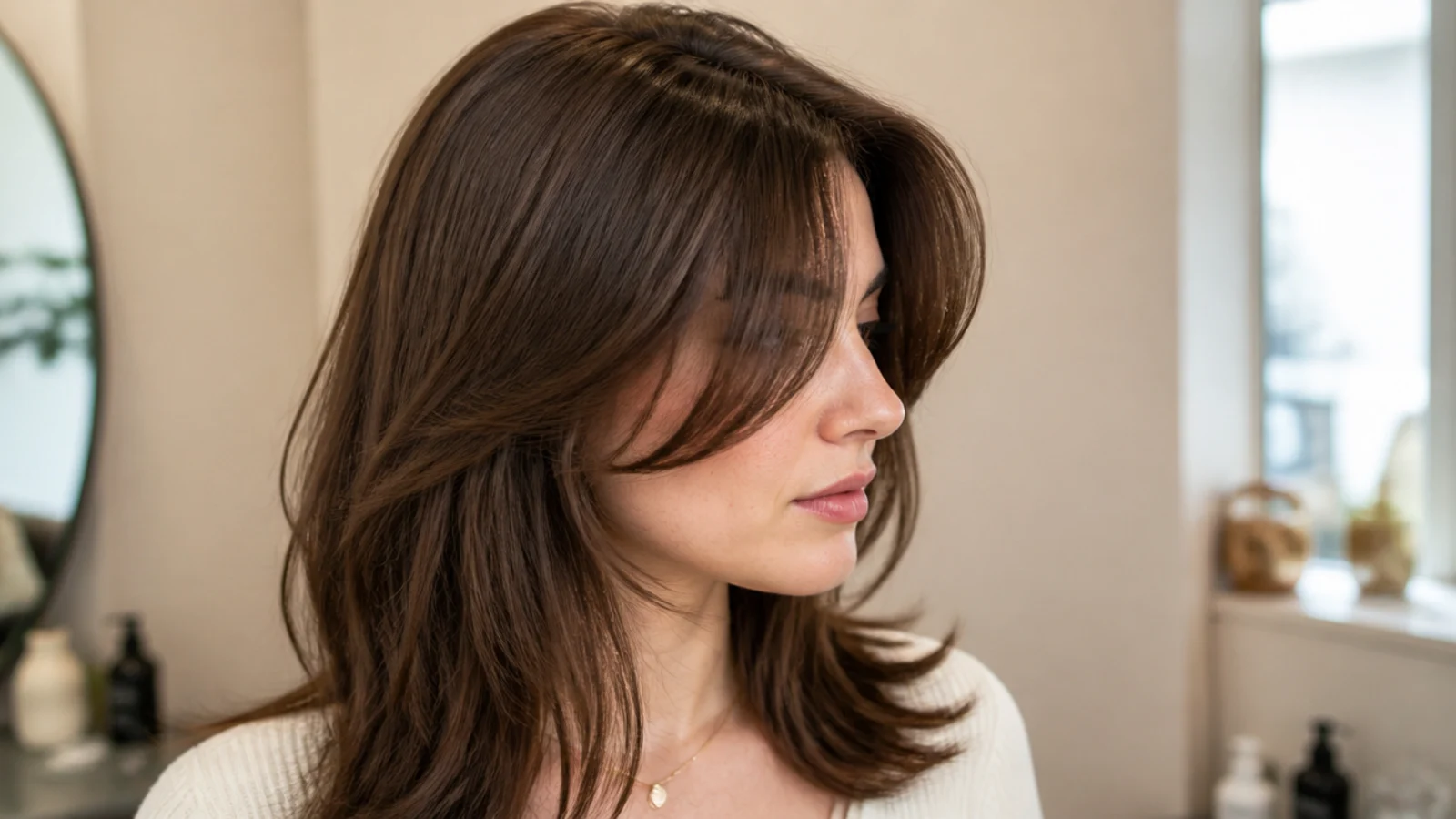
20 Easy Short Curtain Bangs Ideas To Try Now
On short hair a curtain fringe has far less length to grade into, so the same cut has to happen over a steeper angle. Get the section width wrong and it reads as an isolated tuft rather than a fringe.
In this article · 27
- How Short Curtain Bangs Are Built
- Choosing Your Shortest Point
- The 20 Short Curtain Bangs Ideas
- 1. Curtain Bangs on a Blunt Bob
- 2. Curtain Bangs on a French Bob
- 3. Curtain Bangs on a Pixie
- 4. Curtain Bangs on a Lob
- 5. Curtain Bangs on a Shag
- 6. Eyebrow Length Curtain Bangs
- 7. Cheekbone Length Curtain Bangs
- 8. Nose Length Curtain Bangs
- 9. Jaw Length Curtain Bangs
- 10. Wispy Curtain Bangs
- 11. Heavy Curtain Bangs
- 12. Curtain Bangs on Fine Hair
- 13. Curtain Bangs on Thick Hair
- 14. Curtain Bangs on Straight Hair
- 15. Curtain Bangs on Wavy Hair
- 16. Curtain Bangs on Curly Hair
- 17. Curtain Bangs With a Deep Centre Part
- 18. Curtain Bangs With an Off Centre Part
- 19. Air Dried Curtain Bangs
- 20. Grown Out Curtain Bangs
- Styling and Upkeep
- Mistakes to Avoid
- FAQ
- Final Thoughts
Short curtain bangs fail for one reason more than any other: the section taken was too narrow to reach the temples, so the fringe has nothing to blend into.
A curtain fringe is graded, not cut to a line. Shortest at the centre part, progressively longer towards the temples, then joined to whatever sits beside it.
Short hair compresses the grade. There are fewer inches to travel through, so the same shape has to be built over a steeper angle.
How Short Curtain Bangs Are Built
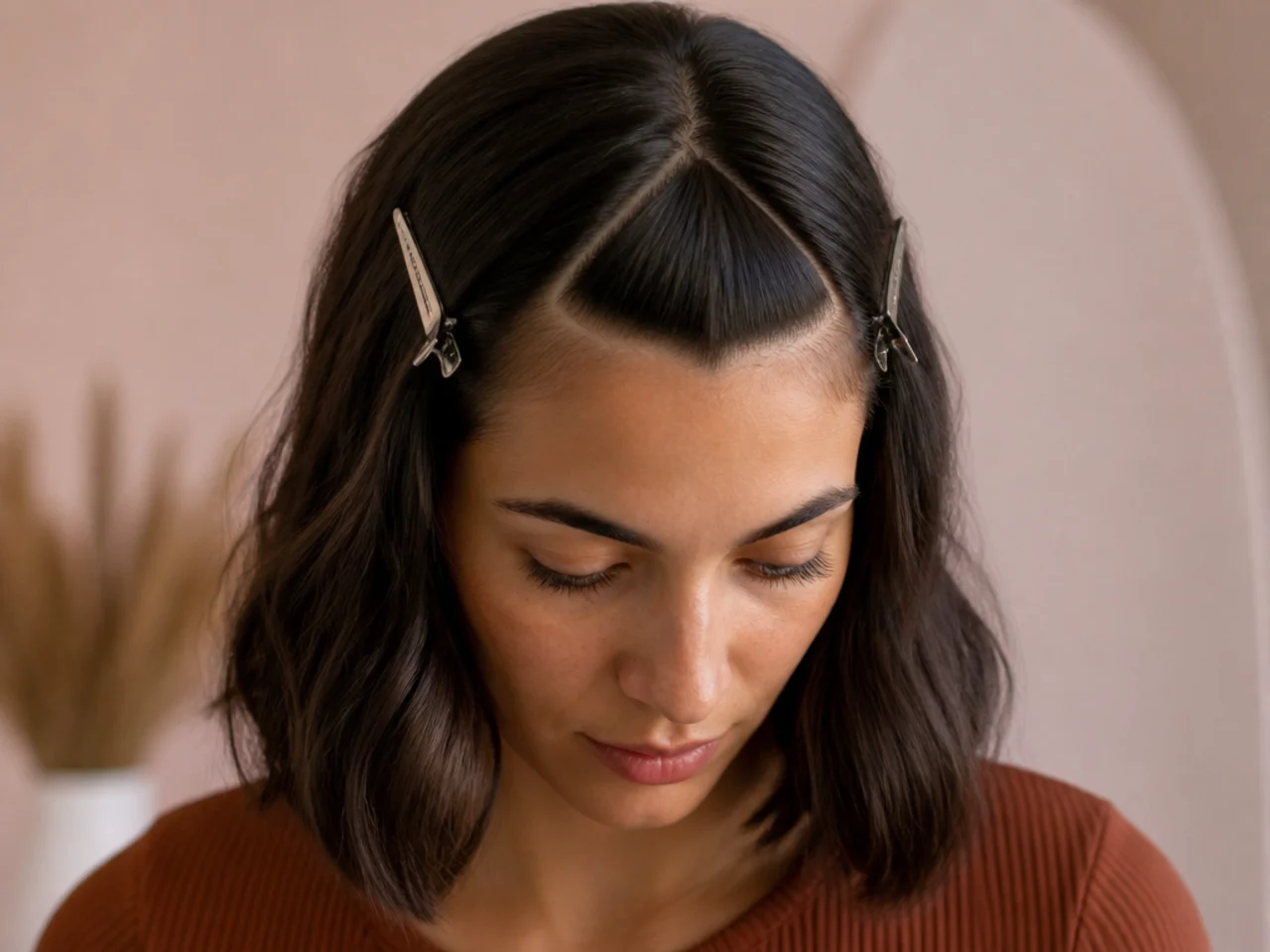
The section is a triangle, not a rectangle. It starts about two inches back at the centre and narrows to points at the temples, which is what lets it join the sides.
The centre is the shortest point. Everything else is measured out from it, and moving it up or down changes the whole fringe.
The join happens fast on short hair. With only a few inches of length beside the fringe, the grade has to be steep or there is a step at the temple.
The part sets the split. Roots dry in whatever direction they were left, so the parting is doing the work that product usually gets credit for.
Choosing Your Shortest Point
Set it against your cheekbone first. It is the point the eye reads first, so it decides whether the fringe shortens or lengthens the face.
Measure it dry if you have any bend. Waves pull up about an inch and curls two or more, and a fringe has less margin for error than any other section.
Adjust the section depth for density. Thick hair needs a shallower section or the fringe becomes a slab. Fine hair needs a deeper one so each half still reads.
Decide the parting before the cut. A fringe split down the centre over a side part behind it fights itself at the root every morning.

The 20 Short Curtain Bangs Ideas
1. Curtain Bangs on a Blunt Bob
The fringe is broken and graded while the perimeter stays solid, and that contrast is what makes both halves read more clearly. Without it, a blunt bob and a blunt fringe form two horizontal lines that flatten the whole head.
2. Curtain Bangs on a French Bob
A French bob sits at the jaw with a fringe as part of its definition, so the curtain version simply replaces the usual blunt one. The grade at the temples matters more here because there are only a couple of inches of length for it to disappear into.

3. Curtain Bangs on a Pixie
On a pixie the fringe becomes the longest section on the head rather than the shortest, which inverts the usual relationship. That length difference is what stops a pixie reading as uniformly cropped, and it gives the front something to fall forward with.

4. Curtain Bangs on a Lob
A shoulder length lob gives the fringe several inches of face framing to grade into, so the join is invisible and the transition can be gradual. It is the easiest short length to cut curtain bangs into for exactly that reason.

5. Curtain Bangs on a Shag
The fringe becomes the shortest point of a cut that is already graded throughout, so it joins the layers with nothing to blend across, as in a short wolf cut with bangs. The layers behind it also hold it forward, which is why a shag fringe rarely needs product to stay in position.

6. Eyebrow Length Curtain Bangs
The shortest point sits level with the brow, which is the highest a curtain fringe can go before it stops splitting and starts reading as a full fringe. It shortens the visible forehead more than any other placement, and it is the least forgiving as it grows.

7. Cheekbone Length Curtain Bangs
The most common placement, because the ends land on the widest point of the face and the two diagonals narrow it. It also clears the eyes completely, which is the practical reason most people settle here after trying shorter.

8. Nose Length Curtain Bangs
Sitting between the cheekbone and the jaw, the ends fall past the eye line and the fringe reads as face framing rather than as a fringe. It is the safest starting point if you have not had a fringe before, since it is only one trim away from being back to nothing.

9. Jaw Length Curtain Bangs
The longest a curtain fringe can be before it stops functioning as one, since below the jaw the two halves no longer curve back and simply hang. On a bob it doubles as the face framing, which means one trim maintains both.

10. Wispy Curtain Bangs
Cut with the tips of the scissors so each strand finishes at a slightly different point, which turns the edge into a haze rather than a line. That softness is what suits a high forehead, because it covers without laying a hard horizontal across the face.

11. Heavy Curtain Bangs
A deeper section taken further back from the hairline, so the fringe carries real density and holds its curve without heat. The tradeoff is upkeep, because a heavier fringe shows growth sooner and needs trimming closer to every four weeks.

12. Curtain Bangs on Fine Hair
Splitting the section down the middle halves the density on each side, which on fine hair can leave both halves showing scalp. Taking the section slightly deeper compensates, and cutting the ends bluntly rather than wispy keeps what density there is concentrated at the edge.

13. Curtain Bangs on Thick Hair
A deep section on thick hair produces a slab that stands away from the forehead at the root. Taking a shallower triangle, only an inch or so back from the hairline, gives the fringe enough weight to lie down without gathering more hair than it can carry.

14. Curtain Bangs on Straight Hair
Straight hair has no bend to produce the outward curve at the ends, so the shape has to come from a brush or from the way the ends are cut. Point cutting the last half inch gives the tips somewhere to break, which is why a straight curtain fringe holds better when it is notched.

15. Curtain Bangs on Wavy Hair
The bend does the outward curve for free, which is the part that normally needs styling. The cost is length, since waves pull up about an inch, so the fringe has to be cut against its dry position rather than where it hangs wet.

16. Curtain Bangs on Curly Hair
Curls shrink two inches or more and each one shrinks by a different amount, so a wet cut fringe lands somewhere nobody chose. Cutting curl by curl on dry hair is the only reliable method, and the curl pattern then supplies the split and the sweep on its own.

17. Curtain Bangs With a Deep Centre Part
Taking the part further back lengthens the fringe section, so each half has more length and falls with a wider, slower curve. It also drops both halves lower on the face, which suits anyone who wants coverage without cutting shorter.

18. Curtain Bangs With an Off Centre Part
Moving the split off centre sends more weight to one side and lifts the roots on the heavy side, because that hair is being pulled against its natural fall. That lift is the reason an off centre fringe looks fuller without any product in it.

19. Air Dried Curtain Bangs
The direction is set at the root while the hair is damp, and once dry it will not move without water. Drying the fringe first, before the rest of the head, is what stops it setting flat and then having to be wetted again.

20. Grown Out Curtain Bangs
At six to eight weeks half an inch of growth has moved the shortest point down a full facial feature, and because the fringe was graded rather than cut to a line it still frames. That is the entire practical advantage over a blunt fringe, which stops working the moment it is no longer level.

Styling and Upkeep
Dry the fringe first. It sets its direction before the rest of the head, and once dry it holds that direction until the next wash.
Set it with the part, not with product. Root direction produces the split. Product applied at the root removes it.
Point cut the last half inch on straight hair. Notched ends give the tips somewhere to break so they curve instead of hanging.
Trim every six to eight weeks. A graded fringe keeps working as it grows, which is why it does not need the three week schedule a blunt one does.
Keep conditioner off the fringe. It is the lightest section on the head and the quickest to be weighed flat.

Mistakes to Avoid
Taking a section too narrow. It has to reach the temples to grade into the sides, or it sits as a tuft with a step on each side.
Cutting it wet. Every texture dries shorter, and a fringe has less margin than any other section on the head.
A centre split over a side part. The two fight at the root and the fringe lifts in the same place every morning.
A section too deep on thick hair. It gathers more hair than the fringe can carry and stands away from the forehead.
Trimming to a level line. Cutting straight across removes the grade and converts a curtain fringe into a blunt one.

FAQ
How wide is the section? Wide enough to reach both temples.
Where is the shortest point? Between the brow and the cheekbone, measured dry.
How often are they trimmed? Six to eight weeks, because they were graded.

Final Thoughts
Bring two instructions rather than a photograph: take the section out to the temples, and set the shortest point at the cheekbone. Those two decide almost everything about how the fringe sits and how it grows.
For the same fringe with more length to grade into see curtain bangs on long hair, and for the closest competing shape see french vs curtain bangs. More in Bangs and Fringe.