20 Curtain Bangs That Flatter Long Round Faces
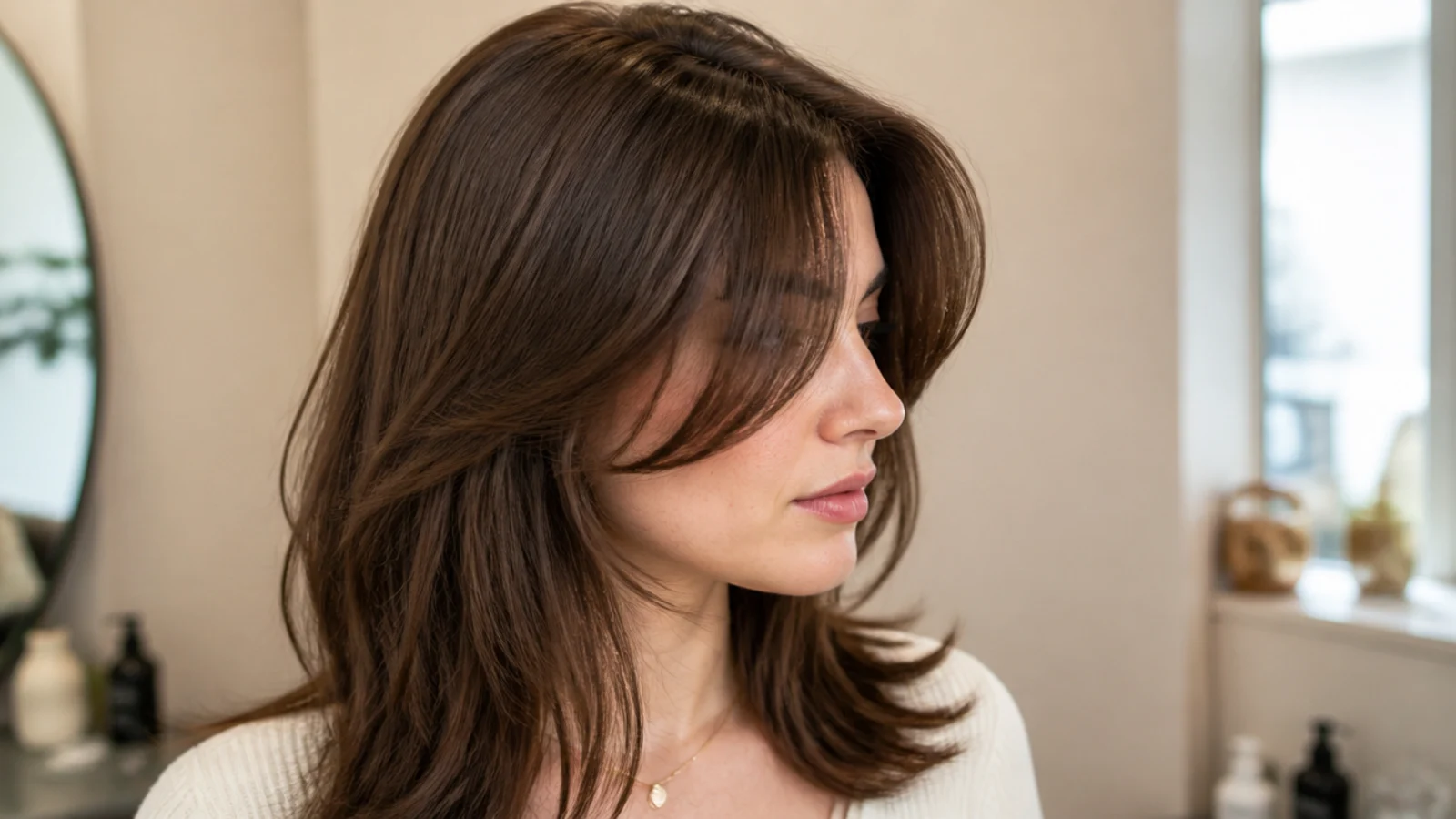
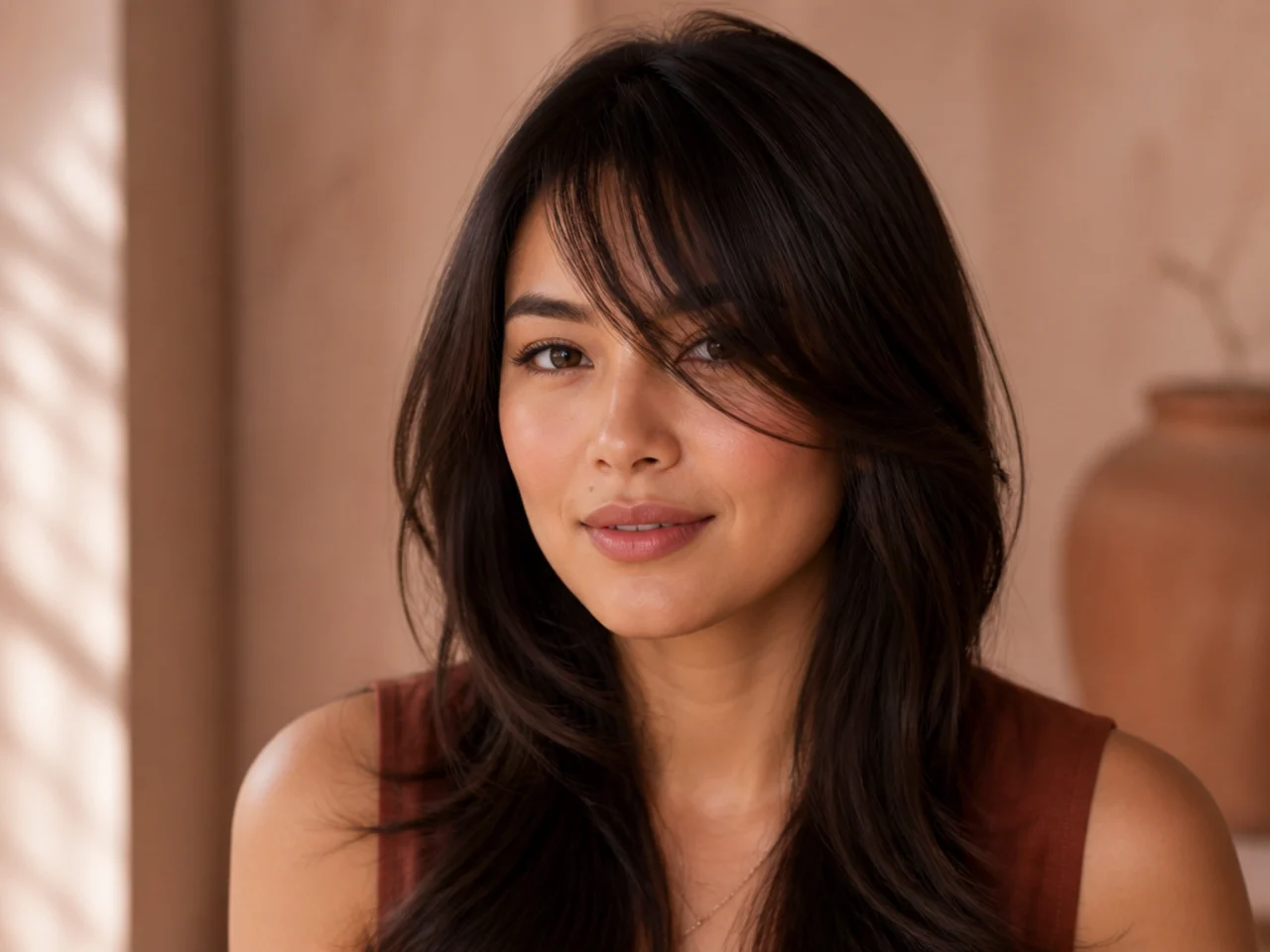
What decides whether curtain bangs narrow a round face or widen it is the angle of the inner edge, not the length. A diagonal sweeping down and out adds height; a level edge lays a horizontal across the widest part of the face.
In this article · 27
- What Curtain Bangs Do to a Round Face
- Choosing Your Length and Split
- The 20 Curtain Bang Variations
- 1. Cheekbone Length Curtain Bangs
- 2. Jaw Grazing Curtain Bangs
- 3. Collarbone Length Curtain Bangs
- 4. Off Centre Split Curtain Bangs
- 5. Wispy Curtain Bangs
- 6. Dense Curtain Bangs
- 7. Bottleneck Curtain Bangs
- 8. Curtain Bangs With Face Framing Layers
- 9. Seventies Style Curtain Bangs
- 10. Curtain Bangs on Straight Hair
- 11. Curtain Bangs on Wavy Hair
- 12. Curtain Bangs on Curly Hair
- 13. Curtain Bangs on Fine Hair
- 14. Curtain Bangs on Thick Hair
- 15. Curtain Bangs With a Deep Side Part
- 16. Curtain Bangs With Long Layers
- 17. Curtain Bangs With a Money Piece
- 18. Curtain Bangs Tucked Behind One Ear
- 19. Curtain Bangs on a Cowlick Hairline
- 20. Curtain Bangs Grown Past the Chin
- Styling and Upkeep
- Mistakes to Avoid
- FAQ
- Final Thoughts
Curtain bangs get blamed for widening a round face when the real culprit is almost always a fringe cut with a level inner edge.
The angle of the inner edge does the work. A diagonal running down and outward adds apparent height to the face. A level edge lays a horizontal line across it and takes that height away.
Length matters far less than where the shortest point sits. Anything from brow to jaw can work, provided the short end clears the cheekbone instead of landing on it.
What Curtain Bangs Do to a Round Face
A round face is nearly as wide as it is long. The eye judges that ratio against the strongest line crossing the face, so any new horizontal reads as extra width.
The centre split is a vertical line. It runs down the middle of the forehead and gives the eye something to travel along top to bottom, which is the one direction a round face has least of.
The sweep is two diagonals. Each half travels down and out. A diagonal is read partly as height and partly as width, so it adds length where a flat fringe only adds width.
The long hair underneath continues the line. Length below the jaw keeps the eye moving downward after the bangs release it, which is why curtain bangs and long hair are a stronger pair than curtain bangs and a bob on this face shape.

Choosing Your Length and Split
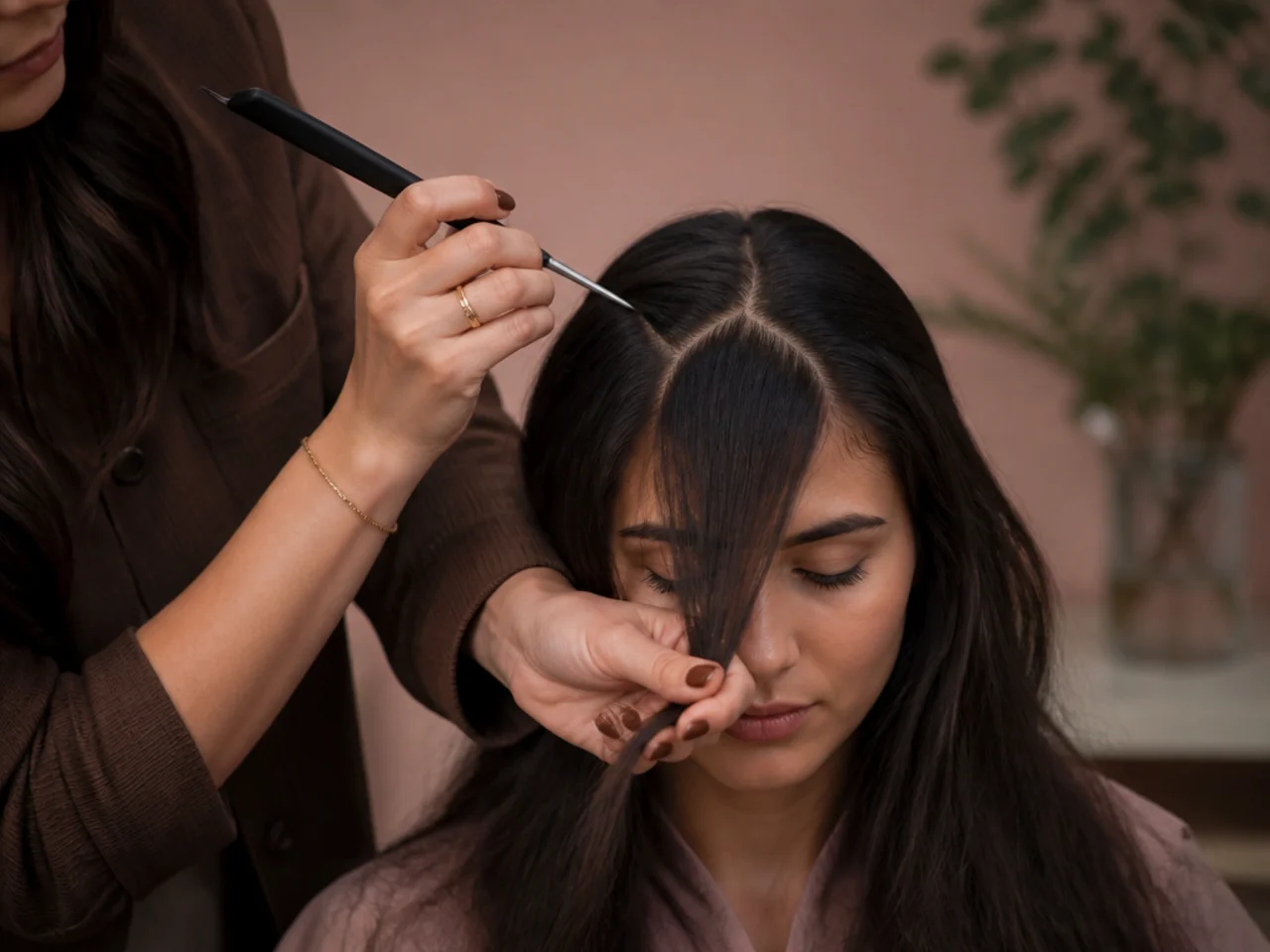
Set the shortest point above the cheekbone. Cut level with it and the ends terminate at the widest part of the face, which is the single most common reason curtain bangs read as widening.
Centre split for symmetry, off centre for length. A round face already reads as symmetrical, so an unequal split gives the eye something irregular to follow and breaks the circle.
Match the depth of the section to your density. On fine hair a deep section robs the crown and flattens the top. On thick hair a shallow section leaves a visible wedge behind the fringe.
Cut dry if your hair bends at all. Wet hair hangs at full stretch and a wave or curl retracts one to four centimetres as it dries, landing the shortest point higher than either of you intended.
The 20 Curtain Bang Variations
1. Cheekbone Length Curtain Bangs
The shortest point sits just above the cheekbone, so the hair is already moving outward by the time it passes the widest part of the face. Cut level with the cheekbone instead and the ends stop precisely where the face is broadest, which is what draws the eye across rather than down.
2. Jaw Grazing Curtain Bangs
The long ends finish at the jaw, so the diagonal runs the full height of the face instead of stopping halfway. Longer curtains also hold their sweep better, because there is more weight below the bend to stop the hair springing back toward the centre.

3. Collarbone Length Curtain Bangs
Barely a fringe: the front pieces are only slightly shorter than the lengths, and the taper between them is what reads as a curtain. It is the version that survives a bad decision, because nothing is ever short enough to look cut off.

4. Off Centre Split Curtain Bangs
Moving the parting two or three centimetres off centre makes the two halves unequal, and unequal halves interrupt the symmetry a round face otherwise emphasises. The heavier side also crosses more of the forehead on a diagonal, which is where the narrowing comes from.

5. Wispy Curtain Bangs
Point cut into fine tips so the edge never forms a solid line. Light passes through the fringe rather than stopping at it, which means the forehead is not visually divided even when the shortest point sits high.

6. Dense Curtain Bangs
More hair drawn forward from further back, which gives the curtain enough weight to fall in one clean curve instead of separating into strands. Take too much and the hair behind thins visibly, so the section should stop before the front of the crown. For that weight without the centre split, french bangs on a round face get there another way.

7. Bottleneck Curtain Bangs
Shorter and narrower through the middle, flaring wider at the ends, so the outline mirrors the neck of a bottle. The narrow middle keeps the forehead open while the flare sits over the cheek, which is exactly the pair of effects a round face wants.

8. Curtain Bangs With Face Framing Layers
The fringe is cut as the top of one continuous line that runs down through the lengths, so there is no step where the bangs end. That unbroken line is a single long diagonal, and long diagonals are what add apparent height to a short face.

9. Seventies Style Curtain Bangs
A deep feathered curtain that starts well back on the head and flicks away at the sides. The flick lifts hair off the temples, and the gap that opens between hair and cheek is what makes the face read narrower than the hair around it.

10. Curtain Bangs on Straight Hair
Straight hair falls exactly where it is cut, so the sweep has to be built with heat rather than with scissors. Dry the fringe forward first, then back and away over a round brush, and let it cool in that position — the bend sets as the hair cools, not while it is hot.

11. Curtain Bangs on Wavy Hair
The natural bend does most of the sweeping, so the cut can be gentler. Waves also draw up a centimetre or two as they dry, which is the reason to cut this fringe dry rather than discover the shortest point has moved.

12. Curtain Bangs on Curly Hair
Cut dry, curl by curl, in the clump each one already forms. A stretched wet curl can be two or three times its dry length, so a wet cut fringe springs to the middle of the forehead. Curtains suit curls anyway, because outward is the direction curls already want to travel.

13. Curtain Bangs on Fine Hair
Keep the section shallow. Fine hair has fewer strands to spare, and a deep fringe section takes them from the crown, where the loss shows straight away as a flat top the fringe cannot compensate for.

14. Curtain Bangs on Thick Hair
Weight comes out of the underside of the fringe, not the surface. Thinning the top layer leaves short pieces that stand up as they grow, while removing bulk underneath lets the curtain lie closer to the face without losing its edge.

15. Curtain Bangs With a Deep Side Part
Pushing the parting well over to one side turns the longer half into a single long diagonal across the forehead. That becomes the strongest line in the style, and it runs corner to corner rather than side to side, which is the whole point on a round face.

16. Curtain Bangs With Long Layers
Layers through the lengths stop the hair below reading as two solid panels of equal width either side of the face. Movement keeps the eye travelling down instead of settling level with the cheeks.

17. Curtain Bangs With a Money Piece
Lightening only the two front sections puts the brightest hair on the diagonal, and the eye goes to the lightest thing in a picture first. Keep the lift to the front two or three centimetres of the fringe so it reads as a highlight rather than a stripe.

18. Curtain Bangs Tucked Behind One Ear
Tucking one side leaves a single sweep across the forehead and exposes one cheek fully. It is asymmetry you can create in five seconds, and it works because the two sides of the face stop being framed identically.

19. Curtain Bangs on a Cowlick Hairline
A cowlick sends hair out of the scalp in a fixed direction, and no amount of drying overrules the root. Put the parting where the cowlick already splits the hair, because a fringe cut against one lifts at the base and will never lie flat.
20. Curtain Bangs Grown Past the Chin
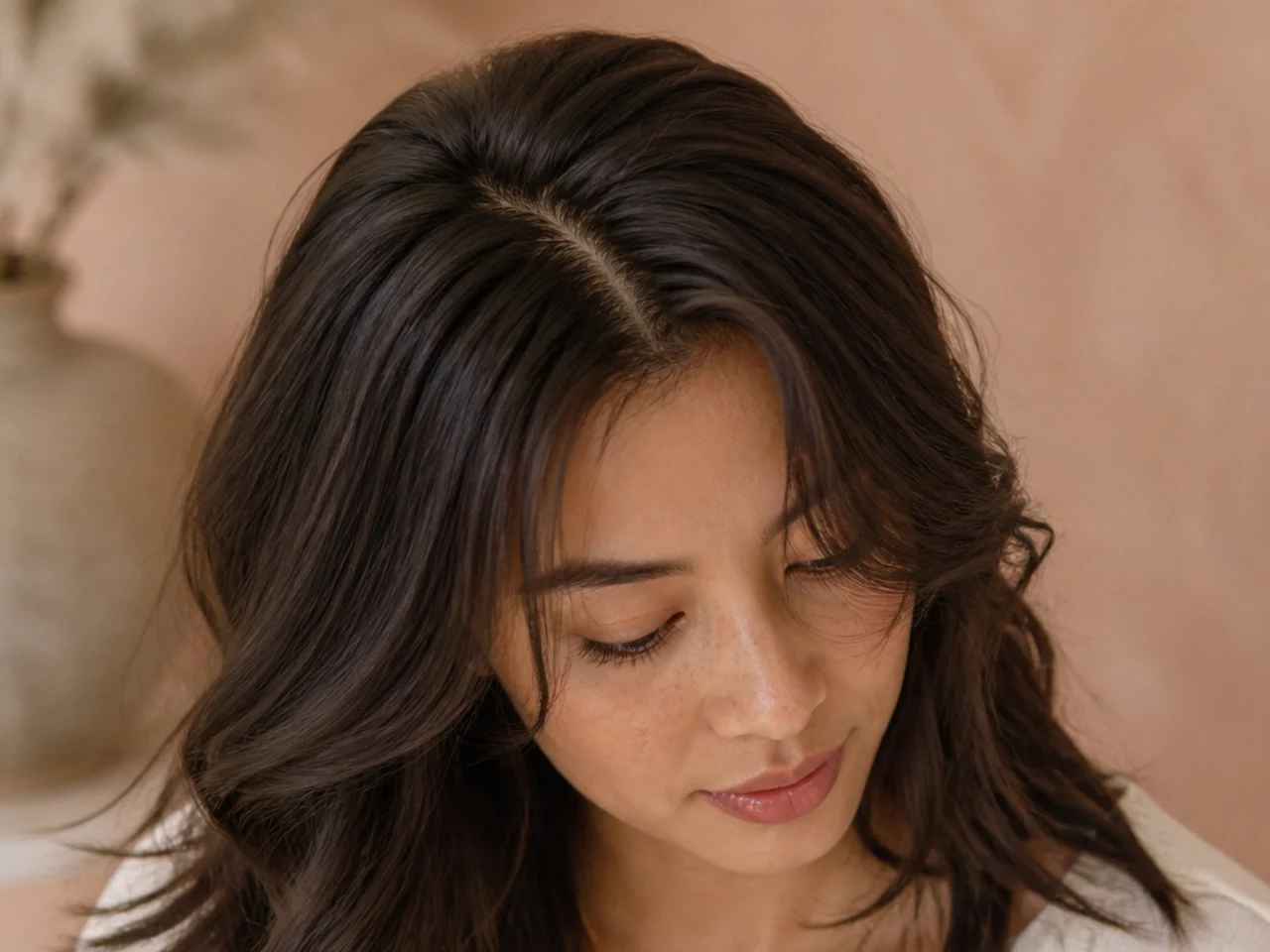
Six months of growth turns a curtain into plain face framing length, and the shape stays wearable the entire way because nothing ever gets short enough to look stranded. That is the strongest practical argument for a curtain over a blunt fringe, and the same logic behind long french bangs.

Styling and Upkeep
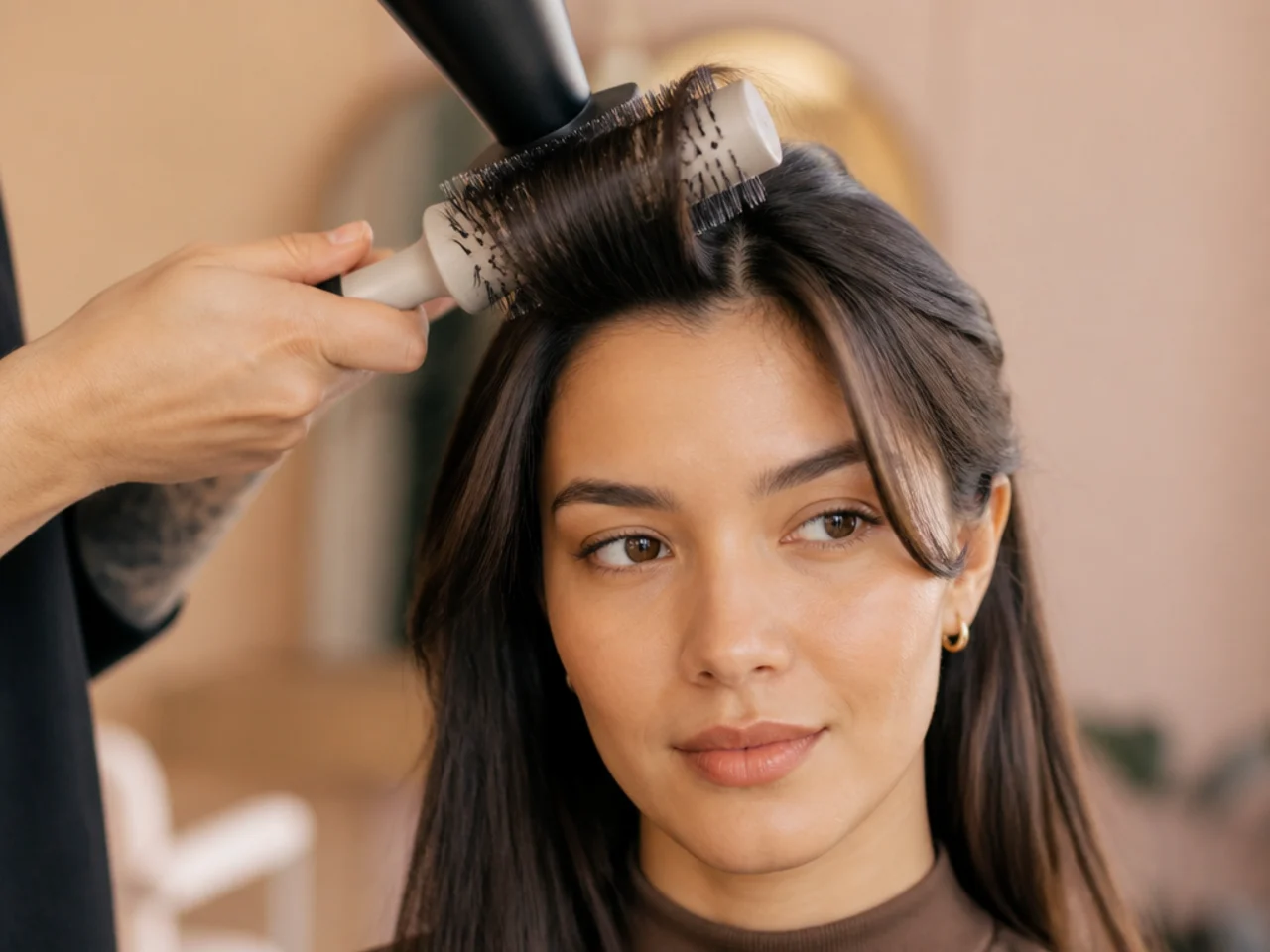
Dry the fringe first, before anything else. It sets its own direction as it dries, and once dry it will not be argued out of it.
Overdirect, then let it cool in place. Brush each half past the opposite side, then back and away. The bend fixes as the hair cools, so a cool shot is worth more than another minute of heat.
Trim every four to six weeks. A centimetre of growth changes the angle of the inner edge, which is the part doing the work.
Keep the iron off the last inch. The tips of a curtain are the finest hair on your head and they scorch before the mid lengths are even warm.
Wash the fringe alone between washes. It sits against the forehead all day and goes greasy at roughly twice the rate of the rest.
Mistakes to Avoid
Cutting wavy or curly bangs wet. Stretched hair retracts as it dries and the fringe you agreed on ends up two inches higher.
Taking the section too far back. Everything behind the front of the crown belongs to the lengths. Borrow from it and the top goes flat.
Cutting the inner edge level. A level edge is a horizontal, and a horizontal across a round face makes it wider every time.
Chasing a blunt fringe instead. A solid straight across fringe puts a hard line at eyebrow height and hides the forehead, removing the only vertical the face had.
Forcing a centre part against a cowlick. The root wins. Set the split where the hair already divides and style from there.

FAQ
Do they widen a round face? Only when the inner edge is cut level instead of on a diagonal.
How short at the shortest point? Just above the cheekbone, never level with it.
How often trimmed? Four to six weeks, or the angle flattens out.

Final Thoughts
Ask for the angle, not the length. "Shortest point above the cheekbone, inner edge cut on a diagonal, longest ends at the jaw" describes a shape a stylist can execute, where "curtain bangs" alone leaves the one decision that matters up to chance.
For the full range on long hair see curtain bangs for long hair, and for the version that skips the split altogether see side swept bangs for a round face. More in Bangs & Fringe.