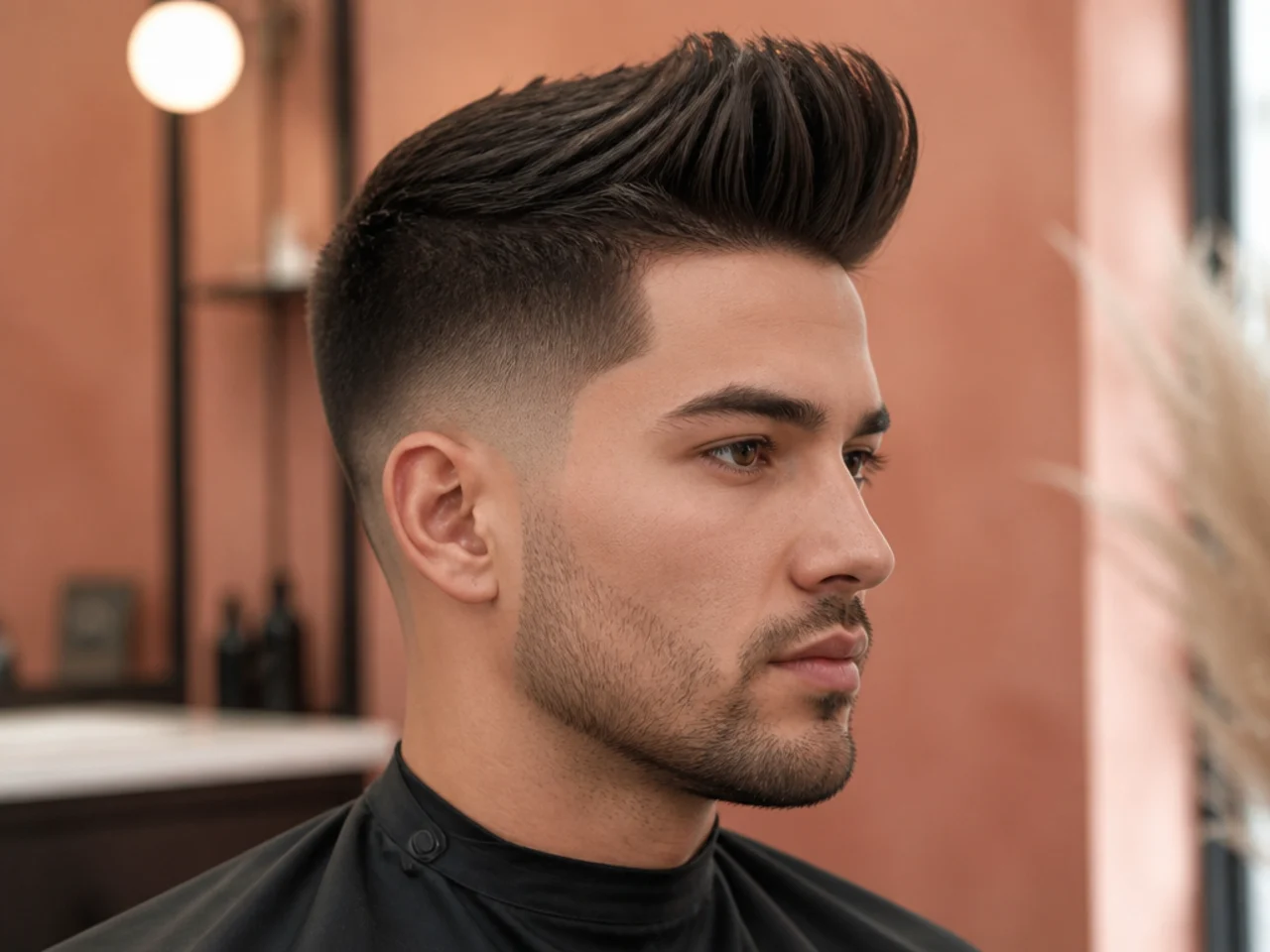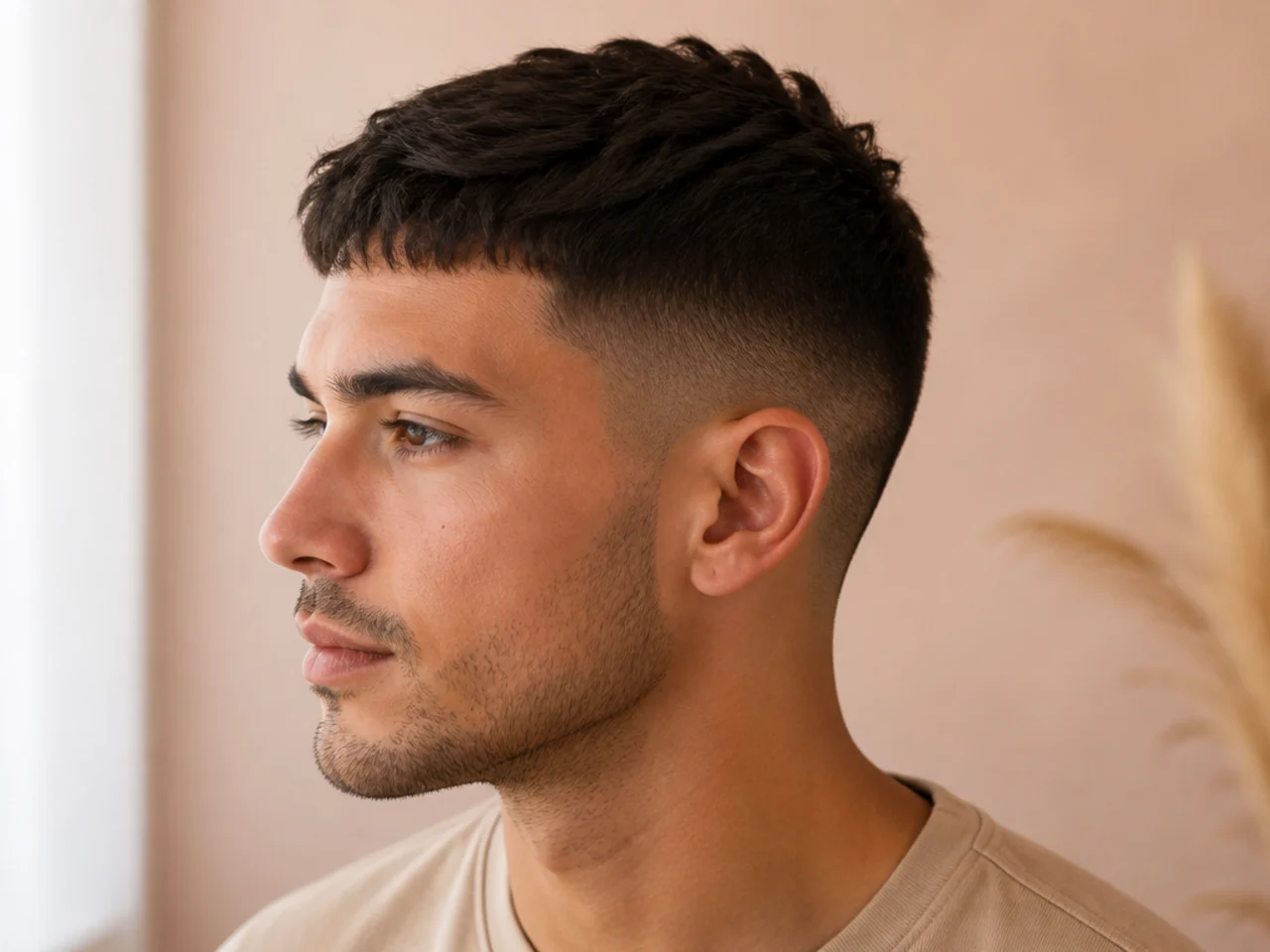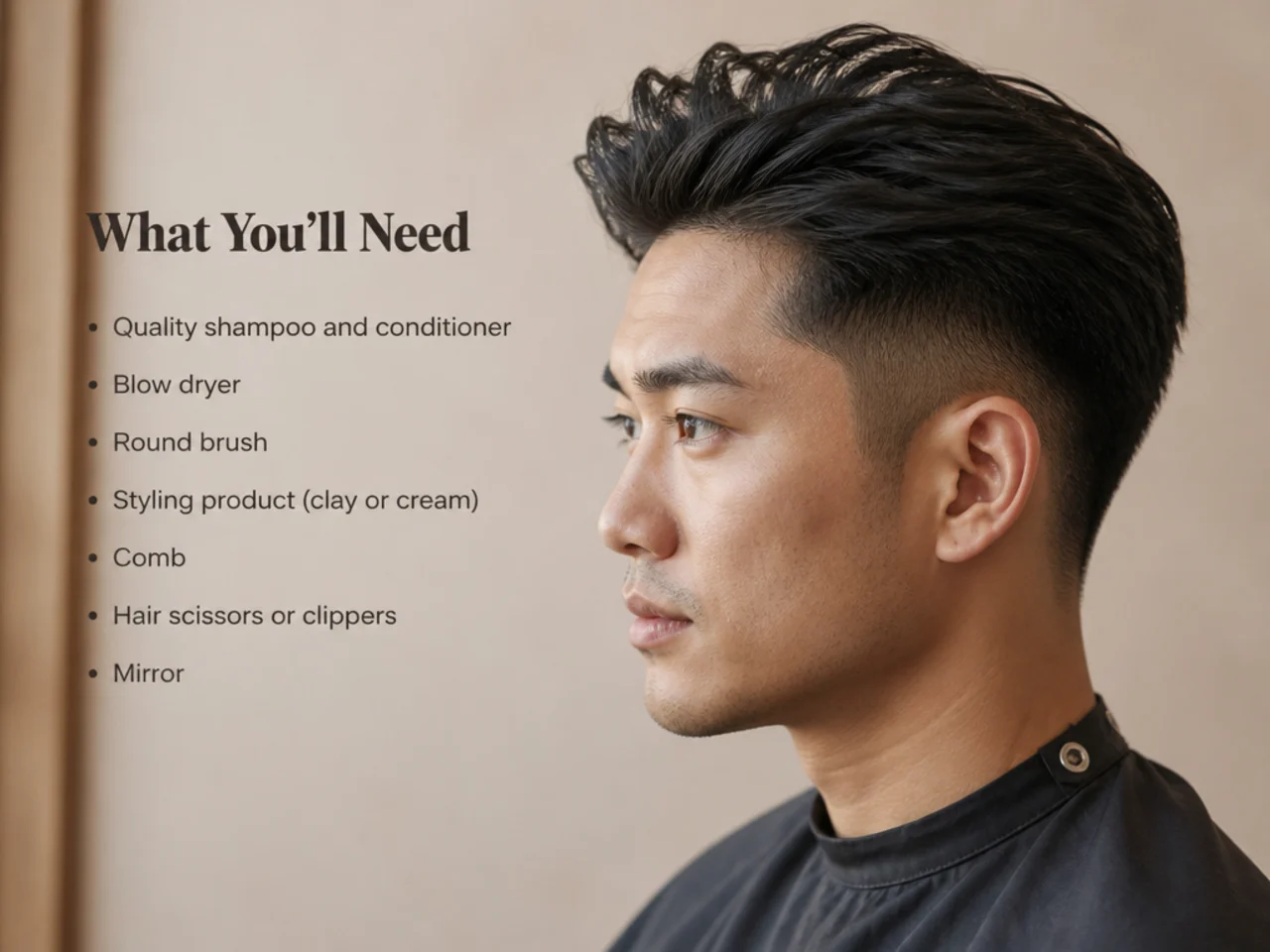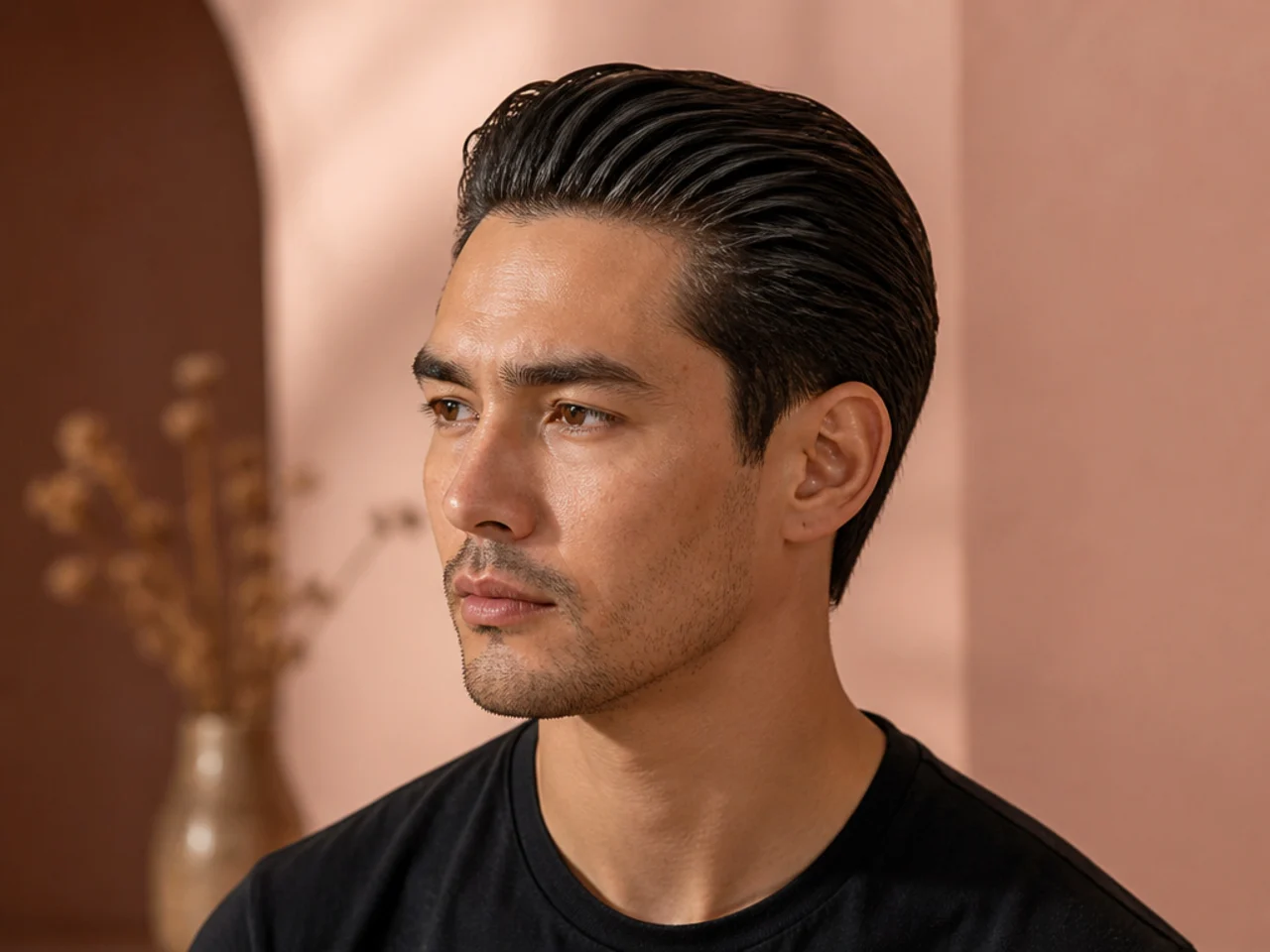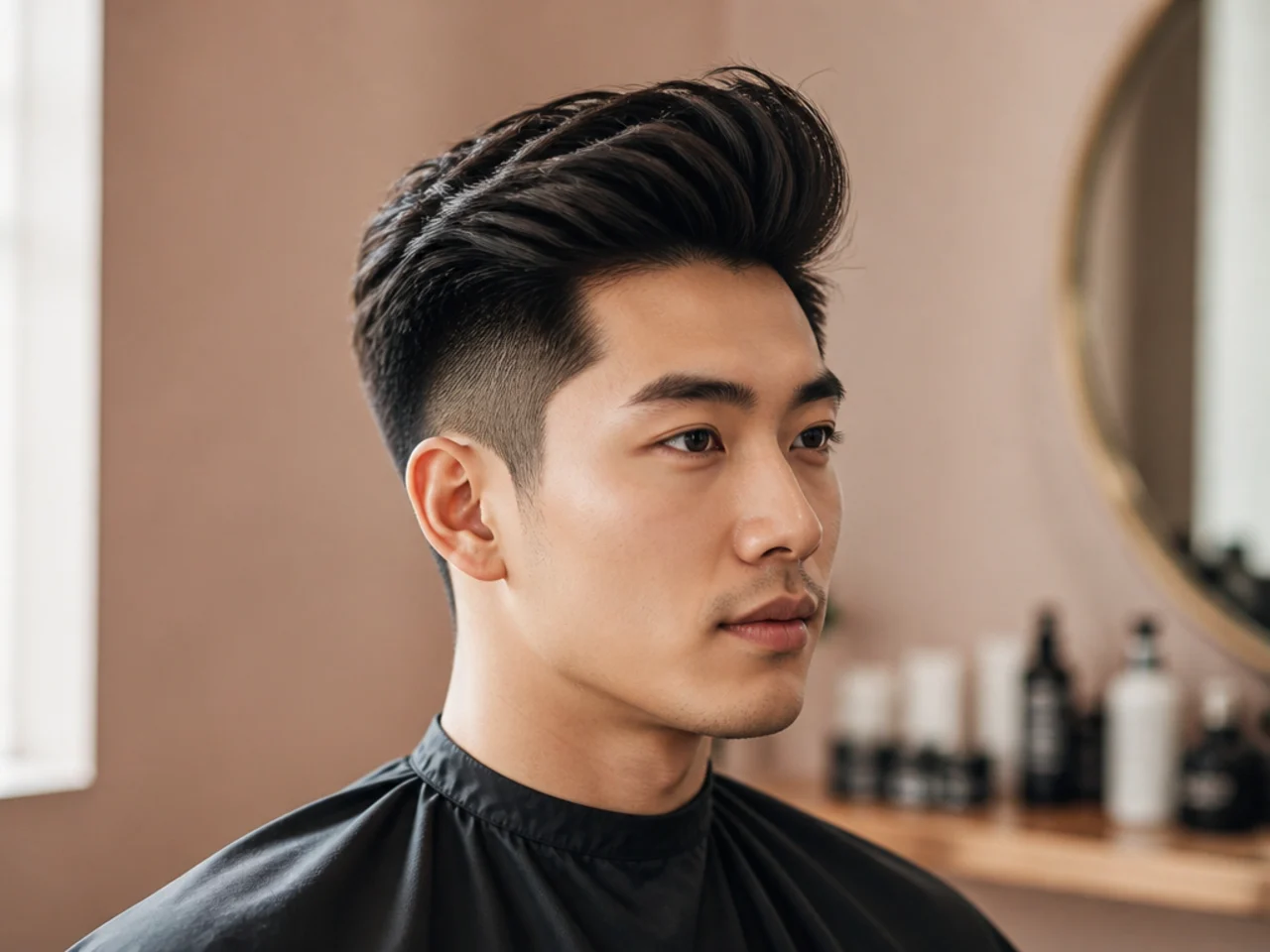
15 Asian Quiff Hairstyles for Men
15 Asian quiff hairstyles for men — K-pop, Korean modern, and Japanese editorial cuts tuned for thick straight hair. Photos, face-shape notes, and the exact ask.
In this article · 27
- What Is an Asian Quiff?
- How to Choose Your Asian Quiff
- The 15 Asian Quiff Variations
- 1. Classic Asian Quiff
- 2. K-Pop Idol Quiff
- 3. Textured Korean Quiff
- 4. Two Block Quiff Hybrid
- 5. Asian Quiff with Mid Fade
- 6. Short Asian Quiff
- 7. Asian Quiff with Low Taper
- 8. Curtain Front Asian Quiff
- 9. Messy Asian Quiff
- 10. Undercut Asian Quiff
- 11. Side-Swept Asian Quiff
- 12. Long Asian Quiff
- 13. Permed Asian Quiff
- 14. Asian Quiff with Light Stubble
- 15. Skin Fade Modern Asian Quiff
- How to Ask Your Barber for an Asian Quiff
- Styling and Maintenance
- FAQ
- Which Asian quiff variation photographs best?
- Can Asian men with wavy hair do a quiff?
- What's the safest Asian quiff for a conservative workplace?
- Do I need to perm my hair for an Asian quiff to work?
- How is an Asian quiff different from a Western quiff?
- Which Asian quiff is best for a round face?
The quiff was built for the hair Asian men are born with. Thick, straight, glossy — it holds a front lift longer than any other hair type on the planet, and the sweep reads clean instead of wispy under studio lighting. This guide runs 15 asian quiff men variations worth asking for by name, from the soft K-pop version stacking Pinterest right now to the sharper Chinese cinema-era finish that still shows up in editorial. Each one comes with the face-shape note, the top length in inches, and the exact language for your barber.
What Is an Asian Quiff?
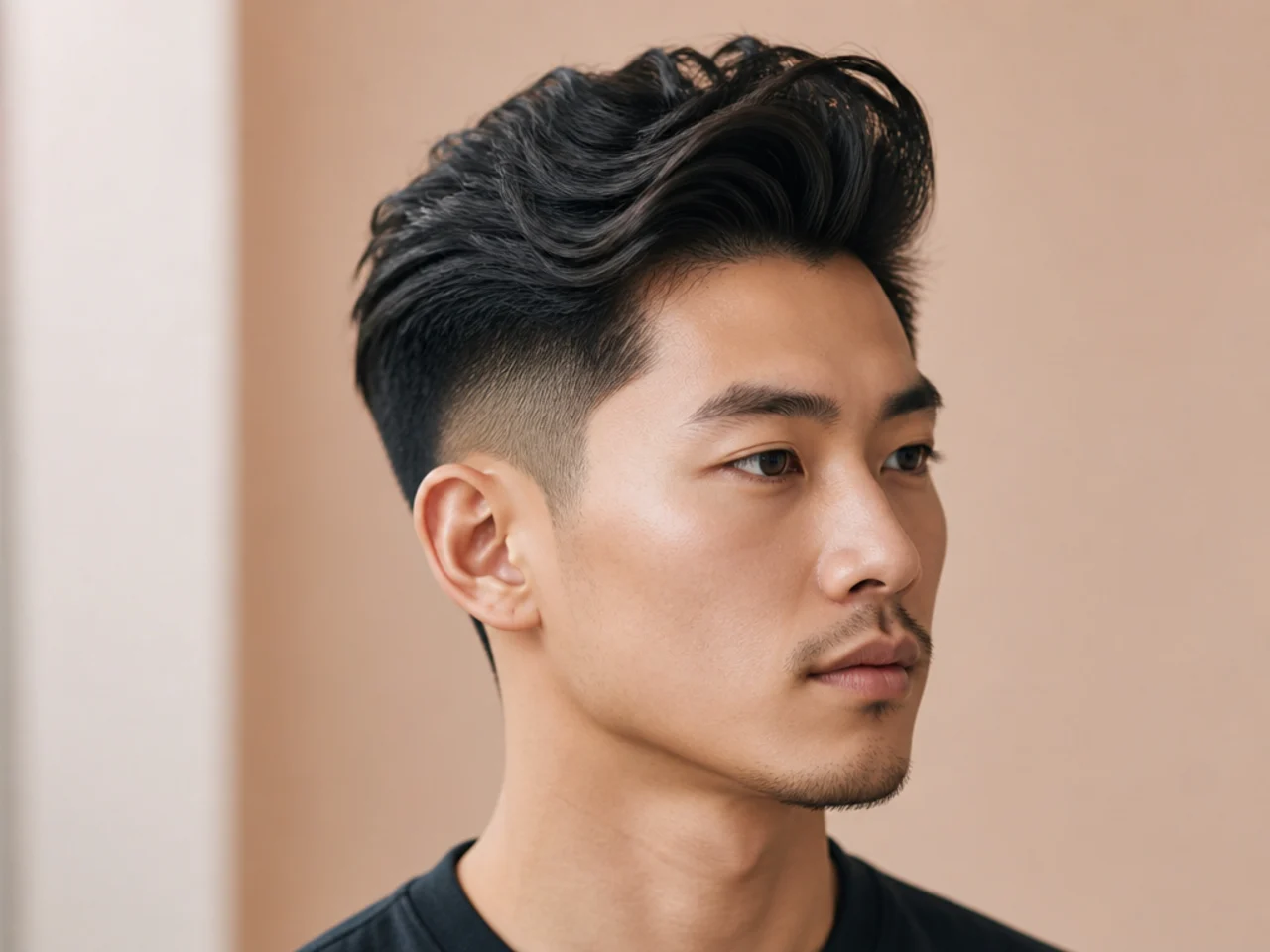
An Asian quiff is a quiff hairstyle tuned for the density, weight, and shine of East and Southeast Asian hair. The base shape is the same — long at the front, shorter through the crown, swept up and back for vertical lift. What changes is the treatment. Top length runs longer (usually four to six inches at the front) so the extra weight has room to actually rise. The sides get scissor-blended or dropped into a soft taper rather than a hard skin fade. The finish leans matte-glossy rather than dry-textured, because that's what looks right with Asian hair's natural sheen.
Korean salons codified the modern version — a longer, softer, front-heavy shape closer to what you see on K-pop stages than to the pomade quiffs of 1950s Americana. Chinese and Japanese barbers layered their own variants: sharper disconnections in Chinese barbering, softer perm-set shapes in Japanese salons. The 15 cuts below pull from all three traditions, plus a handful of universal quiffs that work exceptionally well on the specific hair characteristics Asian men bring to the chair.
How to Choose Your Asian Quiff
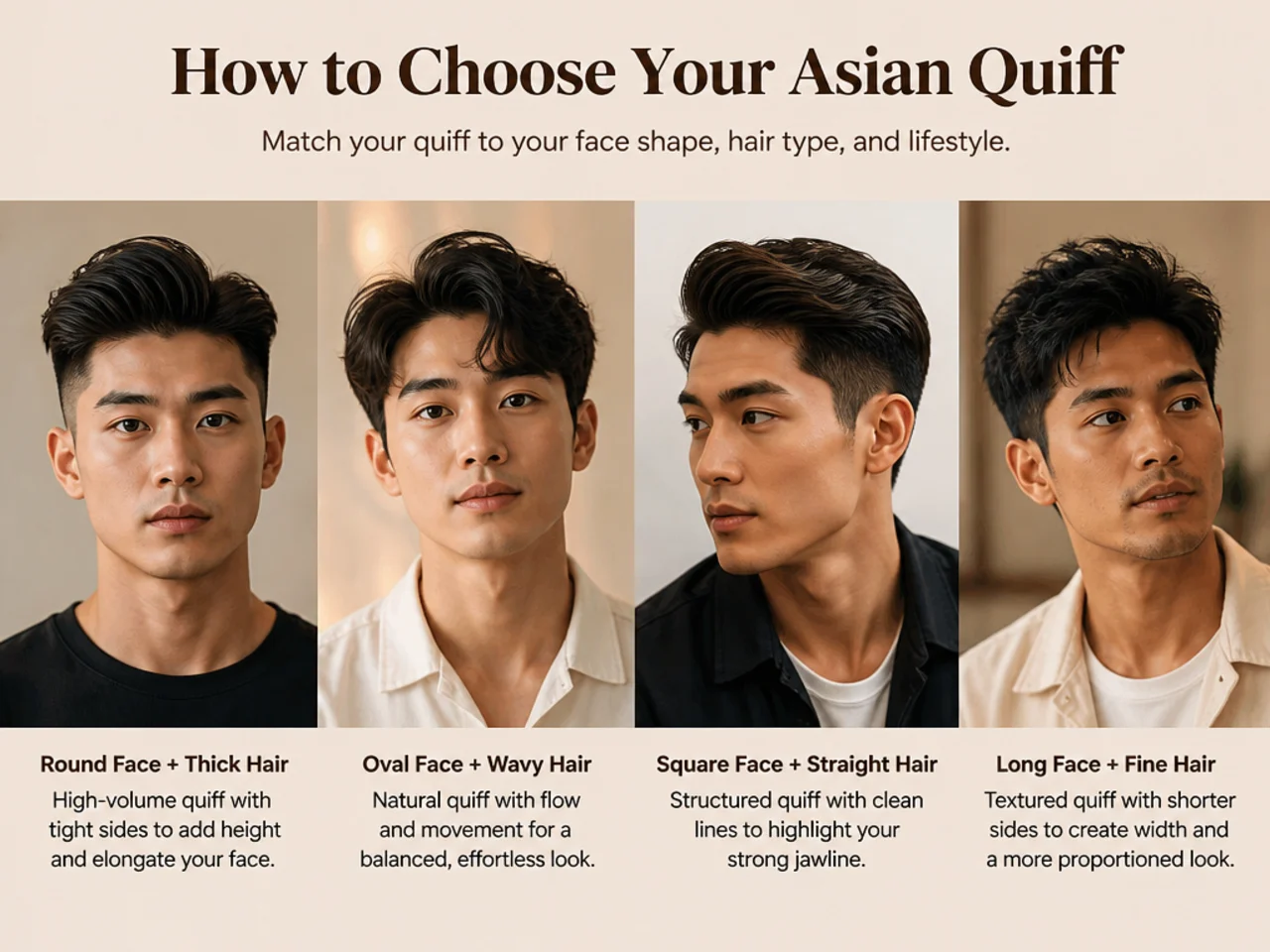
Start with density. Thick Asian hair holds a quiff on its own — you just need the length. Fine Asian hair (rarer but real) wants a light setting perm or a mousse pre-styler to build the base. If your hair sits flat by lunch even after a blow-dry, that's a signal to ask the salon about volume-only perm at the roots rather than fighting it with product every morning.
Face shape steers the top. Oval faces get to pick anything. Round faces need the vertical lift a proper five-to-six-inch front delivers — the taller the sweep, the more it slims the round outline. Square jaws want softness, so ask for a curtain-front or messy finish that curves the perimeter. Long faces stay shorter on top (three to four inches) and heavier at the front to break the vertical read.
Then the honest question: how many minutes do you want to spend on the mirror each morning? A short Asian quiff with a taper is a two-minute cut. A permed K-pop quiff with a matte cream is five minutes on wet hair and you're done. A long editorial quiff with visible sweep and hold needs a blow-dryer, a round brush, and product every day. Pick the routine you'll actually run.
The 15 Asian Quiff Variations
Every variation below is named the way an Asian salon or a Korean barbershop will recognize with a photo. Numbers matter — bring inches on top and a guard number for the sides.
1. Classic Asian Quiff
The neutral shape every other Asian quiff spins off. Top runs five inches at the front, tapers back through the crown, and the sides get scissor-blended into a soft short-not-shaved perimeter. No fade line, no disconnection — everything blends. The density of Asian hair does most of the lift work for you.
Best on straight thick hair with any face shape. The most work-safe version on this list.
Ask for: "Classic quiff, five inches at the front, scissor-blended sides tapered down to number two above the ear, soft blend at the crown."
Styling tip: matte cream through damp hair, round-brush the front up and back, two minutes total.
2. K-Pop Idol Quiff
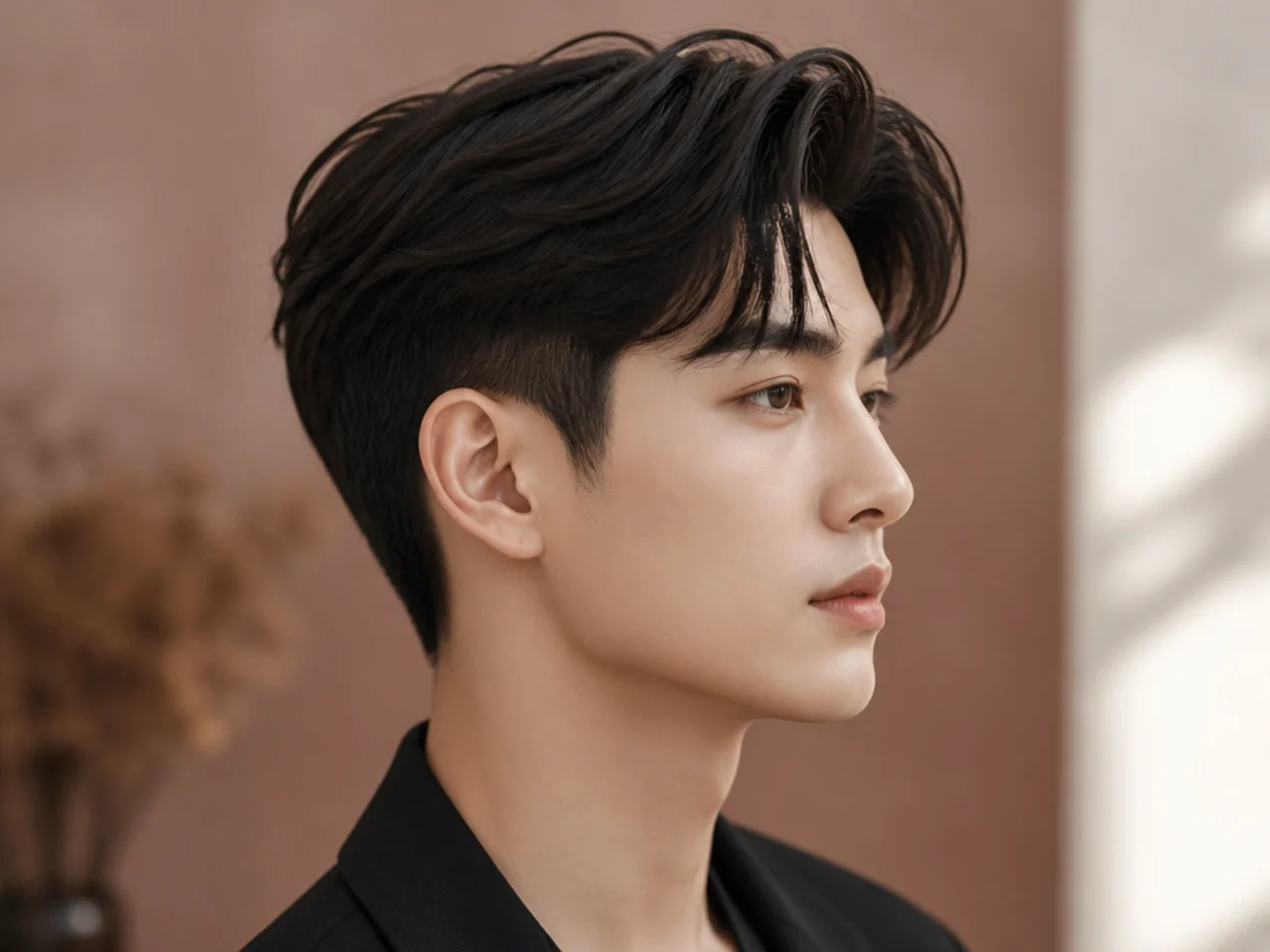
The version pulling straight from a Seoul salon. Top is left longer — five to six inches — with a soft curl set into the front section, either from a light perm or a round brush finish. The sides stay scissor-blended (never faded sharp) and there's usually a slight left-of-center part. Every K-pop group has cycled a version through — Stray Kids, Enhypen, Riize.
Best on straight-to-slightly-wavy hair, oval and heart-shaped faces. Works on the widest age range of any cut here.
Ask for: "Six inches at the front, scissor-blended sides, C-curl setting perm at the crown only, soft off-center part."
Styling tip: light salon-grade cream on damp hair, then blow-dry with fingers pushing the front up and slightly back.
3. Textured Korean Quiff
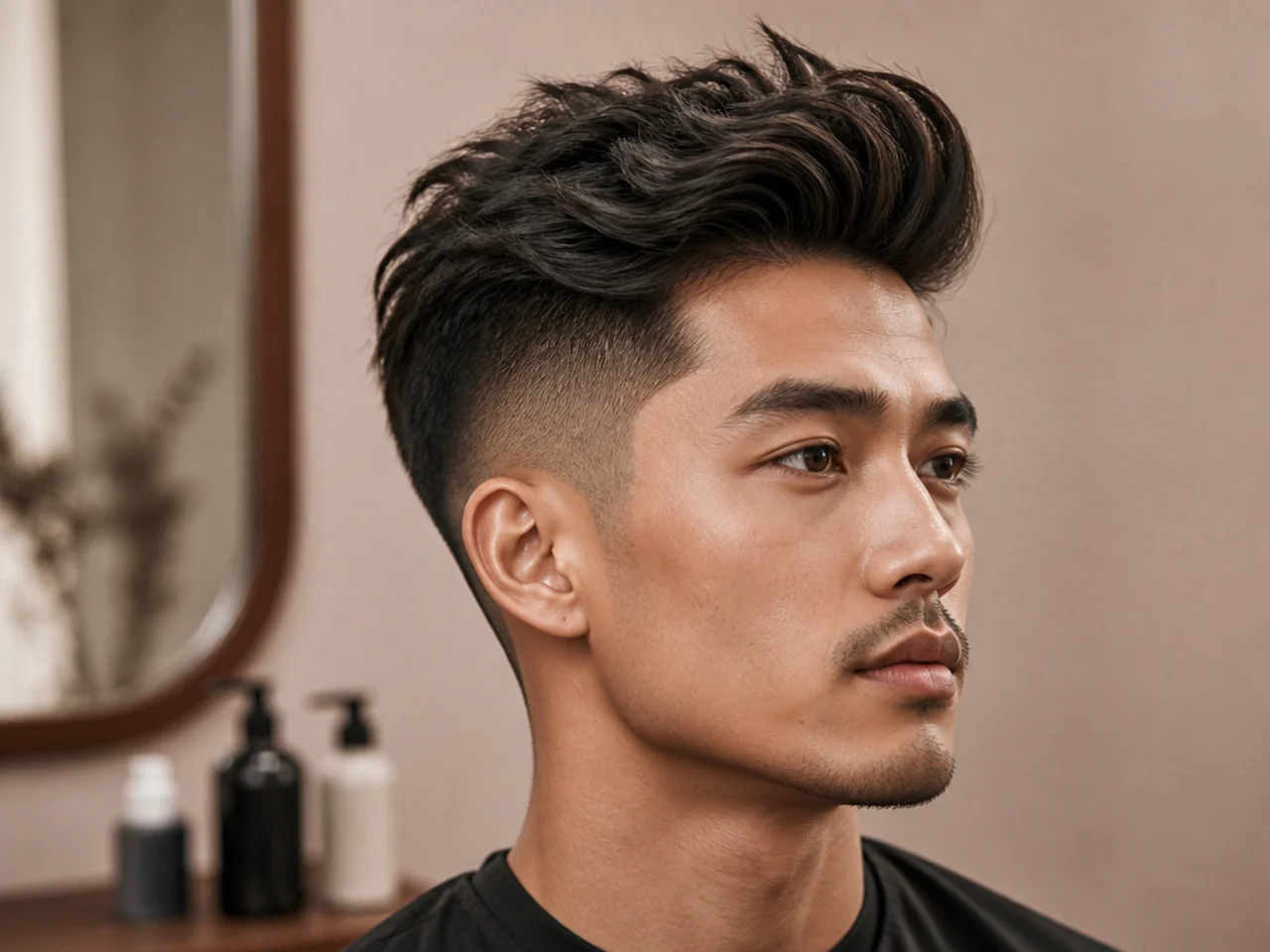
Point-cut layers throughout the top so the density breaks into visible piece-y sections instead of sitting as one heavy fall. The front is left long (five inches) to sweep, but the finish is matte rather than glossy — closer to a modern editorial textured haircut than a traditional K-pop set. The sides drop into a low taper that stays quiet.
Best on thick straight hair that reads heavy in photos. Every face shape.
Ask for: "Point-cut layers on top, low taper fade at the sides, five inches at the front, no thinning shears."
Styling tip: matte clay pressed into the ends first, then push everything up and back with open fingers.
4. Two Block Quiff Hybrid
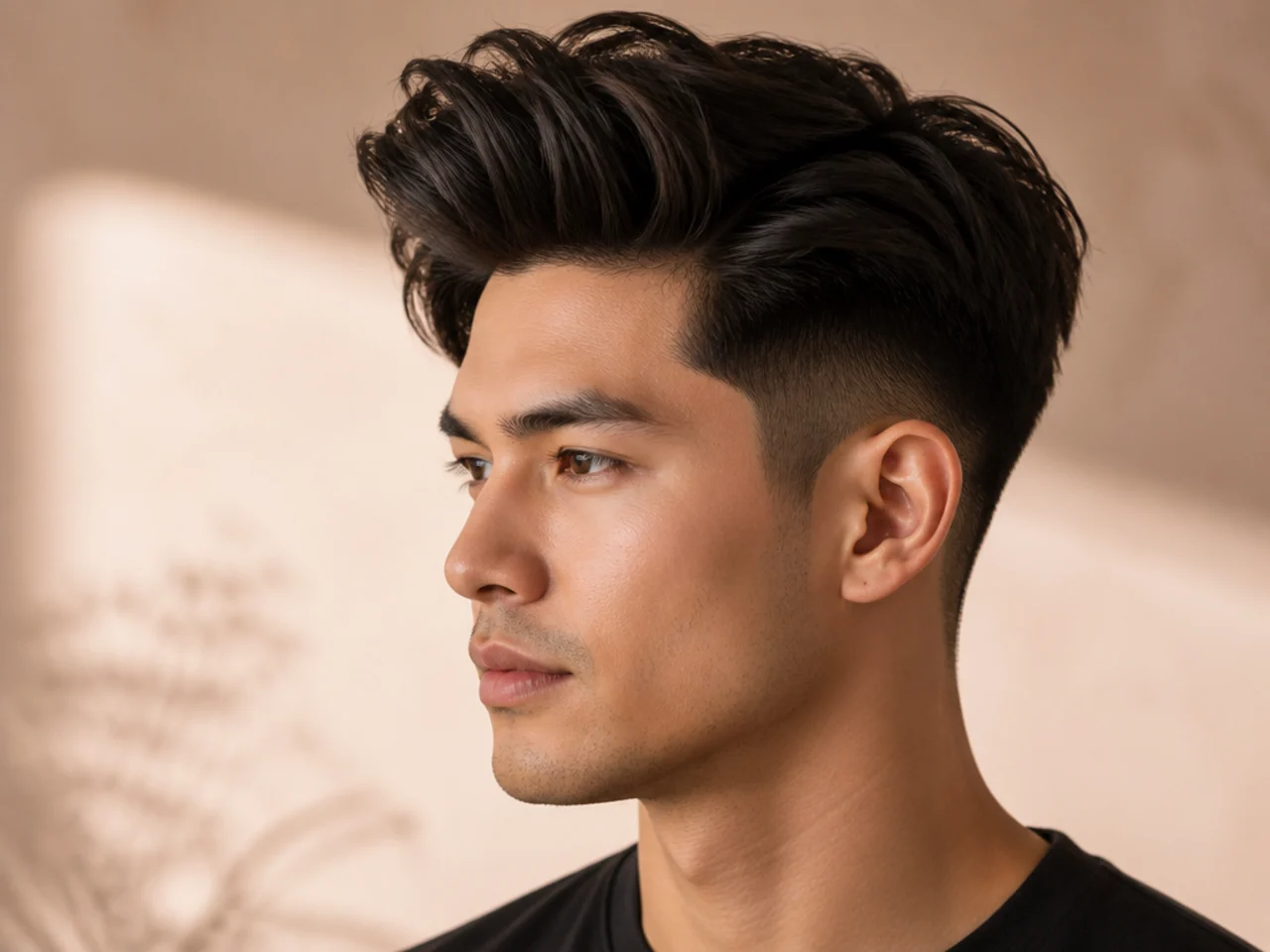
Half two block haircut, half quiff. The under-layer at the sides is buzzed with a two guard, the top is left long enough to lift into a quiff sweep, and the horseshoe seam sits at the widest point of the head. When the top falls forward you see the two block. When it lifts up into the quiff, the underlayer disappears. It's the most photograph-forward Asian quiff cut you can ask for.
Best on straight hair, oval to square face shapes, guys who want a switch between two looks without recutting.
Ask for: "Two block hybrid — number two guard on the underlayer, four inches on top, front left long enough to lift into a quiff sweep."
Styling tip: matte cream, blow-dry the front up and back, and let the underlayer sit hidden.
5. Asian Quiff with Mid Fade
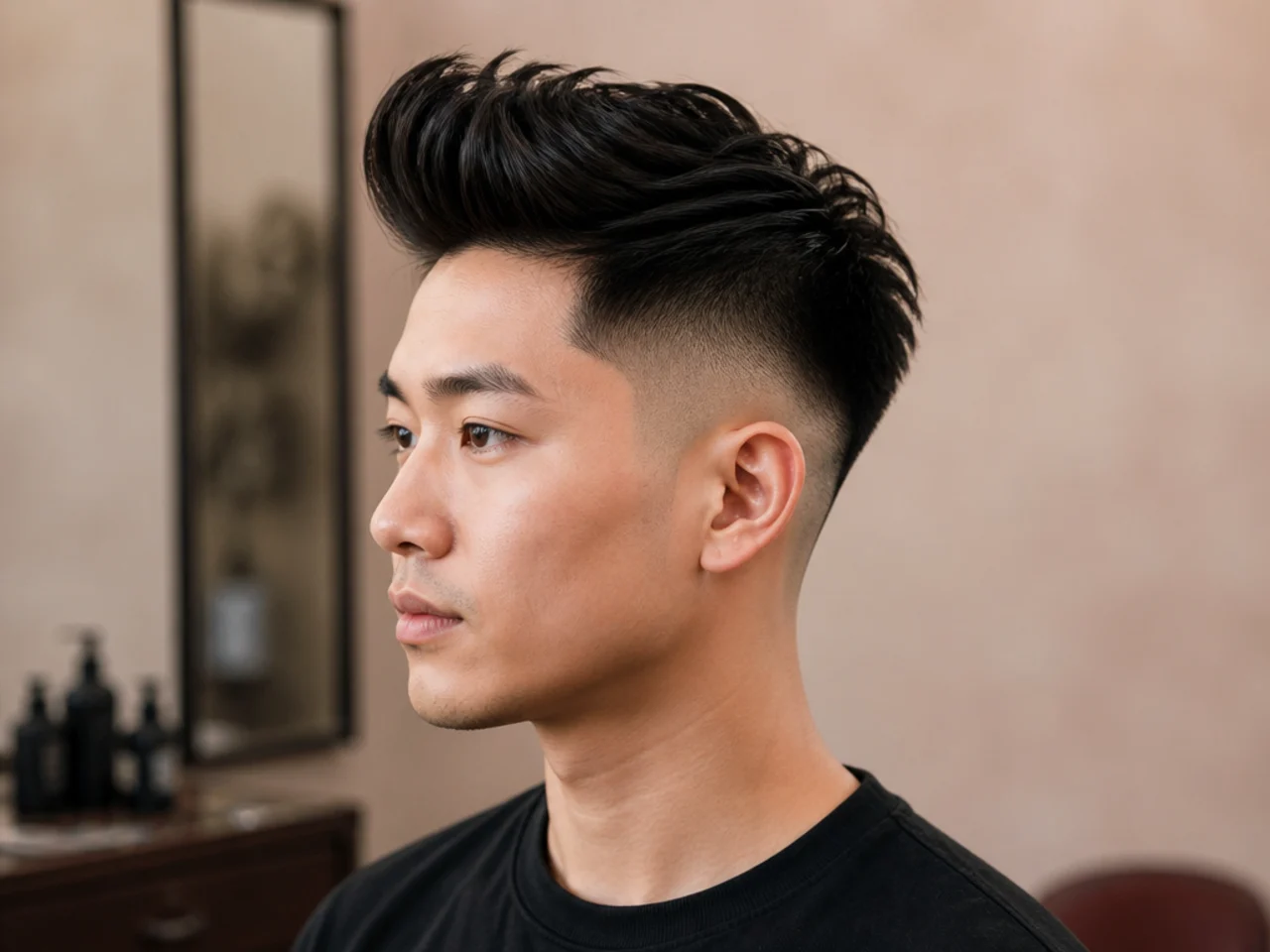
The Western-influenced version. A mid fade climbs to the middle of the temple, and the top is left five inches at the front to sweep up. The contrast between the skin-close sides and the dense top is where the shape gets its modern read. Popular with Asian men working in creative industries or wanting a sharper, more editorial finish than the scissor-blended K-pop softness.
Best on square and oval faces. Not for round faces unless you push the top even taller (six inches minimum).
Ask for: "Mid fade at the temple, five inches at the front, scissor detail through the crown, soft disconnection between top and fade."
Styling tip: mousse pre-styler, round-brush up and back, finish with matte clay.
6. Short Asian Quiff
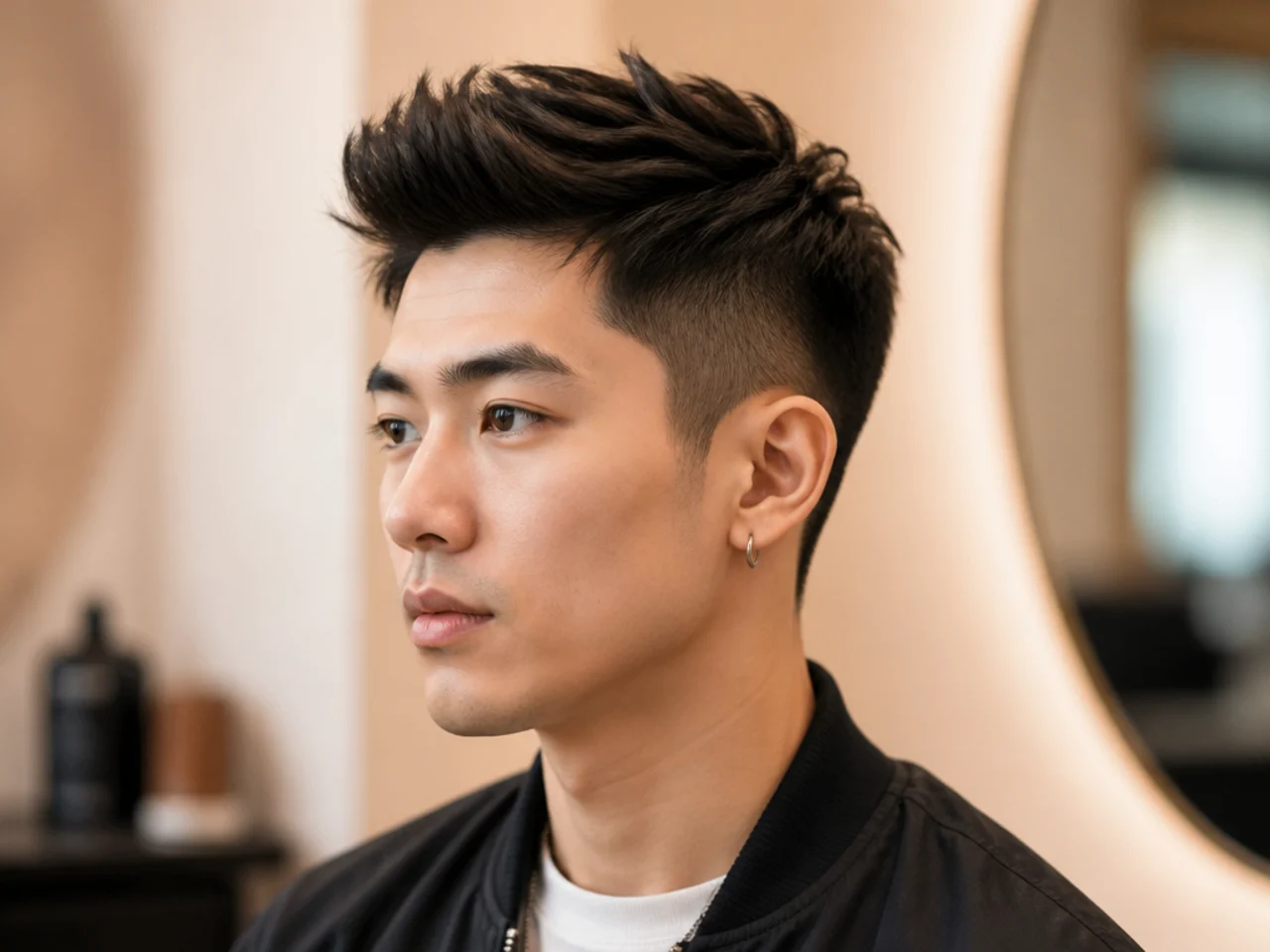
Shift-work length. The top sits at three inches — enough to lift but short enough to hold shape on its own by lunch. Sides get a clean low or mid taper. It's the version to ask for if you work in finance, medicine, or engineering and want the quiff shape without any of the drama.
Best on straight, medium-density hair. Every face shape.
Ask for: "Three inches on top, mid taper at the sides, soft blend at the crown, finish clean and low-key."
Styling tip: rub matte paste between your palms, push the front up with your fingers, done in ninety seconds.
7. Asian Quiff with Low Taper
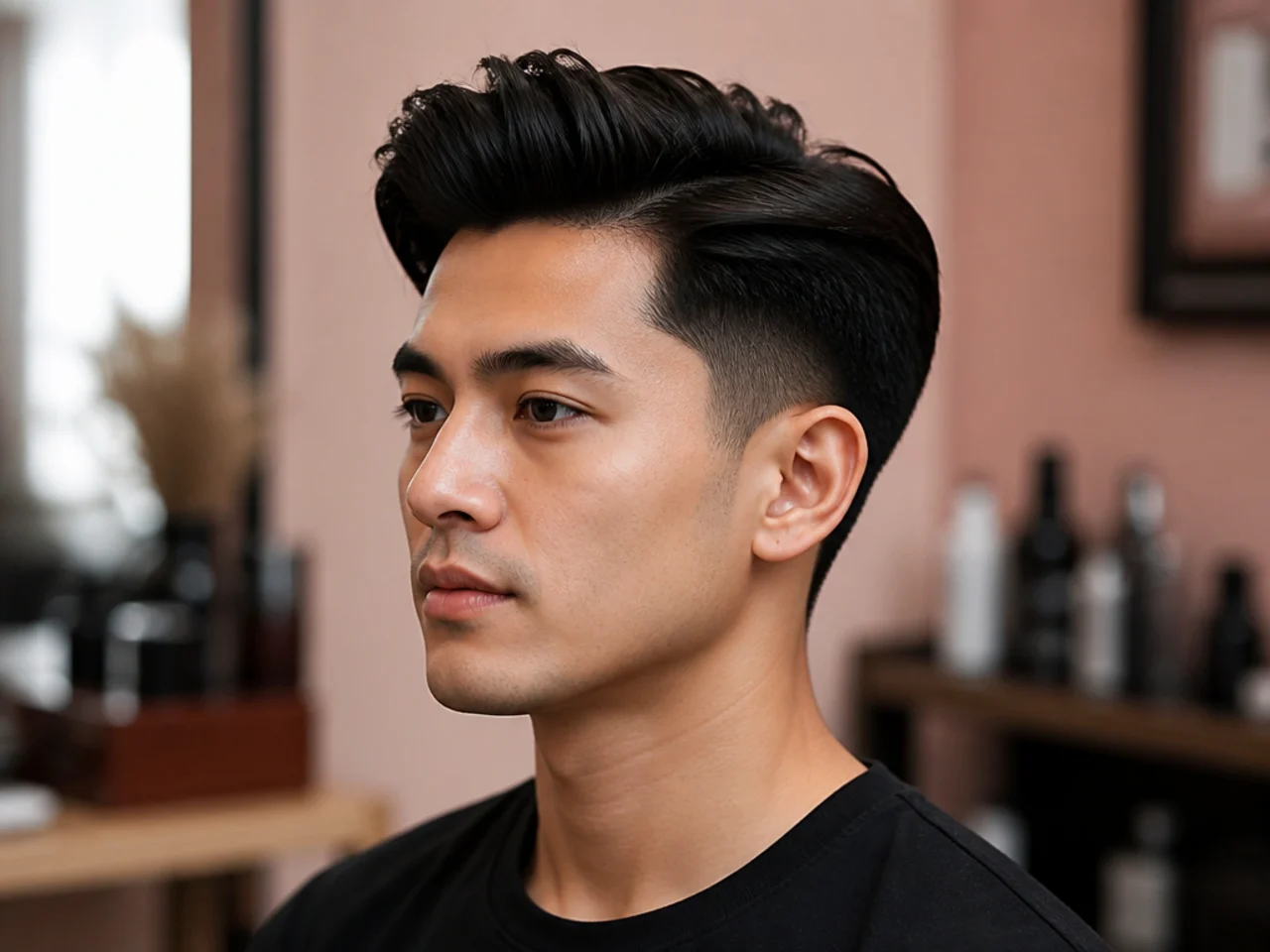
The most versatile Asian quiff on this list. The low taper at the sides sits just above the ear, barely climbing up the temple, so from the front you can barely see it. The top stays long (five inches) for full quiff movement. It reads polished in a suit and casual in a t-shirt — a rare combination.
Best on any face shape, straight to slightly wavy hair, guys who want one cut for every setting.
Ask for: "Low taper starting just above the ear, five inches at the front, scissor layers on top, invisible from the front."
Styling tip: blow-dry front up and back with a vented brush, matte clay through the front only.
8. Curtain Front Asian Quiff
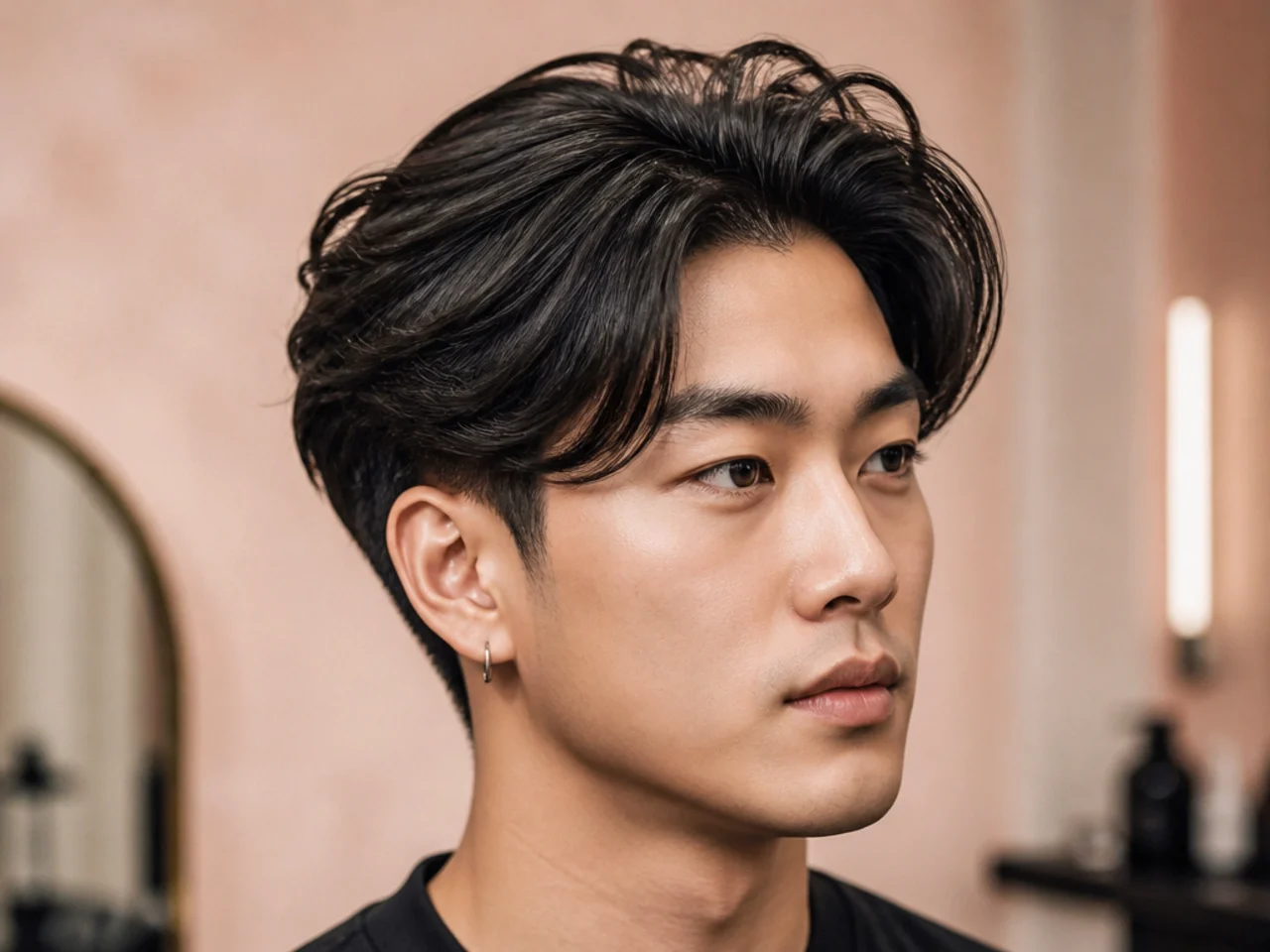
A hybrid the Korean salons started running in the late 2010s and never stopped. The front is cut with a curtain-style middle part but the crown is lifted into a quiff shape. So from the front you see the soft curtain fall, from three-quarters you see the quiff sweep. It softens angular faces and delivers K-drama lead energy without any styling drama.
Best on square and heart-shaped faces, straight hair, guys in their 20s.
Ask for: "Curtain front with a soft middle part, crown lifted into a low quiff, five inches at the front, scissor-blended sides."
Styling tip: blow-dry the front down and to both sides for the curtain, then lift the crown with fingers.
9. Messy Asian Quiff
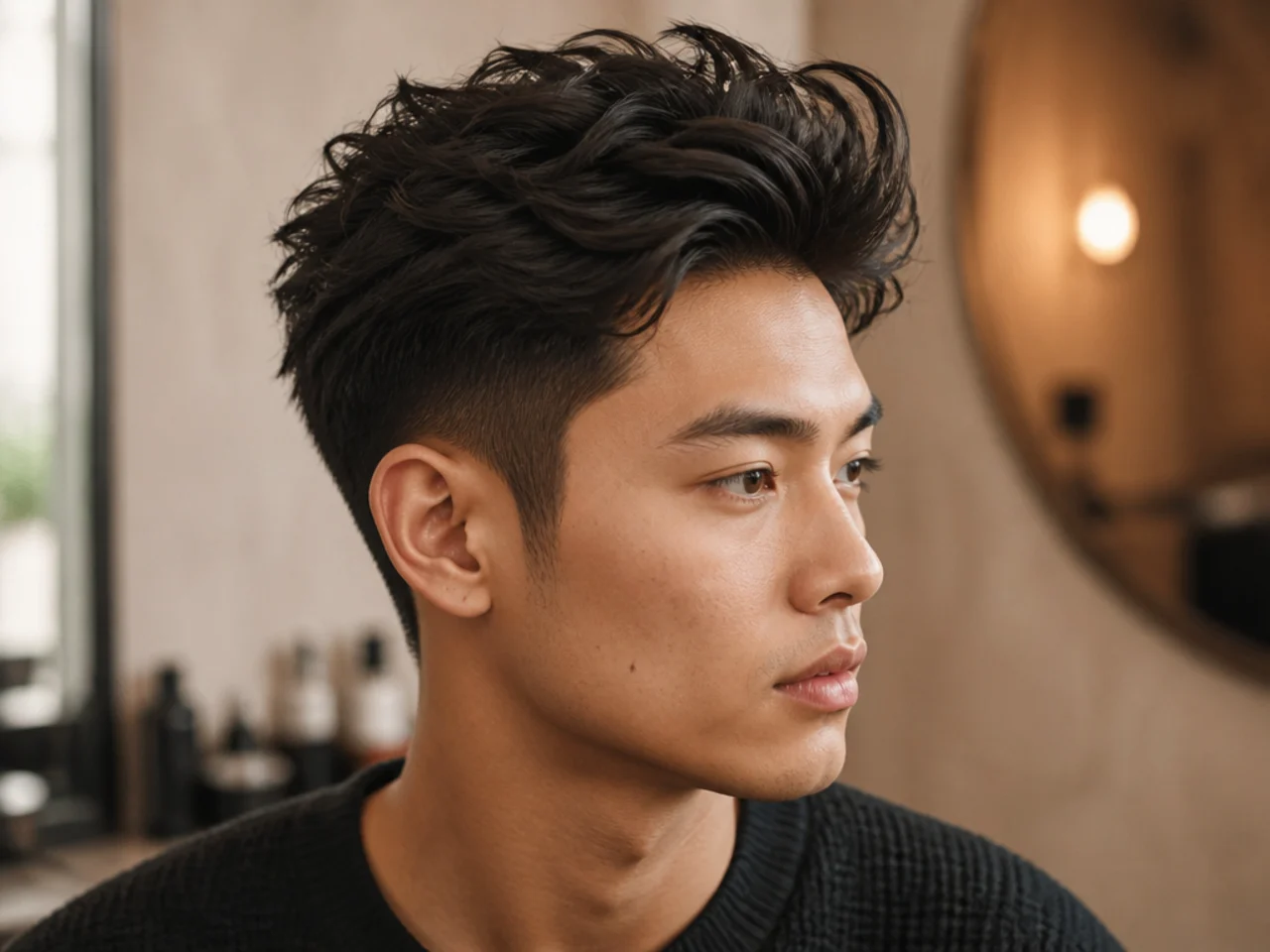
The messy quiff treatment applied to thick Asian hair. Layers run longer at the front (six inches), the perimeter is left slightly rough, and the finish is deliberately unstructured — no clean part, no comb line. Point-cut ends give the top a slept-in read that photograph-heavy Asian hair almost never gets by default.
Best on wavy or thick straight hair with some natural movement, oval to square faces, guys who don't want to think about their hair after 60 seconds in the mirror.
Ask for: "Six inches at the front with point-cut layers, low fade at the sides, worn-in edge — not sharp."
Styling tip: rough-dry with fingers on high heat, matte clay pressed in from ends toward the roots.
10. Undercut Asian Quiff
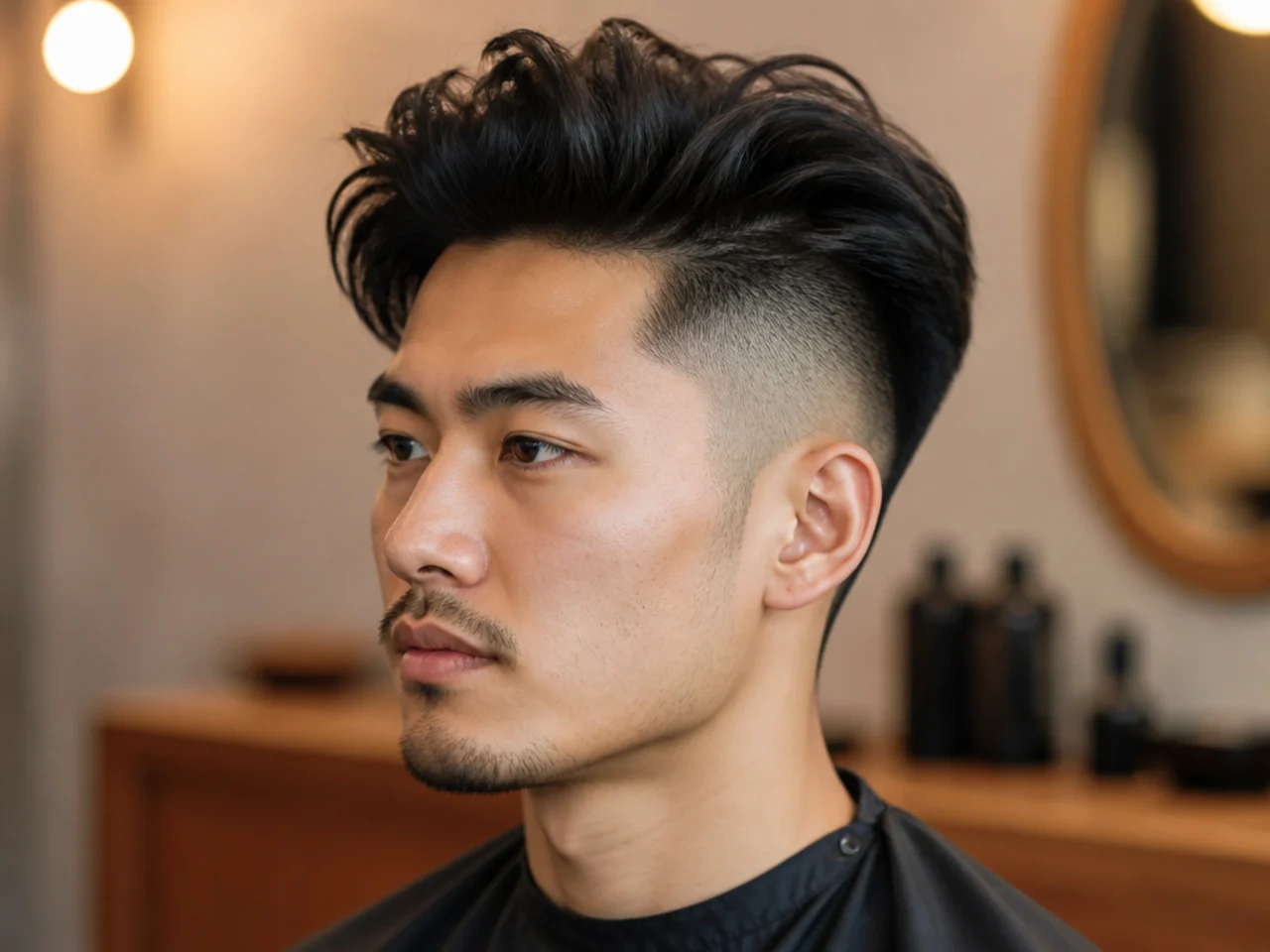
The disconnected version. Sides are clipped short with a two or three guard all the way up, no blend between them and the top, and the top runs six inches long. It's the sharpest quiff on this list — think Chinese cinema-era barbering meets K-pop stage lighting. Not for a conservative office, extremely photograph-friendly.
Best on oval and square faces, straight to slightly wavy hair, guys who don't mind attention.
Ask for: "Disconnected undercut, number three guard on the sides, six inches on top, clean hard line where the disconnection sits."
Styling tip: matte clay for daytime sweep-up, water-based pomade for evening slick-back — same cut, two moods.
11. Side-Swept Asian Quiff
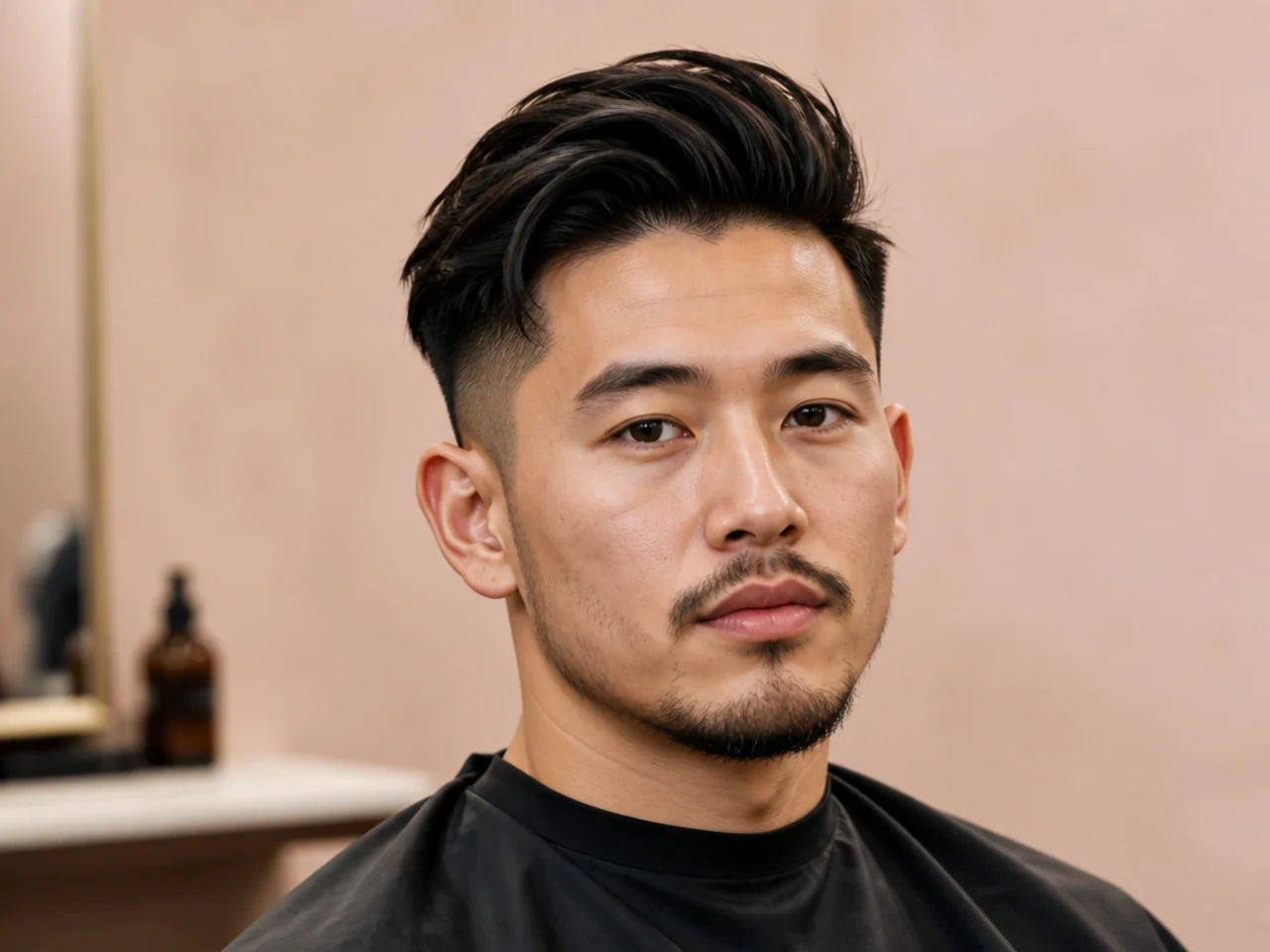
Front sweeps across the forehead diagonally rather than straight up and back. The direction is what distinguishes it — instead of vertical lift, you get soft diagonal movement toward one temple. Very common in Japanese salons, and increasingly on Korean actors playing softer romantic leads. Reads gentle without reading passive.
Best on heart and round faces (the diagonal breaks the width), straight to wavy hair, guys who want the quiff shape without the loudness of a full vertical sweep.
Ask for: "Side-swept quiff, five inches at the front, scissor-blended sides, low taper at the perimeter, diagonal front direction."
Styling tip: blow-dry the front across the forehead with a round brush, finish with light salon cream.
12. Long Asian Quiff
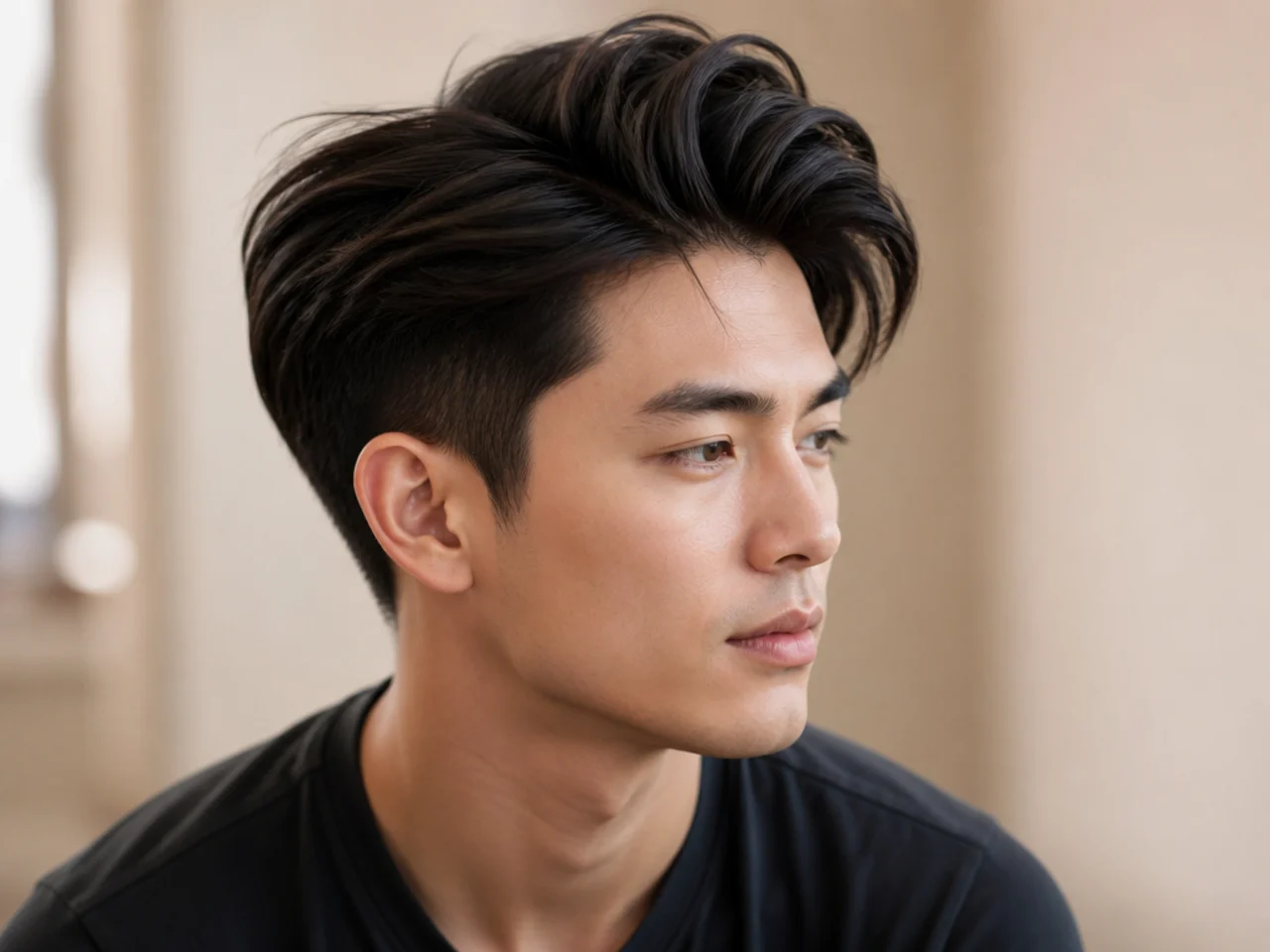
Front sits at seven inches, layered down to five inches at the crown, and the whole top sweeps back with real drama. Needs thick Asian hair — which most Asian readers have — to hold the shape all day, plus a five-minute morning routine. The payoff is a hairstyle that stops people at a distance in photos.
Best on oval, long, and round face shapes. Thick straight-to-wavy hair.
Ask for: "Seven inches at the front, layered down to five inches at the crown, scissor-blended sides or a low fade, shape holds when swept back — doesn't fall in the eyes."
Styling tip: volumizing mousse pre-styler, round-brush from front to crown, firm-hold matte cream, light hairspray finish.
13. Permed Asian Quiff
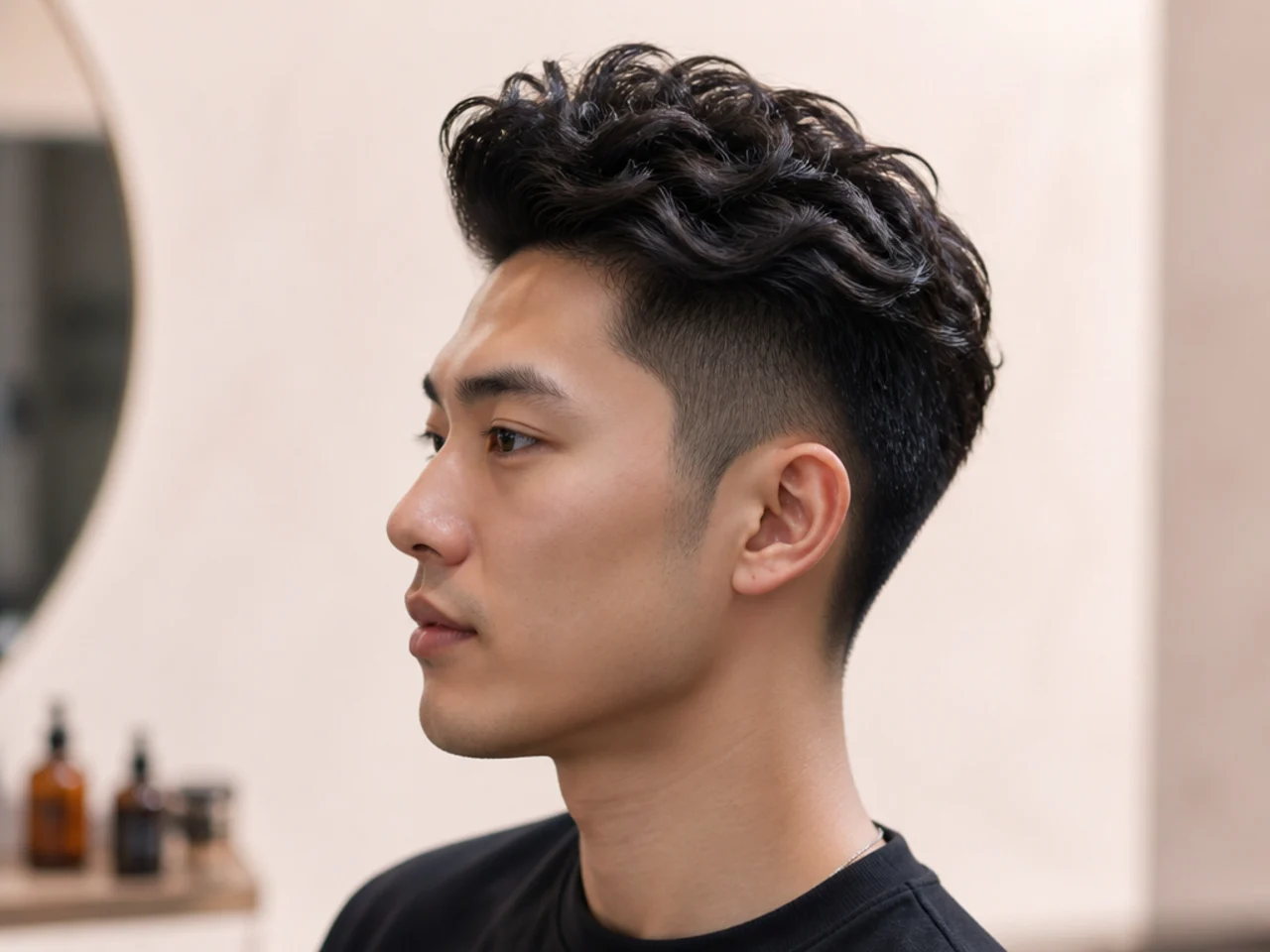
The Korean salon signature move. Instead of blow-drying every morning to build the sweep, you get a light setting perm at the crown and front — the perm holds the C-curl shape for six to eight weeks, and you just wet-and-go each morning. Widely used across K-pop for exactly this reason. The perm is soft enough that it looks natural, not curly.
Best on fine to medium-density Asian hair that goes flat by lunch. Every face shape.
Ask for: "Volume-only setting perm at the crown, soft C-curl at the front section, five inches at the front, scissor-blended sides."
Styling tip: light salon cream on wet hair, air-dry or diffuse on low. No product needed once the perm is in.
14. Asian Quiff with Light Stubble
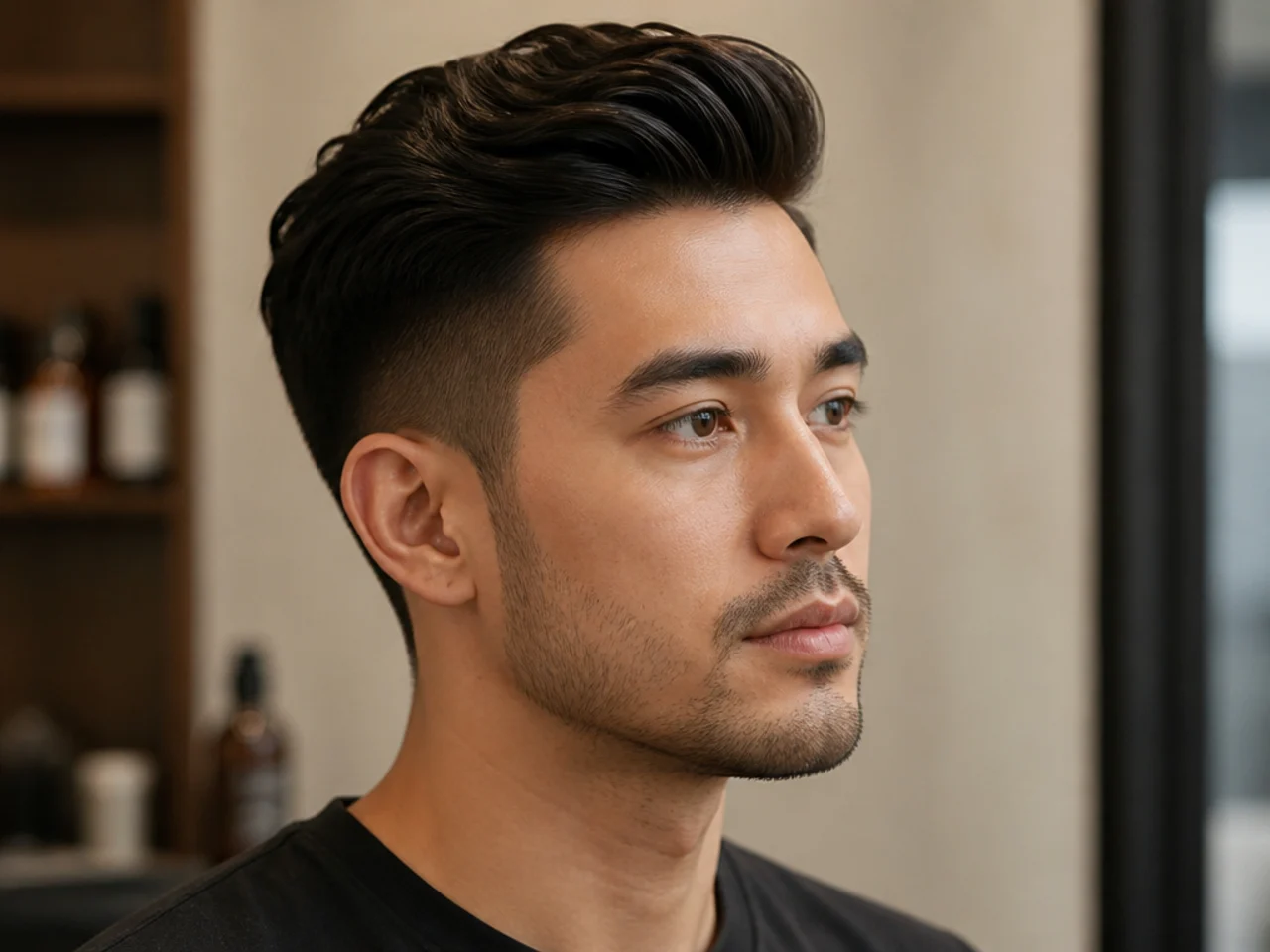
Add a shaped-stubble beard to any of the quiffs above (usually the mid fade or undercut versions) and the whole cut reads a full five years older and sharper. Asian facial hair grows softer and slower than Western beards, which is why stubble at four to seven days rather than a full beard is the standard pairing. The dark stubble against the matte top on Asian skin tones looks editorial.
Best on square, oval, and heart-shaped faces. Straight hair.
Ask for: "Mid fade tying into the beard line, five inches on top, cheek line shaped clean, stubble kept at three to five millimeters."
Styling tip: matte clay in the top, no beard oil (it makes the mid fade transition look greasy).
15. Skin Fade Modern Asian Quiff
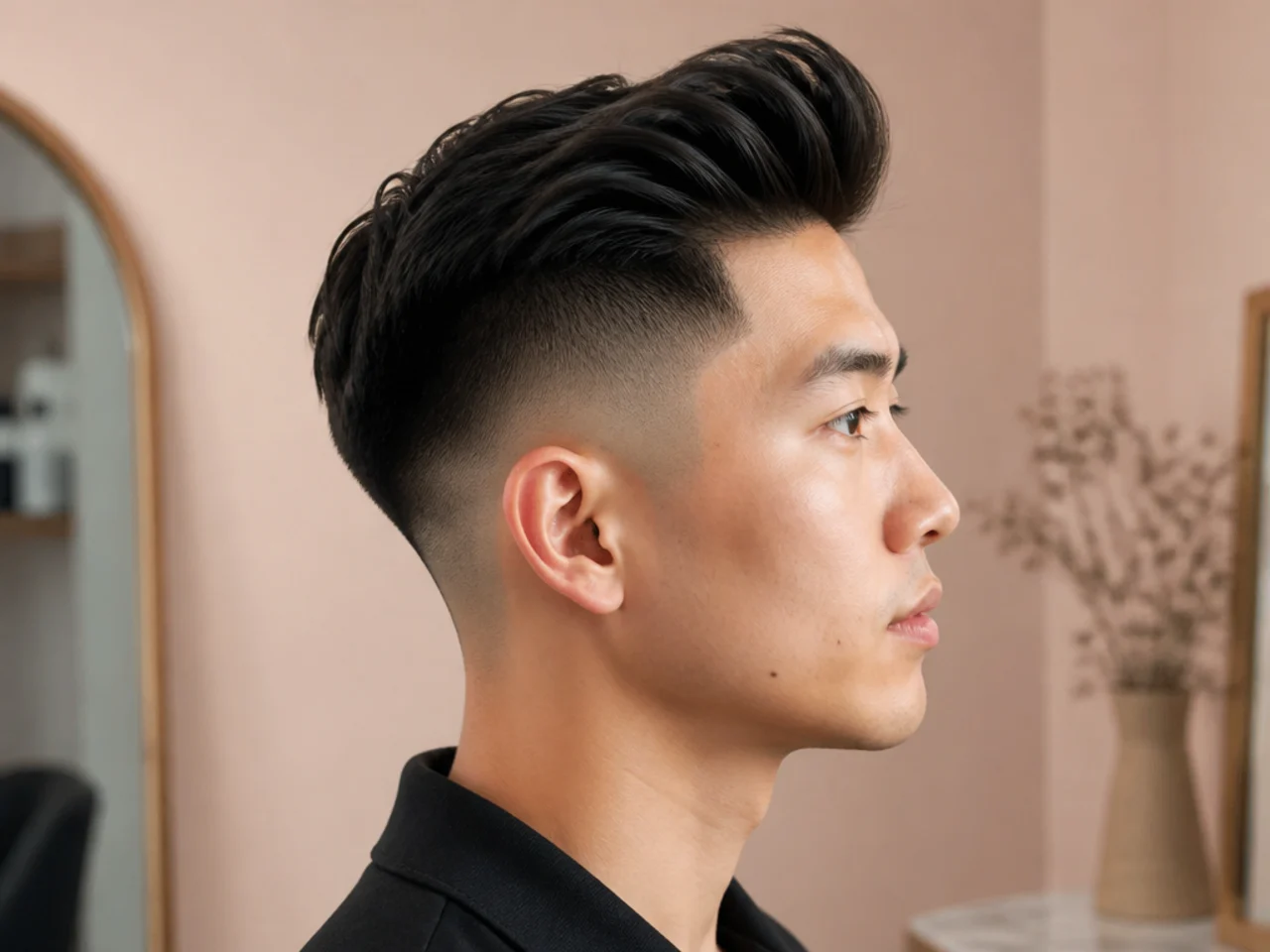
The loudest cut on this list. A high skin fade climbs to the temple with a defined edge — no soft blend, just a clean line where the fade begins. The top runs five to six inches with visible point-cut texture and a matte finish. The contrast between skin-close sides and dense textured top on glossy Asian hair reads editorial in every photo.
Best on angular jaws (this cut slims a wider face), straight to slightly wavy hair, guys who don't mind a two-week fade reset schedule.
Ask for: "High skin fade with a defined line-up at the hairline, point-cut layers on top, six inches at the front, matte finish."
Styling tip: matte clay pressed into the ends only, push the front up and back, cool-shot the shape with a blow-dryer to lock it.
How to Ask Your Barber for an Asian Quiff
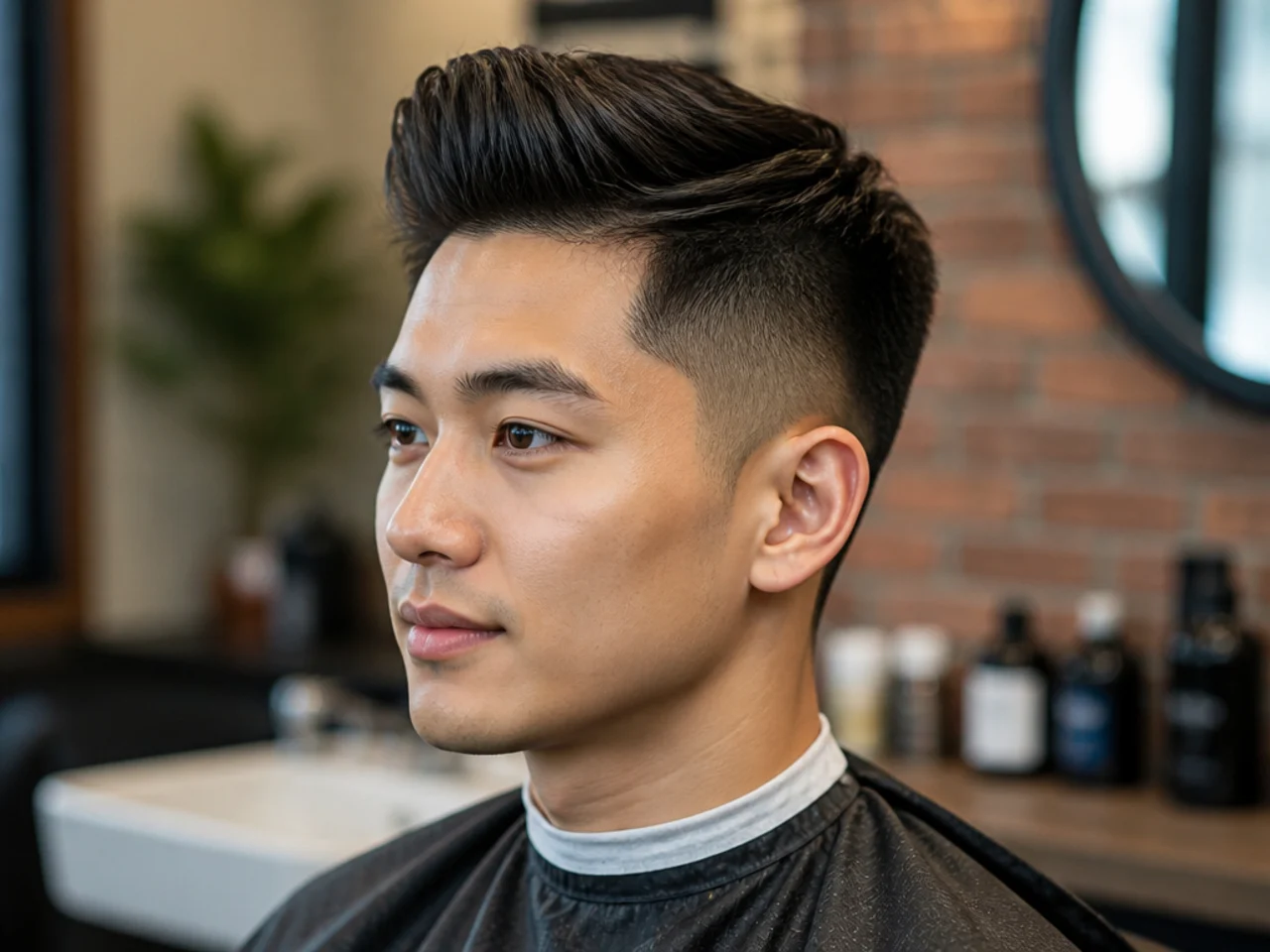
Bring the photo. Then run through these five specifics in this order — it's the exact brief a Korean or Japanese salon expects, and it removes every point where the cut can slide off-brief.
- Name the base cut. "Asian quiff" tells your barber nothing on its own. Say "K-pop soft quiff" or "modern skin fade quiff" or "two block hybrid quiff" — the phrase matches a picture in their head.
- Give the top length in inches, not adjectives. "Long" means five things. "Five inches at the front, four at the crown" means one.
- Specify the side treatment by exact name. Scissor blend, low taper, mid taper, mid fade, high skin fade, disconnected undercut — pick one and use those words.
- Call the finish. Matte-glossy is the K-pop default. Fully matte is the modern textured default. Sleek glossy is the retro or business default.
- Mention the front direction. Up and back for a classic sweep, up and diagonal for side-swept, up and slightly forward for a K-pop C-curl. Barbers cut differently based on which way the top will point.
- If you want a perm, book it as a separate step. Cut first, perm after the trim. Never do them in one appointment — the perm chemicals need to hit finished ends, not fresh cut lines.
- Book your next appointment before you leave. Four to five weeks is the standard cadence for a quiff on Asian hair.
Styling and Maintenance
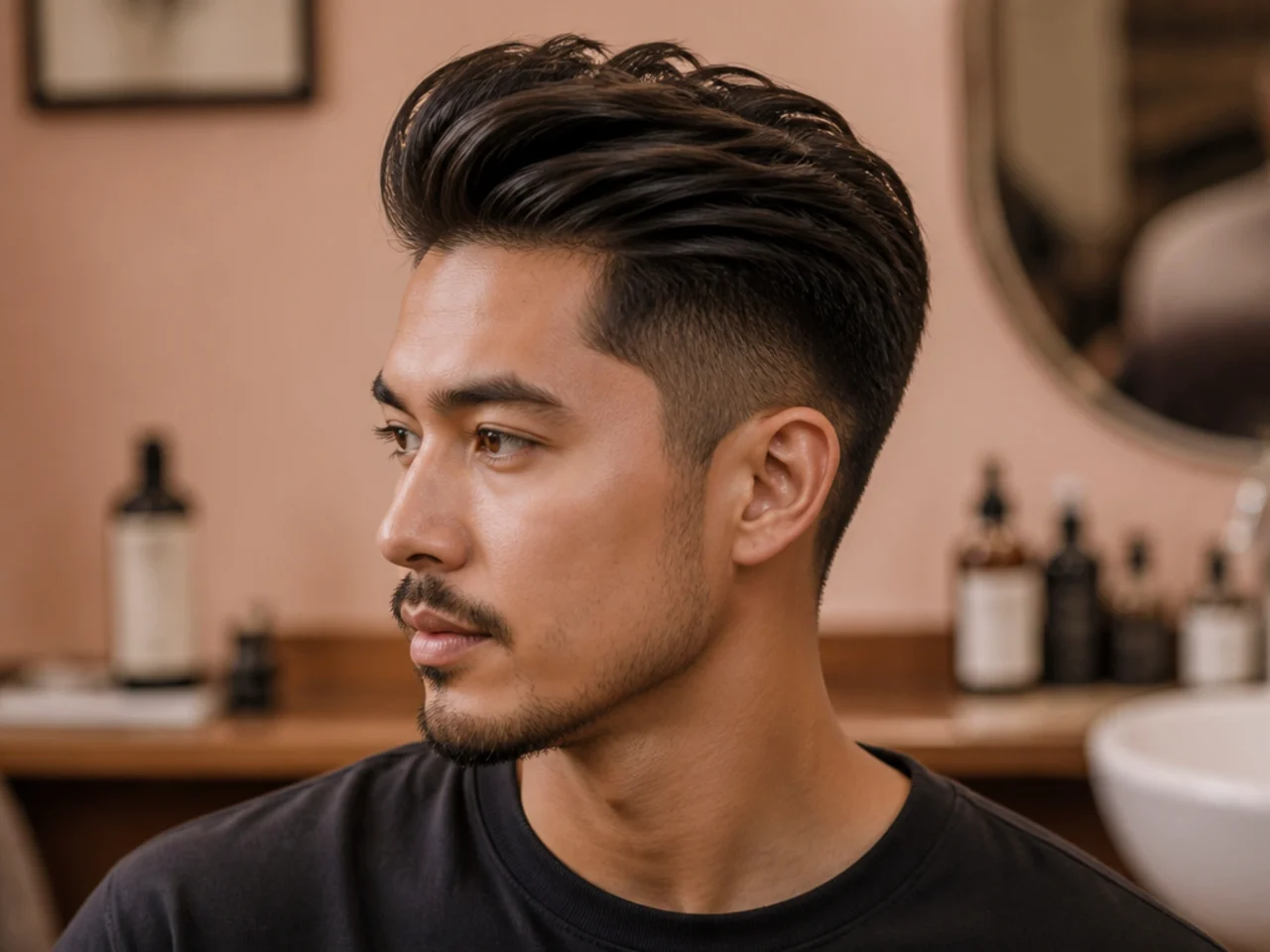
Asian hair takes styling well but demands the right products for the shape you want. A matte cream is the K-pop default — soft hold, semi-glossy finish, no crunch. A matte clay delivers stronger hold with a fully matte finish, better for the messy or textured variations. A light hold water-based pomade works for the retro sleek-back or the slick back evening flip on an undercut quiff. Skip oil-based pomades — they weigh Asian hair down and it never washes out cleanly.
Blow-dryer routine is worth learning if your quiff is longer than four inches. Towel-dry until damp, apply product to the roots and front, then dry with a round brush lifting the front up and back. Cool-shot the shape when it's where you want it. Full routine is under five minutes.
Wash frequency is a trade-off. Every day dries out Asian hair over time and kills the natural gloss. Every other day is the balance — dry shampoo on off-days at the roots to keep the volume up.
Trim cadence: every four to five weeks. Asian hair grows fast, and the front is the first thing to lose the sweep. The moment the front starts sitting forward instead of lifting up, it's time.
FAQ
Which Asian quiff variation photographs best?
The K-pop idol quiff (variation 2) and the skin fade modern Asian quiff (variation 15) are the two most photograph-forward cuts on this list. The K-pop soft version reads warm and cinematic under natural light. The skin fade reads sharp and editorial under studio light. Both play to the glossy density of Asian hair without fighting it.
Can Asian men with wavy hair do a quiff?
Yes — the messy, curtain-front, and permed variations all lean into wave. Ask your barber for scissor layers cut following your wave pattern (not against it) and skip the razor and thinning shears entirely. A wave-friendly cream on damp hair, air-dried or diffused on low, gets the finish.
What's the safest Asian quiff for a conservative workplace?
The short Asian quiff (variation 6) or the Asian quiff with low taper (variation 7). Both keep the shape at three to five inches, use scissor-blended or low-taper sides that read professional from any angle, and don't require a fade reset every two weeks. Both survive the finance-and-consulting dress code.
Do I need to perm my hair for an Asian quiff to work?
No — thick Asian hair holds the shape on its own with a blow-dry. The perm is a shortcut for guys who don't want to blow-dry each morning, or for guys with fine hair that falls flat. A volume-only setting perm at the crown lasts six to eight weeks and cuts your morning routine to under a minute.
How is an Asian quiff different from a Western quiff?
Length and finish. Western quiffs run three to five inches on top and often finish glossy with pomade in a 1950s reference. Asian quiffs run four to six inches on top to counter the weight of dense straight hair, and finish matte or matte-glossy rather than fully slick. The sides also default to scissor-blended or low-taper rather than a sharp skin fade.
Which Asian quiff is best for a round face?
The long Asian quiff (variation 12) or the modern skin fade version (variation 15). Both build maximum vertical height at the front, which is exactly what a round face needs to break the circular outline. Add a mid or high fade at the sides for extra vertical slimming. Every inch of front lift is another degree the round-face outline reads as oval instead.