
20 Half Up Graduation Hairstyles That Hold Under a Cap
Twenty half up graduation styles, and the one rule that separates the ones that survive a mortarboard from the ones that do not. The gathered section has to sit below the cap band, which means low, flat and pinned rather than tied.
In this article · 28
- Where the Cap Sits on a Half Up
- Half Up Versus Updo in Photos
- Half Up by Hair Length
- Putting the Cap On Over a Half Up
- All Day Hold on a Half Up
- Timing on the Morning Of
- The 20 Half Up Graduation Styles
- 1. Half Up With Loose Curls
- 2. Low Half Up Bun
- 3. Dutch Braid Half Up Crown
- 4. French Braid Half Up Twist
- 5. Twisted Halo Half Up
- 6. Half Up Ponytail at the Nape
- 7. Bubble Half Up Ponytail
- 8. Two Strand Twist Half Up
- 9. Half Up With Curtain Bangs
- 10. Sleek Slicked Half Up
- 11. Half Up Fishtail Braid
- 12. Half Up on a Chin Length Bob
- 13. Half Up With Side Accent Braids
- 14. Pearl Pinned Half Up
- 15. Low Half Up Space Buns
- 16. Half Up Rope Twist for Fine Hair
- 17. Half Up Heatless Beach Waves
- 18. Half Up Claw Clip
- 19. Half Up Ribbon Bow
- 20. Half Up Low Chignon
- Final Thoughts
A half up is the obvious answer at graduation and the one that most often comes apart in the car, because of where the gather is tied rather than what it is tied with.
The cap band crosses the exact spot most half ups are tied. An elastic at crown height sits under the rear edge of the mortarboard and props it up, and the board slides from the first turn of your head.
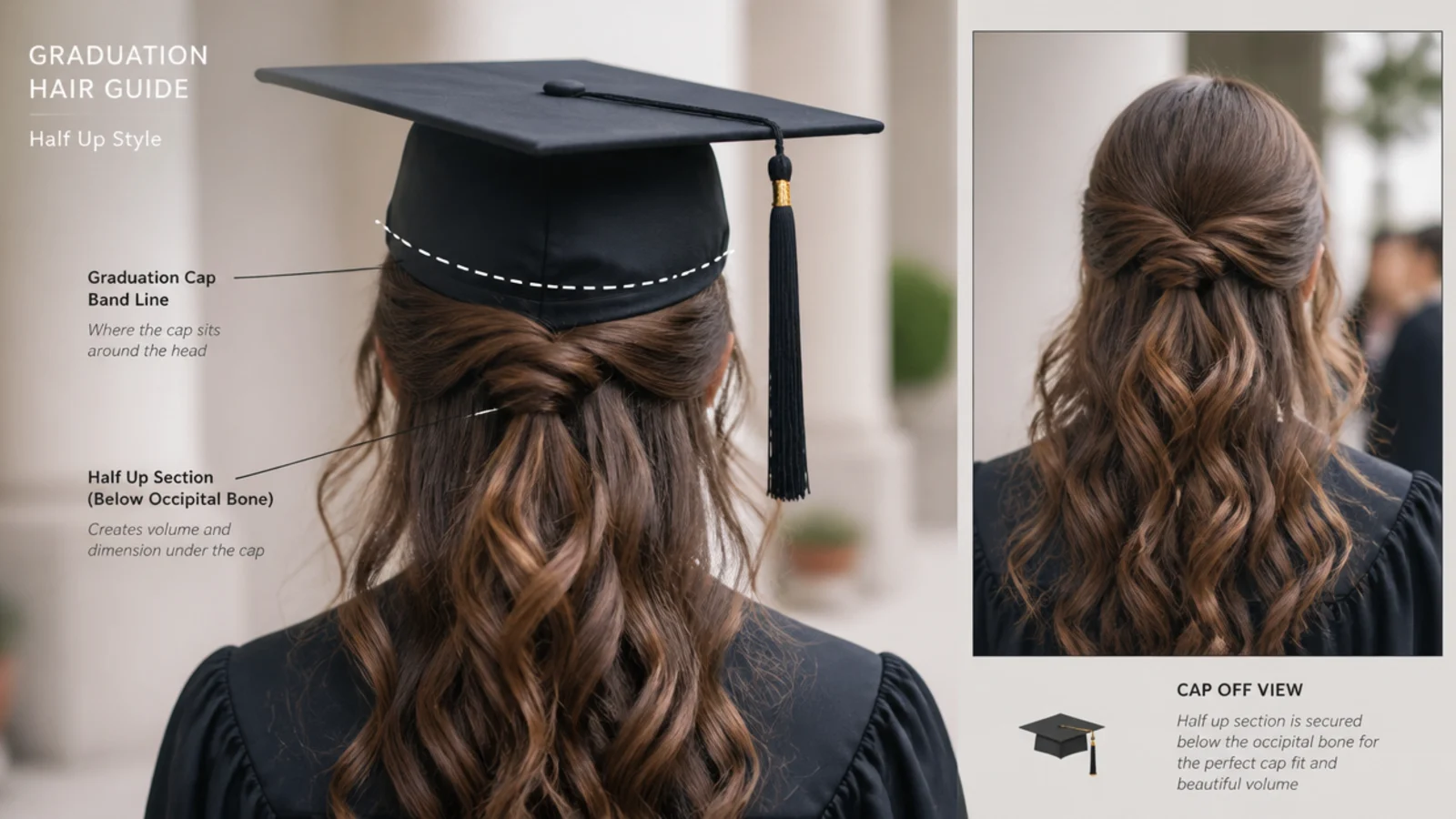
Pin low and flat instead of tying high. The same section gathered at the occipital bone sits below the band entirely, and the cap never knows it is there.
Where the Cap Sits on a Half Up
The band is a fixed loop. It sits a finger above the brows at the front and lands on the occipital bone at the back, and it cannot be pushed further back to clear a knot.
Everything above that line is under the cap. On a half up that means the crown, the sides above the ears, and whatever you tie the top section with.
Everything below it hangs free. The length that falls from the gather is outside the cap and stays exactly as you styled it.
So the gather belongs at the bone, not above it. That single move converts a half up from a fit problem into a non issue.
Half Up Versus Updo in Photos
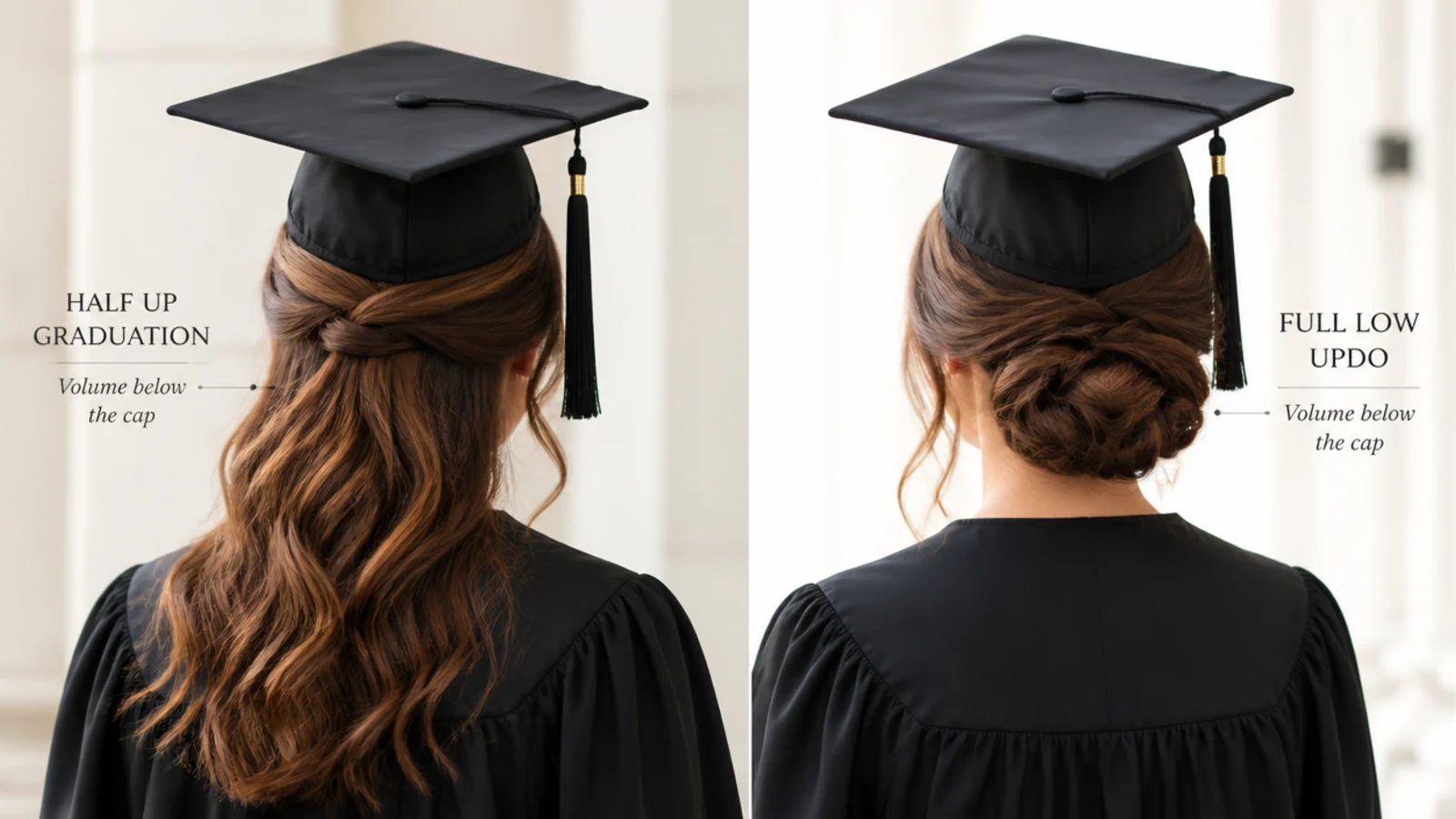
An updo gives you a clean jawline and nothing else. The face carries the frame, which is strong under a cap and plain without one.
A half up keeps visible length in the picture. The gathered top reads as styled while the loose length reads as hair, and both are in the same frame.
The cap off moment favours the half up. There is nothing to take down. The style you wore under the board is the style in the family photographs.
The trade is upkeep. Loose length gets caught in a gown collar and blown around outdoors, where an updo simply does not move.
Half Up by Hair Length
Chin length. There is barely enough to gather, so take a narrow top section only and pin it rather than tying it. A small clip reads better than a straining elastic.
Shoulder length. The most forgiving length for this shape, because the loose portion is long enough to show movement and short enough to stay off the gown collar.
Long hair. Take a wider top section than feels right. A narrow gather on heavy hair puts all the weight on a small number of strands and drags itself loose.
Coils and tight texture. Gather with a soft band and pin, never with a tight elastic, because a coiled section held under tension pulls at the roots all afternoon.

Putting the Cap On Over a Half Up
Lower it, do not slide it. Lift the cap above your head and drop it straight down. Sliding it on from the forehead drags the band backwards across the gather and rakes pins out.
Set the front edge first, then release. Place the front a finger above the brows, hold it there, and let the back settle onto the bone.
Pin the cap into the gather, not into loose hair. Two crossed bobby pins through the inner band and into the pinned section give the cap something solid to hold.
Practise once at home in the gown. The collar sits higher than you expect and changes where the loose length falls.

All Day Hold on a Half Up
Wash the night before. Sebum on the cuticle raises friction between strands, and friction is the only reason a pin stays where you put it.
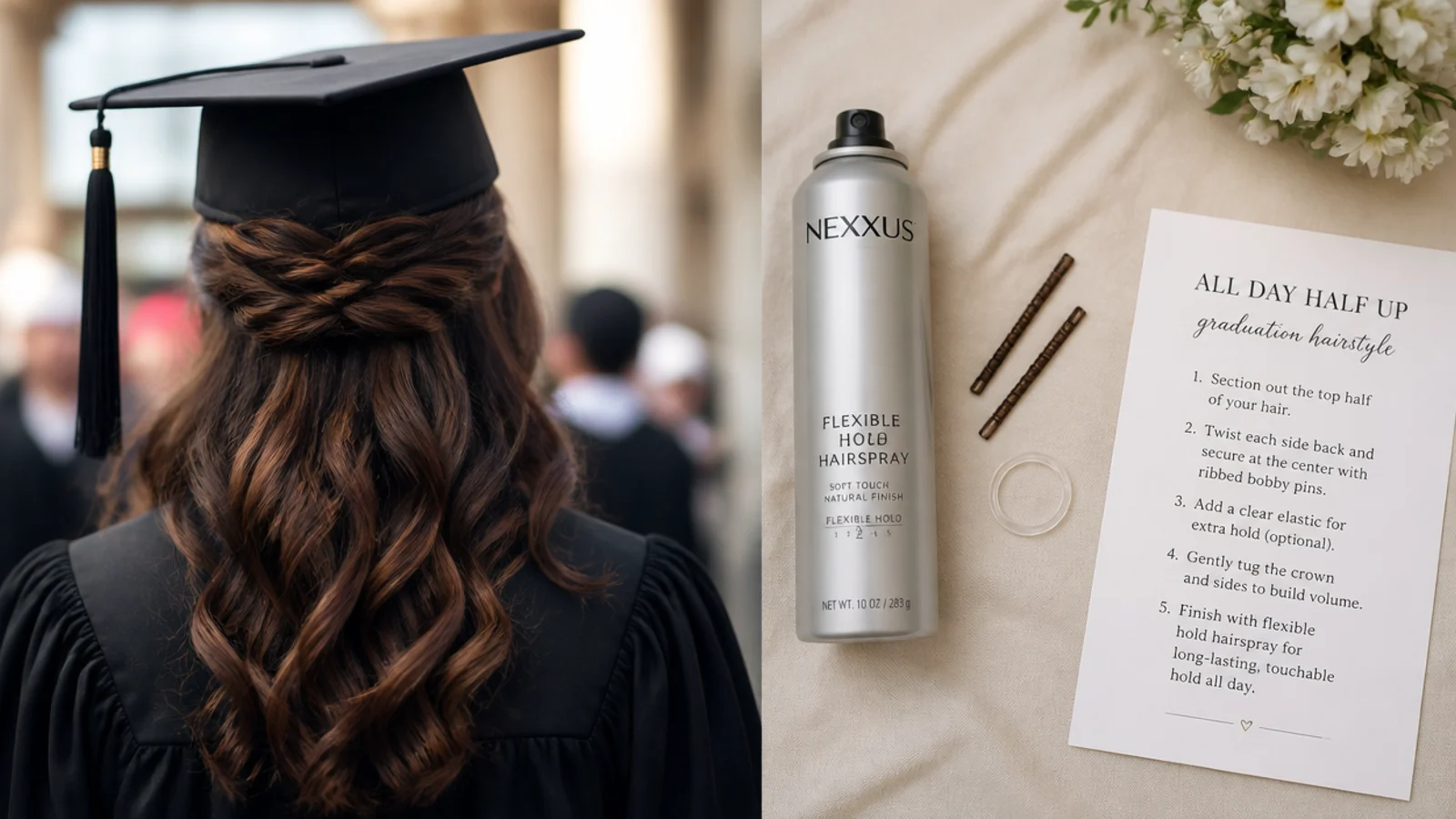
Cross the pins in pairs. Two pins at opposing angles lock rotation both ways. A single pin is a hinge that works itself out over four hours.
Flexible spray, not firm. A flexible polymer film bends when the cap knocks the gather and springs back. A rigid film cracks and drops the section.
Spray the loose length once, low. Most of the movement that ruins a half up happens at the ends, where wind and a gown collar do the damage.
Timing on the Morning Of
Ninety minutes before you leave. Sprayed hair has to dry fully before the cap touches it, or the film sets around a dent.
Set any curl first, pin second. Heat set shape holds as it cools, so a curl released and immediately gathered loses the pattern it was about to keep.
Do the full cap fitting dressed. Gown, cap, both hands free. Turn your head hard and look at the floor.
Pack six pins and a mini spray. The gap between the ceremony and the photographs is when a half up gets rebuilt.

The 20 Half Up Graduation Styles
1. Half Up With Loose Curls
Curl the length first and gather afterwards, because a heat set curl locks its shape as it cools and gathering it warm flattens the pattern permanently. Keep the curl below ear level so the band never crosses a curled root, which is the part that will not recover once compressed.

2. Low Half Up Bun
Twisting the gathered section into a small bun at the occipital bone puts the whole knot below the rear edge of the band. It is also the most stable version here, because a bun distributes the load across several pins instead of hanging it from one elastic.

3. Dutch Braid Half Up Crown
A Dutch braid crosses strands underneath, so the plait sits proud of the scalp — which is why this version has to be pinned down flat as it goes rather than left resting. Done that way it adds pattern across the crown with almost no depth for the band to fight.
4. French Braid Half Up Twist
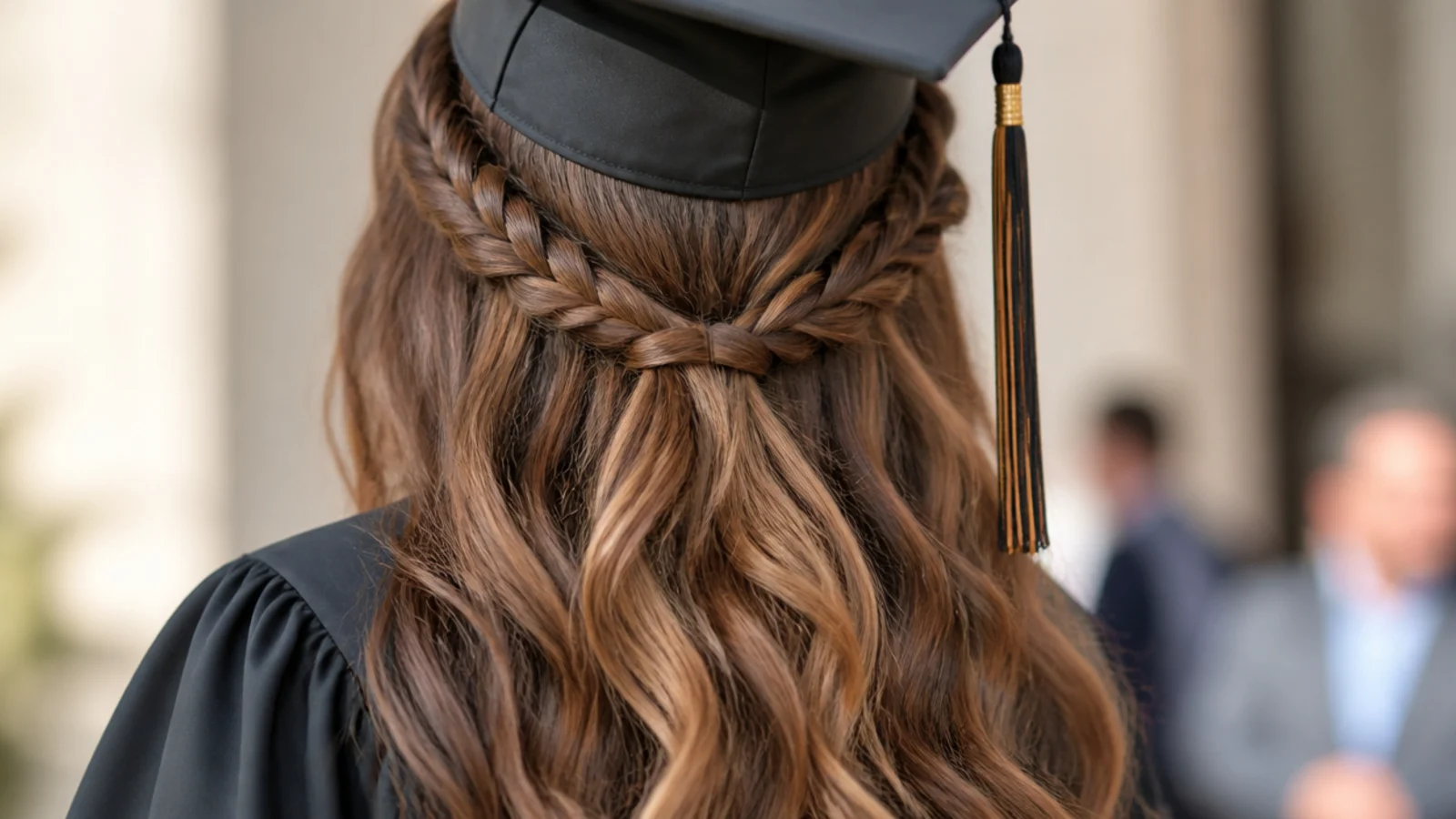
A French braid crosses strands over the top, so it sinks into the head shape rather than standing off it. That makes it the flatter of the two braids and the safer one to run under a mortarboard band.
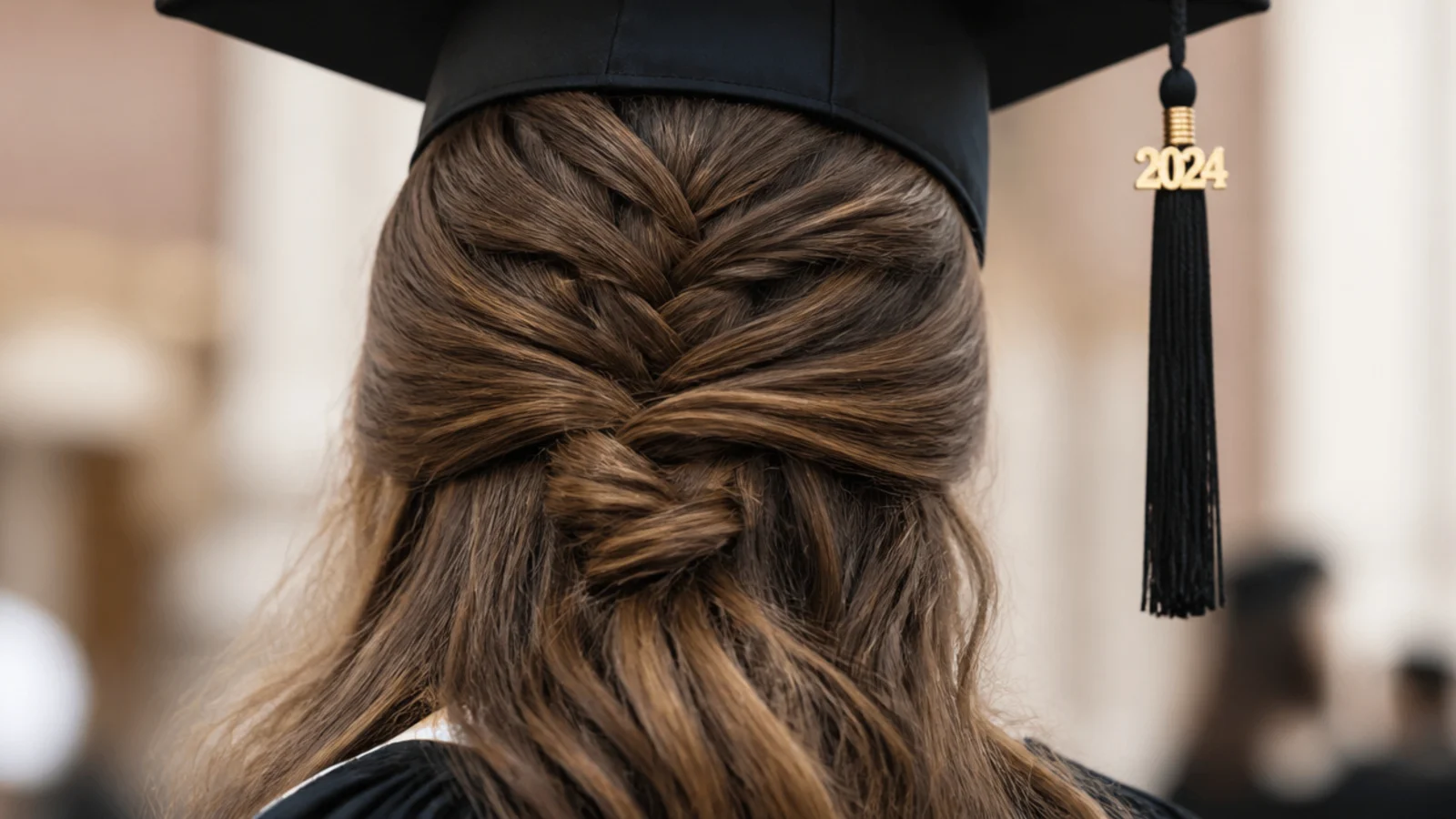
5. Twisted Halo Half Up
Two twists taken back from the temples and joined at the occipital bone frame the face without adding height anywhere the cap sits. The join is the only pinned point, so cross two pins there and the whole style holds from one anchor.

6. Half Up Ponytail at the Nape
Dropping the tie to the occipital bone is the whole trick, and it is why this survives a cap where a high half ponytail does not. The elastic sits below the band, so the board rests on bone instead of on a knot.

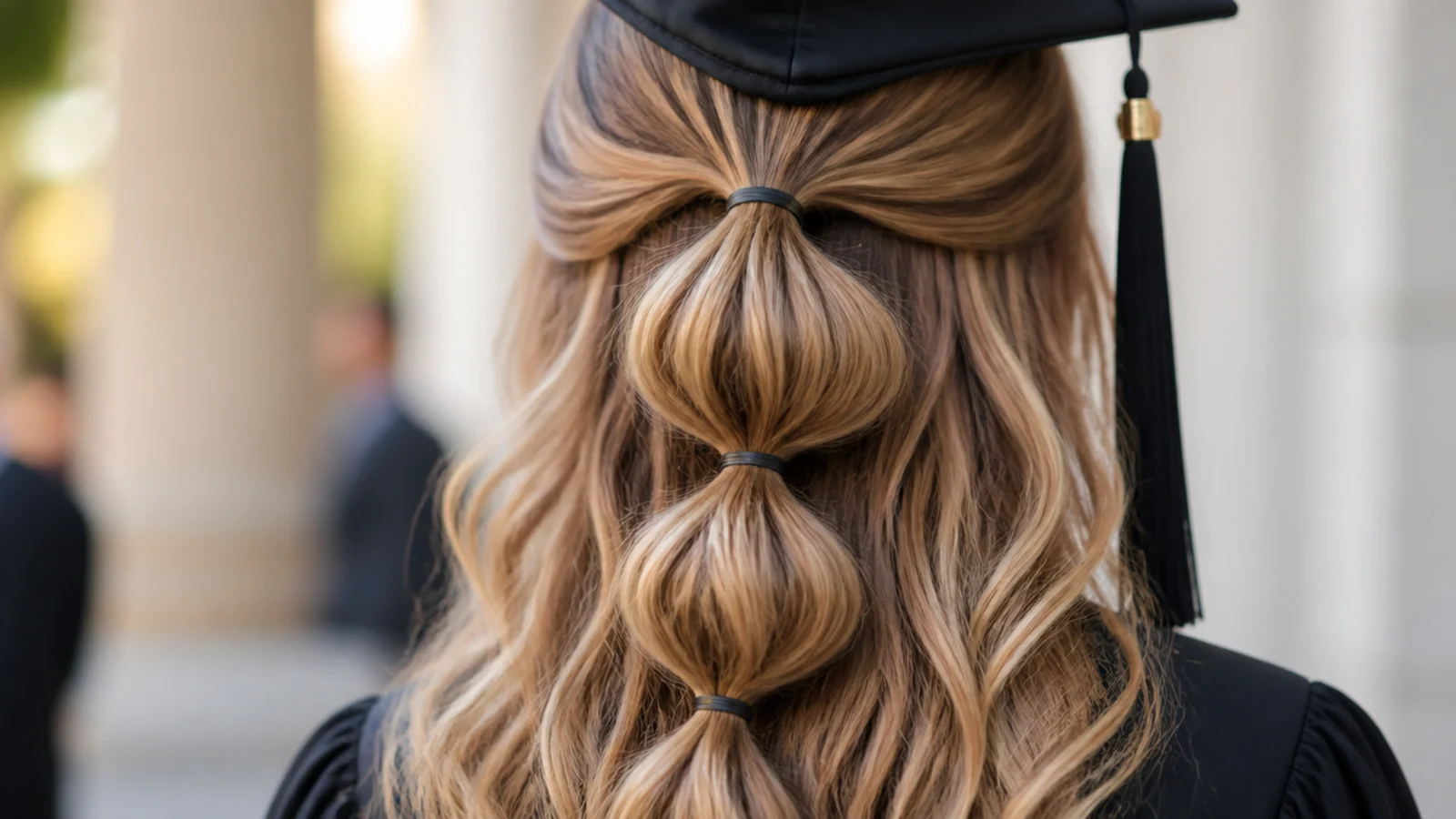
7. Bubble Half Up Ponytail
Segmenting the tail with clear elastics spreads the weight down its length rather than hanging it all from the first band. Over four hours that matters, because a single loaded elastic creeps downwards and takes the shape of the gather with it.
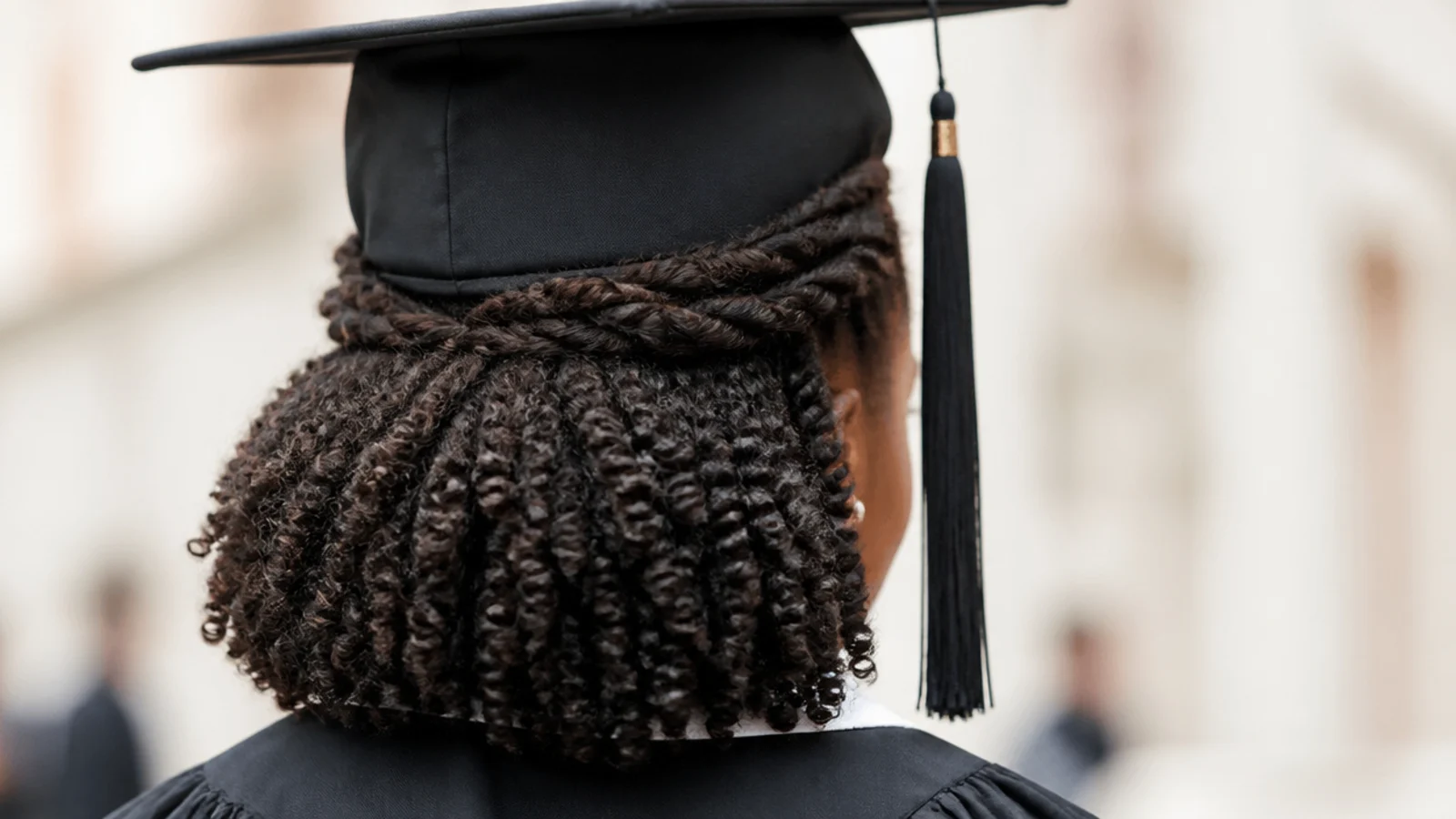
8. Two Strand Twist Half Up
Twisting two sections individually and wrapping them the opposite way makes them lock against each other, so the twist cannot unwind under its own tension. That self locking is what keeps this neat through a ceremony without a single pin in the length.
9. Half Up With Curtain Bangs
Leaving the front pieces out of the gather gives the face a soft frame that the cap brim then sits above. Curl them away from the face before pinning the back, because once the gather is set you cannot get a brush behind them.

10. Sleek Slicked Half Up
Gel lays the crown completely flat, which removes any argument with the band before it starts. Let it dry fully before the cap goes on — a wet film pressed under a band sets in that shape and dries as a visible line.

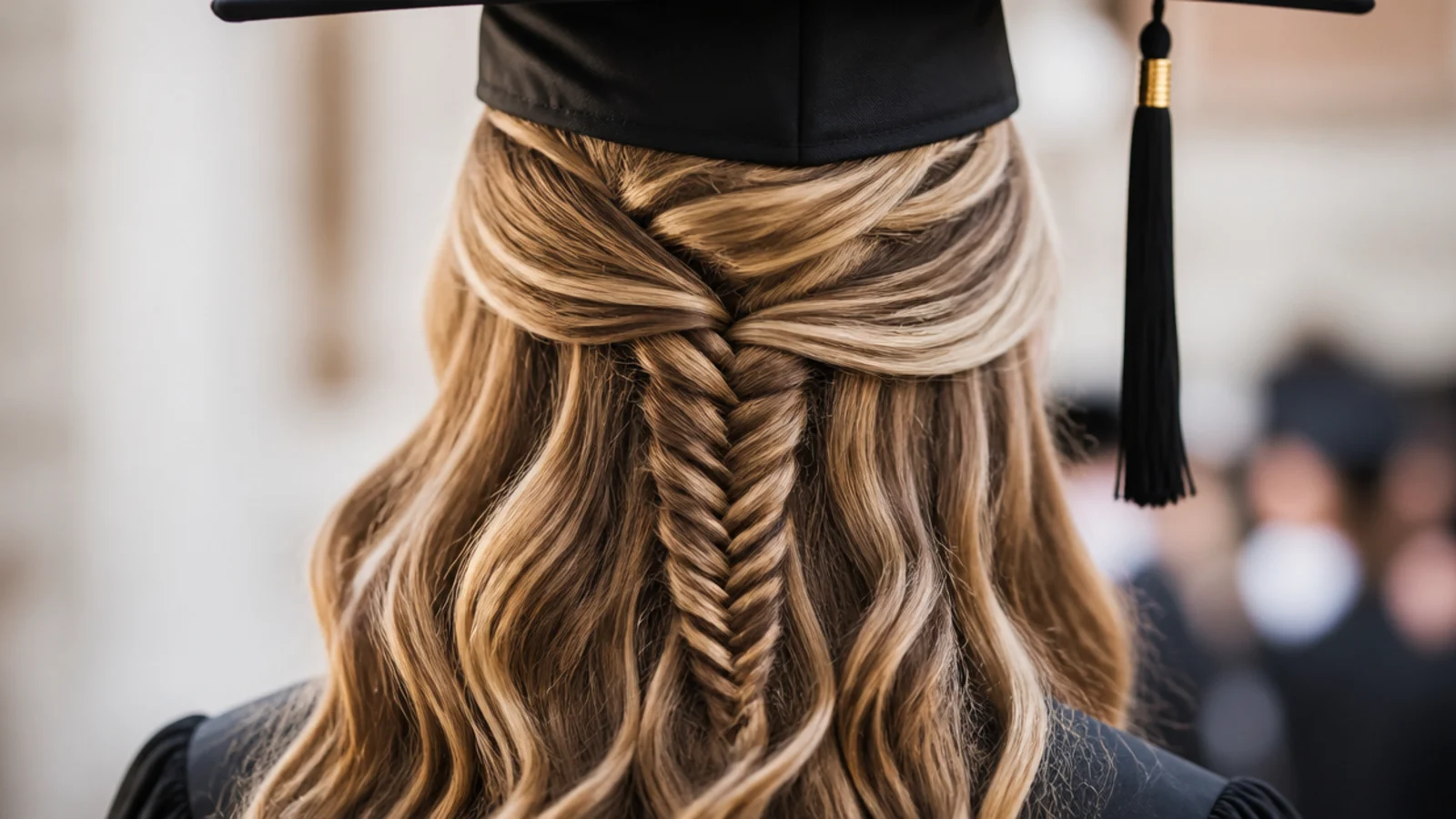
11. Half Up Fishtail Braid
A fishtail crosses thin sections over the top, making it the flattest braid available, so it hangs against the back instead of standing away from it. Start it below the gather and the whole plait falls outside the cap entirely.
12. Half Up on a Chin Length Bob
At bob length there is not enough to tie, so take a narrow top section and pin it rather than gathering it. Two crossed pins hold more reliably than an elastic here, because a short section under tension simply slides out of a band.

13. Half Up With Side Accent Braids
Two thin braids taken from the temples into the gather add detail exactly where a cap brim frames the head. Thin is the point — a narrow braid lies flat against the side of the skull where a thick one would sit under the band.

14. Pearl Pinned Half Up
Decorative pins do structural work only if they are set into a section that is already anchored. Put the functional bobby pins in first, then add pearl pins over them, because a pearl head is heavier and pivots more easily than a plain pin.

15. Low Half Up Space Buns
Two small knots set low and wide, behind the ears rather than on top, keep both of them clear of the band. Splitting the gather also halves the weight on each set of pins, which is why this holds better than one central knot on thick hair.

16. Half Up Rope Twist for Fine Hair
Fine hair gives pins few strands to hook, so a rope twist helps by trapping each pin between two opposing tensions. Backcomb the base of the gather lightly first and the same three pins hold roughly twice as long.

17. Half Up Heatless Beach Waves
Waves set overnight on damp hair hold from hydrogen bonds re forming as the hair dries, which means no heat and no damage before a long day. The wave also disguises the compression line the band leaves, because a bent strand scatters light where a straight one shows the crease.

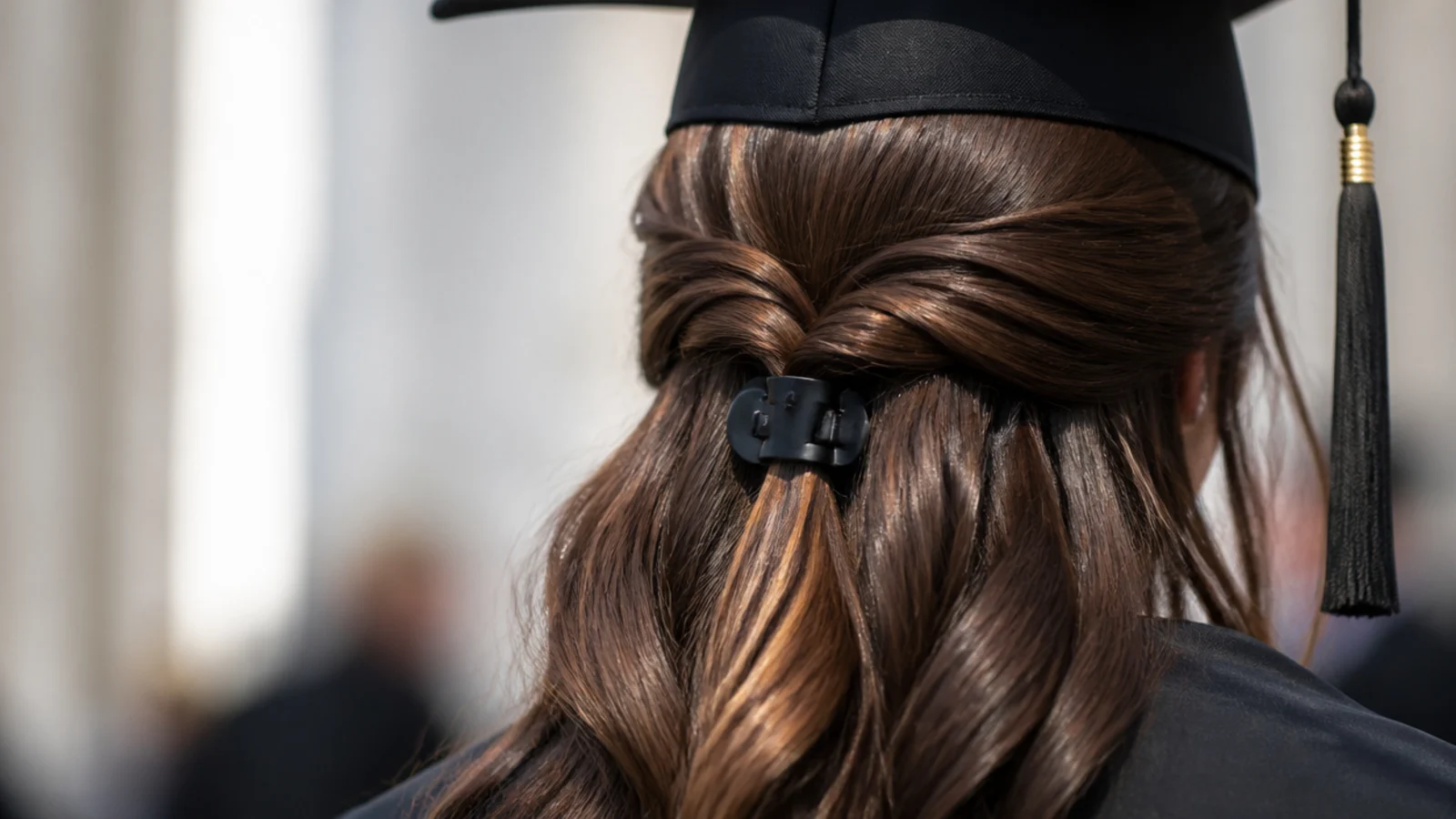
18. Half Up Claw Clip
A clip is the fastest fix of the day and the easiest to redo between the ceremony and the photographs, as covered in more detail in the claw clip version. Choose a small flat clip, because a large one adds depth exactly where the band lands.
19. Half Up Ribbon Bow
A ribbon tied over the elastic hides the band and adds colour under a plain black gown. Tie it after the cap has been fitted once, because a bow crushed under the band comes out flattened and cannot be reshaped.

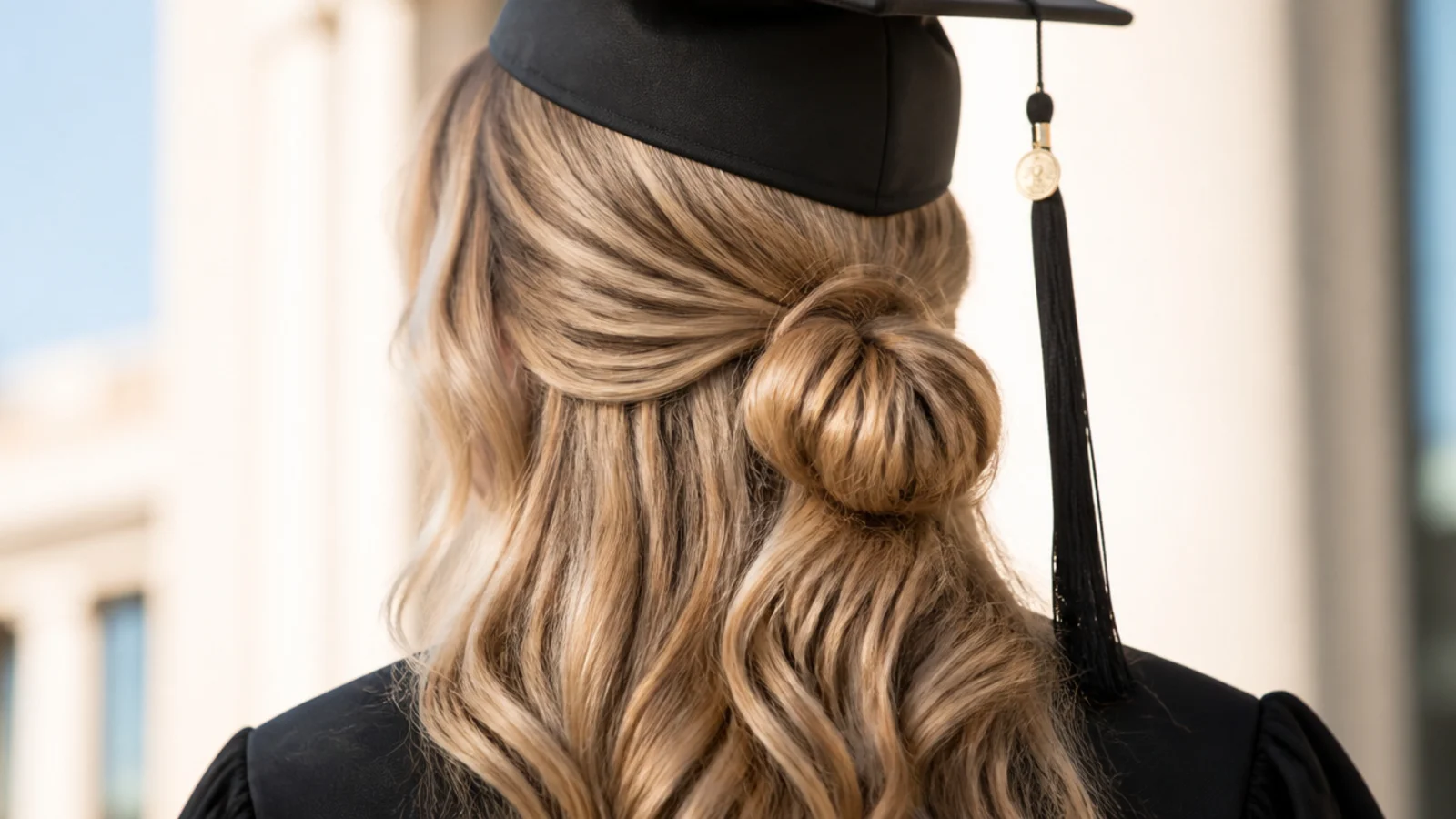
20. Half Up Low Chignon
Coiling the gathered section into a small flat chignon at the nape gives the tidiest possible version of a half up. The coil sits under the band, inside the gown collar, and stays put through sitting down and standing up repeatedly.
Final Thoughts
Every failure of a half up under a cap traces back to the same thing — the gather was tied where the band needs to be. Move it down to the occipital bone, pin it flat in crossed pairs, and the mortarboard sits as it was issued while the length below stays entirely untouched.
Then lower the cap onto your head rather than sliding it on, and carry six spare pins for the gap between the ceremony and the pictures. For the same shape without a cap to plan around see the claw clip version and half up half down hoco hairstyles. More in Occasion Hair.
Frequently asked questions
Related posts
See all posts
15 Graduation Hair Ideas for the Updo Versus Down Decision
Read more
15 Straight Hair Wedding Looks to Save
Read more
20 Gorgeous Prom Looks for Straight Hair
Read more