15 Hair Sketch Reference Ideas to Draw From
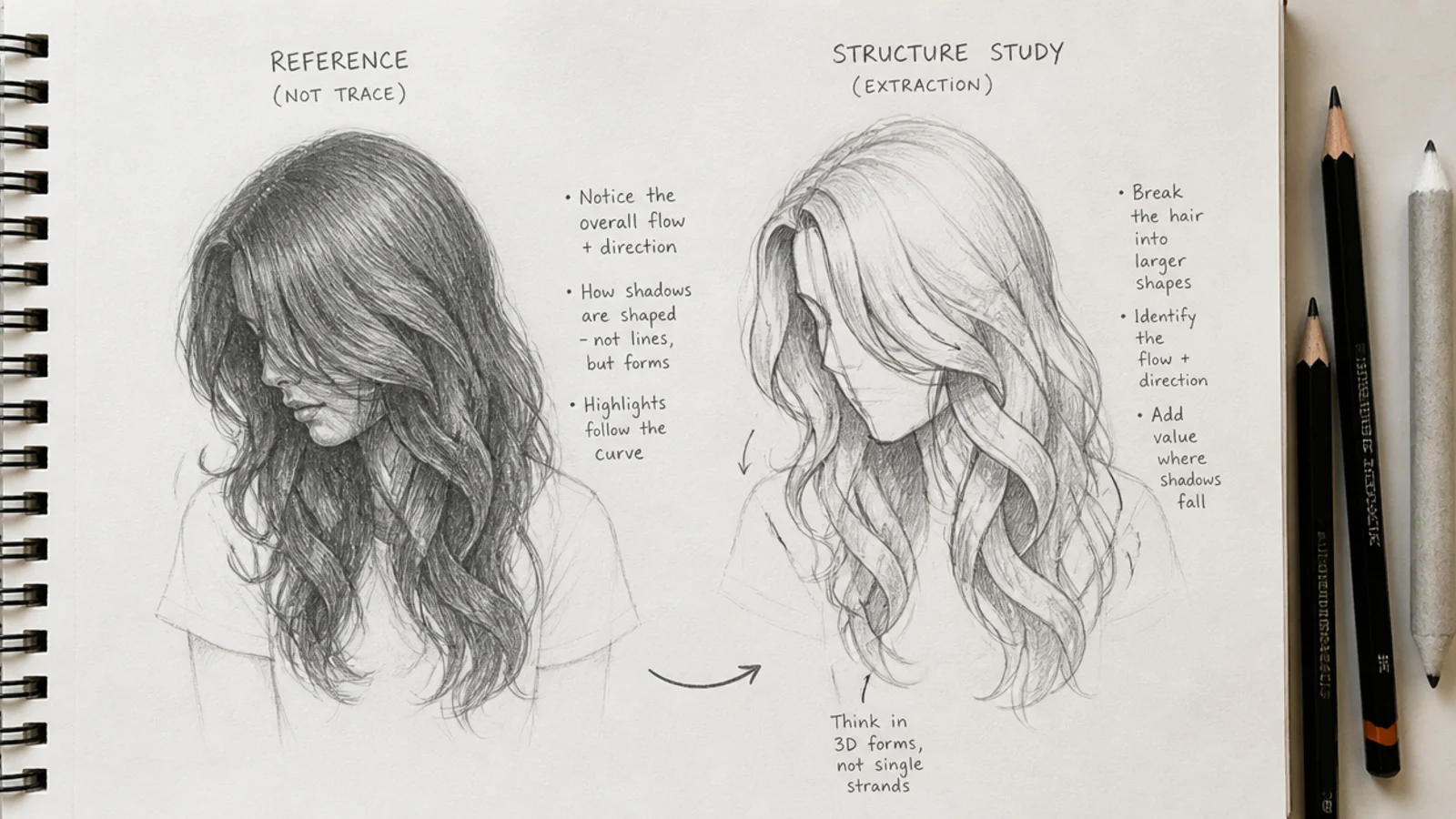
Fifteen hair reference sheets and the difference between the two ways of using one. A reference you copy teaches you that photograph. A reference you interrogate for structure teaches you hair, and the second one transfers.
In this article · 23
- Pencils Paper and Tools
- How to Use a Hair Reference
- Shape Before Strands
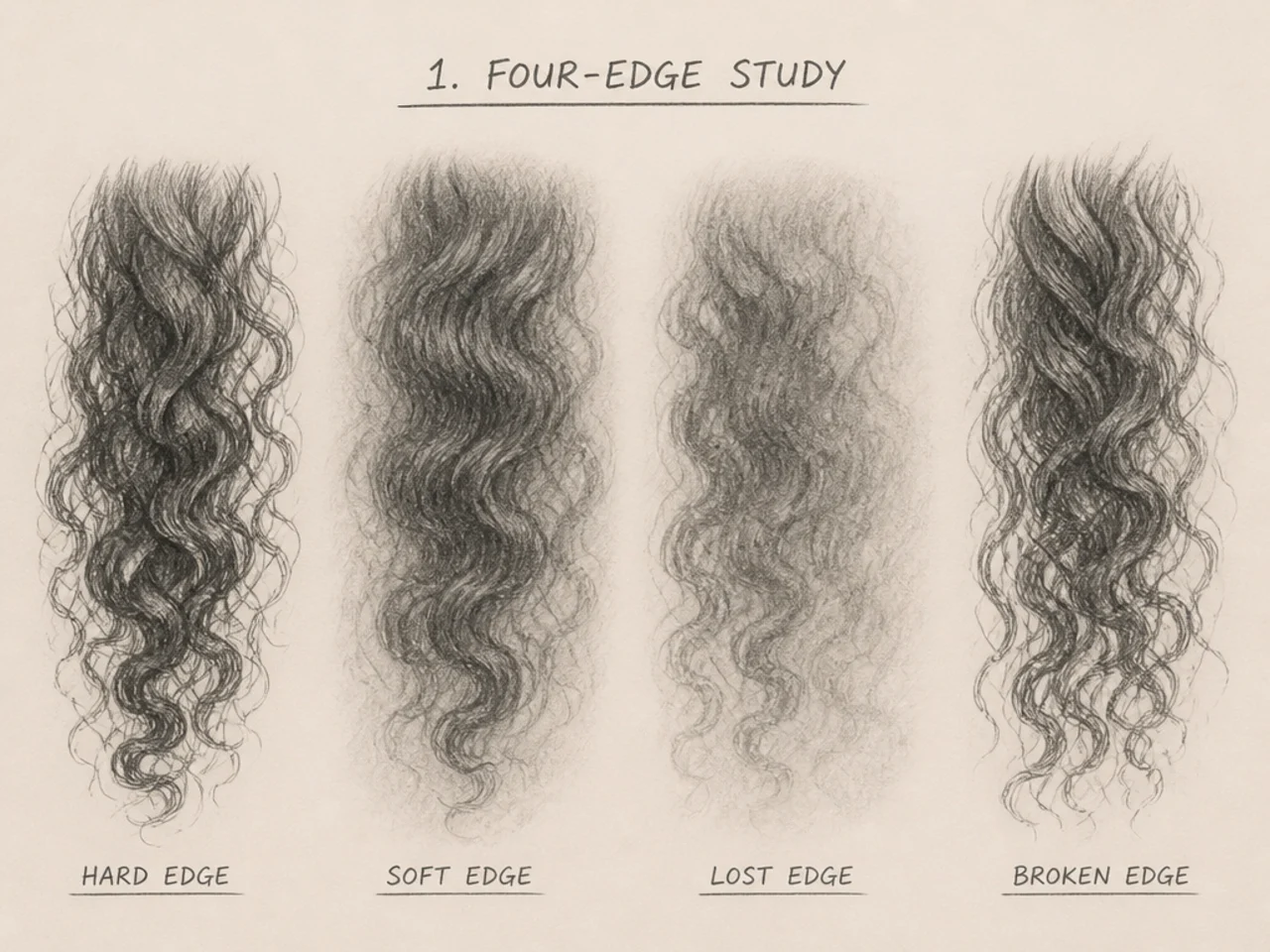
- Four Textures Compared
- Shading and Dark Cores
- Reference and Licensing Mistakes
- The 15 Hair Sketch Reference Ideas
- 1. Crown Swirl in Three Quarter View
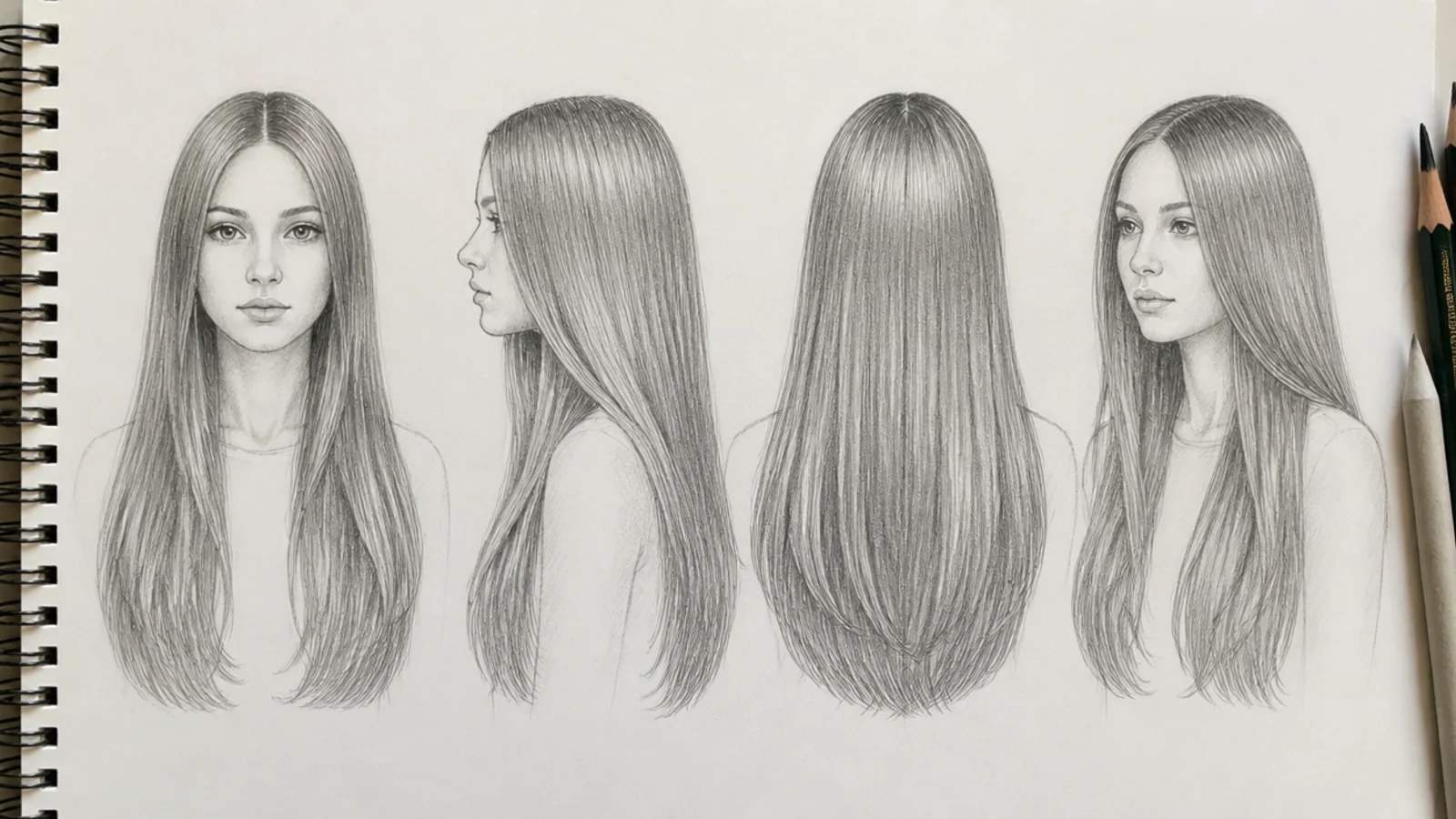
- 2. Straight Hair From Four Angles
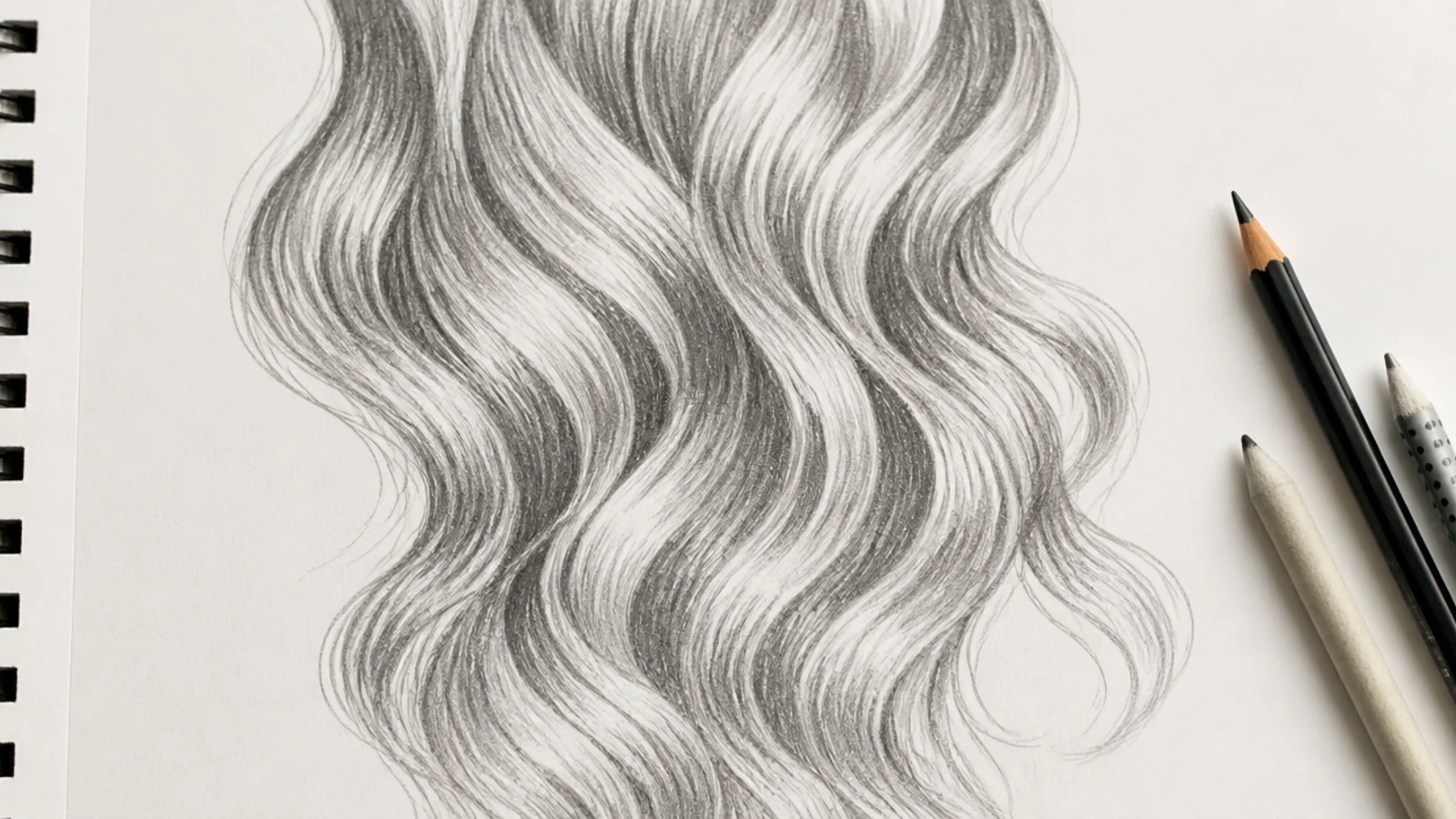
- 3. Wavy Ribbon S Curves
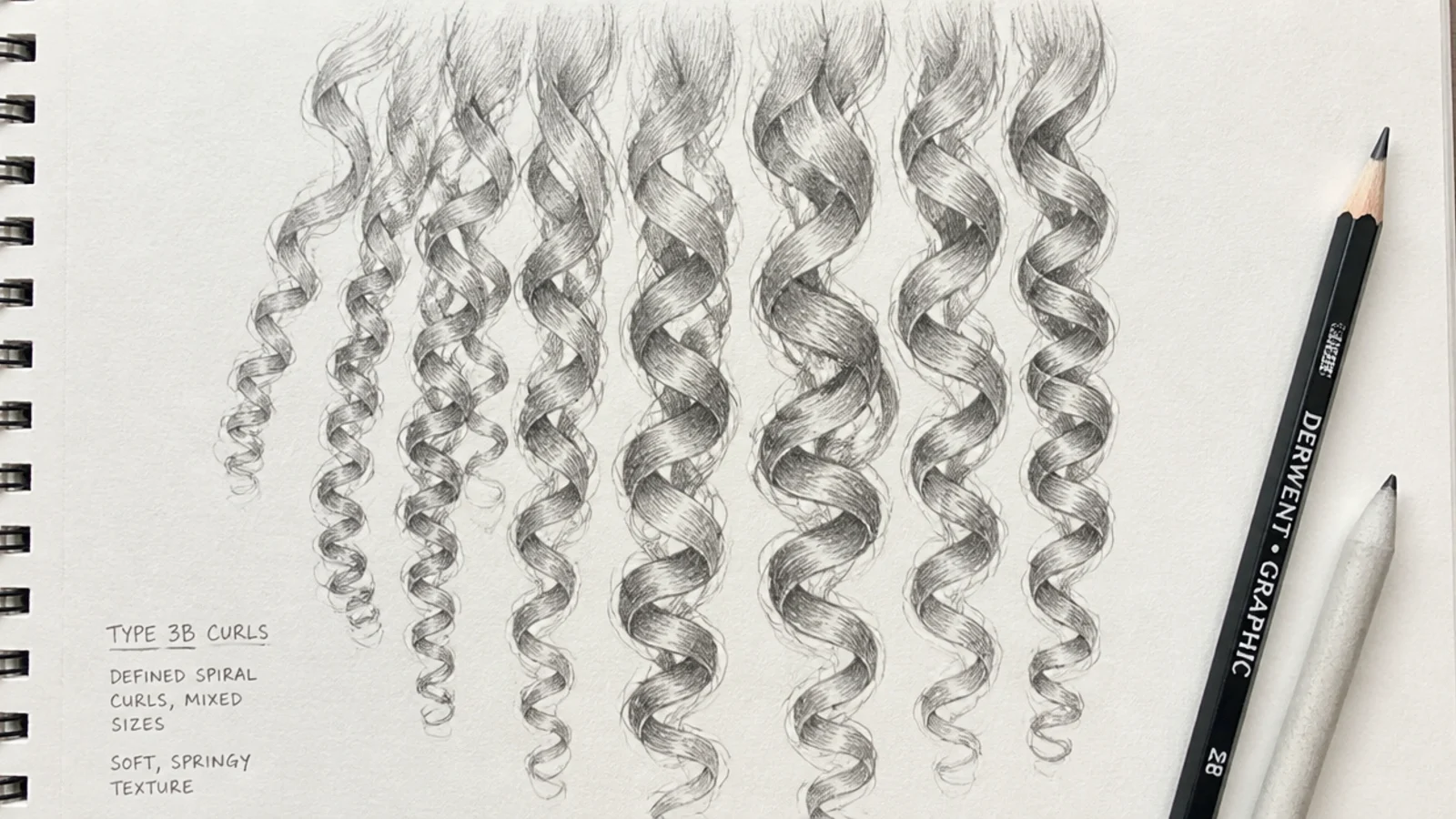
- 4. 3B Curl Ribbon Clusters
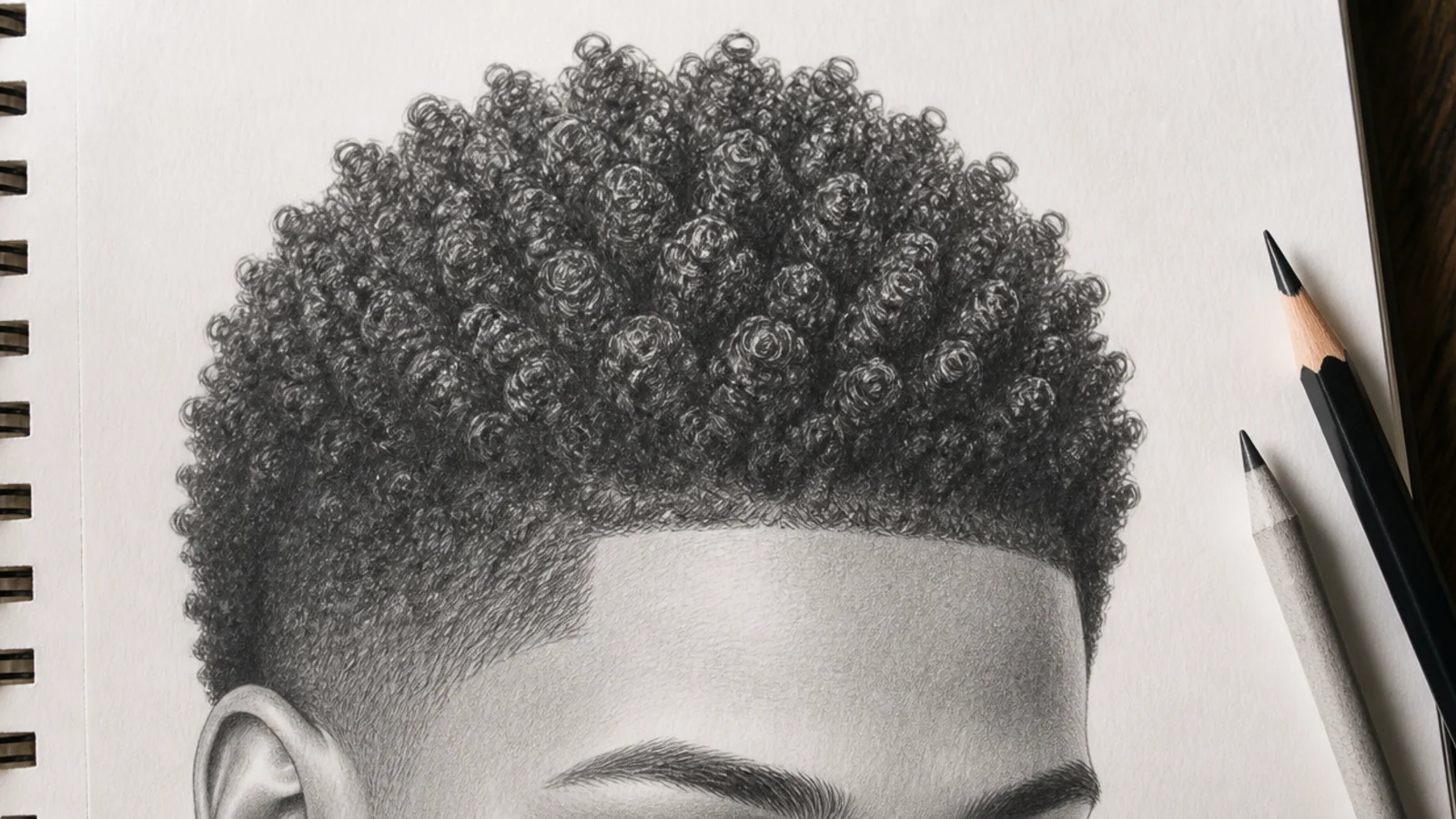
- 5. 4C Coils With a Tapered Hairline
- 6. Locs as Cylinders
- 7. Braid Teardrop Breakdown
- 8. High Ponytail From the Back
- 9. Male Versus Female Hairline
- 10. Buzz Cut Fade Values
- 11. Curtain Bangs From Two Angles
- 12. Value Scale From 2H to 6B
- 13. Anime Highlight Band
- 14. Wind Blown Flow Lines
- 15. Small Scale Thumbnails
- Final Thoughts
A reference you copy teaches you that photograph. A reference you interrogate teaches you hair, and only the second one is still useful on the next drawing.
A reference answers one question at a time. Where the crown sits. How a braid tucks. What a fade does to value. Ask, answer, put it away.
Copy structure, never square inches. Reproducing a photograph faithfully is a rendering exercise. Finding out why the mass sits where it does is a drawing one.
Pencils Paper and Tools
A 2H for the structure you want to keep. Construction lines on a reference sheet are the point of the sheet, so draw them in a grade light enough to sit under the shading without dirtying it.
A 2B for the body and a 6B for the cores. Two grades cover almost every value a hair drawing needs once you vary the pressure.
A mechanical pencil holds a constant width. Useful when a sheet repeats the same small study a dozen times, because a widening point changes the weight of a line halfway through a comparison.
Keep the sheets to one subject each. A page mixing braids, fades and curls is a page you will never find anything on again.
How to Use a Hair Reference
Decide the question before you open the image. Without one you will end up rendering whatever part of the photograph is prettiest.
Look, then close it, then draw. Working from memory a few seconds at a time forces you to build a model of the structure instead of matching tones square by square.
Check afterwards, not during. Compare your drawing with the reference once it is finished and note the single largest error, which is worth more than a dozen small corrections made along the way.
Flip the drawing to test it. Reversing the image exposes a lopsided silhouette immediately, because the eye stops recognising the shape and starts seeing it.
Shape Before Strands
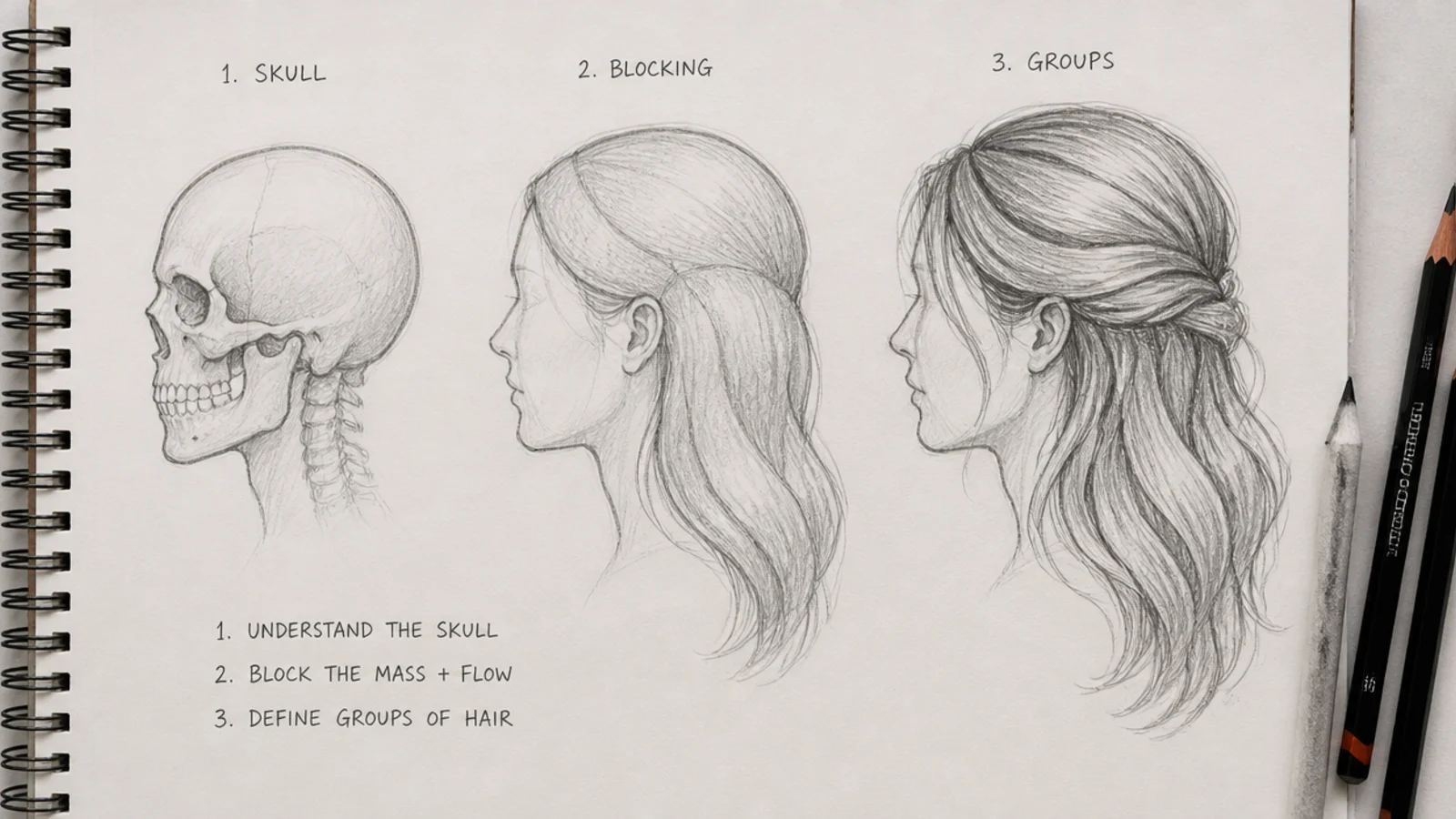
The silhouette is the first and largest decision. Hair has thickness, so its outline sits outside the skull, further out the tighter the pattern.
Squint to judge it. At a squint everything reduces to one grey shape, which is the only reliable way to catch an uneven outer shape while it is still cheap to fix.
Find the crown, then divide the mass. Four or five ribbons is enough at this stage, and each division marks where a dark core will go.
Strands come last and only at the edges. Individual hairs read as detail because everything around them is mass, so putting them everywhere removes the contrast that made them detail.
Four Textures Compared
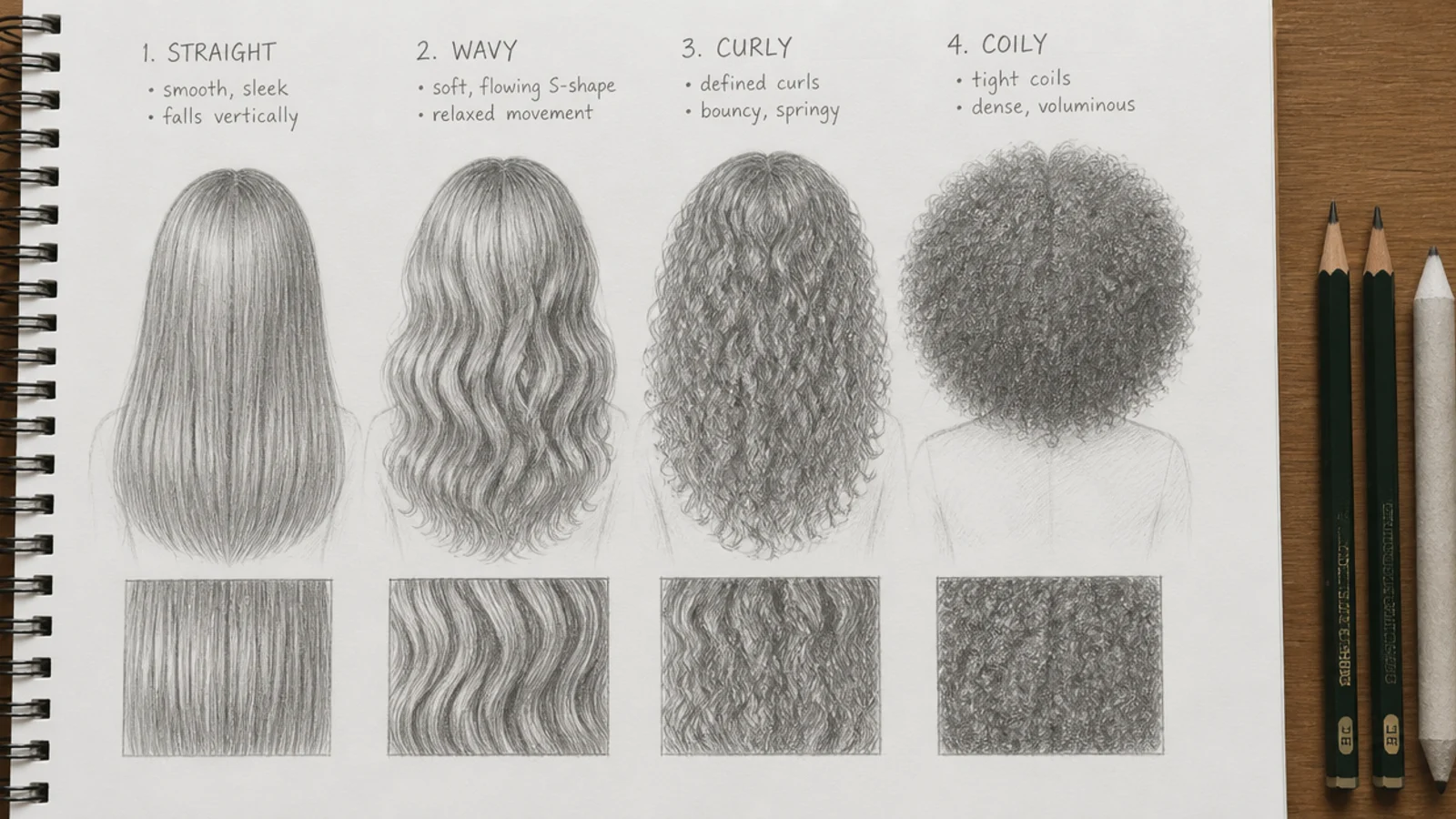
Straight hair is one surface with one long highlight. Nothing in the pattern hides an uneven mid tone, which makes it the least forgiving of the four.
Wavy hair swaps between two faces. Each bend turns the ribbon outward then inward, so the tone alternates along its length without a wave being outlined.
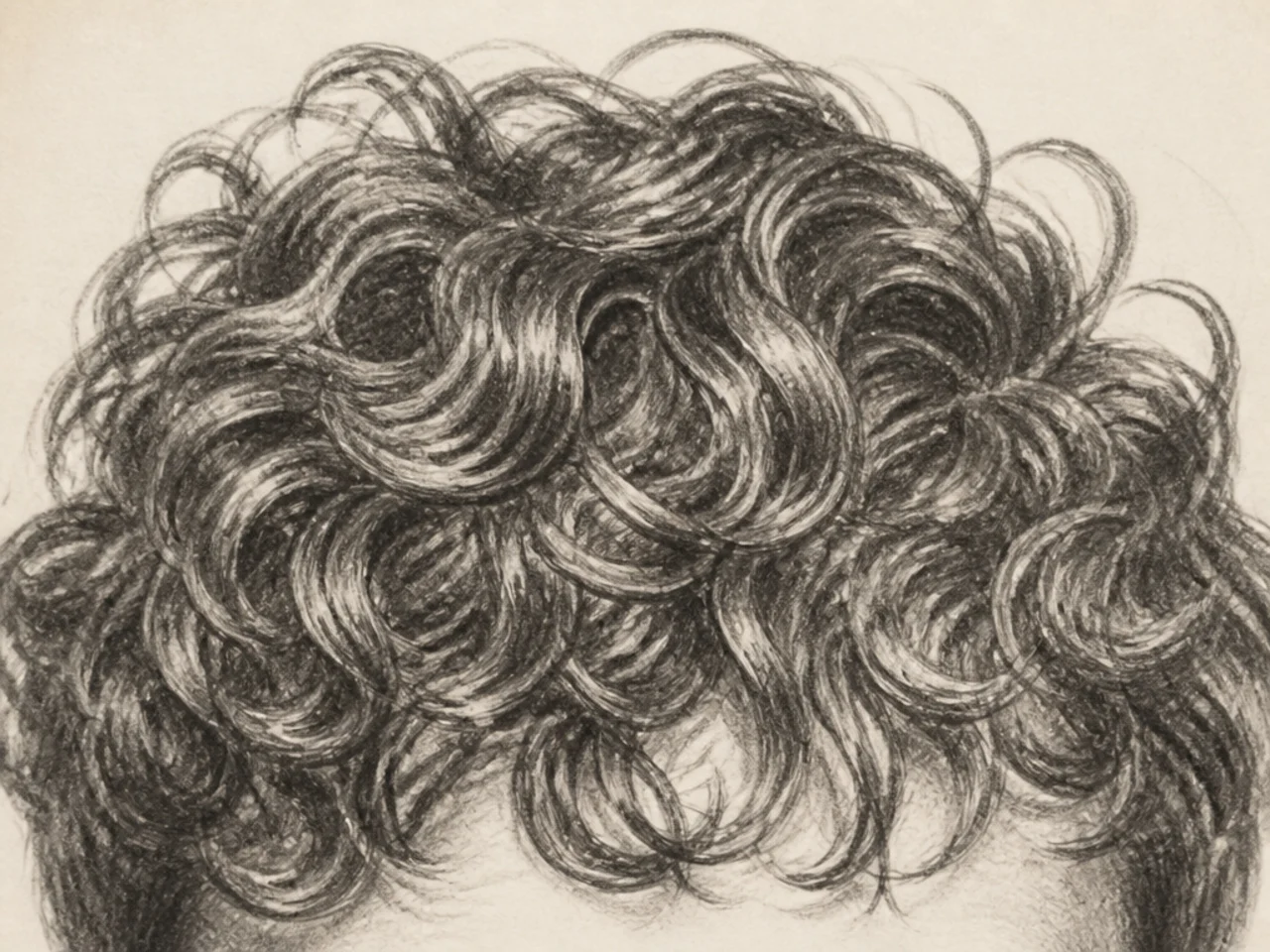
Curly hair resolves into single ringlets. Roughly between marker width and pencil width the eye can pick out one curl at a time, and that is where drawing curls individually is correct.
Coily hair is a surface, not a set of shapes. The loops are too small to resolve, and the mass sits darker than looser hair because tight loops trap light between them.
Shading and Dark Cores
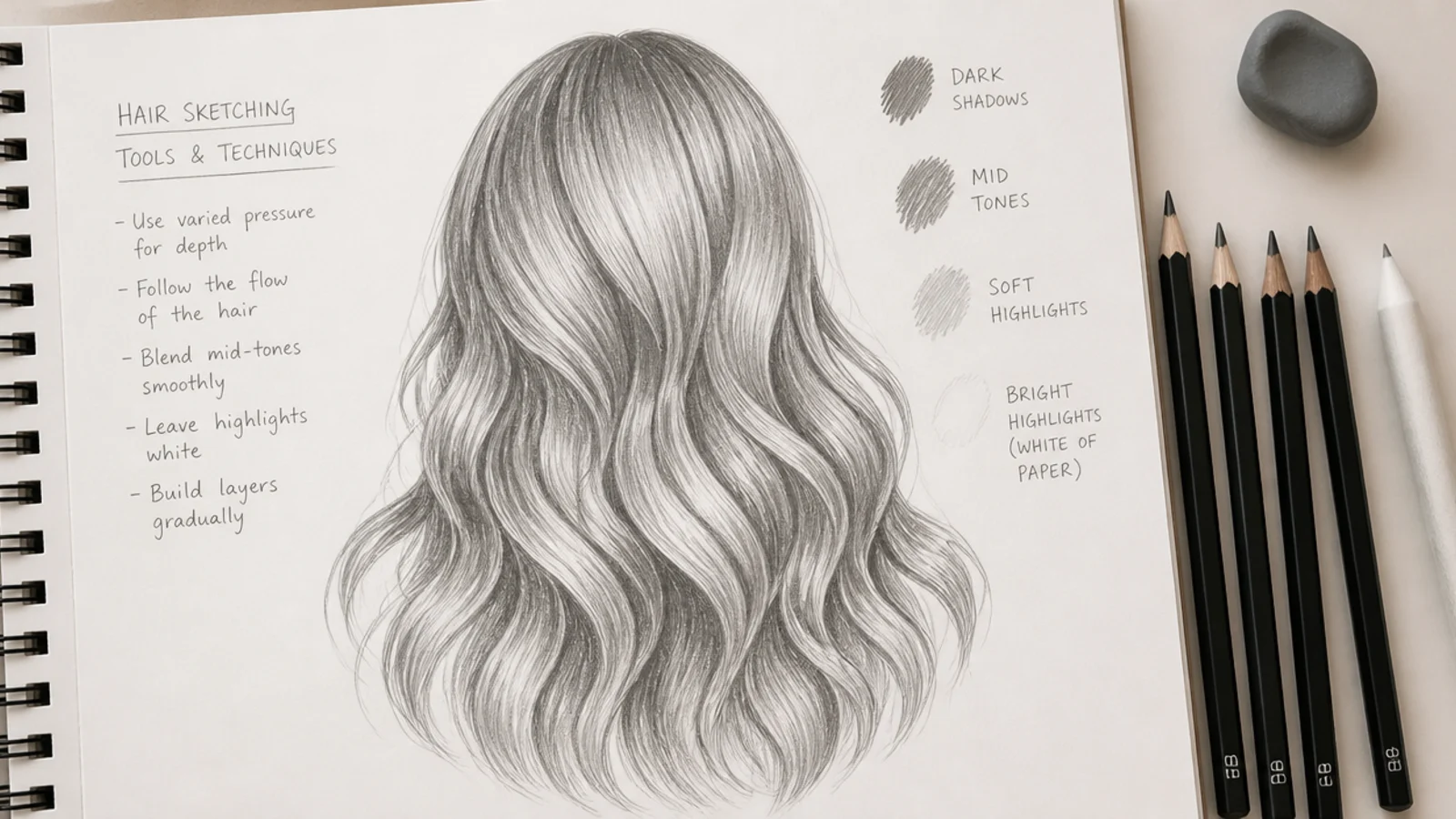
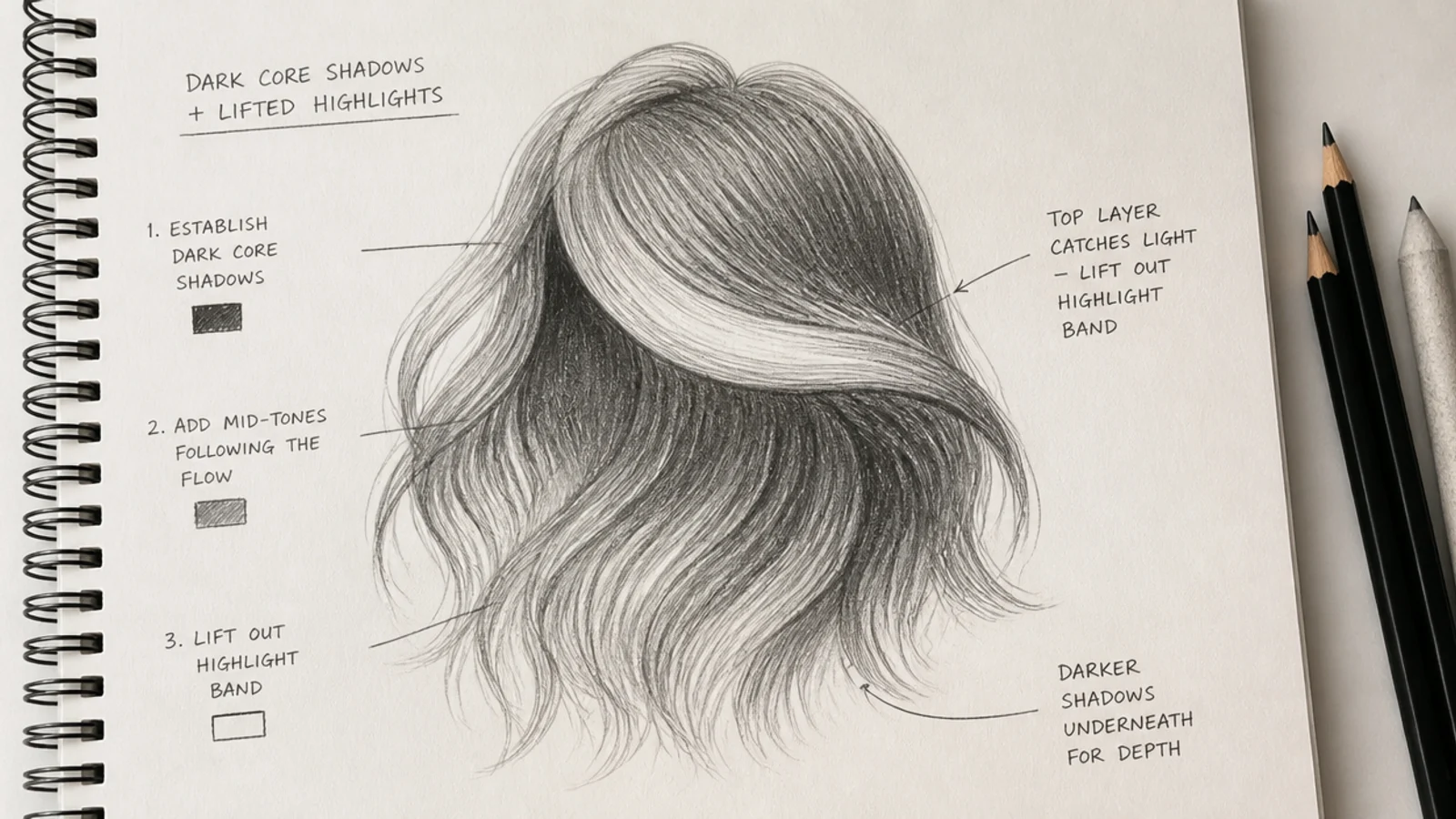
The core is the gap, not the clump. Where two ribbons meet, almost no light arrives, and those narrow deep shadows carry more depth than any strand work does.
Three values inside each clump. Core, body, highlight. One flat tone produces a shape cut from paper in the outline of hair.
Keep the cores unblended. A softened core loses its edge against the mid tone, and that edge is what separates one clump from the next.
Whatever passes behind must darken. When two ribbons cross, one drops a value. Equal tones on both sides of a crossing collapse it flat.
Reference and Licensing Mistakes
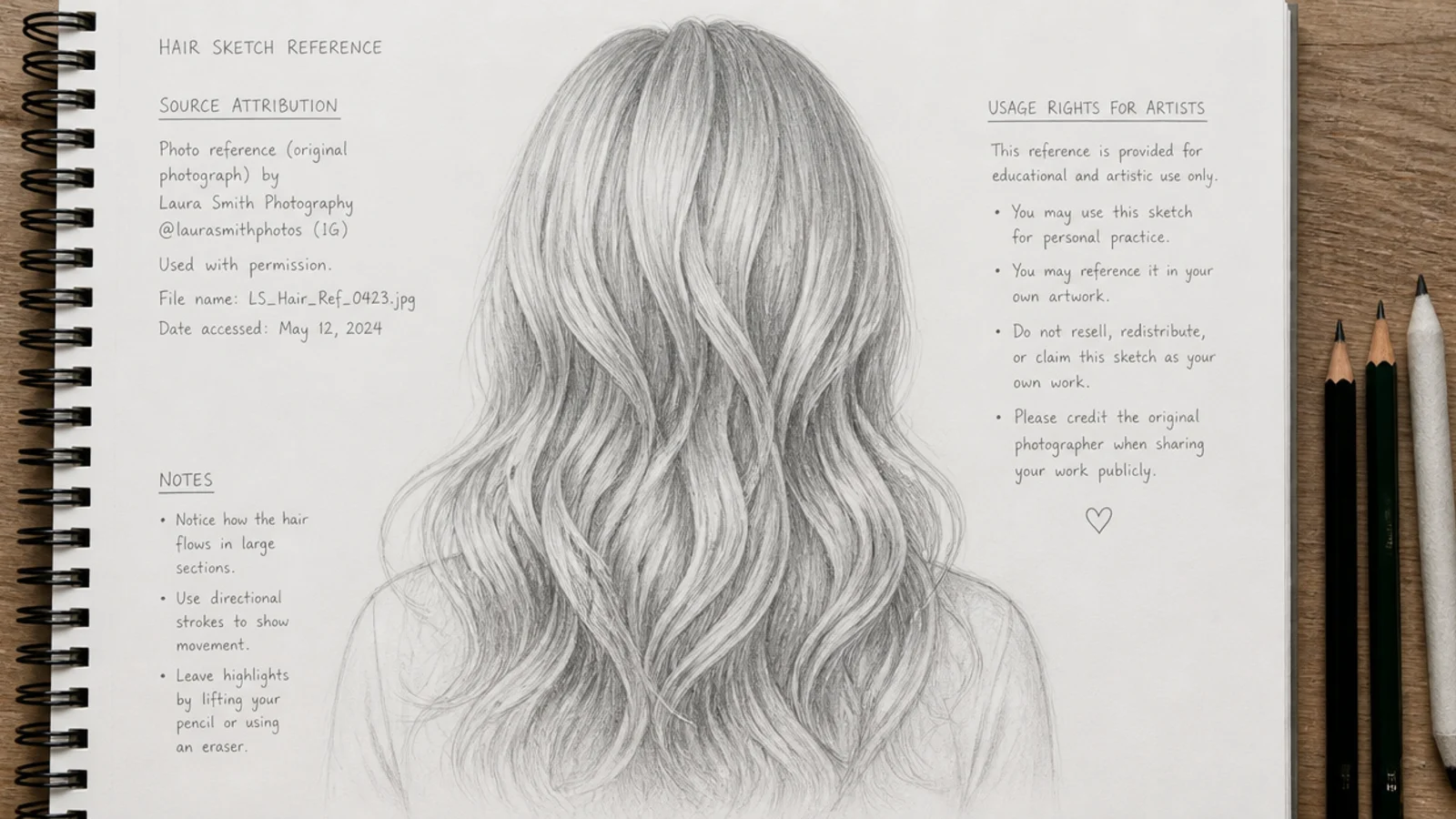
Credit is not a licence. Naming the photographer is courtesy. It does not grant permission to publish a copy of their work.
Copyright sits with the photographer, not the model. Permission from the person in the picture is not permission to use the picture.
A trace is still a copy. Changing medium from photograph to graphite does not make a traced outline an original work.
Private study and publication are different acts. Drawing from any reference to learn is one thing. Selling or posting a close copy is where the problem actually starts.
Build your own reference library. Photographs you took, or study sheets you drew, remove the question entirely and are usually better suited to what you need anyway.
The 15 Hair Sketch Reference Ideas
1. Crown Swirl in Three Quarter View
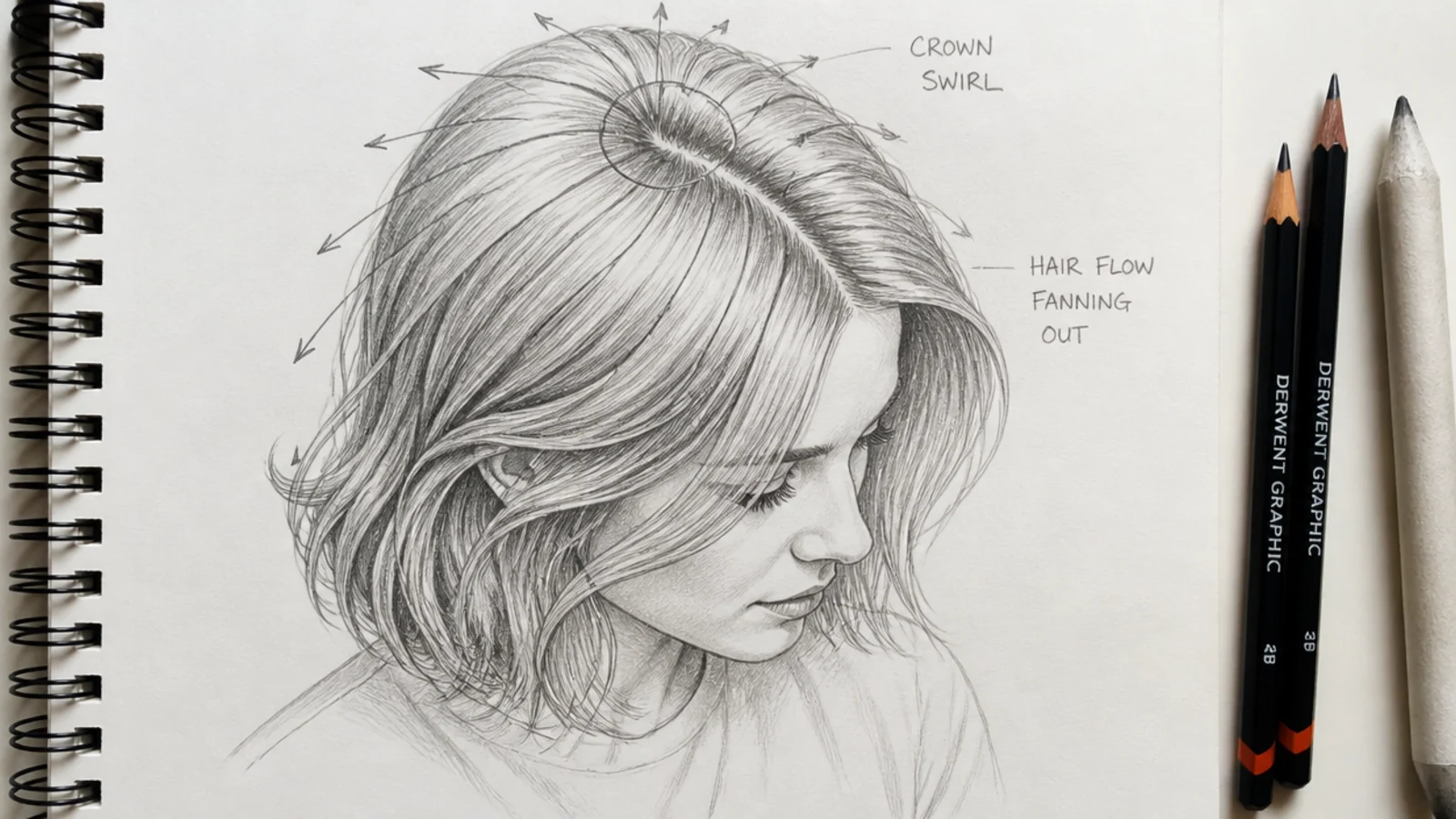
Every direction in a hair drawing starts at the crown, which makes this the sheet you return to most. In three quarter view the swirl sits off centre and behind the ear line, and placing it wrongly misdirects every single strand that follows.
2. Straight Hair From Four Angles
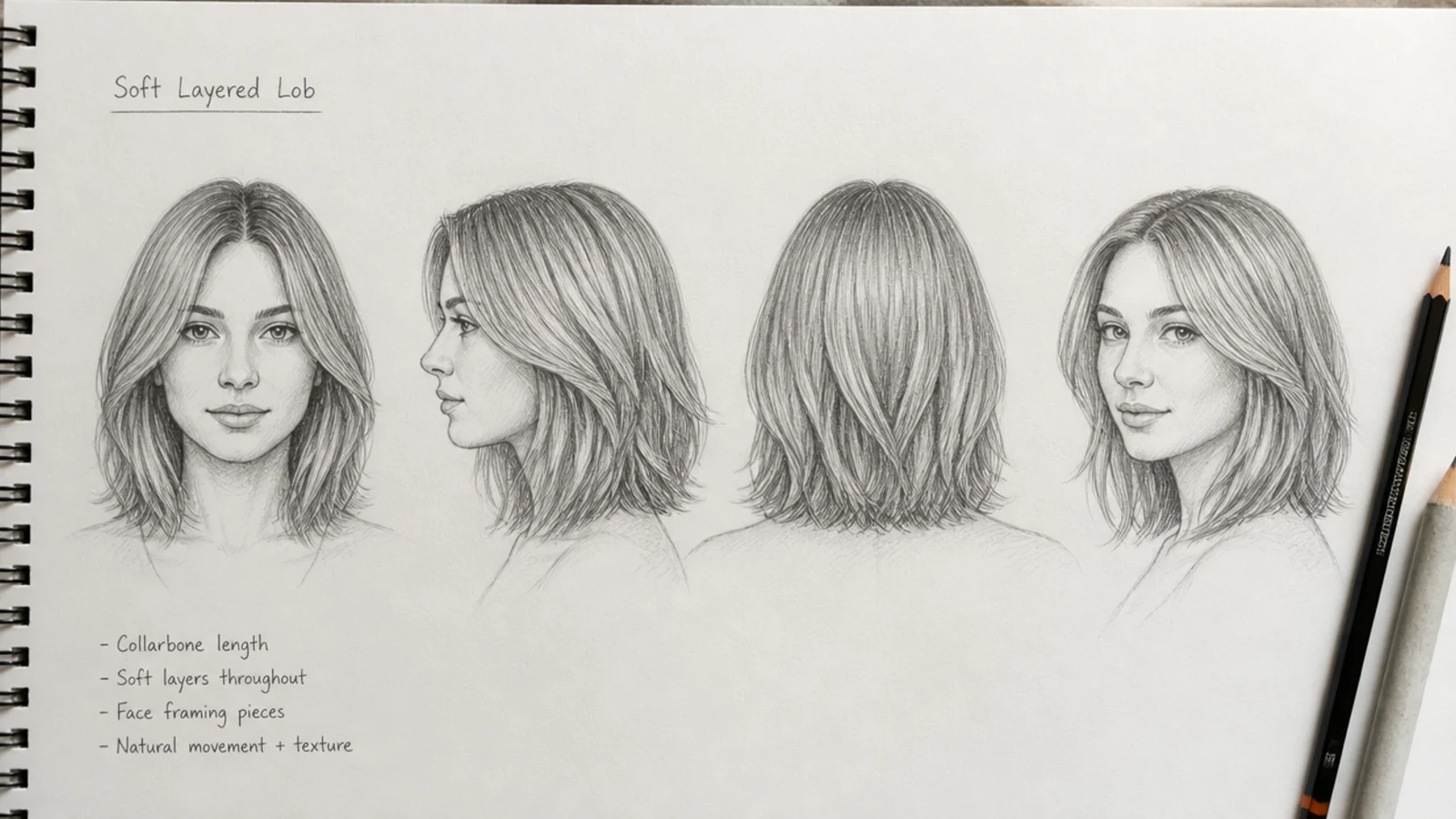
One angle teaches you a shape and four teach you a form. Compare where the mass sits against the skull in each and you find the silhouette barely changes at the front while growing considerably at the back, which is the observation most drawings are missing.
3. Wavy Ribbon S Curves
A wave is a ribbon turning between its outer face and its inner face, and this sheet exists to show where those faces swap. Mark the swap points along a single strand and the shading pattern for every other wave on the head follows from them.
4. 3B Curl Ribbon Clusters
3B curls sit at roughly marker width, so they group into clusters rather than hanging as separate springs. Study how many curls share a single highlight, because giving each curl its own highlight is the most common route to a drawing that looks like a plate of coils.
5. 4C Coils With a Tapered Hairline
Two different jobs meet on this sheet, a mass shaded as a surface and an edge cut into a shape. Use it for the boundary between them, remembering that a taper leaves length all the way down rather than going to skin, so the edge never reaches the value of bare paper.
6. Locs as Cylinders
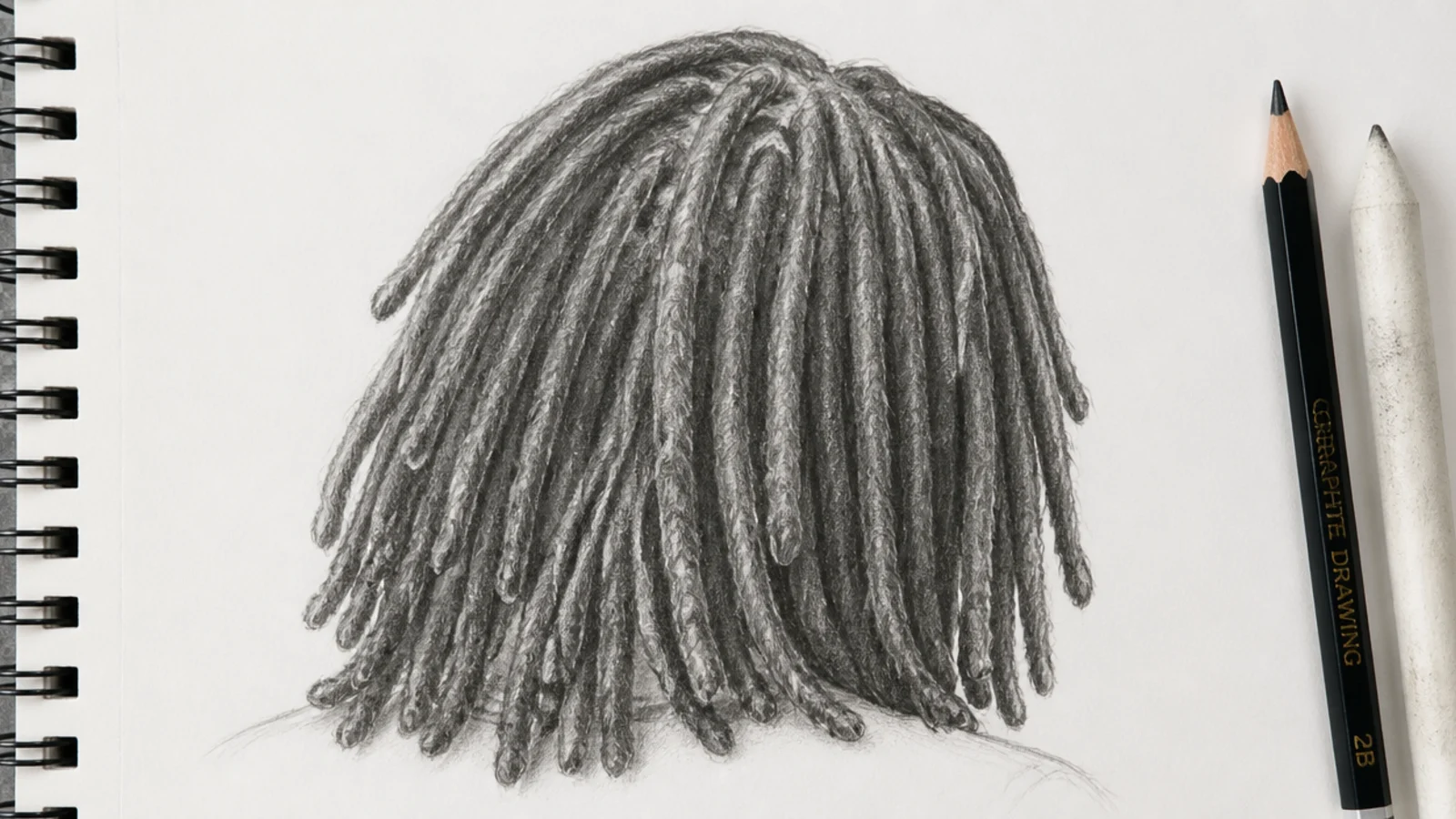
A loc is a cylinder, so the sheet gives you three values across its width and one highlight running its length. Note how that highlight bends where the loc turns, because a highlight drawn straight down a curved cylinder flattens it in a single stroke.
7. Braid Teardrop Breakdown
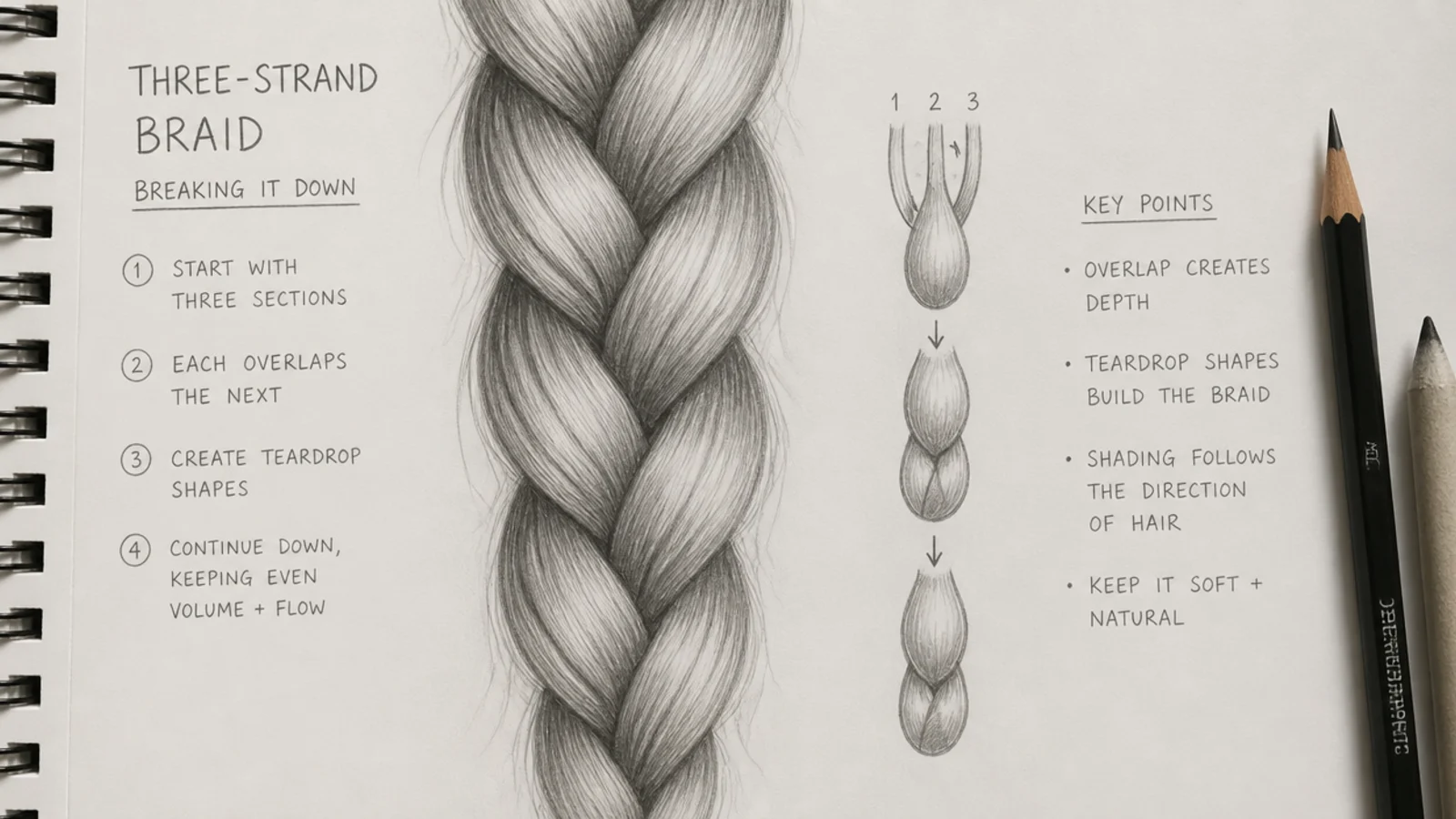
Reduced to shapes, a braid is a stack of teardrops alternating either side of a centre line, each tucking under the next. This is worth more than any photograph because it exposes the tuck point, which is where the shadow belongs and where the pattern is usually lost.
8. High Ponytail From the Back
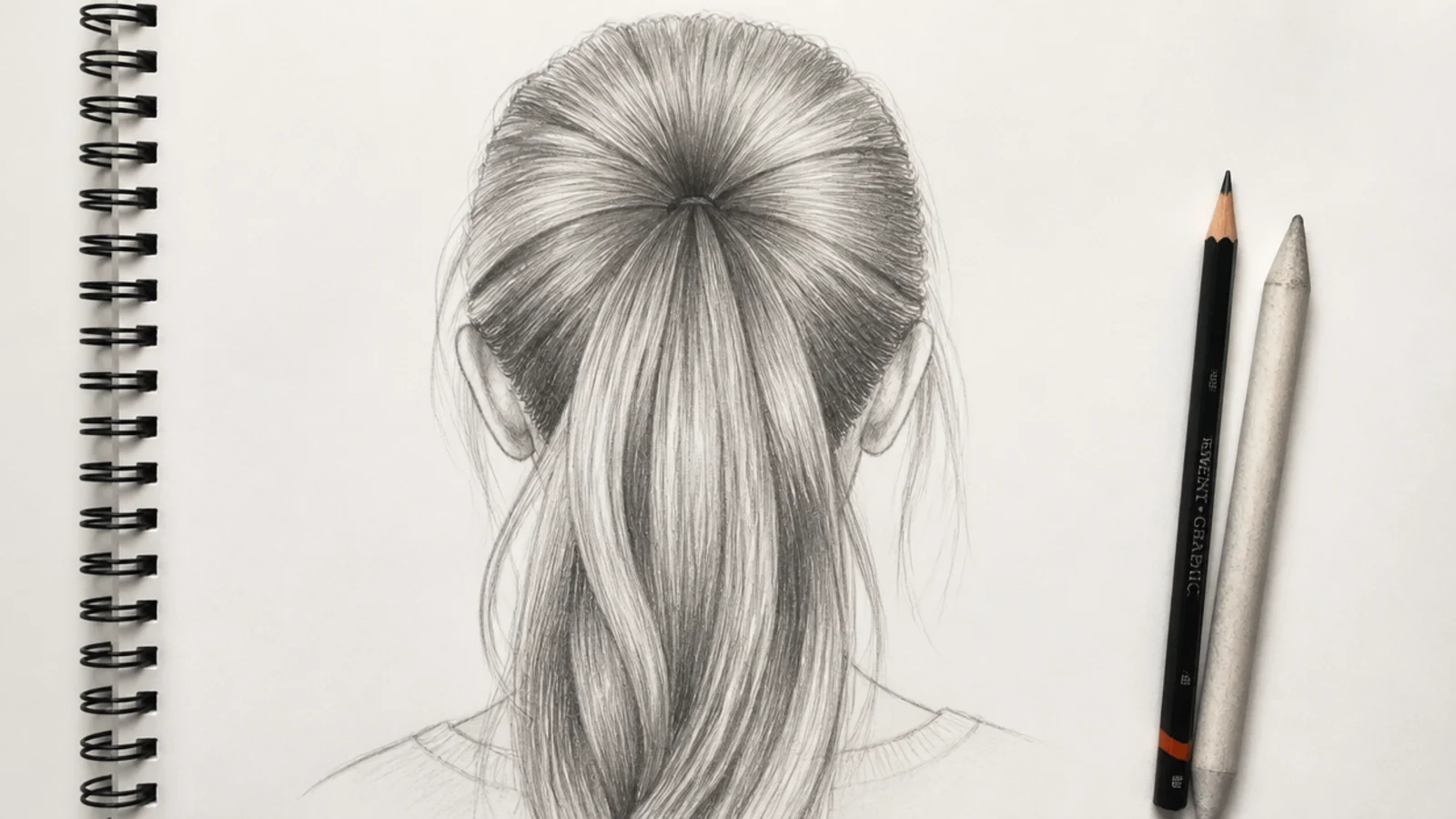
The back view is the only angle that shows where every tension line converges and how the hair lifts away from the nape. Use it to learn the curve those lines take across the skull, since drawing them straight is what flattens the back of a head.
9. Male Versus Female Hairline
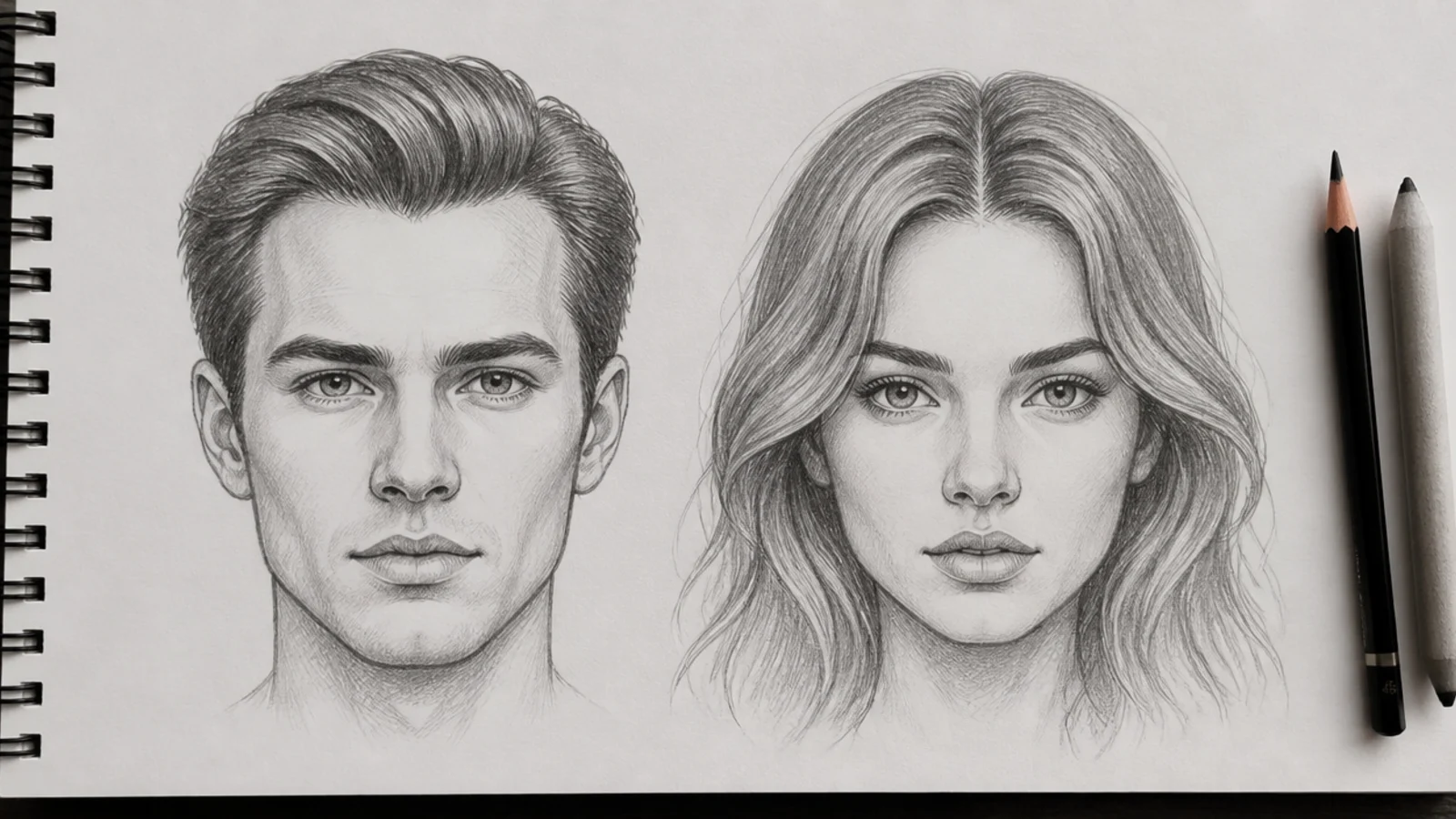
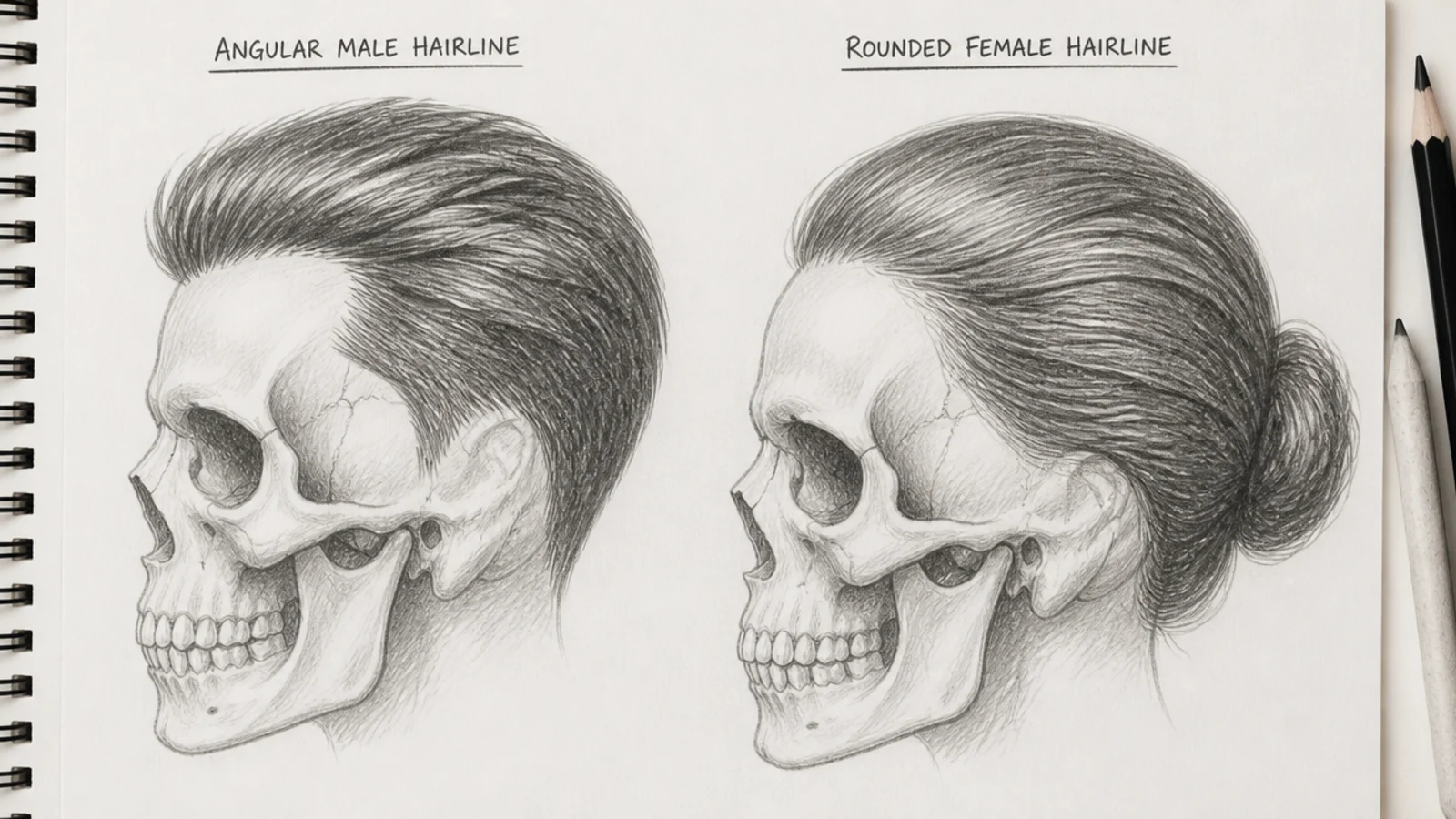
The difference sits at the temple rather than in the hair. A recessed corner above the outer eyebrow reads as male and a continuous rounded curve reads as female, and both are soft gradients of fine hairs rather than drawn lines.
10. Buzz Cut Fade Values
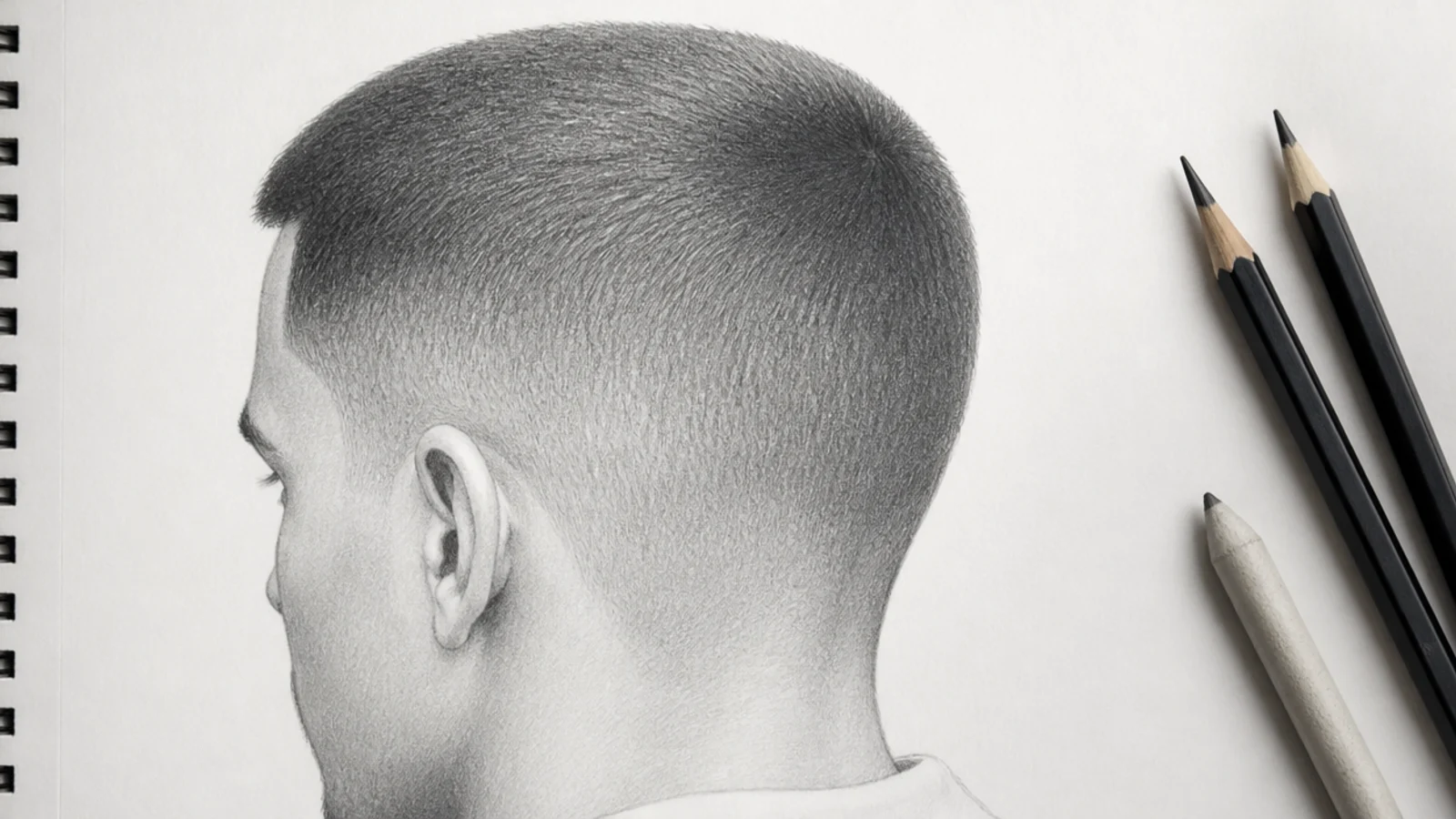
A fade is a value scale wrapped around a head, running from bare skin at the neckline up to full tone above. Reference the step sizes rather than the guard numbers, because a number one leaves three millimetres and a number four leaves thirteen, and the value jump between them is nowhere near even.
11. Curtain Bangs From Two Angles
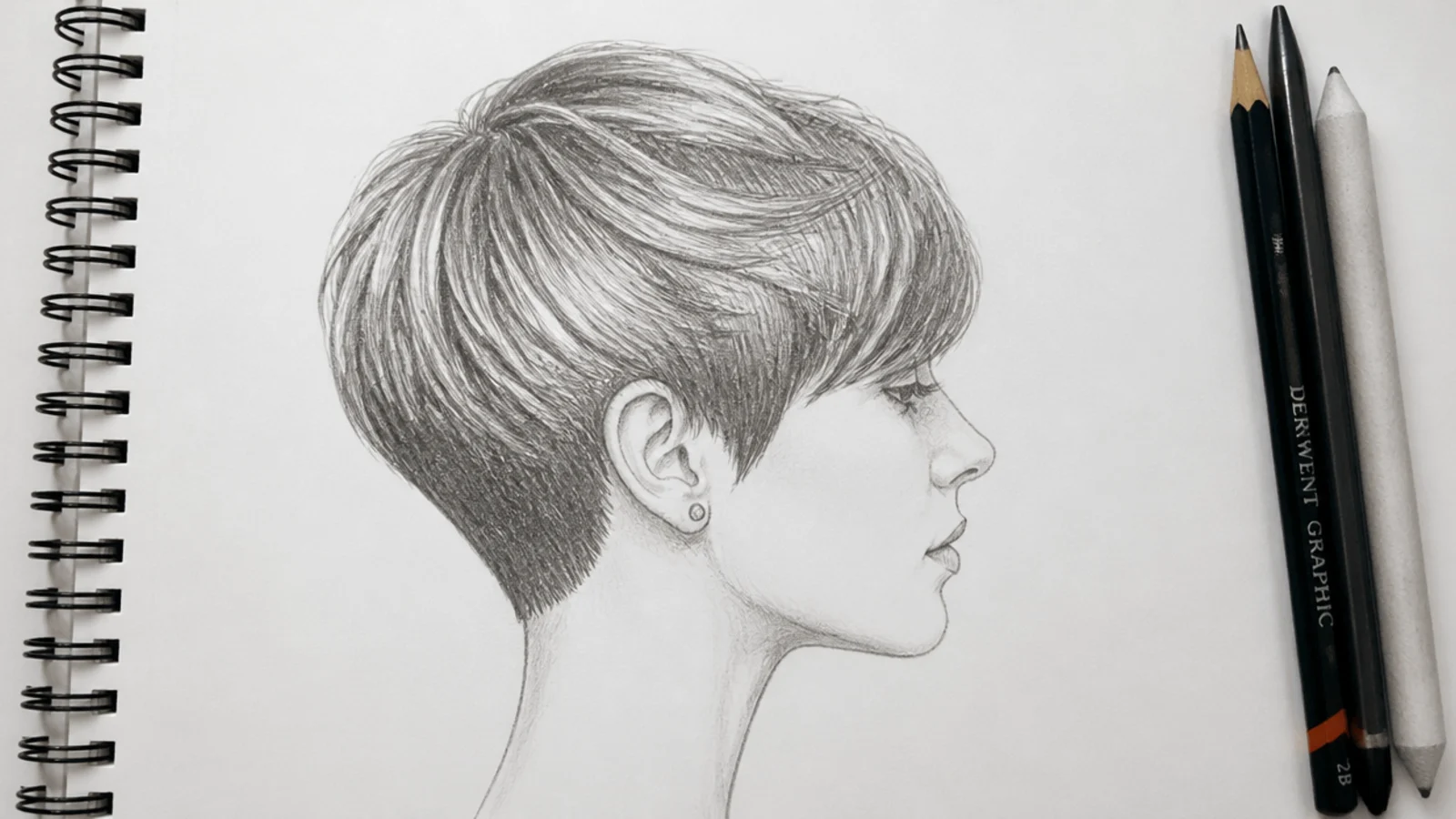
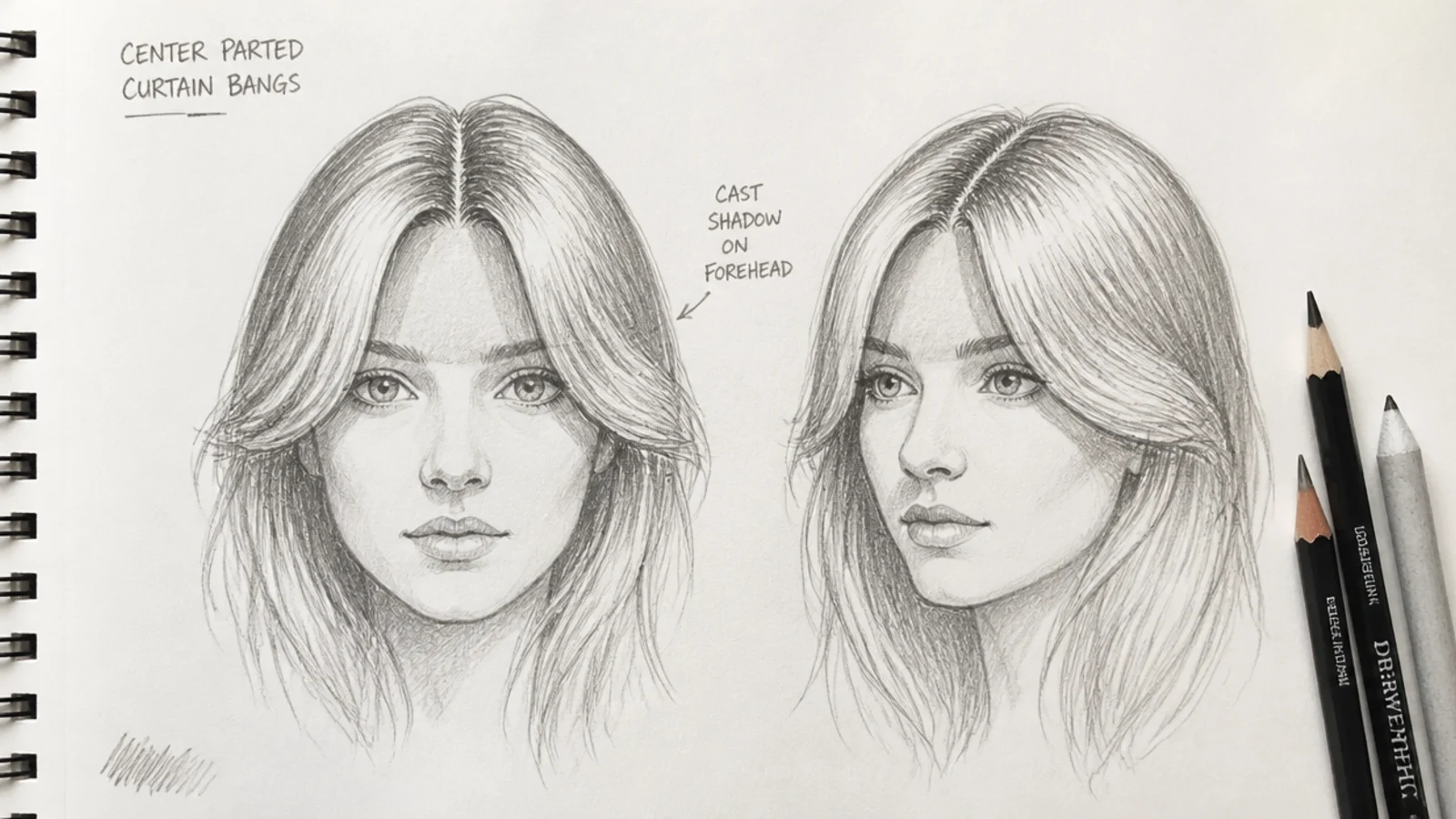
The front view shows the split and the profile shows the lift, and neither is sufficient alone. Use the profile to measure how far the roots stand off the scalp, since that lift is the entire difference between curtain bangs and an ordinary centre parted fringe.
12. Value Scale From 2H to 6B
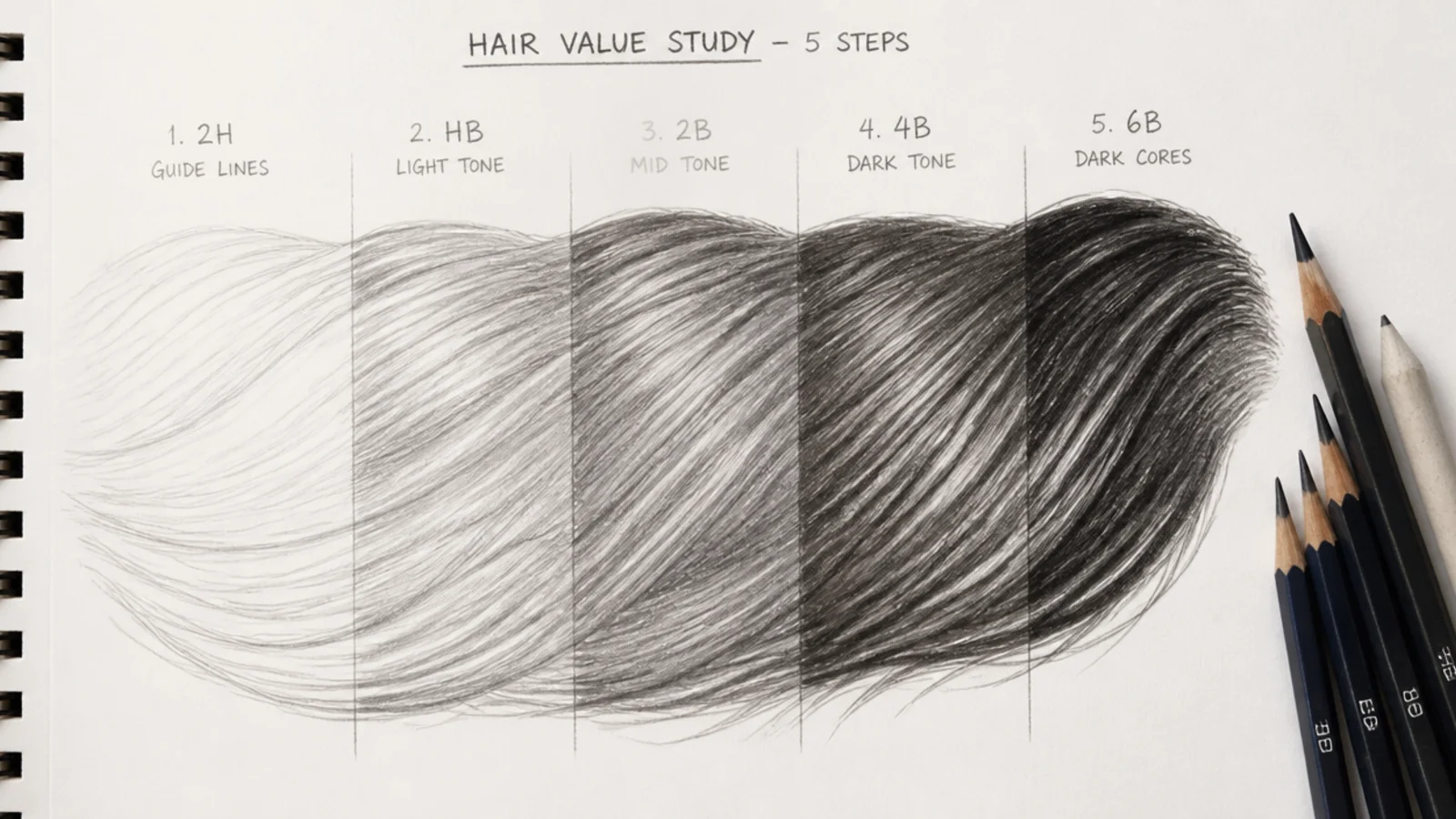
Every hair drawing is a value problem, and a scale tells you how much range you actually have available. Lay one down before starting and you will notice most finished drawings use only the middle third of it, which is the whole reason they look flat.
13. Anime Highlight Band
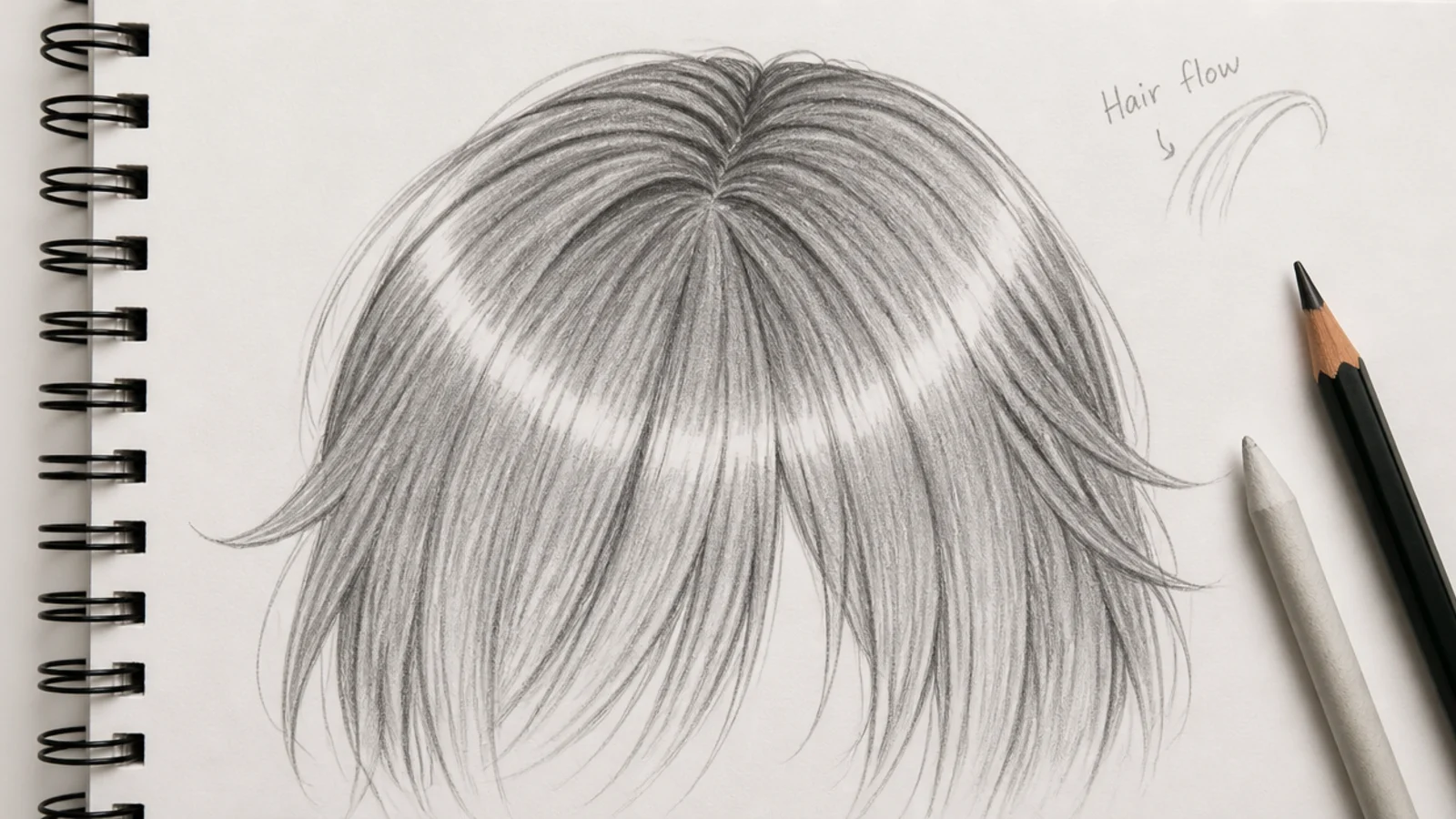
Stylised hair replaces a broken highlight with one hard shape, usually a zigzag band following the curve of the skull. The sheet matters because the band's position is what sells the roundness of the head, and setting it too high turns the style into a headband.
14. Wind Blown Flow Lines
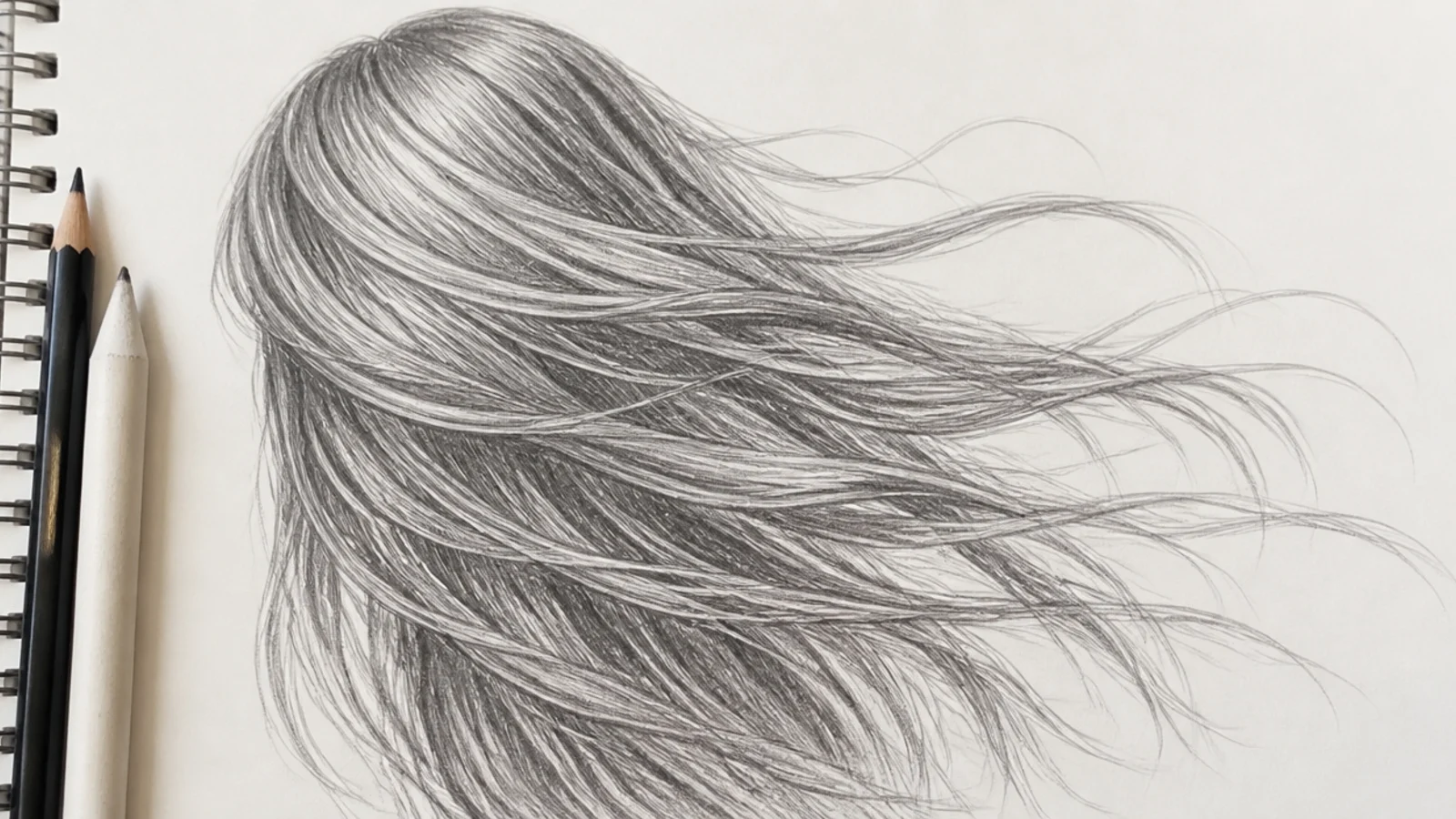
Stripped back to lines, wind blown hair is a set of curves that stay parallel near the roots and separate toward the ends. Draw the flow lines first from a sheet like this and the mass can be built on top of them without any direction contradicting another.
15. Small Scale Thumbnails
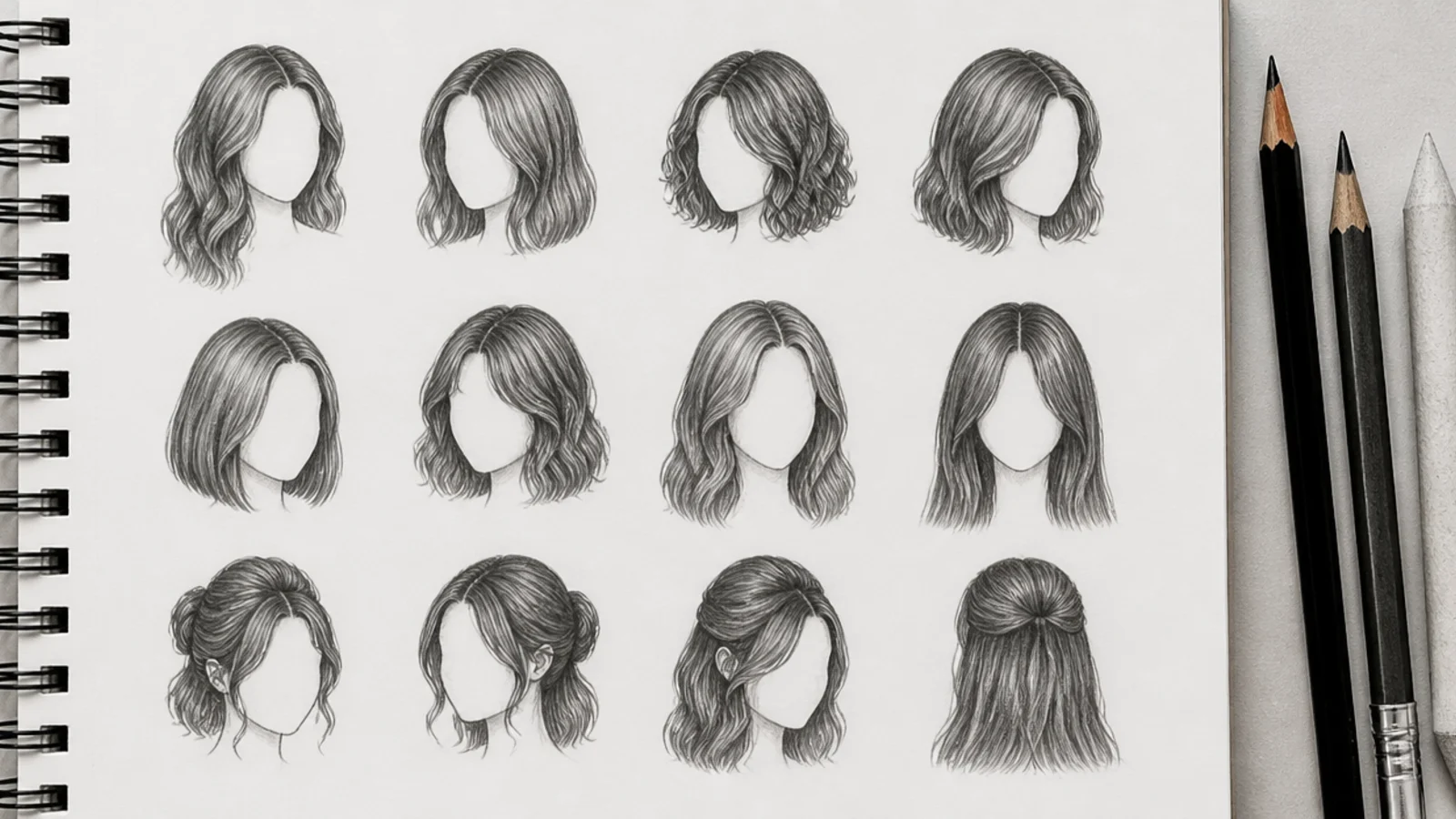
At thumbnail size only the silhouette and one value survive, which makes a sheet of them the best diagnostic tool available. If a style is unrecognisable at postage stamp size the problem is the outer shape, and no amount of rendering at full size will repair it.
Final Thoughts
Keep a shelf of sheets rather than a folder of photographs. A crown swirl, a braid breakdown, a value scale and a set of four textures will answer more questions than a thousand saved images, because each one records a decision you have already worked out rather than a result you would have to reverse engineer again.
For curly hair specifically see 15 curly hair drawing reference ideas, and for the sketching order itself see 15 ways to sketch curly hair easily. More in Hair Drawing.